To save content items to your account,
please confirm that you agree to abide by our usage policies.
If this is the first time you use this feature, you will be asked to authorise Cambridge Core to connect with your account.
Find out more about saving content to .
To save content items to your Kindle, first ensure no-reply@cambridge.org
is added to your Approved Personal Document E-mail List under your Personal Document Settings
on the Manage Your Content and Devices page of your Amazon account. Then enter the ‘name’ part
of your Kindle email address below.
Find out more about saving to your Kindle.
Note you can select to save to either the @free.kindle.com or @kindle.com variations.
‘@free.kindle.com’ emails are free but can only be saved to your device when it is connected to wi-fi.
‘@kindle.com’ emails can be delivered even when you are not connected to wi-fi, but note that service fees apply.
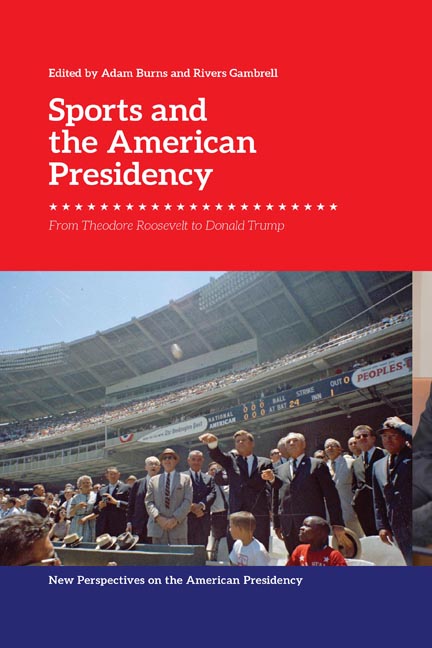
Donald Trump's love of golf adds him to a long line of presidents who have a close association with sports. Indeed, golf might just be the leading presidential pastime, ever since William Howard Taft was photographed strutting the links against the advice of his predecessor Theodore Roosevelt. And it was Roosevelt, more than any president, who set the standard for linking the nation's top job to its favourite physical pastimes. Starting with Roosevelt's significant role in linking the presidency with fandom, advocacy of, and active participation in sports, this volume traces how occupants of the White House continued to develop these connections in various guises across the following century. Though historians have certainly not ignored such associations, the variety of case studies represented here provides a wider and more multidisciplinary selection of standpoints from which to assess the interactions between sports and the presidency than ever before.
This Companion constitutes the first, systematic theorisation of the Italian Gothic. Through an interdisciplinary, trans-medial approach that encompasses prose fiction, poetry, journalism, film, music, and comics, it explores the varied and complex metamorphoses of the Gothic in Italy from the late eighteenth-century to the present day. Although the last thirty years have seen a burgeoning in the academic study of the Gothic at college and university levels and in related publications, scholars have long struggled to even acknowledge the very existence of this mode in the Italian context. This companion does not only fill in a historical and critical gap in the scholarship, but it also contributes to revitalising the field of Gothic Studies, opening new channels of communication, and paving the way to the exploration of the fruitful interchanges between Italian and other European and American configurations of the Gothic.
Until fairly recently, the 'Authorised Version' of cultural modernism stated that the secularising trends of liberal modernity - and the resultant emphasis on irony, parody and dissolution in modernist artforms - had pushed religion to the edges of early twentieth-century culture. This Companion complicates this understanding by furnishing students and academic researchers with more nuanced and probing assessments of the intersections and tensions between religion, myth and creativity during this half century of geopolitical ferment. It addresses the variety and specificity of modernist spiritualities as well as the intricately textured and shifting standpoints that modernist figures have occupied in relation to theological traditions, practices, creeds and institutions. What emerges is a multi-textured account of modernism's deep-rooted concern with the historical and established forms of religion, as well as new engagements with 'occulture' and indigenous traditions. In short, the Companion supplies a lively and original exploration of the aesthetic, publishing, technological and philosophical trends that shape debates about spirituality, community and self from the 1890s to the 1940s and beyond.
Clive Bell was a pivotal member of the Bloomsbury Group. His marriage to Vanessa Bell and his, at times tempestuous, relations with his sister-in-law Virginia Woolf form important strands in the cultural history of modernism. A tireless champion of modernist art, a committed pacifist and conscientious objector, Bell produced a huge body of correspondence with many of the leading artistic and political figures of his time. His lively, witty, highly opinionated letters are a window into the turbulence of the early twentieth-century, populated by friends and acquaintances including T. S. Eliot, Katherine Mansfield, Pablo Picasso and Jean Cocteau, as well as his Bloomsbury set, Desmond MacCarthy, Leonard and Virginia Woolf, Duncan Grant, Maynard Keynes, Roger Fry and Vanessa Bell. Arranged in eight categories - Bloomsbury Circles; Virginia; War; Arts and Letters; To the Editor; Francophile; Travels; Love, Gossip, Home - this selection emphasises Bell's enormously varied life and interests. Born in the reign of Queen Victoria and living long enough to have been able to hear the Beatles on the radio, these letters demonstrate that Bell's appetite for art, for love and for peace never flagged.
Freeman is best known today for her short regionalist fiction. Recently, Freeman studies have taken new turns including ecocriticism, trauma studies, the Gothic, and queer theory. The essay collection pushes these developments further. Contributors aim at revisiting and going beyond Freeman's regionalism. They challenge earlier feminist readings of the female realm by arguing that her short fiction and novels depict women and girls as violent and criminal, suffocating as well as nurturing; they bring to light questions of race and ethnicity that have been conspicuously absent from scholarship on Freeman, as well as issues of class. Because questions of women's work are central to Freeman's oeuvre, this collection discusses Freeman's acumen as a businesswoman herself, a participant as well as a castigator of turn-of-the-century US capitalism. Finally, essays reconsider the periodization of Freeman by exploring her little acknowledged post-1902 and therefore post-marriage fiction - her war stories and her urban stories.
Plastics, Environment, Culture and the Politics of Waste examines plastic as a distinct cultural, political, and environmental phenomenon. It outlines the intricate relationship with plastic that humanity has been building over the course of the twentieth and twenty-first centuries, drawing on examples from history, the arts, and literature, as well as examining the place of plastics in the current health, environmental, and energy crises. The aim of this book is to reveal the complex nature of plastics, from their rapid incorporation into our advancing ways of life, to the re-envisioning of plastics' role in human life and how, through abundant production, consumption, and disposal of plastics, humanity has initiated a toxic invasion of natural environments and human and nonhuman bodies. Bringing together various perspectives from the humanities, this edited collection contributes to the ongoing research on plastics and petrocultures and emphasizes the crucial significance of addressing the plastic crisis through culture.
This book collects twelve previously untranslated lectures by Castoriadis from 1982 to 1983. Castoriadis focuses on the interconnection between philosophy and democracy and the way both emerge within a self-critical imaginary already in development in the work of early Greek poets and Presocratic philosophers.
Displaying both mastery of the relevant scholarship and original interpretation, he reveals the birth of a society that would place its highest value in calling itself and its institutions into question? He argues that this spirit would develop directly into the twin signatures of the Greek world, namely radical philosophy, on the one hand, and radical democratic practices, on the other.
Like no previous interpreter, Castoriadis allows us to feel the existential need, already present in the earliest Greek thinkers, to question the significance of human existence and to share in shaping its meaning. The Greeks not only did this, he argues, they also began the equally important work of establishing the institutions to support such a project.
Consisting of twenty-eight chapters and numerous case studies the volume examines the history of the British and Irish press from its seventeenth-century beginnings up until the end of the eighteenth-century. Five core chapters regard the Business of the Press (including advertising), Production and Distribution, Legal Constraints and Opportunities, Readers and Readerships, and the Emerging Identities and Communities of news writers and journalists. Other contributions focus on particular national realities such as those in Ireland, Scotland and Wales. The contributions examine features relating to the production, transmission and reception of not just news publications but also the more specialised press such as periodical essays, women's periodicals, literary and review journalism, medical journals, and the criminal and religious press. As much early modern news was a transnational phenomenon the volume includes studies on European and trans-Atlantic networks as well as the role of translation in news transmission and output.
This book studies the revealing autobiographical sources left by Rev. James Fraser of Kirkhill (1634-1709), a Gaelic-speaking scholar, traveller and minister. It examines Fraser's self-presentation and situates him within his locality, Scotland, the British Isles and Europe, also incorporating recent historiography to provide a more comprehensive presentation of the social, economic and cultural trajectories of the early modern Highlands.
David Worthington focuses on the Scottish Highlands' strong engagement with Europe and early entanglement with empire. He challenges the assumption that the north Highlands, in particular, was sealed off from the rest of the world before Culloden and he identifies the agency, vitality and resilience of the people of the Highlands prior to the peripheralisation, depopulation and under-development that then occurred.
This collection reconsiders the notion of life and conceptualizes those forms of life which have been excluded from modern philosophy, such as post-Anthropocene life, the life of non-human animals and the life of inorganic objects.
The contributors, who include prominent contemporary philosophers and theorists ask a wide range of questions including: what new forms of subjection can we see with the return of the 'Anthropos'?, what can animals teach us in the Anthropocene?, can we reconstruct the perceptual world of animals and take a look into their 'subjectivity'?, what happens to inorganic matter (waste or digital objects) when no longer used by any subject and can we think about inorganic matter in terms of subjective self-awareness?
The first section, Life Beyond the Anthropocene, critically questions Anthropocene theory and outlines alternative scenarios, such as Gaia theory or post-Anthropocene forms of life on Earth and other planets, as well as new forms of subjectivity. The second part, Human and Non-Human Interactions, investigates the obscure boundary, between life and non-life, and between human and non-human animal life forms. The third part, Forms of Life and New Ontologies, concentrates on new ontologies and discusses life in terms of vitalism, new materialism, movement, form-taking activity and plasticity.
From North Africa to Indonesia, Muslim populations have struggled to cope with the new environmental realities. However, in the era of globalisation, institutionalised Islamist parties, particularly in government, are increasingly addressing green issues and suggesting policies in order to help protect water supplies, reduce pollution and increase tree plantation. This applies to Islamists who participate in electoral politics, as well as those who are classified as transnational or militant. Delving into the causes of this new environmentalism phenomenon, Emmanuel Karagiannis explores the religious and political motivations of five Islamist groups and assesses the degree of influence that Islamic texts, rulings and principles have on the green policies pursued.
This book reveals multiple aspects of life in the Ottoman palace, in both its public space and private space. It does so by exploring the Sultan Abdülhamid I Tomb in Istanbul, investigating the paths that open to us through the graves of the royalty in the mausoleum and those of the courtiers, eunuchs, concubines and female harem managers in the garden graveyard around it. The treasure of information at this graveyard allows us to piece together a wide spectrum of details that illuminate the court funerary culture of the era as we come to an understanding of the role of royal cemeteries in strengthening the bonds between the reigning House and the populace and enhancing the legitimacy of the dynasty's rule.
It introduces the tomb complex to the reader, interpreting its architecture, art and poetry, before exploring the lives and careers of 65 of the 86 people interred. It reveals intriguing stories - from that of Sultan Abdulhamid's daughter Zeyneb, born when he was a prince and raised in secrecy outside the palace until he came to the throne, to that of Prince Murad, exhumed and reburied late one night in 1812. By exploring the history revealed through these life stories, the book sheds light on Ottoman palace life and culture in an era that witnessed the most wrenching changes of modern Ottoman history seen until then - the reforms forcibly introduced by Sultan Mahmud II after 1826 - and uncovers manifestations of these changes in this graveyard.
ReFocus: The Films of Roberta Findlay covers a variety of angles, using queer, feminist, historical, and close textual reading methods to grapple with the complicated and contradictory politics and meanings of this pioneering culture-worker. Chapters examine Findlay's marketing strategies, the gender politics of her exploitation and hardcore films, 1980s horror productions, and several case studies of key individual films, in addition to a new interview with Findlay reflecting on her life and career.
The nimble, creative spirit of Québécois screenwriter and filmmaker, Denis Villeneuve, is reflected in his varied body of work. Villeneuve explores questions of alterity and interculturality, of language and identity, of memory and forgetting, of violence and retribution, throughout his filmography: 'Un 32 août sur terre' (1998), 'Maelström' (2000), 'Polytechnique' (2009), 'Incendies' (2010), 'Enemy' (2013), 'Prisoners' (2013), 'Sicario' (2015), 'Arrival' (2016), 'Blade Runner 2049' (2017) and 'Dune: Part 1' (2021).This edited collection brings together original works of scholarship on all of Villeneuve's feature films from different theoretical approaches, in order to deepen our understanding of this important and yet relatively understudied director; read individually or as a collective whole, these studies reveal important elements of Villeneuve's filmic practice, as well as the evolutions of his oeuvre.
This volume explores the ways petroleum as an industry and substance has moulded the social, cultural and artistic life of the Middle East. Rather than tackle the powers of this crucial resource from the perspective of macro-economics, impersonal rentier states and large corporations, this book 'brings oil back' into the ebbs and flows of Middle Eastern life. It focuses on the ways petroleum mediates and is mediated by national formations and imaginaries, visual practices, as well as scientific, business and artistic production. In focusing on the largest oil producing and exporting region in the world, this volume sheds light on the effects and affects of petroleum's presence within and beyond the oil-industry.
Part 1 - Exposing Oil sets out the main themes through which oil is analysed in the volume (visibility, experience, representation and mediation). Part 2 - Oil Images deals with image making by the oil industry (as graphs, aerial photographs and promotional media) and by artists and designers who have engaged with, and commented on, oil's presence in the region. Part 3 - Oil Subjects focuses on the production of (oil) subjecthood and the formation of oil knowledge.
The Egyptian Social Contract explores the intricacies of the relationship between the state and its citizens, from the establishment of the semi-independent Egyptian nation in 1922 until the 2011 Uprising. The book studies how and why a social contract that had been reformed in the aftermath of World War II became the core of state-citizen relations under President Nasser. It further explores the long and tortuous search for a new social contract in Egypt since the 1970s.
Relli Shechter looks at how this social contract channeled socioeconomic development over time, creating an Egyptian middle-class society. Shechter probes a political economy in which class vision and interests in development intertwined with the rise and entrenchment of authoritarianism. The perseverance of this social contract has mostly inhibited socioeconomic and political reforms, or the making of a new social contract, in Egypt. Such reforms would have challenged Egypt's ruling elite, and no less so its middle-class society.
Hannah Arendt has been classified as a critical theorist, a phenomenologist, an anti-feminist, a feminist ally, a democratic theorist, a republican theorist, a Heidegerrian, and a nostalgic Hellenophile. This book responds to these perspectives in two ways. First, we recognize that one can legitimately derive all these positionings from one or another of her writings; second, we insist nevertheless and precisely because all these approaches play some role in her work that her readers ought to follow her own claim that she 'does not belong to any club'. Instead, we introduce her works as exercises in political thinking, treating her as a dialogue partner, whose judgments and opinions remain open for reflection and discussion.
This volume brings together leading critical voices from a range of disciplines to examine the complex and profoundly significant ways in which female literary artists interrogated and advanced educational philosophy and practice. The volume recreates the plurality and non-linearity of the conversations and forms of literary expression that took place in and through this body of educational writing. Literature and education in the long eighteenth-century share certain perceived aims: the transmission of knowledge, strengthening of understanding, acculturation, and sometimes empowerment. They also share structural forms: lessons; conversations; letters; dramatizations; confessions; narratives; imitations; sometimes fantasies. In the long eighteenth-century, authors of literary texts were often authors of educational treatises who saw their activities in both spheres as interrelated. As such, the parties of teacher and pupil, author and reader frequently overlap. This book provides a historically sensitive understanding of the fraught relations between these parties, drawing attention to the period's debates about authority and freedom as they relate to matters of gender, race, religion, age, and class. This project provides a nuanced understanding of women's literary contributions to the period's strands of educational thought, enabling us to better understand the many and complicated ways in which authors and readers of the period envisaged that literary texts might fulfil, fail, or refuse to fulfil, educational functions.
Why did the Bildungsroman, defined as the novel of development, and its protagonist Youth, become the symbolic form of the US's cultural preoccupation with regional difference amidst the nation's rapid but uneven development c. 1900-1960? As a genre that historically represented the young individual's development in national-historical time, the Bildungsroman became one crucial means of configuring the culturally, politically, and economically asymmetrical effects of national modernization and the US's political ascendence within the capitalist world-system. Responding to that predicament, the novel of uneven development rose to salience, led by its protagonist, the unfixed youth, whose development within the national-historical time of Americanization is unsettled by their preoccupation with regional difference: an immobilizing entanglement I call American literature's regional complex. This book maps four prominent variations across the Midwest, Northeast, South, and Southwest that responded to that uneven development, fragmenting, and ultimately denying the Bildungsroman's consolidation into a coherent nationalist form.
Feuds within fashion houses, megalomaniacs and photoshoot nightmares - fashion and drama have been a perfect match for decades. Over the past ten years, we have witnessed a boom of documentaries about fashion magazine editors, fashion and media politics and the history of fashion houses.
How and why did fashion documentaries and non-fiction media become so popular? Documenting Fashion explores and reassesses the role of documentary media by tracing its history in shaping our understanding of fashion across multiple platforms and different national contexts, including industrial films, newsreels, TV shows, documentary films, digital media and photography. The essays in this collection underpin and profile a scholarly space in which a dialogue between fashion and documentary studies can evolve by drawing from different methodologies and approaches, such as media and cultural studies, ethnography, archival and museum studies, gender studies, marketing and public relations.