A collection of out-of-copyright and rare books from the Cambridge University Library and other world-class institutions that have been digitally scanned, made available online, and reprinted in paperback.
To save content items to your account,
please confirm that you agree to abide by our usage policies.
If this is the first time you use this feature, you will be asked to authorise Cambridge Core to connect with your account.
Find out more about saving content to .
To save content items to your Kindle, first ensure no-reply@cambridge.org
is added to your Approved Personal Document E-mail List under your Personal Document Settings
on the Manage Your Content and Devices page of your Amazon account. Then enter the ‘name’ part
of your Kindle email address below.
Find out more about saving to your Kindle.
Note you can select to save to either the @free.kindle.com or @kindle.com variations.
‘@free.kindle.com’ emails are free but can only be saved to your device when it is connected to wi-fi.
‘@kindle.com’ emails can be delivered even when you are not connected to wi-fi, but note that service fees apply.
The scholar and East India Company administrator Henry Thomas Colebrooke (1765–1837) brought India's rich mathematical heritage to the attention of the wider world with the publication of this book in 1817. Based on Sanskrit texts, it contains English translations of classic works by the Indian mathematicians and astronomers Brahmagupta (598–668) and Bhascara (1114–85), who were instrumental thinkers in the development of algebra. Included here are translations of chapters 12 and 18 of Brahmagupta's best-known work, Brahmasphutasiddhanta, focusing on arithmetic and algebra respectively. Also included in this book are translations of two of the greatest works by Bhascara: Lilavati, his treatise on arithmetic, and Bijaganita, on algebra. Furthermore, Colebrooke's introduction aims to position the Indian advancement of algebra in relation to its development by the Greeks and Arabs.
Christ Church, Canterbury, was the seat of the archbishop and an important pilgrimage site. The letters and other documents in its register reveal not only its history, but how complex was the management of the priory and its estates. This three-volume edition is based on a transcript of the register compiled in 1411. Volume 1, edited by Joseph Brigstocke Sheppard (1827–95) and published in 1887, contains items 1–494, ranging in date from 1210 to 1333. The editor has selected documents addressed to individuals or groups, and the subjects vary widely. The earlier sections include many personal letters from the prior to his friends and colleagues, while others are formal letters of appointment or relate to business matters. Also covered are matters of state (as the prior sat in parliament), such as the deposition of Edward II. The texts are in Latin, Norman French and English, with translations provided for the French documents.
Gervase of Canterbury (c.1145–c.1210) was professed as a member of the cathedral priory of Christ Church, Canterbury, by Thomas Becket in 1163. His observations on both church and court matters give his work breadth, ranging from the king's authority to ecclesiastical topography. A prominent player in the notorious dispute between the monks and Archbishop Baldwin, Gervase attempted to reassert the traditional role of Christ Church as the archiepiscopal church at a time when its position was under threat. This two-volume collection, edited by the scholar William Stubbs (1824–1901) and published between 1879 and 1880, comprises Gervase's entire corpus of Latin works (with marginal notes in English). Volume 1 contains his Chronica, which begins in 1100 and offers insight into the reigns of Stephen, Henry II and Richard I; the Imaginaciones, or statements of the dispute between Baldwin and Christ Church; and a detailed account of the great fire of 1174.
David Herbert Lawrence (1885–1930) expected The Rainbow to cause a stir. In a characteristically open exploration of sensual and explicit themes, the novel traces more than sixty years of pre-war life and three generations of the Brangwen family. Employing language infused with the rich imagery and repetition of biblical texts to treat all subjects - from the green fields and empty skies of the Brangwen farm through to Ursula's encounter with a female schoolteacher - Lawrence took an assuredly striking approach. However, he was unprepared for the vitriolic attacks of his reviewers. The novel was branded 'utter filth' and 'a mass of obscenity'; it was banned only a month after its publication in 1915, unsold copies being confiscated and destroyed. A second, abridged edition would not appear for another eleven years. Now a landmark in the early modernist canon, the original and unabridged text of 1915 is reissued here.
Sir Frederick Madden (1801–73) was for thirty years Keeper of Manuscripts at the British Library. His edition of Matthew Paris' Historia Anglorum has never been superseded: as Richard Vaughan wrote in 1958, 'it is one of the finest of all those published in the Rolls Series, and it set a standard of careful accuracy and profound scholarship which has seldom been equalled since'. Matthew Paris, a monk at St Albans Abbey from 1217 to 1259, wrote and illustrated the single complete surviving manuscript of this 'English History', which covers the years 1067–1253. The editor's introduction to Volume 1 magisterially surveys the manuscript's history and earliest editions of Paris' historical works. The Latin text from 1069 to 1189 follows, and derives chiefly from the work of Paris' predecessor at St Albans, Roger of Wendover, for its coverage of the Norman and Angevin Kings of England.
In the mid-1440s, French knight Jean de Wavrin (c.1400–c.1473) took on the monumental task of compiling the first full-length history of England, spanning almost two millennia. Wavrin, who belonged to a noble family of Artois, was a chronicler under Philip the Good and Charles the Bold, Dukes of Burgundy. During his military career, he often fought on the side of the English, and was keen to keep the kingdom as an ally. He gathered a unique collection of records and used his own first-hand observations to write a work that provides a fascinating insight into the interests and methods of a medieval historian. Part of the Rolls Series of publications of historical documents, this volume, first published in 1887, was translated and edited by the archivist and antiquarian Sir William Hardy (1807–87) and Edward L. C. P. Hardy. It covers the reigns of Henry IV and Henry V.
A scholar of Trinity College, Cambridge, who became canon of Canterbury in 1859, James Craigie Robertson (1813–82) edited this seven-volume work, published between 1875 and 1885, for the Rolls Series, but he died while preparing this final volume, which was completed by Joseph Brigstocke Sheppard (1827–95). Superseding the earlier work of J. A. Giles, the volumes form a collection of contemporary Latin lives and letters relating to the life of Thomas Becket (c.1120–70). Rising through the ranks to become royal chancellor and then archbishop of Canterbury, Becket fell dramatically out of favour with Henry II and, on his return from exile, was famously murdered in the cathedral church at Canterbury. Following his canonisation in 1173, his reputation grew considerably throughout western Christendom. Volume 7 comprises a valuable collection of Latin letters sent by or to the archbishop, originally gathered together by Alan of Tewkesbury.
Literally 'the war of the Irish with the foreigners', the Cogadh Gaedhel re Gallaibh is a poetic account of the Viking invasions of Ireland between 967 and 1016, and of the heroism of King Brian Bóruma. Thought to have been lost until the mid-nineteenth century, the text survives in only three manuscripts. First published in 1867 as part of the Rolls Series, this work provides a facing-page translation of the collated manuscripts. Also included are thorough notes on variations in the texts and points of linguistic interest. In his extensive introduction, the Irish scholar James Henthorn Todd (1805–69) outlines the strengths and weaknesses of each of the three manuscript copies. He sketches the history of Norwegian and Danish raids in Ireland, contextualising the chronicle and providing a summary of its contents. The work still represents an important resource in Celtic studies, and among philologists studying Middle Irish.
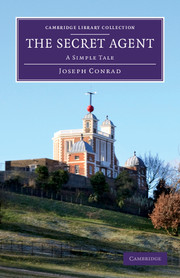
By the time Joseph Conrad (1857–1924) produced this novel in 1907, terrorism had torn its way through London: Victoria station had been partially destroyed, the House of Commons damaged, and Scotland Yard attacked with dynamite. Conrad's story is set in 1886, at the height of these troubles, and was inspired by the 1894 attempt to bomb Greenwich Observatory. Written just after Nostromo (1904), it is a marked departure from Conrad's usual seafaring form and plunges the reader into the claustrophobic, grimy world of late nineteenth-century London. Mr Adolf Verloc - anarchist, spy, and purveyor of pornographic material - heads a cast of shadowy characters all affected directly or indirectly by the anarchist organisation to which he belongs. Although critics acknowledged its power, the novel and its dark subject matter were uneasily received in Conrad's lifetime. This reissue of the first edition confirms the book's place as a classic of twentieth-century fiction.
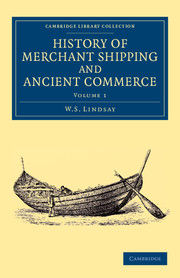
The shipowner and politician William Schaw Lindsay (1816–77) combined a wealth of personal experience with a meticulous approach to research. Originally published in 1874–6, this is his authoritative four-volume history of the world of ships and maritime trade. Its coverage ranges from the legend of Noah's Ark, through ancient commerce and the colonising expeditions of the middle ages, to the progress brought about by the introduction of steam to the shipping of Lindsay's own day. Details on construction and performance sit alongside explanations of the customs and superstitions of seamen, complemented by full accounts of many important nautical events. Volume 1 encompasses shipping in the ancient world, the foundation of a royal and commercial navy in England, and tales of the Norman invasion and the Crusades to the Holy Land, ending with Christopher Columbus' voyages of discovery. Evident throughout the work are Lindsay's practical knowledge and enthusiasm for his subject.
The abbey at Sallay (Sawley) was a Cistercian house founded in 1147/8 by the Percys, close to the Yorkshire-Lancashire border. The chartulary was compiled in the 1330s, comprising records from the foundation onwards, with a few later additions. The house remained a poor foundation, and it suffered when Whalley Abbey was founded only seven miles away in 1296. The 676 charters are arranged in twelve geographical groups, according to the proximity of the properties to Sallay. The documents are given in Latin, with English summaries of each by the editor, Joseph McNulty, who has also attempted to date the charters. Although the abbey is not as well known as other foundations, its charters provide a valuable source for the economic history of the north of England. Volume 2, published in 1934, contains charters 389–676, a previously unknown mid-fourteenth-century valuation of Yorkshire churches and an index.
The abbey at Sallay (Sawley) was a Cistercian house founded in 1147/8 by the Percys, close to the Yorkshire-Lancashire border. The chartulary was compiled in the 1330s, comprising records from the foundation onwards, with a few later additions. The house remained a poor foundation, and it suffered when Whalley Abbey was founded only seven miles away in 1296. The 676 charters are arranged in twelve geographical groups, according to the proximity of the properties to Sallay. The documents are given in Latin, with English summaries of each by the editor, Joseph McNulty, who has also attempted to date the charters. Although the abbey is not as well known as other foundations, its charters provide a valuable source for the economic history of the north of England. Volume 1, published in 1933, contains the first 388 charters.
The records of the medieval English courts were compiled into manuscript 'year books', organised by regnal year of the monarch, and further subdivided into the four law terms. The year books of the reign of Edward III (1312–77), beginning at the eleventh year (1337) and continuing to the twentieth (1346), were to have been edited for the Roll Series by Alfred Horwood (1821–81), who had previously edited the year books of Edward I, but he died while the first volume was in proof. The work was taken over by L.O. Pike (1835–1915), the set of fifteen books being published between 1883 and 1911. (Horwood chose his start date because the year books of Edward II and the first part of the reign of Edward III already existed in modern editions.) This volume contains reports from Easter Term, 15 Edward III, to Michaelmas Term, 15 Edward III.
A scholar of Trinity College, Cambridge, who became canon of Canterbury in 1859, James Craigie Robertson (1813–82) edited for the Rolls Series this seven-volume work, published between 1875 and 1885. Superseding the earlier work of J. A. Giles, it is a collection of contemporary Latin lives and letters relating to the life of Thomas Becket (c.1120–70). Rising through the ranks to become royal chancellor and then archbishop of Canterbury, Becket fell dramatically out of favour with Henry II and, on his return from exile, was famously murdered in the cathedral church at Canterbury. Following his canonisation in 1173, his reputation grew considerably throughout western Christendom. Volume 2 comprises the lives compiled by Benedict of Peterborough and Alan of Tewkesbury, as well as John of Salisbury, who abandoned Becket in the church, and Edward Grim, who was injured trying to protect him.
A Franciscan scholar and theologian, John Peckham (c.1230–92) was appointed archbishop of Canterbury by the pope in 1279. His register survives at Lambeth Palace and is the chief source for his archiepiscopacy. This three-volume edition, prepared by Charles Trice Martin (1842–1914) between 1882 and 1885, rearranges the documents from their original thematic order to a chronological one, and omits the purely formal items, published elsewhere. The text is mostly in Latin, with some Anglo-Norman documents, for which a translation is provided in Appendix 1. Volume 3 contains letters 562–720, from July 1284 to July 1292. Topics include Anglo-Welsh relations and disputes between the Franciscans and other orders at Oxford. Appendix 2 contains an abstract of the entire register, describing the documents left out of this edition. Also provided is an index to the entire work.
This extensive eight-volume work was first published between 1867 and 1877 by the linguist John Dowson (1820–81) from the manuscripts of the colonial administrator and scholar Sir Henry Miers Elliot (1808–53). Before his death, hoping to bolster British colonial ideology, Elliot had intended to evaluate scores of Arabic and Persian historians of India, believing that his translations would demonstrate the violence of the Muslim rulers and 'make our native subjects more sensible of the immense advantages accruing to them under the mildness and the equity of our rule'. Volume 5 charts the end of the Afghan dynasty in 1526 and most of the reign of Akbar, as frankly recounted in Abd-ul-Qadir Bada'uni's Muntakhab-ut-Tawarikh (1595). It also includes chronicles of the rule of the second Mughal emperor, Humayun (1508–56), and the Tarikh-i-Akbari. The appendices contain Elliot's notes on aspects of Indian culture.
Celtic scholar and philologist Whitley Stokes (1830–1909) edited and translated many important early medieval texts from Ireland, in Latin and Irish, which remain standard reading. This two-volume edition of works about Patrick, the fifth-century apostle to Ireland, was first published in 1887. Volume 2 contains a range of works dating from the fifth to the eleventh century. It includes the two surviving works that can be attributed to Patrick himself, the Confession and Letter to Coroticus. The excerpts from the Book of Armagh from the seventh century onward reflect the growing nationwide cult of St Patrick, and Armagh's claim to ecclesiastical primacy by associating Patrick with its church. These include the accounts of Patrick by Tírechán and Muirchu, and the 'Book of the Angel'. There are also hymns by Secundinus and Fiacc, Ninníne's prayer and an Irish homily from the Lebar Brecc. Translations of the Irish, along with several appendices and indexes, are also provided.
This Latin Register of Richard Kellaw, Bishop of Durham (d.1316), is the earliest to survive for this important diocese, where the bishop held quasi-royal authority within his palatinate. He was an active bishop, and the Register, covering the years 1311–16, includes information about ordinations, indulgences, loans, grants and licences to study, as well as about Kellaw's secular administration of his diocese. He also had to deal with constant trouble from the Scots under Robert Bruce. This four-volume work, published between 1873 and 1878, was edited by the historian Sir Thomas Duffus Hardy (1804–78). It is an important source on the civil and ecclesiastical history of the North of England in the early fourteenth century. Volume 2 contains folios 140v to 265. These conclude the sections relating to Kellaw's civil and ecclesiastical administration, and also contain copies of royal writs and legal documents. An index to Volumes 1 and 2 is also provided.
Volume 2 of The Old Testament in Greek According to the Septuagint, edited by the Cambridge scholar Henry Barclay Swete (1835–1917), was first published in 1891. It contains the books from 1 Chronicles to Tobit. Swete set an important precedent for later editors by using an actual manuscript text as the edition's base. He selected the fourth-century Codex Vaticanus, which is still widely considered to contain the earliest and most valuable form of Septuagint text; many later editors have followed suit. Where Vaticanus was defective the text was supplemented by Codex Sinaiticus or Codex Alexandrinus The critical apparatus gives the readings of seven other important ancient manuscripts and fragments. The edition's convenient size and ease of use assured its place as one of the most widely used versions of the Septuagint, and it is still consulted today.
The influence of John Ruskin (1819–1900), both on his own time and on artistic and social developments in the twentieth century, cannot be over-stated. He changed Victorian perceptions of art, and was the main influence behind 'Gothic revival' architecture. As a social critic, he argued for the improvement of the condition of the poor, and against the increasing mechanisation of work in factories, which he believed was dull and soul-destroying. The thirty-nine volumes of the Library Edition of his works, published between 1903 and 1912, are themselves a remarkable achievement, in which his books and essays - almost all highly illustrated - are given a biographical and critical context in extended introductory essays and in the 'Minor Ruskiniana' - extracts from letters, articles and reminiscences both by and about Ruskin. This thirty-ninth and final volume contains the index to the entire edition.