A collection of out-of-copyright and rare books from the Cambridge University Library and other world-class institutions that have been digitally scanned, made available online, and reprinted in paperback.
To save content items to your account,
please confirm that you agree to abide by our usage policies.
If this is the first time you use this feature, you will be asked to authorise Cambridge Core to connect with your account.
Find out more about saving content to .
To save content items to your Kindle, first ensure no-reply@cambridge.org
is added to your Approved Personal Document E-mail List under your Personal Document Settings
on the Manage Your Content and Devices page of your Amazon account. Then enter the ‘name’ part
of your Kindle email address below.
Find out more about saving to your Kindle.
Note you can select to save to either the @free.kindle.com or @kindle.com variations.
‘@free.kindle.com’ emails are free but can only be saved to your device when it is connected to wi-fi.
‘@kindle.com’ emails can be delivered even when you are not connected to wi-fi, but note that service fees apply.
Dunstan was a prominent ecclesiastical figure in tenth-century England and - following his death and canonisation in 988 - the country's most popular saint for over a century; his fame was eventually eclipsed only by that of Thomas Becket. In life a close friend of King Edgar, he was influential as the king's advisor and became archbishop of Canterbury in 959. Published in 1874 as part of the Rolls Series, this work gathers together the lives, letters and other fragments of historical interest that were written to or about Dunstan. As editor, William Stubbs (1825–1901) provides English side-notes to the Latin text as well as a characteristically extensive introduction, which includes a detailed account of English monastic reform. On the subject of Dunstan, he highlights points of particular interest, ranging from questions of chronology to matters of misrepresentation and the mystery identity of biographer 'B'.
This extensive eight-volume work was first published between 1867 and 1877 by the linguist John Dowson (1820–81) from the manuscripts of the colonial administrator and scholar Sir Henry Miers Elliot (1808–53). Before his death, hoping to bolster British colonial ideology, Elliot had intended to evaluate scores of Arabic and Persian historians of India, believing that his translations would demonstrate the violence of the Muslim rulers and 'make our native subjects more sensible of the immense advantages accruing to them under the mildness and the equity of our rule'. Volume 7 covers the period from Shah Jahan (1592–1666) to the early reign of Muhammad Shah (1702–48). It includes various Padshahnama, the works comprising the official visual history of Shah Jahan's reign, most notably that of Abdul Hamid Lahori (d.1654). Also included are substantial extracts from the Muntakhab-ul-Lubab of Khafi Khan, covering the long reign of Aurangzeb (1618–1707).
Fort William College was an academy established in Calcutta in 1800 by the British colonial administrator Richard Wellesley (1760–1842). Its purpose was to train British officials in numerous oriental languages, which resulted in the publication of several pioneering reference works and thousands of translated texts. First published in 1819, this book was compiled by Thomas Roebuck (1781–1819), assistant secretary to the college's council, as a tribute to Lord Wellesley's work. It contains records of all the memorable events that had taken place at the college since its establishment; Roebuck believed this would help new students in learning the principles on which the college was founded, and how former students had benefited accordingly. Drawing on official documents and containing writings by Wellesley himself, the work offers historians and linguists a valuable insight into a highly influential institution in British India.
Ralph de Diceto (d.1199/1200), dean of St Paul's, was both a painstaking compiler of information and an intellectual historian of remarkably wide vision. This two-volume collection of his writings, originally published in 1876, covers the history of the world from the Creation to 1202 (it was continued posthumously). Volume 2 contains the second half of Diceto's most important work, the Ymagines historiarum, his Opuscula (a collection of far shorter texts) as well as various appendices. In his preface to this volume, William Stubbs (1825–1901) assesses the historical value of the work via an exploration of its date of composition and its sources, whether primary or secondary. His edition also benefits from the reintroduction of Ralph's elsewhere-omitted marginal signa - a pictorial code of crosses, swords, and crowns being torn at by jealous hands - which act as signposts for the reader.
This extensive eight-volume work was first published between 1867 and 1877 by the linguist John Dowson (1820–81) from the manuscripts of the colonial administrator and scholar Sir Henry Miers Elliot (1808–53). Before his death, hoping to bolster British colonial ideology, Elliot had intended to evaluate scores of Arabic and Persian historians of India, believing that his translations would demonstrate the violence of the Muslim rulers and 'make our native subjects more sensible of the immense advantages accruing to them under the mildness and the equity of our rule'. Volume 2 begins with accounts of the earliest inroads of the Ghaznivid conquerors, tracing the rise to power of the Muslims in India. It includes History of the World Conqueror by Ata-Malik Jovayni (1226–83), one of the main sources on the rapid sweep of Genghis Khan's armies through Asia. The volume closes in 1257 during the reign of Nasir-ud-din Mahmud (1246–66).
William Campbell (1824–86) compiled this two-volume work for the Rolls Series between 1873 and 1877. It covers the first five years of the reign of Henry VII, following his accession to the throne after the Battle of Bosworth in 1485. The contemporary material is rich in information regarding Henry's governance and character, including his meticulous approach to financial matters and his penchant for splendour. Volume 1 brings together a variety of illustrative and carefully transcribed documents, presented in English, Latin and French. Covering the year 1485–6, it introduces the people who would come to shape Henry's reign. Revealing Henry's concern to reward his allies, the documents reflect the turbulence of the previous decades and the uneasy character of this period. This is a valuable resource for researchers of the early Tudors, providing insight into Henry's reign in its early, and most anxious, stages of development.
The shipowner and politician William Schaw Lindsay (1816–77) combined a wealth of personal experience with a meticulous approach to research. Originally published in 1874–6, this is his authoritative four-volume history of the world of ships and maritime trade. Its coverage ranges from the legend of Noah's Ark, through ancient commerce and the colonising expeditions of the middle ages, to the progress brought about by the introduction of steam to the shipping of Lindsay's own day. Details on construction and performance sit alongside explanations of the customs and superstitions of seamen, complemented by full accounts of many important nautical events. Volume 3 describes the extraordinary progress made by the United States of America in the first half of the nineteenth century, discusses Cromwell's Navigation Acts and the causes and effects of their abolition, and concludes with a warning against excessive legislation. Lindsay's practical knowledge and enthusiasm for his subject are evident throughout the work.
A scholar of Trinity College, Cambridge, who became canon of Canterbury in 1859, James Craigie Robertson (1813–82) edited for the Rolls Series this seven-volume work, published between 1875 and 1885. Superseding the earlier work of J. A. Giles, it is a collection of contemporary Latin lives and letters relating to the life of Thomas Becket (c.1120–70). Rising through the ranks to become royal chancellor and then archbishop of Canterbury, Becket fell dramatically out of favour with Henry II and, on his return from exile, was famously murdered in the cathedral church at Canterbury. Following his canonisation in 1173, his reputation grew considerably throughout western Christendom. Volume 3 contains the lives compiled by William Fitzstephen, a close contemporary, and Herbert of Bosham, who campaigned for Becket's canonisation and was one of his longest-serving clerks and closest friends.
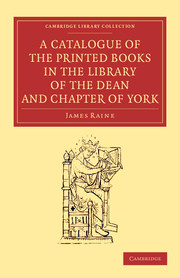
York Minster has the largest cathedral library in England. The original library was established in the eighth century, but nothing survives from this period. A new collection was begun in 1414 when John Newton left books to the Minster, and a new library was erected. Further bequests followed - including in 1628 the important collection of Tobie Matthew, archbishop of York - which reflect the religious controversies of the sixteenth century. Today the library contains some 120,000 items, of which more than 25,000 were printed before 1801. This catalogue, published in 1896, was compiled by James Raine (1830–96), chancellor of York Minster, a leading figure in the nineteenth-century restoration of the library. It contains an alphabetical list of most of the printed books that were then in the library, but does not include recent theological acquisitions or the bequest by Edward Hailstone (d.1890) of 10,000 items on Yorkshire.
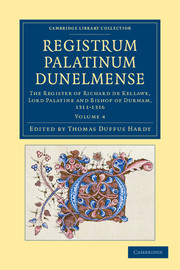
This Latin Register of Richard Kellaw, Bishop of Durham (d.1316), is the earliest to survive for this important diocese, where the bishop held quasi-royal authority within his palatinate. He was an active bishop, and the Register, covering the years 1311–16, includes information about ordinations, indulgences, loans, grants and licences to study, as well as about Kellaw's secular administration of his diocese. During his five-year episcopate, he also had to deal with constant trouble from the Scots under Robert Bruce. This four-volume work, published as part of the Rolls Series between 1873 and 1878, was edited by the historian Sir Thomas Duffus Hardy (1804–78). It is an important source on the civil and ecclesiastical history of the North of England in the early fourteenth century. Volume 4 contains documents relating to Durham from sources other than the Register, excerpts from the letter book of Bishop Richard de Bury, appendices and indexes.