A collection of out-of-copyright and rare books from the Cambridge University Library and other world-class institutions that have been digitally scanned, made available online, and reprinted in paperback.
To save content items to your account,
please confirm that you agree to abide by our usage policies.
If this is the first time you use this feature, you will be asked to authorise Cambridge Core to connect with your account.
Find out more about saving content to .
To save content items to your Kindle, first ensure no-reply@cambridge.org
is added to your Approved Personal Document E-mail List under your Personal Document Settings
on the Manage Your Content and Devices page of your Amazon account. Then enter the ‘name’ part
of your Kindle email address below.
Find out more about saving to your Kindle.
Note you can select to save to either the @free.kindle.com or @kindle.com variations.
‘@free.kindle.com’ emails are free but can only be saved to your device when it is connected to wi-fi.
‘@kindle.com’ emails can be delivered even when you are not connected to wi-fi, but note that service fees apply.
'All children, except one, grow up.' Mrs Darling half-remembers Peter Pan from her own childhood; he is an insubstantial figure with a baby's laugh and a habit of blowing out stars. She believes him to be imaginary - until he leaves his shadow in her children's nursery. Accompanied by a foul-mouthed fairy, Peter is in search of good stories, and upon learning that the eldest Darling girl, Wendy, knows a great many, he lures her and her two brothers back to the island of Neverland. There, the dreams and imaginings of childhood become real. Lost boys, pirates and warring Indians populate the shifting landscape, which suddenly seems darker and more frightening without the bedside lamps of home. Adapted by J. M. Barrie (1860–1937) from his most famous play, this novelised and illustrated version of the story was first published in 1911.
The prosperous Cluniac priory of St John the Evangelist, Pontefract, was founded around 1090 by Robert de Lacy, remaining subject to its mother-house of La Charité-sur-Loire until the fourteenth century. The charters in this two-volume work have been arranged by type: seigniorial charters; episcopal and papal charters; royal charters; and those relating to priory property, arranged geographically according to proximity to Pontefract. The chartulary is particularly valuable for topographical studies and local and family history - in many cases the names of all witnesses have been transcribed. The manuscript was originally compiled in the first half of the thirteenth century, with additions made on blank leaves over the following centuries (not included by the editor). Volume 1, published in 1899, comprises the first 45 folios, containing 233 charters, and an introduction on the history of the priory and the de Lacy family. Each Latin charter is preceded by a brief English summary.
The thirteenth-century Latin legal treatise best known as Bracton is now thought to be the work of several hands, and Henry de Bracton (d.1268) to have been only the last of these. Work began on it in the 1230s and largely ceased in the early 1250s, but the treatise - an ambitious survey of English law - was never finished. Between 1878 and 1883, the scholar and jurist Sir Travers Twiss (1809–97) edited and published this work in six volumes for the Rolls Series. His text was mainly based on the first printed edition of 1569. Although he provided the first English translation of Bracton, Twiss's work has been criticised and since superseded. Volume 1 contains Book 1 and most of Book 2. These include the general introduction, the law of persons and most of the law of things.
A former prior of Belvoir, Roger of Wendover (d.1236) established himself as a chronicler at St Albans. This three-volume work, edited by Henry G. Hewlett (1832–97) and published between 1886 and 1889, comprises the latter part of the larger Flores opus and the part of the Latin text for which Wendover can claim direct responsibility. Volume 3 includes the introductory matter, glossary and index to all three volumes. Hewlett's introduction discusses the little we know of Roger of Wendover's life as well as his shortcomings and merits as an annalist - namely that he was unreasoningly credulous yet invariably candid. His true importance, however, is as a key influence on his historiographical successor, Matthew Paris, whose political outlook and interests he helped to shape. A comparison is drawn between this work and that of Paris, the more gifted chronicler, who 'complemented the deficiencies of Wendover's narrative by substantial additions'.
Born within walking distance of ten Nottinghamshire pits, David Herbert Lawrence (1885–1930) was painfully aware that his frail physique and quiet character were ill suited to the mining industry upon which his community depended. The difficulties of his youth are manifest in Sons and Lovers, his first major novel and an insider's portrayal of the culture of the collieries. Writing to a friend, Lawrence explained the seed of his plot: 'a woman of character and refinement goes into the lower class, and has no satisfaction in her own life'. Stemming from this are the intricate difficulties in the relationships of Paul Morel, the second son of this unhappy mother, torn between her overpowering influence and two vastly different women - the quiet, old-fashioned Miriam and the modern divorcee Clara. Although initially deemed indecent and rejected for publication, Sons and Lovers appeared for the first time in 1913.
The names of Thomas Bewick (1753–1828) and his brother John (1760–1795) are synonymous with beautiful, delicate and accurate woodcuts of the natural world. Their instantly recognisable style was to influence book illustration well into the nineteenth century. The antiquary and print collector Thomas Hugo (1820–76), best known as a collector of Bewick woodcuts, first published this two-volume catalogue of his extensive collection in 1866–8. It has since emerged that many of the items sourced from printers' offices and booksellers across the country - including Thomas Bewick's own publisher, Emerson Charnley - cannot be authenticated as the Bewicks' work. The collection was nonetheless a remarkable assemblage of valuable materials, including uncut first editions, woodblocks, handbills and broadsides (all regrettably dispersed after Hugo's death) which might otherwise have been lost. Lavishly illustrated throughout, Volume 1 comprises the catalogue, which includes an appendix of Bewick portraits, letters and memorabilia.
This extensive eight-volume work was first published between 1867 and 1877 by the linguist John Dowson (1820–81) from the manuscripts of the colonial administrator and scholar Sir Henry Miers Elliot (1808–53). Before his death, hoping to bolster British colonial ideology, Elliot had intended to evaluate scores of Arabic and Persian historians of India, believing that his translations would demonstrate the violence of the Muslim rulers and 'make our native subjects more sensible of the immense advantages accruing to them under the mildness and the equity of our rule'. Volume 1 contains introductory material and Elliot's original preface; early Arab geographers' chronicles, including Ibn Khordadbeh's ninth-century Book of Roads and Kingdoms and tenth-century works by Estakhri and Ibn Hawqal; histories of Sindh, including the Chach Nama; and extensive appendices giving further contextual information and ethnographic notes on India.
One of the leading figures in the age of great engineers, David Stevenson (1815–86) was the son of a lighthouse builder, and while studying at Edinburgh University he was already gaining experience at his father's side. It is for his lighthouses and works of inland navigation that he is best remembered: he designed Britain's most northerly lighthouse and worked on improving navigation on rivers such as the Dee, the Forth and the Clyde. His article on inland navigation for the Encyclopaedia Britannica was published separately in 1858, and was revised and updated for this second edition in 1872. Although Stevenson acknowledges that the age of the canal has been superseded by the age of the railway, he maintains that there is much to learn from the older technology. Illustrated with cross-sections and plans, this work will be of interest to readers seeking to explore the history of Britain's industrial infrastructure.
Although born in Australia, the historian and folklorist Joseph Jacobs (1854–1916) spent his adult years in England and America. Educated at Cambridge and Berlin, he came to public attention in 1882 following the publication in The Times of a series of articles on the persecution of Jews in Russia that had followed the assassination of Alexander II. The Mansion House Committee to aid the Jews of Russia was established as a result of these articles. In 1885 he published this book, listing all the printed works on the 'Jewish Question' that had appeared in the previous decade. It is notable that those items originating in Germany form the bulk of the bibliography, providing as much material as all other countries combined. Revealing in its scope, this has been described as the most important contemporary bibliography on the subject.
The period 1361–4, when these five court rolls from Yorkshire were compiled, was an important era in medieval English jurisprudence, as the older system of keepers of the peace was transformed into that of justices of the peace, who were given full powers to judge cases of felony as well as to enforce the labour laws. Yet in 1364 this system was suddenly abandoned and the powers of the justices diminished. Published in 1939 for the Yorkshire Archaeological Society, the original Latin texts of the five rolls are prefaced here with an extensive introduction by the noted historian of medieval jurisprudence Bertha Haven Putnam (1872–1960), who provides historical and legal context and analyses the content of the rolls, tabulating the various types of offences that were committed, including homicide, larceny and trespass. Putnam also includes, as appendices, selections from the rolls of the exchequer and the king's bench.
Ranulf Higden (d.1364) was a monk at the abbey of St Werburgh in Chester. His most important literary work is this universal chronicle, which survives in over a hundred Latin manuscripts, testifying to its popularity. The earliest version of it dates from 1327, but Higden continued writing until his death, expanding and updating the text. It was also continued in other monastic houses, most importantly by John Malvern of Worcester. The English translation made by John Trevisa in the 1380s was also widely circulated and is included in this work, published in nine volumes for the Rolls Series between 1865 and 1886. The chronicle shows how fourteenth-century scholars understood world history and geography. Volume 8 concludes Book 7, reaching the reign of Edward III. The appendices contain some of the continuations written after Higden's death.
This spy story of 1915 by John Buchan (1875–1940) is an archetype of the genre, but may be better known today through its film and television versions (especially that of Alfred Hitchcock in 1935). Curiously, although all keep the theme of German espionage which will trigger a world war, none of them sticks at all closely to Buchan's original plot. This is the first of five novels in which Richard Hannay, formerly a mining engineer in colonial Africa, now a patriotic gentleman of leisure, finds himself pitted against the enemies of the British Empire. Although the book is an exciting, if occasionally implausible, adventure story, it may be marred for a modern readership by the racism and anti-Semitism it expresses, though this was not exceptional for the period. The writing is also noticeable, however, for lyrical descriptions of the Scottish border country in which Buchan himself grew up.
This extensive eight-volume work was first published between 1867 and 1877 by the linguist John Dowson (1820–81) from the manuscripts of the colonial administrator and scholar Sir Henry Miers Elliot (1808–53). Before his death, hoping to bolster British colonial ideology, Elliot had intended to evaluate scores of Arabic and Persian historians of India, believing that his translations would demonstrate the violence of the Muslim rulers and 'make our native subjects more sensible of the immense advantages accruing to them under the mildness and the equity of our rule'. Volume 4 covers the death of Timur in 1405 and continues to Akbar (1542–1605), including the autobiography of Babur (1483–1530), the Tarikh-i-Sher Shahi (1580), and the Tarikh-i-Daudi, covering the fall of the Karrani dynasty of Bengal and the rise of Akbar. The appendices discuss further anecdotal and related literature of the age.
Malmesbury abbey was a seventh-century foundation, re-established in the late tenth century and supported by royal patronage for several centuries. It was famous for its enormous library, and especially the work of the twelfth-century historian William of Malmesbury. This register of charters was compiled in the late thirteenth century and, although some are later forgeries, it is an important collection of Anglo-Saxon documents. It provides vital information about Wessex from the seventh century on, as well as material about the later difficulties between the monks and the bishop of Salisbury. This two-volume edition of the Latin texts with English side-notes was prepared by John Sherren Brewer (1809–79) and completed by Charles Trice Martin (1842–1914). Volume 1 (1879) contains royal decrees such as Magna Carta, the extensive rent roll of the abbey's properties (mostly local), and charters relating to them. The appendix contains an account of the early history of Britain.
James Raine (1830–96), canon of York, edited in three volumes these Latin works relating to the diocese, covering the period from 650 to 1522. Volume 3, published in 1894, contains a miscellany of 176 charters, letters, wills, papal bulls and other documents, dating from 930 to 1522, extracted from the registers of the archbishops and the muniments of the dean and chapter. Only three date from before 1066. The lengthy struggle for the primacy between York and Canterbury, and between York and other dioceses such as Durham and Lincoln, is a regular cause of concern, and the archbishop of York also claimed the obedience of Scottish bishops. The volume ends with an inventory of the sumptuous jewels, plate and vestments belonging to the see at the beginning of the sixteenth century. An index to all three volumes is also provided, along with English side-notes to the Latin text.
This extensive eight-volume work was first published between 1867 and 1877 by the linguist John Dowson (1820–81) from the manuscripts of the colonial administrator and scholar Sir Henry Miers Elliot (1808–53). Before his death, hoping to bolster British colonial ideology, Elliot had intended to evaluate scores of Arabic and Persian historians of India, believing that his translations would demonstrate the violence of the Muslim rulers and 'make our native subjects more sensible of the immense advantages accruing to them under the mildness and the equity of our rule'. Volume 6 covers the death of Akbar in 1605 and includes extracts from the Akbarnama of Abul Fazl (1551–1602), the emperor's vizier and court historian. It also covers the reign of Jahangir (1569–1627) with extracts from the Jahangirnama, his own memoirs. The appendices include a translation of the introduction to Ferishta's early seventeenth-century history.
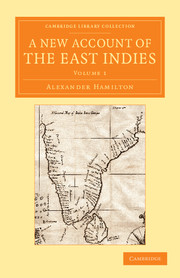
Little is known of Captain Alexander Hamilton other than what he tells us in this work, first published in 1727. Written during his retirement, it is both an invaluable source of information on south-east Asia at the time and a lively travelogue of Hamilton's adventurous seafaring life in the service of the East India Company and independently between 1688 and 1723. An engaging storyteller, Hamilton writes of encounters with pirates, the Portuguese, and of a poisoning in Malacca, as well as providing vivid descriptions of the countries he visited - from Africa to Japan via India, Sumatra and China - and their social customs, religions, trade and commerce. His idiosyncratic maps and illustrations enhance his narrative despite his admission that he makes 'but little use of the pencil'. Volume 1 takes the reader up the east coast of Africa to the Middle East, and round the coast of India to Ceylon.
This Latin Register of Richard Kellaw, Bishop of Durham (d.1316), is the earliest to survive for this important diocese, where the bishop held quasi-royal authority within his palatinate. He was an active bishop, and the Register, covering the years 1311–16, includes information about ordinations, indulgences, loans, grants and licences to study, as well as about Kellaw's secular administration of his diocese. During his five-year episcopate, he also had to deal with constant trouble from the Scots under Robert Bruce. This four-volume work, published as part of the Rolls Series between 1873 and 1878, was edited by the historian Sir Thomas Duffus Hardy (1804–78). It is an important source on the civil and ecclesiastical history of the North of England in the early fourteenth century. Volume 1 contains the first 140 folios (of 366), which comprise documents from the years 1311–14.
Little is known about the life of Symeon of Durham (fl. c.1090–c.1128), other than that he was one of the monks present at the translation of the remains of Saint Cuthbert in 1104. This second volume of his complete works, published in 1885, was edited by Thomas Arnold (1823–1900) with an introduction and English side-notes. The main Latin text here is Symeon's history of the kings of Britain, which was intended as a continuation of Bede's history from the year 731 up to the writer's own day. Much of the early narrative is taken from local Durham annals, and later sections are borrowed from the chronicle of John of Worcester, but from 1119 to 1129 Symeon is an independent and unique authority. John of Hexham's continuation of the history, up to 1153, is also included, in addition to appendices on the genealogies of the Anglo-Saxon kings, a glossary and an index to both volumes.
A scholar of Trinity College, Cambridge, who became canon of Canterbury in 1859, James Craigie Robertson (1813–82) edited for the Rolls Series this seven-volume work, published between 1875 and 1885. Superseding the earlier work of J. A. Giles, it is a collection of contemporary Latin lives and letters relating to the life of Thomas Becket (c.1120–70). Rising through the ranks to become royal chancellor and then archbishop of Canterbury, Becket fell dramatically out of favour with Henry II and, on his return from exile, was famously murdered in the cathedral church at Canterbury. Following his canonisation in 1173, his reputation grew considerably throughout western Christendom. Volume 1 comprises the collection of miracles, originally thought lost and therefore unpublished, compiled by William of Canterbury, who was present at the scene of Becket's murder.