A collection of out-of-copyright and rare books from the Cambridge University Library and other world-class institutions that have been digitally scanned, made available online, and reprinted in paperback.
To save content items to your account,
please confirm that you agree to abide by our usage policies.
If this is the first time you use this feature, you will be asked to authorise Cambridge Core to connect with your account.
Find out more about saving content to .
To save content items to your Kindle, first ensure no-reply@cambridge.org
is added to your Approved Personal Document E-mail List under your Personal Document Settings
on the Manage Your Content and Devices page of your Amazon account. Then enter the ‘name’ part
of your Kindle email address below.
Find out more about saving to your Kindle.
Note you can select to save to either the @free.kindle.com or @kindle.com variations.
‘@free.kindle.com’ emails are free but can only be saved to your device when it is connected to wi-fi.
‘@kindle.com’ emails can be delivered even when you are not connected to wi-fi, but note that service fees apply.
Composed in the twelfth century by the leading Muslim jurist Burhan al-Din al-Marghinani (1135–97), the original Arabic al-Hidāyah remains a central text of Islamic personal law. This English translation, from a Persian version of the work, was prepared by the orientalist Charles Hamilton (c.1752–92) for the East India Company in 1791. Although since superseded, it remains a fascinating document in the history of colonial jurisprudence. The legal system was central to the entrenchment of British rule in India, providing the framework for active control of civil administration and the courts. Translations of Islamic texts were intended to remove the language barrier for colonial officials, and blurred British and native law for the first time. Hamilton's text is one such, and its dedication to Warren Hastings and lengthy preliminary section outline its purpose and composition. Volume 1 contains sections on zakat (alms), marriage, fosterage, divorce, slavery, and vows.
Best known for his ideas relating to evolution, French naturalist Jean-Baptiste Lamarck (1744–1829) first built his reputation as a botanist and was elected to the prestigious Académie des Sciences in 1779. His career took a new turn in 1793 when he was made professor of 'insects, worms and microscopic animals' at the Muséum National d'Histoire Naturelle, although he lacked prior knowledge of the subject area. Undaunted, Lamarck set out to classify organisms which few naturalists had considered worthy of study since Linnaeus. He was the first to distinguish vertebrates from 'invertebrates' - a term he coined - by the presence of a vertebral column. In this groundbreaking seven-volume work, published between 1815 and 1822, he arranges invertebrates into twelve classes, laying the foundations for the modern study of these organisms. Volume 3, first published in 1816, covers tunicates, worms and insects.
Selection of Despatches Written by the Venetian Ambassador, Sebastian Giustinian, and Addressed to the Signory of Venice, January 12th, 1515, to July 26th, 1519
Sebastian Giustinian (1460–1543) served as the Venetian ambassador to the court of Henry VIII between 1515 and 1519, during which time he sent back frequent and detailed dispatches to the Signory of Venice. In 1515, when Giustinian arrived at the English court, Henry was only twenty-four and described as 'expert in arms, and of great valour, and most excellent in his personal endowments'. In this first of two volumes, Guistinian's letters paint a vivid portrait of a diplomat's life at court, covering treaty negotiations, meetings with Cardinal Wolsey, and the personal qualities of the monarch and his queen. Translator and editor Rawdon Lubbock Brown (1806–83) had an unrivalled knowledge of the Venetian archives: he was the first historian to appreciate the importance of the dispatches sent from London by the Venetian ambassadors. His edition of Giustinian's correspondence provided an entirely new insight into Henry's reign when it was first published in 1854.
A lawyer by profession, Theodore Martin (1816–1909) gained literary distinction as both a humorous essayist and versatile translator. He found his greatest success, however, in the role of biographer to Prince Albert (1819–61). Commissioned by Queen Victoria to memorialise her late husband, this five-volume work was first published between 1875 and 1880. Intended as a continuation of the biography begun by Charles Grey (also reissued in this series), it has been described as 'less adulatory in tone than might be expected'. A treasury of letters and memoranda, it presents a detailed portrait of the character, words and deeds of a man whose life was necessarily immersed in the great events of his time. Volume 4 deals with the difficult period of 1856–9, which saw mutiny in India, worldwide commercial uncertainty, and the beginning of a decline in Albert's health.
Composed in the twelfth century by the leading Muslim jurist Burhan al-Din al-Marghinani (1135–97), the original Arabic al-Hidāyah remains a central text of Islamic personal law. This English translation, from a Persian version of the work, was prepared by the orientalist Charles Hamilton (c.1752–92) for the East India Company in 1791. Although since superseded, it remains a fascinating document in the history of colonial jurisprudence. The legal system was central to the entrenchment of British rule in India, providing the framework for active control of civil administration and the courts. Translations of Islamic texts were intended to remove the language barrier for colonial officials, and blurred British and native law for the first time. Volume 3 contains sections on agency, claims, laws of business, deposits, loans, gifts, the hiring of slaves, freed slaves, and disputed land sales.
A lawyer by profession, Theodore Martin (1816–1909) gained literary distinction as both a humorous essayist and versatile translator. He found his greatest success, however, in the role of biographer to Prince Albert (1819–61). Commissioned by Queen Victoria to memorialise her late husband, this five-volume work was first published between 1875 and 1880. Intended as a continuation of the biography begun by Charles Grey (also reissued in this series), it has been described as 'less adulatory in tone than might be expected'. A treasury of letters and memoranda, it presents a detailed portrait of the character, words and deeds of a man whose life was necessarily immersed in the great events of his time. Volume 2 covers the period from 1848 to 1854, the births of Princes Arthur and Leopold, the collapse of the Chartist movement and the 'spectacular success' of the Great Exhibition of 1851.
A lawyer by profession, Theodore Martin (1816–1909) gained literary distinction as both a humorous essayist and versatile translator. He found his greatest success, however, in the role of biographer to Prince Albert (1819–61). Commissioned by Queen Victoria to memorialise her late husband, this five-volume work was first published between 1875 and 1880. Intended as a continuation of the biography begun by Charles Grey (also reissued in this series), it has been described as 'less adulatory in tone than might be expected'. A treasury of letters and memoranda, it presents a detailed portrait of the character, words and deeds of a man whose life was necessarily immersed in the great events of his time. Volume 5 covers Albert's final years, from 1859 to his protracted illness and death in 1861 at the age of forty-two.
Henry Thoby Prinsep (1792–1878), a colonial administrator who reached the highest rank in the East India Company and its successor, the Council of India, published this Code of Practice in 1866: the third edition of 1869, reissued here, was necessitated by new legislation in that year. (Prinsep's earlier work, Origin of the Sikh Power in the Punjab, is also reissued in this series.) In the preface to this work, written as a guide for local magistrates and administrators, Prinsep states his intent to present, in a convenient form, all the rules of procedure in the criminal courts of British India. Each stage of the process is annotated with explanatory material, and case law and precedents are also cited where appropriate. Appendices contain further relevant legislation, such as rules on extradition and the conduct of the police. An index of cases cited and a general index are also provided.
Selection of Despatches Written by the Venetian Ambassador, Sebastian Giustinian, and Addressed to the Signory of Venice, January 12th, 1515, to July 26th, 1519
Sebastian Giustinian (1460–1543) served as the Venetian ambassador to the court of Henry VIII between 1515 and 1519, during which time he sent back frequent and detailed dispatches to the Signory of Venice. Guistinian's letters paint a vivid portrait of a diplomat's life at court. In this second of two volumes, Giustinian writes of Sir Thomas More, an outbreak of plague, the predicament of Catherine of Aragon, and many other diplomatic and social matters. Translator and editor Rawdon Lubbock Brown (1806–83) had an unrivalled knowledge of the Venetian archives: he was the first historian to appreciate the importance of the dispatches sent from London by the Venetian ambassadors. His edition of Giustinian's correspondence provided an entirely new insight into Henry's reign when it was first published in 1854. Volume 2 also includes an account of the English embassy to the French court in 1518.
Best known for his ideas relating to evolution, French naturalist Jean-Baptiste Lamarck (1744–1829) first built his reputation as a botanist and was elected to the prestigious Académie des Sciences in 1779. His career took a new turn in 1793 when he was made professor of 'insects, worms and microscopic animals' at the Muséum National d'Histoire Naturelle, although he lacked prior knowledge of the subject area. Undaunted, Lamarck set out to classify organisms which few naturalists had considered worthy of study since Linnaeus. He was the first to distinguish vertebrates from 'invertebrates' - a term he coined - by the presence of a vertebral column. In this groundbreaking seven-volume work, published between 1815 and 1822, he arranges invertebrates into twelve classes, laying the foundations for the modern study of these organisms. Volume 2, first published in 1816, covers polyps and radiata.
This work of 1822 was written by Royal Navy Lieutenant Edward Bold to help sailors navigate from Britain to West Africa, via Madeira, the Canaries and the Cape Verde Islands. Bold was concerned about 'excessively erroneous hydrographic descriptions' that misled ships and put crews in danger. Writing after Britain's abolition of the slave trade, Bold was an advocate of developing other types of commerce with this region of Africa - an area, as he discovered, rich in valuable ivory - and part of the work describes the system of trade that stretched from port to port along the continent's western coast, including useful information such as that, upon arriving, sailors should indicate their desire to trade by 'firing a gun and hoisting your colours'. With its navigational detail and observations about trade, this work is a useful source on Anglo-African commerce in the nineteenth century.
Best known for his ideas relating to evolution, French naturalist Jean-Baptiste Lamarck (1744–1829) first built his reputation as a botanist and was elected to the prestigious Académie des Sciences in 1779. His career took a new turn in 1793 when he was made professor of 'insects, worms and microscopic animals' at the Muséum National d'Histoire Naturelle, although he lacked prior knowledge of the subject area. Undaunted, Lamarck set out to classify organisms which few naturalists had considered worthy of study since Linnaeus. He was the first to distinguish vertebrates from 'invertebrates' - a term he coined - by the presence of a vertebral column. In this groundbreaking seven-volume work, published between 1815 and 1822, he arranges invertebrates into twelve classes, laying the foundations for the modern study of these organisms. Volume 1, first published in 1815, introduces zoological concepts and begins the classification with the simplest microscopic organisms, the infusoria.
Fellow and Master of University College, Oxford, the classical scholar Reginald Walter Macan (1848–1941) published in 1908 this two-volume edition (in three parts) of the last books of Herodotus, which cover the Greco-Persian Wars during the period 486 to 479 BCE. Part 2 of Volume 1 contains the text of Books 8 and 9 in Greek, with commentary and scholarly apparatus. Book 8 covers the Greek naval retreat after Thermopylae and the evacuation of Athens. Book 9 recounts such events as the Battle of Plataea, the Athenian blockade of Sestos and the Persian defeat in Ionia. Macan's edition, particularly valuable for its introduction, commentary, maps and extensive indexes, remains valuable to scholars of the history of textual criticism and the historiography of the classical world.
An English civil servant who worked in British India and Nepal, Brian Houghton Hodgson (c.1801–94) was also a specialist in Tibetan Buddhism. First published in 1874, this is a collection of his essays on nineteenth-century Nepal and Tibet, earlier versions of which had appeared in the Journal of the Bengal Asiatic Society and two books of Hodgson's own, later updated for the Phoenix, a monthly magazine for China, Japan and eastern Asia. Diverse in coverage, the essays represent over thirty years' research. Those in Part 1 focus on Buddhism, covering religious practices, writing, literature, attitudes to Buddhism and the differences between Buddhism and Shaivism. The pieces in Part 2 explore other aspects of Nepal and the Himalayas, such as tribal culture, colonisation and commerce. Discussing a range of linguistic, cultural, sociological and economic topics, this collection remains relevant to scholars working in these fields.
This two-volume work comprises a fourteenth-century cartulary containing charters and deeds that document the history of Selby Abbey from its foundation under William the Conqueror in 1069 until the mid-fifteenth century. The editor, J. T. Fowler (1834–1924), originally a surgeon, left medicine for the church. He studied at Durham University before becoming a deacon in the Durham diocese and holding posts in the university itself. The contents of the cartulary are divided across the two volumes, originally published between 1891 and 1893, and Fowler has aimed to reproduce the Latin text as closely as possible, noting any errors in occasional footnotes. Volume 2 includes a preface discussing some personal names of interest found in the cartulary. Also featured is a description of the abbey by architect Charles Clement Hodges (1852–1932), with illustrative plates. The appendix contains further documents relating to the ownership of the abbey's lands.
A highly influential Czech historian and politician, František Palacký (1798–1876) became in 1825 the first editor of the journal of the Bohemian Museum, a key cultural institution in the development of Czech nationalism. He was actively involved in the nineteenth-century Czech national revival, helping also to found the Czech national theatre. Entering politics in 1848, he served as president of the Prague Slavic Congress, and later became a member of the Austrian senate as a supporter of greater Czech autonomy. In this extensive work, comprising ten separate parts - published in German between 1836 and 1867 - Palacký gives a detailed account of Bohemian history until 1526. It remains an important and ambitious feat of scholarship, still relevant to students of central European history. The second part of Volume 5 (1867) deals with the years 1500–26 and the reigns of Vladislaus II and Ludwig I.
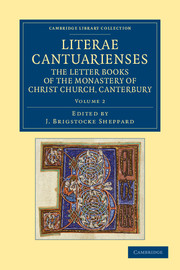
Christ Church, Canterbury, was the seat of the archbishop and an important pilgrimage site. The letters and other documents in its register reveal not only its history, but how complex was the management of the priory and its estates. This three-volume edition is based on a transcript of the register compiled in 1411. Volume 2, edited by Joseph Brigstocke Sheppard (1827–95) and published in 1888, contains items 495–943, ranging in date from 1333 to 1373. The editor has selected documents addressed to individuals or groups, and the subjects vary widely. Most relate to church affairs and include formal letters of appointment and disputes with other monasteries. Others are financial, dealing with rents, taxes and donations by important pilgrims. Also covered are matters of national importance (as the prior sat in parliament), such as the Hundred Years' War and the Black Death. The texts are in Latin, Norman French and English, with translations provided for the French documents.
The prosperous Cluniac priory of St John the Evangelist, Pontefract, was founded around 1090 by Robert de Lacy, remaining subject to its mother-house of La Charité-sur-Loire until the fourteenth century. The charters in this two-volume work have been arranged by type: seigniorial charters; episcopal and papal charters; royal charters; and those relating to priory property, arranged geographically according to proximity to Pontefract. The chartulary is particularly valuable for topographical studies and local and family history - in many cases the names of all witnesses have been transcribed. The manuscript was originally compiled in the first half of the thirteenth century, with additions made on blank leaves over the following centuries (not included by the editor). Volume 2, published in 1902, contains charters 234–556, on local property holdings and leases, and an index to the whole work. Each Latin charter is preceded by a brief English summary.
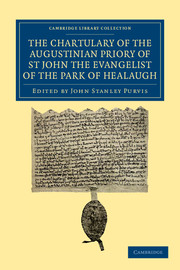
Healaugh Park began as a hermitage in the twelfth century before being re-established as an Augustinian priory in 1218. It remained a small and poor community, with seven canons in 1381 and six in 1535. The Chartulary was compiled in the early sixteenth century, so it covers a much longer period than is usual. It comprises 194 folios, beginning with a pedigree of the Haget family, patrons of the house, a list of priors, and documents relating to Healaugh's early history. There is no geographical or chronological logic to the arrangement of subsequent documents, nor any attempt to date them. The last twenty folios contain later material, mostly in English, which is interesting for the study of dialect and pronunciation at the time, and topographical information. Valuable to local historians, the Chartulary also shows how such small foundations struggled with financial and disciplinary matters. English summaries of the Latin documents are provided.
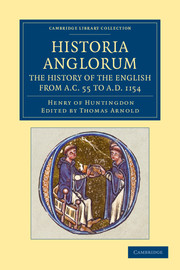
Henry of Huntingdon (c.1088–c.1157) wrote his comprehensive Latin chronicle of English history at the behest of the bishop of Lincoln, who asked him to provide a narrative from the earliest English kings right up to their own day. Henry's fondness for anecdotes - including the story of King Cnut attempting to hold back the tide - adds charm to his account. Although the work was originally completed by 1130, Henry continued to add to his magnum opus for many years, producing a version that concluded with the death of King Stephen and the accession of Henry II in 1154. This is the version edited for the Rolls Series in 1879 by Thomas Arnold (1823–1900), whose scholarly introduction describes the various different versions of the text, lists the extant manuscripts, and surveys Henry's sources. The text is accompanied by side-notes in English as well as appendices, a glossary and an index.