A collection of out-of-copyright and rare books from the Cambridge University Library and other world-class institutions that have been digitally scanned, made available online, and reprinted in paperback.
To save content items to your account,
please confirm that you agree to abide by our usage policies.
If this is the first time you use this feature, you will be asked to authorise Cambridge Core to connect with your account.
Find out more about saving content to .
To save content items to your Kindle, first ensure no-reply@cambridge.org
is added to your Approved Personal Document E-mail List under your Personal Document Settings
on the Manage Your Content and Devices page of your Amazon account. Then enter the ‘name’ part
of your Kindle email address below.
Find out more about saving to your Kindle.
Note you can select to save to either the @free.kindle.com or @kindle.com variations.
‘@free.kindle.com’ emails are free but can only be saved to your device when it is connected to wi-fi.
‘@kindle.com’ emails can be delivered even when you are not connected to wi-fi, but note that service fees apply.
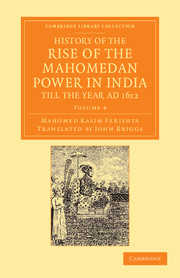
The Persian chronicler Ferishta (1560–1620) composed his great work, published in this four-volume English translation in 1829, at the court of Bijapur - where he spent most of his life - under the patronage of King Ibrahim Adil Shah II. It covers Muslim India from around 975 to 1612 and is notable for its balance, despite Ferishta's close involvement with some of the events and people he records. Valuable additions to the text made by the translator, East India Company officer John Briggs (1785–1875), include genealogical tables and notes, as well as a comparative chronology of events in Europe and India. Volume 4 covers the kings of Gujarat, Malwa, Khandesh, Bengal and Bihar, Jaunpur, and Multan. There are also histories of Sindh and Kashmir. A comparative chronology of the minor kingdoms that eventually became part of the Mughal empire is included, and Briggs' appendices provide glossaries of names and places.
A highly influential Czech historian and politician, František Palacký (1798–1876) became in 1825 the first editor of the journal of the Bohemian Museum, a key cultural institution in the development of Czech nationalism. He was actively involved in the nineteenth-century Czech national revival, helping also to found the Czech national theatre. Entering politics in 1848, he served as president of the Prague Slavic Congress, and later became a member of the Austrian senate as a supporter of greater Czech autonomy. In this extensive work, comprising ten separate parts - published in German between 1836 and 1867 - Palacký gives a detailed account of Bohemian history until 1526. It remains an important and ambitious feat of scholarship, still relevant to students of central European history. Volume 5 covers the era of the Jagiellonian dynasty; this first part (1865) deals with the era of Vladislaus II from 1471 to 1500.
Trained as a doctor, John Crawfurd (1783–1868) went on to have a distinguished career in colonial administration with the East India Company. He held senior posts in Java from 1811 to 1816, including that of resident at the court of Yogyakarta. A talented linguist and ethnologist, Crawfurd acquired a sound knowledge of ancient Kawi and contemporary Javanese. Upon his return to Britain in 1817, he became a fellow of the Royal Society and published this three-volume work on the Indonesian islands, principally Java, to great acclaim. Following further service abroad, he published accounts of his various missions in south-east Asia and an encyclopaedic sequel to the present work (all of which are reissued in the Cambridge Library Collection). Volume 1 examines the character and manners of the islanders as well as their arts, sciences, medicine, and agricultural techniques.
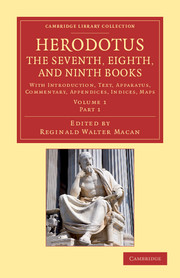
Fellow and Master of University College, Oxford, the classical scholar Reginald Walter Macan (1848–1941) published in 1908 this two-volume edition (in three parts) of the last books of Herodotus, which cover the Greco-Persian Wars during the period 486 to 479 BCE. Part 1 of Volume 1 contains an extensive introduction, addressing the characteristics of each book, followed by the text of Book 7 in Greek, with commentary and scholarly apparatus. Book 7 covers the Persian defeat at Marathon, the death of Darius, and the famous holding of the pass for three days by a Greek contingent at Thermopylae. Macan's edition, particularly valuable for its introduction, commentary maps, and extensive indexes, remains valuable to scholars of the history of textual criticism and the historiography of the classical world.
This extensive eight-volume work was first published between 1867 and 1877 by the linguist John Dowson (1820–81) from the manuscripts of the colonial administrator and scholar Sir Henry Miers Elliot (1808–53). Before his death, hoping to bolster British colonial ideology, Elliot had intended to evaluate scores of Arabic and Persian historians of India, believing that his translations would demonstrate the violence of the Muslim rulers and 'make our native subjects more sensible of the immense advantages accruing to them under the mildness and the equity of our rule'. Volume 8 addresses criticism of the previously published volumes, and includes additions and corrections to them. The volume also contains extracts of numerous additional histories covering the end of the Mughal Empire from Muhammad Shah (1702–1748) to the establishment of British political and military dominance in India in the mid-nineteenth century.
The Ssabians were a Middle Eastern community (or possibly two separate communities) mentioned in the Qur'an and early Islamic writings, and categorised variously as 'people of the book' or 'heathens'. They are documented almost exclusively in Arabic sources, and this rare 1856 book, published in German in St Petersburg, remains an invaluable reference work about them, and includes substantial extracts from the early sources. The book aroused the interest of the theosophists in the 1890s owing to its portrayal of a mysterious and secretive Syriac- or Aramaic-speaking pagan sect, accomplished in astronomy and medicine, that functioned as an intellectual intermediary between the Greek and Arabic worlds. Volume 2 introduces the main sources and presents selections from forty-five texts, with variant readings, German translations and detailed notes. They include a wide variety of genres, ranging from religion, philosophy, literature and autobiography to historical, geographical, legal and lexicographic works.
A lawyer by profession, Theodore Martin (1816–1909) gained literary distinction as both a humorous essayist and versatile translator. He found his greatest success, however, in the role of biographer to Prince Albert (1819–61). Commissioned by Queen Victoria to memorialise her late husband, this five-volume work was first published between 1875 and 1880. Intended as a continuation of the biography begun by Charles Grey (also reissued in this series), it has been described as 'less adulatory in tone than might be expected'. A treasury of letters and memoranda, it presents a detailed portrait of the character, words and deeds of a man whose life was necessarily immersed in the great events of his time. Volume 1 covers Albert's youth, his marriage to Victoria and the early years as her husband, up until the birth of their sixth child, Princess Louise, in 1848.
This two-volume work comprises a fourteenth-century cartulary containing charters and deeds that document the history of Selby Abbey from its foundation under William the Conqueror in 1069 until the mid-fifteenth century. The editor, J. T. Fowler (1834–1924), originally a surgeon, left medicine for the church. He studied at Durham University before becoming a deacon in the Durham diocese and holding posts in the university itself. The contents of the cartulary are divided across the two volumes, originally published between 1891 and 1893, and Fowler has aimed to reproduce the Latin text as closely as possible, noting any errors in occasional footnotes. Volume 1 includes the Historia Selebiensis monasterii, a history of Selby written in 1174 by an anonymous Selby monk. Fowler's version is reprinted from an imperfect 1657 edition by the Jesuit historian Philippe Labbe and does not attempt to correct the errors found in that version.
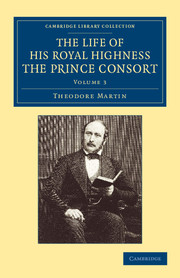
A lawyer by profession, Theodore Martin (1816–1909) gained literary distinction as both a humorous essayist and versatile translator. He found his greatest success, however, in the role of biographer to Prince Albert (1819–61). Commissioned by Queen Victoria to memorialise her late husband, this five-volume work was first published between 1875 and 1880. Intended as a continuation of the biography begun by Charles Grey (also reissued in this series), it has been described as 'less adulatory in tone than might be expected'. A treasury of letters and memoranda, it presents a detailed portrait of the character, words and deeds of a man whose life was necessarily immersed in the great events of his time. Volume 3 covers the period from 1854 to 1856 and deals extensively with the significant role played by Albert during the Crimean War.
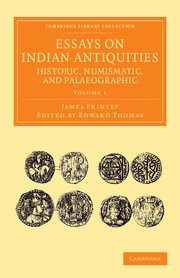
A key figure in the history of Benares (Varanasi), James Prinsep (1799–1840) was instrumental in expanding Western knowledge of Indian civilisation. After briefly studying under Pugin, he became an assay master in Calcutta in 1819, and soon moved to Benares. His talents were many, and within a few years he had completed a detailed map of the city, designed a new mint, engineered a system to improve sanitation and begun studying the inscriptions and coins that helped him to decipher two ancient scripts and to establish the dates of Indian dynasties. Collected in 1858 and edited by the numismatist Edward Thomas (1813–86), these essays are generously illustrated, often in Prinsep's hand, and display the enormous breadth of his knowledge. Volume 1 includes a short biography by his brother, along with articles on coins, relics and archaeological discoveries.
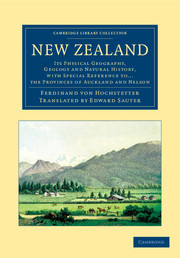
Inhabited by Polynesians since the thirteenth century and discovered by Europeans in the seventeenth, New Zealand is a geologically diverse island group where active volcanoes and frequent earthquakes have resulted in a rich variety of rock formations and geothermal activity. In 1859–60, the geologist Ferdinand von Hochstetter (1829–84) was employed by Auckland's government to undertake the first systematic geological survey of the islands, the results of which were first published in German in 1863 and translated into this English version in 1867. Hochstetter describes his travels across New Zealand, his encounters with native people and his scientific observations. He analyses plants, wildlife and fossils, describes mountains, rocks and boiling springs, and evaluates evidence of glaciers and tectonic activity. As a result of Hochstetter's work, several species in New Zealand were named after him. This book remains a valuable resource in the history of Australasian natural science.
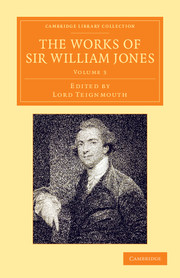
A renowned Enlightenment polymath, Sir William Jones (1746–94) was a lawyer, translator and poet who wrote authoritatively on politics, comparative linguistics and oriental literature. Known initially for his Persian translations and political radicalism, Jones became further celebrated for his study and translation of ancient Sanskrit texts following his appointment to the supreme court in Calcutta in 1783. He spent the next eleven years introducing Europe to the mysticism and rationality of Hinduism through works such as his nine 'Hymns' to Hindu deities and his translation of the Sanskrit classic Sacontalá, influencing Romantic writers from William Blake to August Wilhelm Schlegel. Volume 3 of his thirteen-volume works, published in 1807, contains Jones' 'Anniversary Discourses' (1784–94) addressed to the Asiatick Society as its president - including 'On the Hindus' (1786), a seminal work of comparative linguistics. It also contains his landmark essay of cultural comparison, 'On the Gods of Greece, Italy, and India' (1784).
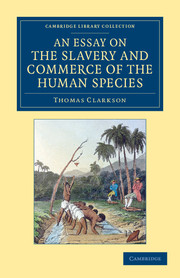
Particularly the African, Translated from a Latin Dissertation, Which Was Honoured with the First Prize in the University of Cambridge, for the Year 1785
This 1786 publication is a translation of a prizewinning Latin essay written by Thomas Clarkson (1760–1846) at Cambridge the previous year. Clarkson's deep research into the Atlantic slave trade instilled in him a sense of duty, inspiring him to devote his life to abolitionism. The publication of the essay introduced Clarkson to like-minded campaigners, notably William Wilberforce (1759–1833) and Granville Sharpe (1735–1813), with whom he helped to establish in 1787 the pioneering Society for Effecting the Abolition of the Slave Trade. Thoughts on the African Slave Trade (1788) by the sailor, slave trader and Anglican clergyman John Newton (1725–1807) is also reissued in this volume. Published thirty-four years after Newton's retirement from the slave trade, this pamphlet apologises for his 'too late' conversion to the abolitionist movement and describes the horrific conditions aboard slave ships during the Middle Passage.
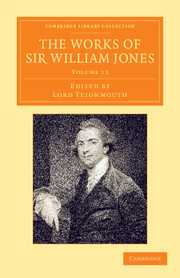
A renowned Enlightenment polymath, Sir William Jones (1746–94) was a lawyer, translator and poet who wrote authoritatively on politics, comparative linguistics and oriental literature. Known initially for his Persian translations and political radicalism, Jones became further celebrated for his study and translation of ancient Sanskrit texts following his appointment to the supreme court in Calcutta in 1783. He spent the next eleven years introducing Europe to the mysticism and rationality of Hinduism through works such as his translation of the Sanskrit classic Sacontalá. Volume 13 of his thirteen-volume works, published in 1807, contains Jones' most critical engagements with Hinduism, including his translations of the Sanskrit Hitópadésa (Aesop-like fables of Hindu mythology) and sacred religious texts such as the Iśa Upanishad. The volume also contains Jones' nine original 'Hymns' to Hindu deities, poems based on Hindu philosophy that influenced Romantics such as William Blake, Robert Southey and Percy Bysshe Shelley.
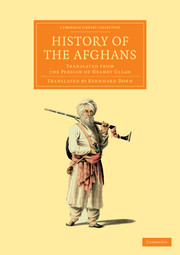
History of the Afghans was compiled by Nimat Allah (fl.1613–30) at the court of the Mughal emperor Jahangir (1569–1627). Drawing on various manuscript sources, it contains both mythical and historical accounts of the Afghan people. The wide coverage includes discussion of the Pashtun and their origins, the prophet Yakub (Jacob), King Talut (Saul) and the Afghan migration to Ghor, the late medieval sultans Bahlul, Sikandar and Ibrahim of the Lodi dynasty, and the lives of saints. The work also features the genealogy of Afghan tribes as well as reports of miracles. The German orientalist Bernhard Dorn (1805–81) published this English translation from the original Persian between 1829 and 1836. This reissue incorporates the separately published parts in one volume. Dorn's respected translation of this important text remains of interest to scholars of Asiatic history and tradition.
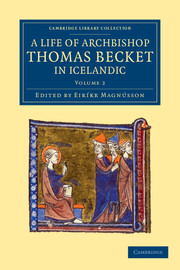
This Old Norse text and English translation, prepared by the librarian and scholar Eiríkr Magnússon (1833–1913) and published in two volumes between 1875 and 1883, remains the standard edition of the 'Saga of Archbishop Thomas'. Composed in Iceland in the early fourteenth century, it narrates the life, death and miracles of Thomas Becket, based on earlier Latin and Old French traditions. Embedded in the saga is a lost Latin life by Robert of Cricklade, written soon after Becket's murder in 1170, which contains some unique details: for example, that he had a stammer. The saga is valuable not only as evidence for Becket's life, but as an insight into the development of his saintly cult in Iceland. Volume 2 includes an extensive introduction to the text and its place in the tradition of Becket historiography, an account of St Thomas's miracles, several appendices of related texts, and an extensive glossary of words and phrases.
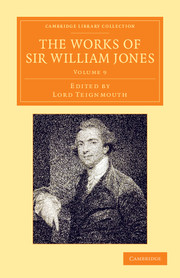
A renowned Enlightenment polymath, Sir William Jones (1746–94) was a lawyer, translator and poet who wrote authoritatively on politics, comparative linguistics and oriental literature. Known initially for his Persian translations and political radicalism, Jones became further celebrated for his study and translation of ancient Sanskrit texts following his appointment to the supreme court in Calcutta in 1783. He spent the next eleven years introducing Europe to the mysticism and rationality of Hinduism through works such as his nine 'Hymns' to Hindu deities and his translation of the Sanskrit classic Sacontalá. Volume 9 of his thirteen-volume works, published in 1807, contains Jones' translation of the Speeches of Isaeus (1779) and perhaps his most influential translation, Sacontalá (1789), a Hindu love fable that explores the depths of Hindu mythology and philosophy. Lauded throughout Europe, Sacontalá would inspire Goethe to write that once it is mentioned, 'everything is said'.
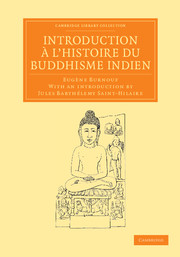
Eugène Burnouf (1801–52), an eminent French orientalist and scholar of Sanskrit, made groundbreaking contributions to the knowledge of Zoroastrianism and to the deciphering of the Zend and Pāli languages. He was a member of the Académie des Inscriptions et Belles-Lettres, and of numerous Asiatic societies throughout Europe. When he first published this monumental work of scholarship in 1844, Burnouf established European Buddhist studies on solid foundations. In it, he presents the Indian historical context in which Buddhism developed, as well as its connections and debates with Brahmanism. He also sheds light on the role of the caste system in this religion. To this day, Burnouf's pioneering vision continues to shape our understanding of Buddhism. This second edition was published posthumously in 1876, with an introduction by the French philosopher and journalist Jules Barthélemy Saint-Hilaire (1805–95). It remains of relevance to students of religion, oriental studies and Indian history.