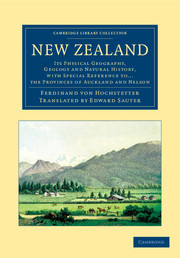

Inhabited by Polynesians since the thirteenth century and discovered by Europeans in the seventeenth, New Zealand is a geologically diverse island group where active volcanoes and frequent earthquakes have resulted in a rich variety of rock formations and geothermal activity. In 1859–60, the geologist Ferdinand von Hochstetter (1829–84) was employed by Auckland's government to undertake the first systematic geological survey of the islands, the results of which were first published in German in 1863 and translated into this English version in 1867. Hochstetter describes his travels across New Zealand, his encounters with native people and his scientific observations. He analyses plants, wildlife and fossils, describes mountains, rocks and boiling springs, and evaluates evidence of glaciers and tectonic activity. As a result of Hochstetter's work, several species in New Zealand were named after him. This book remains a valuable resource in the history of Australasian natural science.
Loading metrics...
* Views captured on Cambridge Core between #date#. This data will be updated every 24 hours.
Usage data cannot currently be displayed.
This section outlines the accessibility features of this content - including support for screen readers, full keyboard navigation and high-contrast display options. This may not be relevant for you.
Accessibility compliance for the PDF of this book is currently unknown and may be updated in the future.
