Refine search
Actions for selected content:
26204 results in Theoretical Physics and Mathematical Physics
Electronic states at the surfaces of crystals: III. The approximation of tight binding: further extensions
-
- Journal:
- Mathematical Proceedings of the Cambridge Philosophical Society / Volume 35 / Issue 2 / April 1939
- Published online by Cambridge University Press:
- 24 October 2008, pp. 232-241
- Print publication:
- April 1939
-
- Article
- Export citation
PSP volume 35 issue 2 Cover and Back matter
-
- Journal:
- Mathematical Proceedings of the Cambridge Philosophical Society / Volume 35 / Issue 2 / April 1939
- Published online by Cambridge University Press:
- 24 October 2008, pp. b1-b2
- Print publication:
- April 1939
-
- Article
-
- You have access
- Export citation
A note on tests of significance in multivariate analysis
-
- Journal:
- Mathematical Proceedings of the Cambridge Philosophical Society / Volume 35 / Issue 2 / April 1939
- Published online by Cambridge University Press:
- 24 October 2008, pp. 180-185
- Print publication:
- April 1939
-
- Article
- Export citation
PSP volume 35 issue 1 Cover and Back matter
-
- Journal:
- Mathematical Proceedings of the Cambridge Philosophical Society / Volume 35 / Issue 1 / January 1939
- Published online by Cambridge University Press:
- 24 October 2008, pp. b1-b2
- Print publication:
- January 1939
-
- Article
-
- You have access
- Export citation
Note on a paper by J. A. Todd
-
- Journal:
- Mathematical Proceedings of the Cambridge Philosophical Society / Volume 35 / Issue 1 / January 1939
- Published online by Cambridge University Press:
- 24 October 2008, pp. 125-126
- Print publication:
- January 1939
-
- Article
- Export citation
On the representation of Eddington's E-numbers by matrices
-
- Journal:
- Mathematical Proceedings of the Cambridge Philosophical Society / Volume 35 / Issue 1 / January 1939
- Published online by Cambridge University Press:
- 24 October 2008, pp. 123-125
- Print publication:
- January 1939
-
- Article
- Export citation
On subordinate functions
-
- Journal:
- Mathematical Proceedings of the Cambridge Philosophical Society / Volume 35 / Issue 1 / January 1939
- Published online by Cambridge University Press:
- 24 October 2008, pp. 1-26
- Print publication:
- January 1939
-
- Article
- Export citation
Note on the slow motion of fluid
-
- Journal:
- Mathematical Proceedings of the Cambridge Philosophical Society / Volume 35 / Issue 1 / January 1939
- Published online by Cambridge University Press:
- 24 October 2008, pp. 27-43
- Print publication:
- January 1939
-
- Article
- Export citation
The rates of unimolecular reactions in gases
-
- Journal:
- Mathematical Proceedings of the Cambridge Philosophical Society / Volume 35 / Issue 1 / January 1939
- Published online by Cambridge University Press:
- 24 October 2008, pp. 56-69
- Print publication:
- January 1939
-
- Article
- Export citation
-
The molecule of a dissociating gas is treated as a dynamical system with n normal modes of vibration with incommensurable frequencies. The assumption that the molecule dissociates when one coordinate attains a critical high value leads to a unimolecular velocity constant expressed as an integral; analytical expressions are derived for bounds to its value. Calculations in a simple case indicate that the velocity constant is approximately of the form

This is in general agreement with experiment if the constant W is identified with the corresponding empirical energy constant.
A note on a simple molecular mechanism for heterogeneous catalytic reactions
-
- Journal:
- Mathematical Proceedings of the Cambridge Philosophical Society / Volume 35 / Issue 1 / January 1939
- Published online by Cambridge University Press:
- 24 October 2008, pp. 130-132
- Print publication:
- January 1939
-
- Article
- Export citation
The emission and absorption of heavy electrons
-
- Journal:
- Mathematical Proceedings of the Cambridge Philosophical Society / Volume 35 / Issue 1 / January 1939
- Published online by Cambridge University Press:
- 24 October 2008, pp. 84-94
- Print publication:
- January 1939
-
- Article
- Export citation
Superlattice formation of the type AB in an adsorbed layer
-
- Journal:
- Mathematical Proceedings of the Cambridge Philosophical Society / Volume 35 / Issue 1 / January 1939
- Published online by Cambridge University Press:
- 24 October 2008, pp. 70-83
- Print publication:
- January 1939
-
- Article
- Export citation
PSP volume 35 issue 1 Cover and Front matter
-
- Journal:
- Mathematical Proceedings of the Cambridge Philosophical Society / Volume 35 / Issue 1 / January 1939
- Published online by Cambridge University Press:
- 24 October 2008, pp. f1-f2
- Print publication:
- January 1939
-
- Article
-
- You have access
- Export citation
Current effects in cylindrical superconductors
-
- Journal:
- Mathematical Proceedings of the Cambridge Philosophical Society / Volume 35 / Issue 1 / January 1939
- Published online by Cambridge University Press:
- 24 October 2008, pp. 95-107
- Print publication:
- January 1939
-
- Article
- Export citation
-
Experiments are described which show the effect of current on the transition of cylindrical superconductors to the normal state produced by increasing an external magnetic field. The transition curves were determined with an accuracy of 0·1%. Both longitudinal and transverse fields were used.
The following results were found.
(a) Transverse field
(i) The field strength at which the first traces of resistance appeared was independent of current strength for reasonably small currents (up to about 100 mA. for 0·010 cm. wire).
(ii) With increase of current the transition curve at first changed shape, becoming more and more nearly linear, and then was displaced parallel to itself toward smaller values of the applied field by an amount in accordance with Silsbee's hypothesis.
(iii) The change in shape of the transition curve was accurately reproducible and was identical for specimens of the same material and diameter.
(iv) The results for specimens of different diameter could be accurately correlated if the measured values of the resistance were plotted against the current divided by the specimen diameter raised to the power (l + R/Rn), i.e. I/(diam.)(1+R/Rn), where R/Rn is the ratio of the measured resistance to the resistance just above the transition point.
(b) Longitudinal field
(i) With increase of current, however slight, the transition curve was displaced parallel to itself, toward smaller values of the applied field, without showing any change in shape.
(ii) The displacement of critical field for a given change of current was completely independent of the diameter of the specimen.
(iii) The observed shift to smaller fields was much greater than could be accounted for by the additional field produced by the current at the surface of the wire.
(iv) If we denote the (extrapolated) value of the critical field for zero current by (Hc) and the difference between this and the observed value for a current (I) by (ΔHc) then I and Hc are connected by the empirical relation
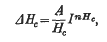
where A and n are constants depending on the nature of the superconducting metal.

when Hc is expressed in gauss and I in milliamperes.
Notes on the two-centre problem in wave mechanics. I. The hyperbolic nodes of the wave equation
-
- Journal:
- Mathematical Proceedings of the Cambridge Philosophical Society / Volume 35 / Issue 1 / January 1939
- Published online by Cambridge University Press:
- 24 October 2008, pp. 44-55
- Print publication:
- January 1939
-
- Article
- Export citation
The fluctuation theorem. (Shot effect)
-
- Journal:
- Mathematical Proceedings of the Cambridge Philosophical Society / Volume 35 / Issue 1 / January 1939
- Published online by Cambridge University Press:
- 24 October 2008, pp. 127-129
- Print publication:
- January 1939
-
- Article
- Export citation
The fine structure of the X-ray absorption edges of aluminium and zinc
-
- Journal:
- Mathematical Proceedings of the Cambridge Philosophical Society / Volume 35 / Issue 1 / January 1939
- Published online by Cambridge University Press:
- 24 October 2008, pp. 108-113
- Print publication:
- January 1939
-
- Article
- Export citation
Momentum transfer and heat flow in liquid helium II
-
- Journal:
- Mathematical Proceedings of the Cambridge Philosophical Society / Volume 35 / Issue 1 / January 1939
- Published online by Cambridge University Press:
- 24 October 2008, pp. 114-122
- Print publication:
- January 1939
-
- Article
- Export citation
Uniqueness theorems and the maximum-minimum principle for a type of non-linear partial differential equations
-
- Journal:
- Mathematical Proceedings of the Cambridge Philosophical Society / Volume 34 / Issue 4 / October 1938
- Published online by Cambridge University Press:
- 24 October 2008, pp. 527-533
- Print publication:
- October 1938
-
- Article
- Export citation
-
It is well known that solutions of partial linear differential equations of the second order and of elliptic type are uniquely determined by their boundary data, and that they assume their maximum and minimum values on the boundary. The usual proofs make use of the principle of superposition and are therefore not applicable to non-linear problems. But recently Pryce has proved the uniqueness theorem for the non-linear equations of minimal surfaces and of Born's electrostatics. These equations are the Euler equations of the variational problem
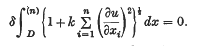
k = + 1 corresponds to the case of minimal surfaces in n + 1 dimensions; k = − b−2, n = 3 corresponds to Born's electrostatics. Pryce's procedure depends essentially on the notion of conjugate variables in the calculus of variations for multiple integrals and can therefore be extended to a wide class of differential equations arising from variational problems (for several functions of several variables) as we show in § 3.
The penetrating power of cosmic-ray shower particles
-
- Journal:
- Mathematical Proceedings of the Cambridge Philosophical Society / Volume 34 / Issue 4 / October 1938
- Published online by Cambridge University Press:
- 24 October 2008, pp. 614-619
- Print publication:
- October 1938
-
- Article
- Export citation
