Refine search
Actions for selected content:
26204 results in Theoretical Physics and Mathematical Physics
Contributions to the theory of Ramanujan's function τ(n) and similar arithmetical functions: I. The zeros of the function
on the line
-
- Journal:
- Mathematical Proceedings of the Cambridge Philosophical Society / Volume 35 / Issue 3 / July 1939
- Published online by Cambridge University Press:
- 24 October 2008, pp. 351-356
- Print publication:
- July 1939
-
- Article
- Export citation
-
In this and the succeeding paper I solve two problems suggested by Prof. Hardy, namely (1) that of proving that Ramanujan's function

has no zeros on the line
 and (2) that of finding an asymptotic formula
where A is a constant. I also prove similar results concerning the coefficients of general modular forms. I am indebted to Prof. Hardy and Mr Ingham for various suggestions, and in particular to Mr Ingham's paper, “A note on Riemann's ζ-function and Dirichlet's L-functions”.

 and (2) that of finding an asymptotic formula
Elastic collisions of mesons with electrons and protons
-
- Journal:
- Mathematical Proceedings of the Cambridge Philosophical Society / Volume 35 / Issue 3 / July 1939
- Published online by Cambridge University Press:
- 24 October 2008, pp. 463-473
- Print publication:
- July 1939
-
- Article
- Export citation
Quantum electrodynamics. I
-
- Journal:
- Mathematical Proceedings of the Cambridge Philosophical Society / Volume 35 / Issue 3 / July 1939
- Published online by Cambridge University Press:
- 24 October 2008, pp. 419-437
- Print publication:
- July 1939
-
- Article
- Export citation
On circles determined by five lines in a plane
-
- Journal:
- Mathematical Proceedings of the Cambridge Philosophical Society / Volume 35 / Issue 3 / July 1939
- Published online by Cambridge University Press:
- 24 October 2008, pp. 518-519
- Print publication:
- July 1939
-
- Article
- Export citation
Note on the sensitive time of a Wilson expansion chamber
-
- Journal:
- Mathematical Proceedings of the Cambridge Philosophical Society / Volume 35 / Issue 3 / July 1939
- Published online by Cambridge University Press:
- 24 October 2008, pp. 512-515
- Print publication:
- July 1939
-
- Article
- Export citation
Contributions to the theory of Ramanujan's function τ(n) and similar arithmetical functions: II. The order of the Fourier coefficients of integral modular forms
-
- Journal:
- Mathematical Proceedings of the Cambridge Philosophical Society / Volume 35 / Issue 3 / July 1939
- Published online by Cambridge University Press:
- 24 October 2008, pp. 357-372
- Print publication:
- July 1939
-
- Article
- Export citation
-
Suppose that

is an integral modular form of dimensions −κ, where κ > 0, and Stufe N, which vanishes at all the rational cusps of the fundamental region, and which is absolutely convergent for
 Then
Then
where a, b, c, d are integers such that ad − bc = 1.
 Then
Then
A remark on a theorem of severi
-
- Journal:
- Mathematical Proceedings of the Cambridge Philosophical Society / Volume 35 / Issue 3 / July 1939
- Published online by Cambridge University Press:
- 24 October 2008, pp. 516-517
- Print publication:
- July 1939
-
- Article
- Export citation
A note on functions regular and bounded in the unit circle and small at a set of points near the circumference of the circle
-
- Journal:
- Mathematical Proceedings of the Cambridge Philosophical Society / Volume 35 / Issue 3 / July 1939
- Published online by Cambridge University Press:
- 24 October 2008, pp. 382-388
- Print publication:
- July 1939
-
- Article
- Export citation
-
The following theorem was proved by Milloux:
Theorem A. Suppose that f (z) is regular and that | f(z) | < 1 in the unit circle. Suppose also that the set of points in the circle | z | ≤ r′ < 1 at which

cannot be enclosed in circles, the sum of whose radii is equal to 2eh−1. Then
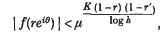
where K is a numerical constant.

The half-value period of

-
- Journal:
- Mathematical Proceedings of the Cambridge Philosophical Society / Volume 35 / Issue 3 / July 1939
- Published online by Cambridge University Press:
- 24 October 2008, pp. 523-525
- Print publication:
- July 1939
-
- Article
- Export citation

PSP volume 35 issue 3 Cover and Front matter
-
- Journal:
- Mathematical Proceedings of the Cambridge Philosophical Society / Volume 35 / Issue 3 / July 1939
- Published online by Cambridge University Press:
- 24 October 2008, pp. f1-f2
- Print publication:
- July 1939
-
- Article
-
- You have access
- Export citation
PSP volume 35 issue 3 Cover and Back matter
-
- Journal:
- Mathematical Proceedings of the Cambridge Philosophical Society / Volume 35 / Issue 3 / July 1939
- Published online by Cambridge University Press:
- 24 October 2008, pp. b1-b2
- Print publication:
- July 1939
-
- Article
-
- You have access
- Export citation
An automatic curve follower for use with the differential analyser
-
- Journal:
- Mathematical Proceedings of the Cambridge Philosophical Society / Volume 35 / Issue 3 / July 1939
- Published online by Cambridge University Press:
- 24 October 2008, pp. 494-505
- Print publication:
- July 1939
-
- Article
- Export citation
A new notation for quantum mechanics
-
- Journal:
- Mathematical Proceedings of the Cambridge Philosophical Society / Volume 35 / Issue 3 / July 1939
- Published online by Cambridge University Press:
- 24 October 2008, pp. 416-418
- Print publication:
- July 1939
-
- Article
- Export citation
On the derivation of discontinuous functions
-
- Journal:
- Mathematical Proceedings of the Cambridge Philosophical Society / Volume 35 / Issue 3 / July 1939
- Published online by Cambridge University Press:
- 24 October 2008, pp. 373-381
- Print publication:
- July 1939
-
- Article
- Export citation
The minimum χ′2 approximation
-
- Journal:
- Mathematical Proceedings of the Cambridge Philosophical Society / Volume 35 / Issue 3 / July 1939
- Published online by Cambridge University Press:
- 24 October 2008, p. 520
- Print publication:
- July 1939
-
- Article
- Export citation
Zur Summabilitätstheorie der Fourierschen Doppelreihe
-
- Journal:
- Mathematical Proceedings of the Cambridge Philosophical Society / Volume 35 / Issue 3 / July 1939
- Published online by Cambridge University Press:
- 24 October 2008, pp. 343-350
- Print publication:
- July 1939
-
- Article
- Export citation
-
Es sei f(ξ) eine L-integrierbare und nach 2π periodische Funktion der reellen Variabeln ξ und es sei {sn} die Folge der Partialsummen ihrer Fourierschen Reihe an einer Stelle ξ = x, wo die Funktion stetig ist. Dann ist nach einem klassischen Satze von Fejér

und nach Hardy und Littlewood

Vor kurzem hat L. Fejér gefunden, dass der Hardy-Littlewoodsche Satz (2) Spezialfall eines “gewöhnlichen” Summabilitätssatzes wie (1) ist, der sich aber auf die Fouriersche Reihe einer Funktion zweier Variabeln bezieht. Dieser Satz ist der folgende.
Quantum electrodynamics. II
-
- Journal:
- Mathematical Proceedings of the Cambridge Philosophical Society / Volume 35 / Issue 3 / July 1939
- Published online by Cambridge University Press:
- 24 October 2008, pp. 438-462
- Print publication:
- July 1939
-
- Article
- Export citation
A problem in conduction of heat
-
- Journal:
- Mathematical Proceedings of the Cambridge Philosophical Society / Volume 35 / Issue 3 / July 1939
- Published online by Cambridge University Press:
- 24 October 2008, pp. 394-404
- Print publication:
- July 1939
-
- Article
- Export citation
The effect of interstellar matter on climatic variation
-
- Journal:
- Mathematical Proceedings of the Cambridge Philosophical Society / Volume 35 / Issue 3 / July 1939
- Published online by Cambridge University Press:
- 24 October 2008, pp. 405-415
- Print publication:
- July 1939
-
- Article
- Export citation
Note on the calculation of the Peltier effect
-
- Journal:
- Mathematical Proceedings of the Cambridge Philosophical Society / Volume 35 / Issue 3 / July 1939
- Published online by Cambridge University Press:
- 24 October 2008, pp. 521-522
- Print publication:
- July 1939
-
- Article
- Export citation
