Refine search
Actions for selected content:
26204 results in Theoretical Physics and Mathematical Physics
Introduction to the theory of operators: V. Metric Rings
-
- Journal:
- Mathematical Proceedings of the Cambridge Philosophical Society / Volume 36 / Issue 2 / April 1940
- Published online by Cambridge University Press:
- 24 October 2008, pp. 139-149
- Print publication:
- April 1940
-
- Article
- Export citation
A proof of a generalization of gaskin's theorem
-
- Journal:
- Mathematical Proceedings of the Cambridge Philosophical Society / Volume 36 / Issue 2 / April 1940
- Published online by Cambridge University Press:
- 24 October 2008, pp. 244-245
- Print publication:
- April 1940
-
- Article
- Export citation
The adsorption of dipoles
-
- Journal:
- Mathematical Proceedings of the Cambridge Philosophical Society / Volume 36 / Issue 2 / April 1940
- Published online by Cambridge University Press:
- 24 October 2008, pp. 242-243
- Print publication:
- April 1940
-
- Article
-
- You have access
- Export citation
The invariant theory of isotropic turbulence
-
- Journal:
- Mathematical Proceedings of the Cambridge Philosophical Society / Volume 36 / Issue 2 / April 1940
- Published online by Cambridge University Press:
- 24 October 2008, pp. 209-223
- Print publication:
- April 1940
-
- Article
- Export citation
On the stability of crystal lattices. II
-
- Journal:
- Mathematical Proceedings of the Cambridge Philosophical Society / Volume 36 / Issue 2 / April 1940
- Published online by Cambridge University Press:
- 24 October 2008, pp. 173-182
- Print publication:
- April 1940
-
- Article
- Export citation
An application of the method of coincidence counting in a β-particle spectrograph of novel design
-
- Journal:
- Mathematical Proceedings of the Cambridge Philosophical Society / Volume 36 / Issue 2 / April 1940
- Published online by Cambridge University Press:
- 24 October 2008, pp. 224-235
- Print publication:
- April 1940
-
- Article
- Export citation
The postulation of a multiple variety
-
- Journal:
- Mathematical Proceedings of the Cambridge Philosophical Society / Volume 36 / Issue 1 / January 1940
- Published online by Cambridge University Press:
- 24 October 2008, pp. 27-33
- Print publication:
- January 1940
-
- Article
- Export citation
The azimuthal dependence of processes involving mesons
-
- Journal:
- Mathematical Proceedings of the Cambridge Philosophical Society / Volume 36 / Issue 1 / January 1940
- Published online by Cambridge University Press:
- 24 October 2008, pp. 34-42
- Print publication:
- January 1940
-
- Article
- Export citation
An attempt to measure the velocity of propagation of heat in liquid he II
-
- Journal:
- Mathematical Proceedings of the Cambridge Philosophical Society / Volume 36 / Issue 1 / January 1940
- Published online by Cambridge University Press:
- 24 October 2008, pp. 127-130
- Print publication:
- January 1940
-
- Article
- Export citation
The theory of the structure and formation of a certain type of immobile adsorbed film with an application to the adsorption of oxygen on tungsten
-
- Journal:
- Mathematical Proceedings of the Cambridge Philosophical Society / Volume 36 / Issue 1 / January 1940
- Published online by Cambridge University Press:
- 24 October 2008, pp. 53-68
- Print publication:
- January 1940
-
- Article
- Export citation
Considerations of the effect of space-charge in the magnetron
-
- Journal:
- Mathematical Proceedings of the Cambridge Philosophical Society / Volume 36 / Issue 1 / January 1940
- Published online by Cambridge University Press:
- 24 October 2008, pp. 94-100
- Print publication:
- January 1940
-
- Article
- Export citation
-
When a diode thermionic tube, having cylindrical symmetry, is placed in a magnetic field parallel to its axis it is commonly called a magnetron. If there is a given potential difference between the anode and cathode of the tube, and if the magnetic field is steadily increased, a sharp and pronounced decrease of anode current occurs when the field reaches a certain value. It is easy to show that, if electrons leave without velocity from a cathode of radius b, they will just graze a concentric anode of radius a at potential V when the magnetic field H has the value given by

The orders of products and commutators in prime-power groups
-
- Journal:
- Mathematical Proceedings of the Cambridge Philosophical Society / Volume 36 / Issue 1 / January 1940
- Published online by Cambridge University Press:
- 24 October 2008, pp. 14-26
- Print publication:
- January 1940
-
- Article
- Export citation
PSP volume 36 issue 1 Cover and Back matter
-
- Journal:
- Mathematical Proceedings of the Cambridge Philosophical Society / Volume 36 / Issue 1 / January 1940
- Published online by Cambridge University Press:
- 24 October 2008, p. b1
- Print publication:
- January 1940
-
- Article
-
- You have access
- Export citation
PSP volume 36 issue 1 Cover and Front matter
-
- Journal:
- Mathematical Proceedings of the Cambridge Philosophical Society / Volume 36 / Issue 1 / January 1940
- Published online by Cambridge University Press:
- 24 October 2008, p. f1
- Print publication:
- January 1940
-
- Article
-
- You have access
- Export citation
Properties of some superconductors
-
- Journal:
- Mathematical Proceedings of the Cambridge Philosophical Society / Volume 36 / Issue 1 / January 1940
- Published online by Cambridge University Press:
- 24 October 2008, pp. 84-93
- Print publication:
- January 1940
-
- Article
- Export citation
Notes on special systems of orthogonal Functions (III): A System of orthogonal polynomials†
-
- Journal:
- Mathematical Proceedings of the Cambridge Philosophical Society / Volume 36 / Issue 1 / January 1940
- Published online by Cambridge University Press:
- 24 October 2008, pp. 1-8
- Print publication:
- January 1940
-
- Article
- Export citation
-
Generalities. Suppose that

is real and L2(0, ∞), that

is its Mellin transform, and that
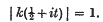
Then K(1)(x) generates a “Watson transformation”, with a “Fourier theorem”

valid for every F(x) of L2(0, ∞).

The adsorption of dipoles
-
- Journal:
- Mathematical Proceedings of the Cambridge Philosophical Society / Volume 36 / Issue 1 / January 1940
- Published online by Cambridge University Press:
- 24 October 2008, pp. 69-78
- Print publication:
- January 1940
-
- Article
- Export citation
The inner shell ionization of atoms by electron impact
-
- Journal:
- Mathematical Proceedings of the Cambridge Philosophical Society / Volume 36 / Issue 1 / January 1940
- Published online by Cambridge University Press:
- 24 October 2008, pp. 43-52
- Print publication:
- January 1940
-
- Article
- Export citation
Paramagnetic hysteresis
-
- Journal:
- Mathematical Proceedings of the Cambridge Philosophical Society / Volume 36 / Issue 1 / January 1940
- Published online by Cambridge University Press:
- 24 October 2008, pp. 79-83
- Print publication:
- January 1940
-
- Article
- Export citation
The interpretation of ionization measurements in gases at high pressures
-
- Journal:
- Mathematical Proceedings of the Cambridge Philosophical Society / Volume 36 / Issue 1 / January 1940
- Published online by Cambridge University Press:
- 24 October 2008, pp. 101-126
- Print publication:
- January 1940
-
- Article
- Export citation
