Refine search
Actions for selected content:
26204 results in Theoretical Physics and Mathematical Physics
PSP volume 36 issue 3 Cover and Back matter
-
- Journal:
- Mathematical Proceedings of the Cambridge Philosophical Society / Volume 36 / Issue 3 / July 1940
- Published online by Cambridge University Press:
- 24 October 2008, p. b1
- Print publication:
- July 1940
-
- Article
-
- You have access
- Export citation
The influence of magnetization on the benedicks homogeneous thermoelectric effect
-
- Journal:
- Mathematical Proceedings of the Cambridge Philosophical Society / Volume 36 / Issue 3 / July 1940
- Published online by Cambridge University Press:
- 24 October 2008, pp. 381-386
- Print publication:
- July 1940
-
- Article
- Export citation
A class of fundamental [n−1] Scrolls
-
- Journal:
- Mathematical Proceedings of the Cambridge Philosophical Society / Volume 36 / Issue 3 / July 1940
- Published online by Cambridge University Press:
- 24 October 2008, pp. 288-299
- Print publication:
- July 1940
-
- Article
- Export citation
Note on Dr Atkinson's paper
-
- Journal:
- Mathematical Proceedings of the Cambridge Philosophical Society / Volume 36 / Issue 3 / July 1940
- Published online by Cambridge University Press:
- 24 October 2008, pp. 323-324
- Print publication:
- July 1940
-
- Article
- Export citation
The calculations of processes involving mesons by matrix methods
-
- Journal:
- Mathematical Proceedings of the Cambridge Philosophical Society / Volume 36 / Issue 3 / July 1940
- Published online by Cambridge University Press:
- 24 October 2008, pp. 363-380
- Print publication:
- July 1940
-
- Article
- Export citation
Note on the slow motion of fluid
-
- Journal:
- Mathematical Proceedings of the Cambridge Philosophical Society / Volume 36 / Issue 3 / July 1940
- Published online by Cambridge University Press:
- 24 October 2008, pp. 300-313
- Print publication:
- July 1940
-
- Article
- Export citation
Note on the method of molecular orbitals
-
- Journal:
- Mathematical Proceedings of the Cambridge Philosophical Society / Volume 36 / Issue 2 / April 1940
- Published online by Cambridge University Press:
- 24 October 2008, pp. 193-200
- Print publication:
- April 1940
-
- Article
- Export citation
On the stability of crystal lattices. I
-
- Journal:
- Mathematical Proceedings of the Cambridge Philosophical Society / Volume 36 / Issue 2 / April 1940
- Published online by Cambridge University Press:
- 24 October 2008, pp. 160-172
- Print publication:
- April 1940
-
- Article
- Export citation
The radioactivity of the fluorine isotope of mass twenty
-
- Journal:
- Mathematical Proceedings of the Cambridge Philosophical Society / Volume 36 / Issue 2 / April 1940
- Published online by Cambridge University Press:
- 24 October 2008, pp. 252-254
- Print publication:
- April 1940
-
- Article
- Export citation
On two classical lattice point problems
-
- Journal:
- Mathematical Proceedings of the Cambridge Philosophical Society / Volume 36 / Issue 2 / April 1940
- Published online by Cambridge University Press:
- 24 October 2008, pp. 131-138
- Print publication:
- April 1940
-
- Article
- Export citation
-
1. Let r(n) be the number of representations of n as a sum of two squares, d(n) the number of divisors of n, and


where γ is Euler's constant. Thus P(x) is the error term in the problem of the lattice points of a circle, and Δ(x) the error term in Dirichlet's divisor problem, or the problem of the lattice points of a rectangular hyperbola.
PSP volume 36 issue 2 Cover and Back matter
-
- Journal:
- Mathematical Proceedings of the Cambridge Philosophical Society / Volume 36 / Issue 2 / April 1940
- Published online by Cambridge University Press:
- 24 October 2008, p. b1
- Print publication:
- April 1940
-
- Article
-
- You have access
- Export citation
The thermodynamic derivation of langmuir's isotherm
-
- Journal:
- Mathematical Proceedings of the Cambridge Philosophical Society / Volume 36 / Issue 2 / April 1940
- Published online by Cambridge University Press:
- 24 October 2008, pp. 248-251
- Print publication:
- April 1940
-
- Article
- Export citation
Hydrodynamical images
-
- Journal:
- Mathematical Proceedings of the Cambridge Philosophical Society / Volume 36 / Issue 2 / April 1940
- Published online by Cambridge University Press:
- 24 October 2008, pp. 246-247
- Print publication:
- April 1940
-
- Article
- Export citation
A method of solving second order simultaneous linear differential equations using the mallock machine
-
- Journal:
- Mathematical Proceedings of the Cambridge Philosophical Society / Volume 36 / Issue 2 / April 1940
- Published online by Cambridge University Press:
- 24 October 2008, pp. 204-208
- Print publication:
- April 1940
-
- Article
- Export citation
On sets of fractional dimensions
-
- Journal:
- Mathematical Proceedings of the Cambridge Philosophical Society / Volume 36 / Issue 2 / April 1940
- Published online by Cambridge University Press:
- 24 October 2008, pp. 152-159
- Print publication:
- April 1940
-
- Article
- Export citation
-
1. Any number x can be expressed uniquely in the form
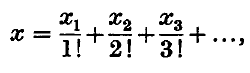
where the xr's are positive integers and where xr < r. In the present paper we consider the set of numbers Eb for which the xr's are bounded, so that 0 ≤ xr < b say, where b also is an integer. We prove that this set has dimension function
h(t) = b−u,
where t = euu−u−½(b − 1)(2π)−½, in the sense of Hausdorff.
The average number of electrons accompanying a cosmic-ray meson due to collisions of the meson with atomic electrons
-
- Journal:
- Mathematical Proceedings of the Cambridge Philosophical Society / Volume 36 / Issue 2 / April 1940
- Published online by Cambridge University Press:
- 24 October 2008, pp. 183-192
- Print publication:
- April 1940
-
- Article
- Export citation
PSP volume 36 issue 2 Cover and Front matter
-
- Journal:
- Mathematical Proceedings of the Cambridge Philosophical Society / Volume 36 / Issue 2 / April 1940
- Published online by Cambridge University Press:
- 24 October 2008, p. f1
- Print publication:
- April 1940
-
- Article
-
- You have access
- Export citation
On the calculation of the energy in unsaturated hydrocarbon molecules
-
- Journal:
- Mathematical Proceedings of the Cambridge Philosophical Society / Volume 36 / Issue 2 / April 1940
- Published online by Cambridge University Press:
- 24 October 2008, pp. 201-203
- Print publication:
- April 1940
-
- Article
- Export citation
-
It frequently happens that we wish to evaluate the total energy of the mobile, or π, electrons in an unsaturated hydrocarbon molecule. According to the method of molecular orbitals(1) this energy is the sum of individual electronic energies ∊r, and the summation is over all the occupied orbitals. The energies ∊r are the roots of the secular determinant, and, if we write

and suppose that there are n unsaturated carbon atoms, then the equation that gives the energies zr is

Contributions to the theory of Ramanujan's function τ(n) and similar arithmetical functions: iii. a note on the sum function of the fourier coefficients of integral modular forms
-
- Journal:
- Mathematical Proceedings of the Cambridge Philosophical Society / Volume 36 / Issue 2 / April 1940
- Published online by Cambridge University Press:
- 24 October 2008, pp. 150-151
- Print publication:
- April 1940
-
- Article
- Export citation
-
Suppose that
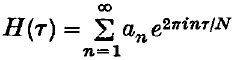 is an integral modular form of dimensions − κ, where κ > 0, and Stufe N, which vanishes at all the rational cusps of the fundamental region, and which is absolutely convergent for
 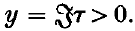 The purpose of this note is to prove that
The notation employed is that of my second paper under the same general title* I refer to this paper as II.
 is an integral modular form of dimensions − κ, where κ > 0, and
  The purpose of this note is to prove that
The scattering of X-radiation by liquid helium II
-
- Journal:
- Mathematical Proceedings of the Cambridge Philosophical Society / Volume 36 / Issue 2 / April 1940
- Published online by Cambridge University Press:
- 24 October 2008, pp. 236-241
- Print publication:
- April 1940
-
- Article
- Export citation
