Refine search
Actions for selected content:
237306 results in Physics and Astronomy

The International Atlas of Mars Exploration
- Curiosity, InSight and Perseverance
-
- Published online:
- 13 June 2025
- Print publication:
- 22 May 2025
Electro-osmotic flow of semi-dilute polyelectrolyte solutions in nanochannels
-
- Journal:
- Journal of Fluid Mechanics / Volume 1013 / 25 June 2025
- Published online by Cambridge University Press:
- 13 June 2025, A11
-
- Article
- Export citation
-
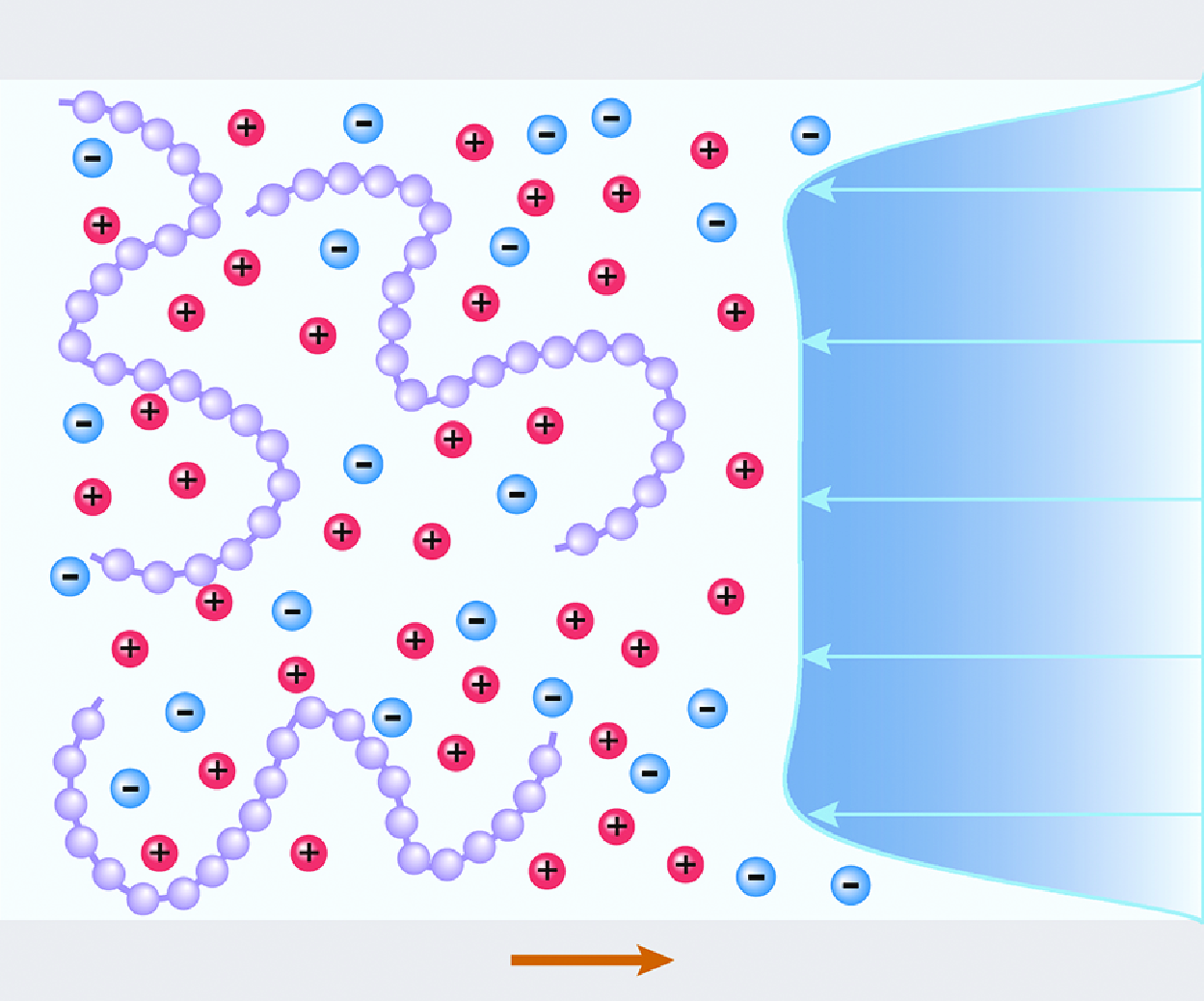
This paper presents a theoretical model for the electro-osmotic flow (EOF) of semi-dilute polyelectrolyte (PE) solutions in nanochannels. We use mean-field theories to describe the properties of electric double layer and viscosity of PE solutions that are prerequisites for constructing the EOF model. The EOF model is validated via a good match to the existing experimental results. Based on the validated EOF model, we conduct a comprehensive analysis of EOF of semi-dilute PE solutions in nanochannels. First, we observe considerable EOF of PE solutions in the uncharged nanochannels, which is in stark contrast to EOF of simple electrolyte solutions. The analyses show that the EOF of PE solutions in uncharged nanochannels is triggered by the external electric field acting on the near-wall non-electroneutral regions resulting from the confinement-induced inhomogeneous distribution of PE monomers. Although the solutions are electroneutral as a whole, the presence of local non-electroneutral regions and the mismatch between non-electroneutral regions and high-viscosity regions lead to the net EOF in uncharged nanochannels. Furthermore, we reveal that the EOF mobility $\mu _{{eof}}$ in uncharged nanochannels exhibits a scaling law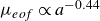 $\mu _{{eof}} \propto a^{-0.44}$ (wherein $a$ denotes monomer Kuhn length) and is inversely proportional to the PE chain length, while it decreases nonlinearly with the charge fraction of the PE chains. Moreover, the EOF mobility reaches its maximum at specific bulk monomer concentration, and increases with the nanochannel height before converging to that under no confinement. Second, we analyse the EOF of PE solutions in nanochannels with various wall effects, such as surface charge density, slip length and adsorption length. When the surface charge is absent, the adsorption length significantly influences the direction and magnitude of the EOF, whereas the slip length has no effect. When the wall becomes increasingly charged, the influence of adsorption length on EOF gradually diminishes, while the importance of the slip length progressively intensifies and the EOF is highly influenced by the co-action of various wall effects in a complicated manner. When the surface wall is oppositely charged to polymer monomers, the EOF mobility varies nonlinearly with the surface charge density, while a zero net flow of EOF followed by a direction reversal is discovered when the wall is likely charged to polymer monomers.


A platform for all-optical Thomson/Compton scattering with versatile parameters
-
- Journal:
- High Power Laser Science and Engineering / Volume 13 / 2025
- Published online by Cambridge University Press:
- 13 June 2025, e56
-
- Article
-
- You have access
- Open access
- HTML
- Export citation
Spatial distributions of laser–plasma instability in the beam overlapping region
-
- Journal:
- High Power Laser Science and Engineering / Volume 13 / 2025
- Published online by Cambridge University Press:
- 13 June 2025, e59
-
- Article
-
- You have access
- Open access
- HTML
- Export citation

Dynamical modes of highly elastic loops settling under gravity in a viscous fluid
-
- Journal:
- Journal of Fluid Mechanics / Volume 1013 / 25 June 2025
- Published online by Cambridge University Press:
- 13 June 2025, A13
-
- Article
-
- You have access
- Open access
- HTML
- Export citation
-
The settling of highly elastic non-Brownian closed fibres (called loops) under gravity in a viscous fluid is investigated numerically. The loops are represented using a bead–spring model with harmonic bending potential and finitely extensible nonlinear elastic stretching potential. Numerical solutions to the Stokes equations are obtained with the use of HYDROMULTIPOLE numerical codes, which are based on the multipole method corrected for lubrication to calculate hydrodynamic interactions between spherical particles with high precision. Depending on the elasto-gravitation number $B$, a ratio of gravitation to bending forces, the loop approaches different attracting dynamical modes, as described by Gruziel-Słomka et al. (2019 Soft Matt. 15, 7262–7274) with the use of the Rotne–Prager mobility of the elastic loop made of beads. Here, using a more precise method, we find and characterise a new mode, analyse typical time scales, velocities and orientations of all the modes, compare them and investigate their coexistence. We analyse numerically the transitions (bifurcations) to a different mode at certain critical values of the elasto-gravitation number.

Apollon Real-Time Adaptive Optics: astronomy-inspired wavefront stabilization in ultraintense lasers - ERRATUM
-
- Journal:
- High Power Laser Science and Engineering / Volume 13 / 2025
- Published online by Cambridge University Press:
- 13 June 2025, e36
-
- Article
-
- You have access
- Open access
- HTML
- Export citation
Multiscale settling dynamics of Kolmogorov-scale sediment-like particles in turbulence
-
- Journal:
- Journal of Fluid Mechanics / Volume 1013 / 25 June 2025
- Published online by Cambridge University Press:
- 13 June 2025, A5
-
- Article
- Export citation
Capsule damage by an enclosed microswimmer
-
- Journal:
- Journal of Fluid Mechanics / Volume 1013 / 25 June 2025
- Published online by Cambridge University Press:
- 13 June 2025, A12
-
- Article
-
- You have access
- Open access
- HTML
- Export citation
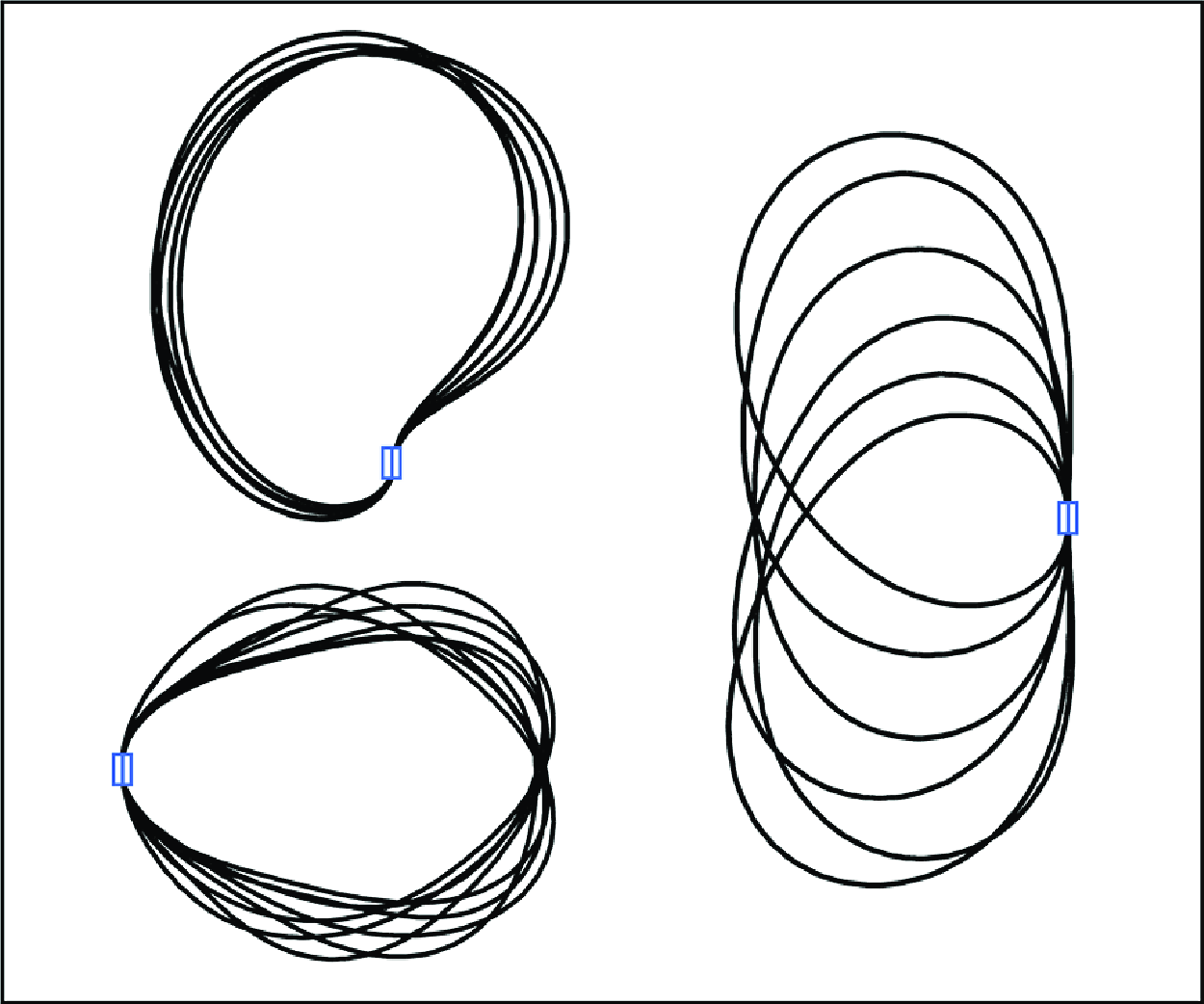
Flow-induced oscillations of a clamped flexible ring
-
- Journal:
- Journal of Fluid Mechanics / Volume 1013 / 25 June 2025
- Published online by Cambridge University Press:
- 13 June 2025, A6
-
- Article
-
- You have access
- Open access
- HTML
- Export citation

Response of non-premixed jet flames to blast waves
-
- Journal:
- Journal of Fluid Mechanics / Volume 1013 / 25 June 2025
- Published online by Cambridge University Press:
- 13 June 2025, A3
-
- Article
-
- You have access
- Open access
- HTML
- Export citation
-
The work investigates the response dynamics of non-premixed jet flames to blast waves that are incident along the jet axis. In the present study, blast waves, generated using the wire-explosion technique, are forced to sweep across a non-premixed jet flame that is stabilised over a nozzle rim positioned at a distance of 264 mm from the source of the blast waves. The work spans a wide range of fuel-jet Reynolds numbers ( $Re$; ranging from 267 to 800) and incident blast-wave Mach numbers ( $M_{s,r}$; ranging from 1.025 to 1.075). The interaction imposes a characteristic flow field over the jet flame marked by a sharp discontinuity followed by a decaying profile and a delayed second spike. The second spike in the flow field profile corresponds to the induced flow that follows the blast front. While the response of the flame to the blast front was minimal, it was found to detach from the nozzle rim and lift off following the interaction with the induced flow. Subsequently, the lifted flame was found to reattach back at the nozzle or extinguish, contingent on the operating $Re$ and $M_{s,r}$. Alongside flame lift-off, flame-tip flickering was aggravated under the influence of the induced flow. A simplified theoretical model extending the vorticity transport equation was developed to estimate the change in flickering time scales and length scales owing to the interaction with the induced flow. The observed experimental trends were further compared against theoretical predictions from the model.


A B-integral management strategy in discrete single-crystal fibers: towards direct power scaling of femtosecond sources near 2 μm
-
- Journal:
- High Power Laser Science and Engineering / Volume 13 / 2025
- Published online by Cambridge University Press:
- 13 June 2025, e53
-
- Article
-
- You have access
- Open access
- HTML
- Export citation
Enhanced astrometry of the rapid ASKAP continuum survey for precise localisation of fast radio bursts
-
- Journal:
- Publications of the Astronomical Society of Australia / Volume 42 / 2025
- Published online by Cambridge University Press:
- 13 June 2025, e060
-
- Article
-
- You have access
- Open access
- HTML
- Export citation
-
Fast radio bursts (FRBs) are short, intense radio signals from distant astrophysical sources, and their accurate localisation is crucial for probing their origins and utilising them as cosmological tools. This study focuses on improving the astrometric precision of FRBs discovered by the Australian Square Kilometre Array Pathfinder (ASKAP) by correcting systematic positional errors in the Rapid ASKAP Continuum Survey (RACS), which is used as a primary reference for ASKAP FRB localisation. We present a detailed methodology for refining astrometry in two RACS epochs (RACS-Low1 and RACS-Low3) through crossmatching with the Wide-field Infrared Survey Explorer (WISE) catalogue. The uncorrected RACS-Low1 and RACS-Low3 catalogues had significant astrometric offsets, with all-sky median values of $0.58''$ in RA and $-0.26''$ in Dec. (RACS-Low1) and $0.29''$ in RA and $1.24''$ in Dec. (RACS-Low3), with a substantial and direction-dependent scatter around these values. After correction, the median offset was completely eliminated, and the 68% confidence interval in the all-sky residuals was reduced to $0.2''$ or better for both surveys. By validating the corrected catalogues against other, independent radio surveys, we conclude that the individual corrected RACS source positions are accurate to a 1- $\sigma$ confidence level of $0.3''$ over the bulk of the survey area, degrading slightly to $0.4''$ near the Galactic plane. This work lays the groundwork to extend our corrections to the full RACS catalogue that will enhance future radio observations, particularly for FRB studies.


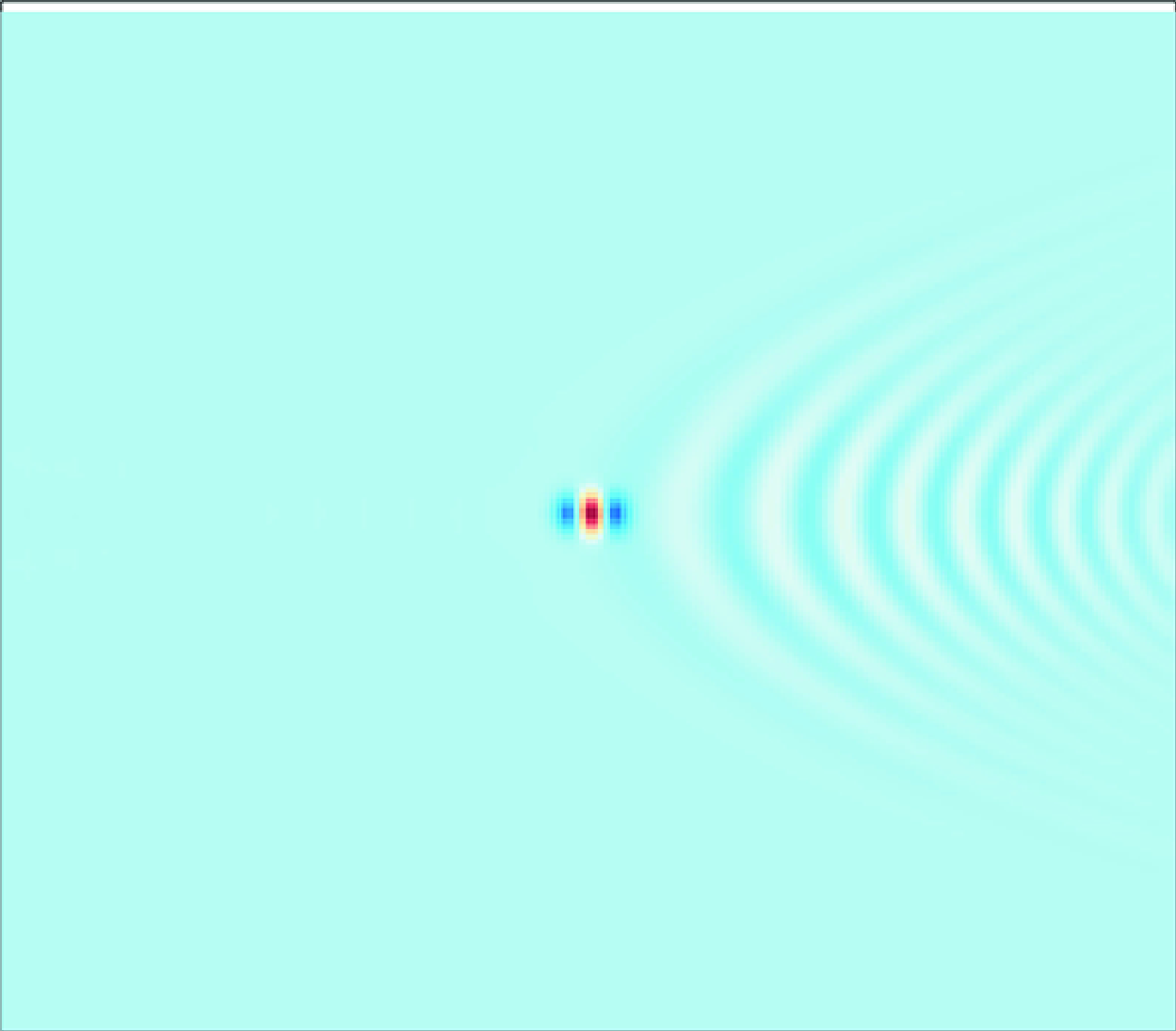
Towards eliminating the nonlinear Kelvin wake
-
- Journal:
- Journal of Fluid Mechanics / Volume 1013 / 25 June 2025
- Published online by Cambridge University Press:
- 13 June 2025, A10
-
- Article
-
- You have access
- Open access
- HTML
- Export citation
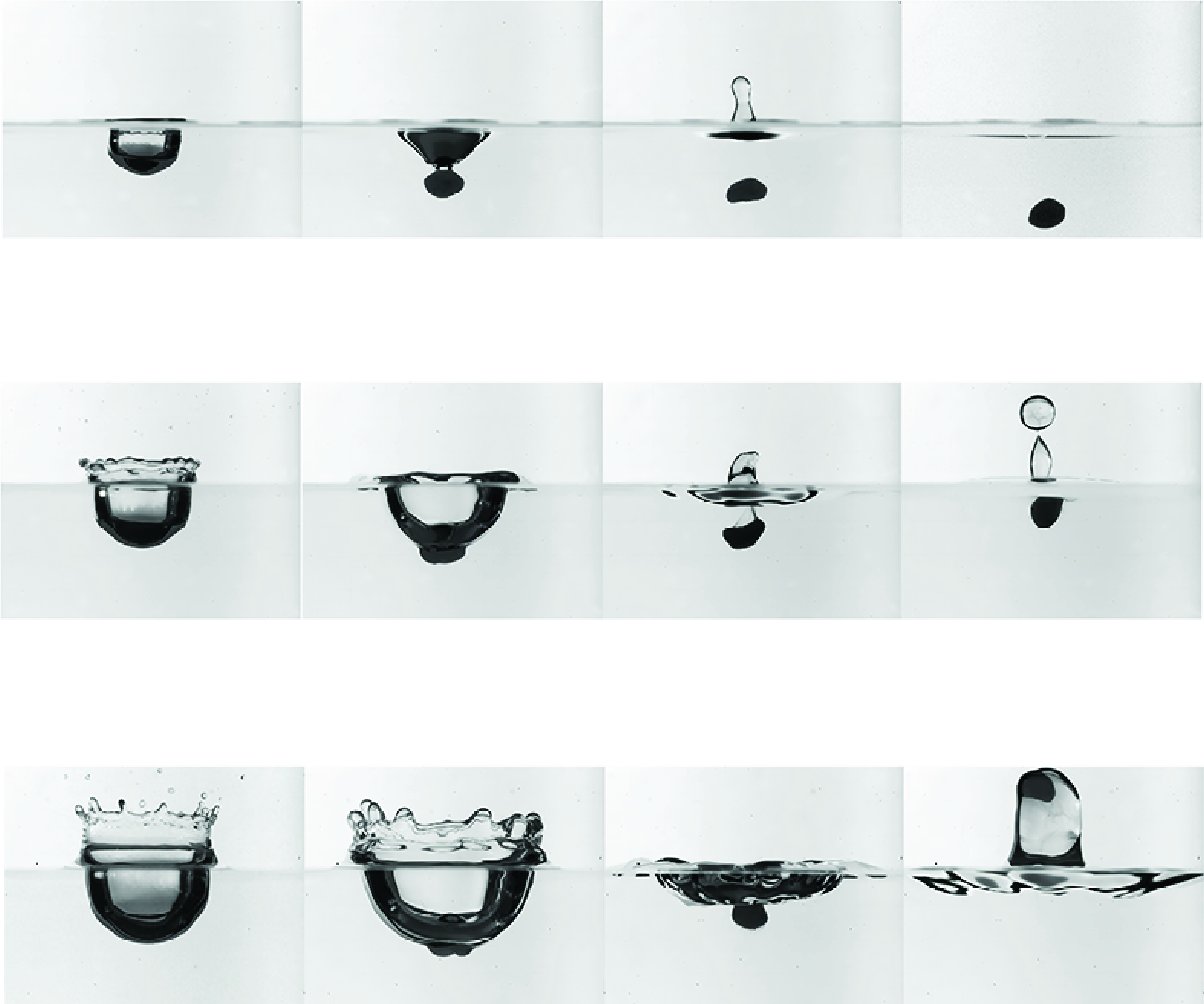
Rebounding hydrogel sphere water entry
-
- Journal:
- Journal of Fluid Mechanics / Volume 1013 / 25 June 2025
- Published online by Cambridge University Press:
- 13 June 2025, A2
-
- Article
- Export citation

Dynamics of rotating helices in a viscous fluid
-
- Journal:
- Journal of Fluid Mechanics / Volume 1013 / 25 June 2025
- Published online by Cambridge University Press:
- 13 June 2025, R1
-
- Article
-
- You have access
- Open access
- HTML
- Export citation
Bibliography
-
- Book:
- Advanced Linear Algebra
- Published online:
- 27 May 2025
- Print publication:
- 12 June 2025, pp 445-448
-
- Chapter
- Export citation
7 - Jordan Decomposition
-
- Book:
- Advanced Linear Algebra
- Published online:
- 27 May 2025
- Print publication:
- 12 June 2025, pp 210-229
-
- Chapter
- Export citation
Notations and Conventions
-
- Book:
- Advanced Linear Algebra
- Published online:
- 27 May 2025
- Print publication:
- 12 June 2025, pp xvii-xviii
-
- Chapter
- Export citation
References
-
- Book:
- A First Course in Magnetohydrodynamics
- Published online:
- 05 June 2025
- Print publication:
- 12 June 2025, pp 493-499
-
- Chapter
- Export citation
Variable Glossary
-
- Book:
- A First Course in Magnetohydrodynamics
- Published online:
- 05 June 2025
- Print publication:
- 12 June 2025, pp 486-492
-
- Chapter
- Export citation
