To save content items to your account,
please confirm that you agree to abide by our usage policies.
If this is the first time you use this feature, you will be asked to authorise Cambridge Core to connect with your account.
Find out more about saving content to .
To save content items to your Kindle, first ensure no-reply@cambridge.org
is added to your Approved Personal Document E-mail List under your Personal Document Settings
on the Manage Your Content and Devices page of your Amazon account. Then enter the ‘name’ part
of your Kindle email address below.
Find out more about saving to your Kindle.
Note you can select to save to either the @free.kindle.com or @kindle.com variations.
‘@free.kindle.com’ emails are free but can only be saved to your device when it is connected to wi-fi.
‘@kindle.com’ emails can be delivered even when you are not connected to wi-fi, but note that service fees apply.
This article addresses the gaps between ethnographic archives and community members who are often deprived of accessing their own materials. In reflecting on results from collaborative research with a Nepalese immigrant community in Alberta, Canada, where we created a Digital Community Archive (DCA), I draw attention to the benefits of combining strategies from applied ethnomusicology and Participatory Action Research (PAR). I propose a new model for archiving in ethnomusicology, the Community Collaborative Participatory Archive (CCPA). This model can improve ethnomusicological archival practice by focusing on collaborative, egalitarian, and grassroots participation, shared roles, and authority in the archival creation and development process.
Focusing on the Sufi festival (mawsim) of Nabi Rubin, which used to take place near Jaffa in Palestine, this article explores the indigenous performance traditions that were an important part of Palestinian cultural life prior to the mass displacement of Palestinians by Zionist forces in the Nakba of 1948. Using the extinct festival of Nabi Rubin as a specific example, the article sheds light on a significant and neglected part of Palestinian theatre and performance history: indigenous Palestinian performance practices which have been omitted from the literature on Palestinian theatre. Thus the article advocates for a more inclusive approach to the study of performance that gives value to indigenous performance practices, which form a fundamental part of Palestine’s rich cultural history. It also examines the sociocultural changes that accompanied the Arab Nahda (‘renaissance’) and the manner in which it influenced cultural life in Jaffa and the festival of Nabi Rubin.
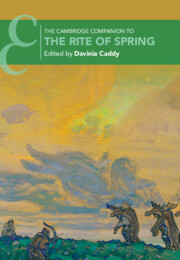
A Companion not only to the historic, path-breaking ballet production by Diaghilev, Nijinsky, Roerich and Stravinsky that premiered in Paris in 1913, but also to its legacy across the centuries. The newly commissioned essays will guide students and ballet-goers as they encounter this fascinating work and enable them to navigate the complex artistic currents it set in motion, intertwining music, theatrical ballet and modern dance with the wider world of ideas. The book embraces The Rite of Spring as a spectrum of creative possibility that has impacted the arts, politics, gender, race and national identity, and even popular culture, from the 1910s to the present day. It distils an enormous body of literature, sharing insights from the very latest research while inviting readers to rethink standard scholarly narratives, and brings together contributions from specialists across multiple disciplines: music history, theory and analysis, dance and theatre studies, art history, Russian history, and European modernism.
This essay takes as its point of departure the so-called ‘Verdi A’, 432Hz. From the late 1860s through to the 1880s, the opera composer was intensely preoccupied with the question of tuning, weighing in several times on the matter of where A should sit. Verdi was concerned for the strain that high tunings should place on singers’ voices. He advocated on multiple occasions for global acceptance of an A well below 440, and sent Arrigo Boito to argue in favour of A=432 at the Congresso dei Musicisti Italiani, held in Milan on 16–21 June 1881. In the 1880s, Italy remained one of the only nations in Europe that had not adopted equal temperament wholesale for fixed-tone instruments; as in the case of its spoken languages during this same period, and the locations of its A, temperament varied by region, with the southern part of the peninsula clinging to meantones. This article argues that ‘Verdi tuning’ represents the end point of a number of longer shifts in the conceptualization of musical sound, particularly in the Italian context: from temperament to tuning (accordatura); from relative conceptions of musical pitch to an absolute one; from local and regional variations towards a standardized system; from an older notion of all-encompassing nature to a presumed separation between nature and culture. Tracing this history through the Italian long nineteenth century will involve concentrating on what this article calls music-adjacent sound: that is, interrogative play with musical pitch; sound experiments from musical materials and operatic voices; instrument tuning by ear; listening for overtones; legislating preferred ratios and (eventually) frequencies for musical use; and constructing a theory of music that draws together these means of sounding. Music-adjacent sound is where the conditions for music-making were and still are established. This article argues that an attention to these sonic and nearly musical moments can demonstrate how listening and the musical imagination were cultivated outside the boundaries of any work or performance.
In this article, I argue that the musical landscape in Panama during the nineteenth century was much more active, diverse and globally connected than previously observed by authors of traditionally accepted music historiography of the country. Particularly, I discuss the heightened activity in the second half of the century through primary sources concerning violinist Miguel Iturrado (d. 1879). I further argue that the violin culture fostered by Iturrado and his contemporaries became a solid platform for cultural exchange which allowed for the development of early-twentieth-century music production in Panama. I conclude that the flourishing of numerous fin-de-siècle concert violinists, as well as the advent of the violinist-composers of dance music now known as the Azuero School in the first third of twentieth-century Panama, are directly related to Iturrado’s –and his colleagues’– musical and cultural achievements.
In the nineteenth century Western art music advanced towards a peak of sonorous magnificence, perhaps reached in 1848 at Paris when Hector Berlioz conducted an ensemble of 1,022 performers. The guitar, however, continued to sound at the level of a small continuo group for an Italian opera of the 1640s. During the 1800s the guitar’s reputation was deeply affected, often for the better, by its evocation of past sonorities that the ear was prepared to relinquish but the historical imagination could not bear entirely to forgo. Various attempts were nonetheless made to strengthen the sound by external and internal changes, some of them well received in their day, but no increase in the size or depth of the guitar’s body, no change in the pattern of the internal bracing and no addition of extra strings fundamentally enlarged its scope. Not suited to the new concert halls in which provincial towns and cities invested much of their civic pride, the guitar fared no better amidst the din of the music halls either, according to the guitarist and vaudeville comedian Ernest Shand (1868–1924). The editor of Shand’s compositions finds that ‘interest in the instrument was all but gone’ by the 1890s when Shand was unable to make a living from his composing, playing and teaching.
Catharina Pratten was the only exponent of the guitar to make a lifelong career from the instrument in Britain. A living link with the ‘Great Vogue’ for the guitar of the 1830s, she composed companionable solo pieces designed for the amateur, arranged songs, published methods, and taught a wide range of pupils, including some form the aristocracy, during almost the entire Victorian period. The considerable revival of interest in Madame Pratten during recent years, however, is in danger once more of the underestimating the importance of accompanied song to the Victorian fortunes of the guitar. About half of her many publications comprise guitar-accompanied vocal music including settings of nursery rhymes, opera favourites and English ballads. Although this was not the part of her legacy most valued by the coterie of advanced pupils she left behind, it undoubtedly inspired many who sought the services of this unique female musical entrepreneur.
In the early Victorian period many popular entertainers began to realise how much the guitar could offer them as a portable source of accompaniment to use for a musical spot in their act. During the ‘hungry’ 1840s, sustained economic downturn, and a series of bad harvests, created conditions that demanded as much resourcefulness from travelling performers as they could muster, especially the small fry with no reputation to trade on. This large tribe of guitar-players, who have never received the attention they merit, included some who performed are in costume or worked under a stage name such as ‘The British Minstrel’ or ‘The Banker’s Daughter’. Although most of these players have left few traces, sometimes indeed only one, they do not form the background to Victorian guitar playing, unless we choose to put theme there. They populate the foreground as the paid exponents of the guitar that members of the public were most often given the chance to see.
Although the guitar was primarily used to accompany singing in Victorian England sophisticated chamber arrangements of music by Beethoven and Mozart were circulating in manuscript during the first decades of Victoria’s reign. This repertoire is almost entirely unknown and is discussed here for the first time. Duets for guitar and pianoforte were also fairly abundant into the 1840s. There was also a clear sense, especially among music publishers with a vested interest in the notion, that a ‘classical’ solo repertoire of guitar music had emerged during the first third of the century when the instrument was in fashion. Yet although there were still notable solo players towards mid-century, such as Joseph Anelli, making a career as a ‘serious’ guitar player, which had always been a precarious business was by 1850 virtually impossible, at least in Britain. Even Anelli’s concert programmes started to show the influence of the many popular entertainers who had begun to use the guitar, explored in the next chapter.
A wide range of new opportunities for playing in ‘public’ emerged after mid-century and awaited the venturesome amateur guitar-player who could sing, especially young and unmarried female player who might come from every social class above the labouring poor. Social clubs, political societies such as the Primrose League, and sports clubs for tennis, cycling, golf and cricket mounted regular (or at least annual) entertainments which provided amateur singers using guitars with something to play for in every sense of the expression. Their instrument seemed agreeably novel; so did their art of self-accompaniment as they faced the audience directly in a manner that few self-accompanying singers using a pianoforte could hope to do. In addition there were new contexts for amateur performance that have almost been in entirely overlooked by historians of nineteenth-century music, notably the ‘Penny Reading’ where a wide variety of vocal and instrumental music was performed, reaching down to the level of small villages in parish halls and school rooms, often to raise funds for some charitable or philanthropic purpose.