To save content items to your account,
please confirm that you agree to abide by our usage policies.
If this is the first time you use this feature, you will be asked to authorise Cambridge Core to connect with your account.
Find out more about saving content to .
To save content items to your Kindle, first ensure no-reply@cambridge.org
is added to your Approved Personal Document E-mail List under your Personal Document Settings
on the Manage Your Content and Devices page of your Amazon account. Then enter the ‘name’ part
of your Kindle email address below.
Find out more about saving to your Kindle.
Note you can select to save to either the @free.kindle.com or @kindle.com variations.
‘@free.kindle.com’ emails are free but can only be saved to your device when it is connected to wi-fi.
‘@kindle.com’ emails can be delivered even when you are not connected to wi-fi, but note that service fees apply.
This chapter addresses an alternative history of The Rite of Spring: principally, as a meme of modernity within popular culture and cinema. Stravinsky’s score, we learn, has inspired countless jazz practitioners and film directors: who, how, when and why are important questions raised, giving the reader a clear sense of the contemporary currency of Stravinsky’s music with an audience of listeners and musicians for whom the original ballet has taken on new life and meaning.
With a focus on Stravinsky’s score and thus the ballet’s musical aspect, this chapter explores several waystations on The Rite of Spring’s journey from ballet to instrumental work – in concert, on record and, most recently, online. Rather than offering a complete history, this account explores a few of the key transformations that took place over the twentieth century as The Rite was re-imagined as a composition for symphony orchestra, allied not with choreography, costumes and décor but with the creative vision of a conductor, the practical skills of a sound editor and the promotional machine of a record label.
Focusing solely on the musical output of composer Igor Stravinsky, this chapter explores the evolution of what would become a characteristic compositional process – so-called ‘block form’ – in later works including Concertino, Symphony in Three Movements and Introitus T. S. Eliot in Memoriam. Close analysis of scores for these works, as well as a 1943 revision of the ‘Sacrificial Dance’ from The Rite, shows how Stravinsky crafted an idiomatic compositional technique that could produce both textural variation and structure coherence, while, in some cases, supporting a musical narrative.
This chapter explores a handful of the many new productions of The Rite of Spring that have been staged since the ballet’s original performance in 1913. Introducing the topic by way of critical reflection on the challenges facing scholars and students of such choreographic reinterpretations, this account describes three of the most canonical revisions of the ballet (by Léonide Massine, Maurice Béjart and Pina Bausch) before dwelling principally on two more recent and seemingly self-reflexive versions: Yvonne Rainer’s RoS Indexical (2007) and Nora Chipaumire’s rite riot (2014).
Offers a wide-ranging yet nuanced account of the articles and reviews of The Rite of Spring that emerged in the Parisian press – the daily newspapers and specialist music and theatre journals – around the time of the premiere in May 1913. In doing so, this chapter seeks to chip away at some of the myth-making and exaggerated rhetoric that has contributed to our (mis)understanding of the supposedly riotous first night at the newly built Théâtre de Champs-Élysées, Paris. Close examination of the press reveals what, or rather who, most angered or else stupefied spectators and how choreography, music, decors and costumes were regarded by a select audience. Broader social and political tensions come to the fore as reports in the press are read in the context of a wider cultural history of the period.
Situates the original 1913 production of Sergei Diaghilev’s The Rite of Spring in its local theatrical context, exploring the scheduling and significance of the ballet within the Parisian calendar. Recounts the popular reception of the Ballets Russes’s annual ‘Saisons Russes’ in the French capital, focusing on the pre-war period but also offering a broader history of the troupe and its activities until its dissolution in 1929. Describes the principal stylistic characteristics of the troupe’s productions in terms of music, choreography and visuals (decors and costumes), suggesting historical developments and trajectories that aligned with broader strands of cultural influence during the first decades of the twentieth century. Also explores the nineteenth-century background of theatrical dance in Russia and Western Europe.
Discussions of sample-based music are traditionally single-authored, despite the frequency of multi-genre content found within this repertoire. This article builds a case for a new approach for future analyses, justified by highlighting repertoire that embeds samples from different genres, times, and cultures and that calls upon a variety of disciplinary expertise to attend to these disparate contents. Multi-voice commentary is an approach that includes insider voices to speak to the content of sample-based music, building a reception network that runs counter to single authorial modes, broadening the narrative around sample-based music and its lineage. Certain sample-based works are most in need of this new approach, based on situations of ‘sampling up’, ‘down’, or ‘sideways’, tendencies developed from Nader’s concept of ‘studying up’ and Walser’s writings on ‘appropriations from below’. Theoretical ideas from Fish and Barthes are also brought into this discussion to further the case for a multiplicity of readings.
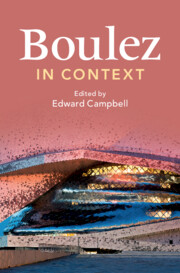
Pierre Boulez was a towering figure in contemporary music from the 1940s and 1950s to his death in 2016. This volume demonstrates his distinctive impact on new music and situates him within a wide range of contexts to enhance appreciation of the cultural embeddedness of his work. Successive sections consider his early life and education, his engagements with cultural, musical, literary and artistic modernism, his relationships with his modernist predecessors and contemporaries, and the intersections of his work with literature, visual art, mathematics, philosophy and technology. Contributors explore his various roles as composer, conductor, recording artist, writer, teacher and systems builder, as well as his role in French cultural politics, his move to Germany and the time he spent in the United States. This book is essential for students and educators but also accessible to a general audience interested in Boulez's legacy and his unique position in recent music history.
This article focuses on the Italian inventor, telephone pioneer and opera house technician Antonio Meucci (1808–1889), exploring the shifting relationships between Meucci’s experiments and his operatic connections across his transatlantic career. Meucci first developed an acoustic telephone while working at Florence’s Teatro della Pergola, before discovering the transmission of sound via electricity during his tenure as chief machinist at Havana’s Teatro Tacón in the 1840s. These experiments were further refined after his relocation to New York, where he continued to be part of a network of Italian musicians, thinkers, journalists and scientific practitioners while seeking to patent his invention. Feted among the Italian diasporic community in the USA – both for his technological innovations and for his close relationship with Italian revolutionary Giuseppe Garibaldi – at the time of his death Meucci was nonetheless embroiled in a lengthy legal case against Alexander Graham Bell over the primacy of the telephone’s invention, a dispute not fully resolved until the twenty-first century. This article accordingly unfolds in three main parts, focusing in turn on Florence, Havana and New York. Meucci’s experiments – and his complex emigrant environment – collectively highlight the Italian opera house as a global and multidimensional site of technological and sonic innovation, during a period when the telephone gradually moved from conceptual fantasy to material reality. At the same time, Meucci’s career can challenge direct links between Italian sonic environments and Italy itself. Ultimately, I argue, the complex and changing relationships between opera and the telephone invite more nuanced approaches to histories of music and technology, while demonstrating the centrality of the Italian opera house and its sounds – within, across, and beyond the stage – to nineteenth-century auditory cultures more broadly.
Malta was a British colony for over 150 years until it became independent in 1964. Though the presence of the British in Malta was considerable and permeated all sectors of Maltese life and culture, the island’s commercial and cultural ties with neighbouring Italy never ceased. This article aims to analyse how Malta’s cultural sympathies and affinities with Italy alongside British colonialism contributed to the musical growth of the wind band tradition in Malta between the mid-nineteenth and the mid-twentieth century. The co-existence in Malta of the political and cultural conflict brought about by the two competing cultures at this time and, paradoxically, their confluence transpire here as central to processes of musical growth through opportunities for syncretism.
This article examines the evolution of Soviet operatic conventions during Khrushchev’s Thaw. The first opera to be prematurely cancelled from the Bolshoi Theatre since Stalin was Rodion Shchedrin’s 1961 opera Not Love Alone, and as such, it set the standard for what would be deemed unacceptable in Thaw-era opera. Using this opera as a case study, I employ extensive archival material, including never-before-accessed audience surveys and internal Bolshoi Theatre meeting minutes, to analyse the opera’s path to official acceptance – and then official rejection. I thus illuminate the competing demands that composers, Party bureaucrats, and audiences expected of the Soviet opera project, and the convergences and divergences with the Stalin-era. Finally, I demonstrate why the project of creating a robust repertoire of contemporary-themed Soviet opera failed during the Thaw, never to be revived with such fervour, and demonstrate why Shchedrin’s opera was the attempt closest to achieving enduring success.