To save content items to your account,
please confirm that you agree to abide by our usage policies.
If this is the first time you use this feature, you will be asked to authorise Cambridge Core to connect with your account.
Find out more about saving content to .
To save content items to your Kindle, first ensure no-reply@cambridge.org
is added to your Approved Personal Document E-mail List under your Personal Document Settings
on the Manage Your Content and Devices page of your Amazon account. Then enter the ‘name’ part
of your Kindle email address below.
Find out more about saving to your Kindle.
Note you can select to save to either the @free.kindle.com or @kindle.com variations.
‘@free.kindle.com’ emails are free but can only be saved to your device when it is connected to wi-fi.
‘@kindle.com’ emails can be delivered even when you are not connected to wi-fi, but note that service fees apply.
Ulcerative colitis (UC) is a chronic inflammatory disease involving the colon and rectum. One of the most modifiable environmental factors affecting UC severity is the patient’s dietary pattern. Although the role of dietary patterns on UC aetiology has been investigated previously, its relationship with disease severity has not yet been elucidated. This study examined the association between UC patients’ dietary patterns and disease severity. This cross-sectional study was conducted in 340 UC patients. Using an FFQ, food patterns were assessed. Twenty-five food categories were categorised based on the similarity of the nutrient composition of the food using the factor analysis method. A simple clinical colitis activity index was used to determine disease severity. Three dietary patterns were identified based on the factor analysis: healthy, unhealthy and Western dietary pattern. After adjusting for potential confounding factors, patients who were in the highest tertile of healthy dietary pattern compared with the lowest tertile were 92 % less likely to have severe UC (OR: 0·08; 95 % CI: 0·03, 0·22). Also, those in the highest tertile of the Western dietary pattern were 3·86 times more likely to have severe UC than those in the lowest tertile (OR: 3·86; 95 % CI: 1·86, 8·00). Even after controlling for confounding variables, unhealthy dietary pattern did not increase the risk of severe UC. Our data indicate the beneficial role of healthy dietary pattern in amelioration of disease severity in UC patients. To confirm this association, more studies are needed, especially prospective cohort studies.
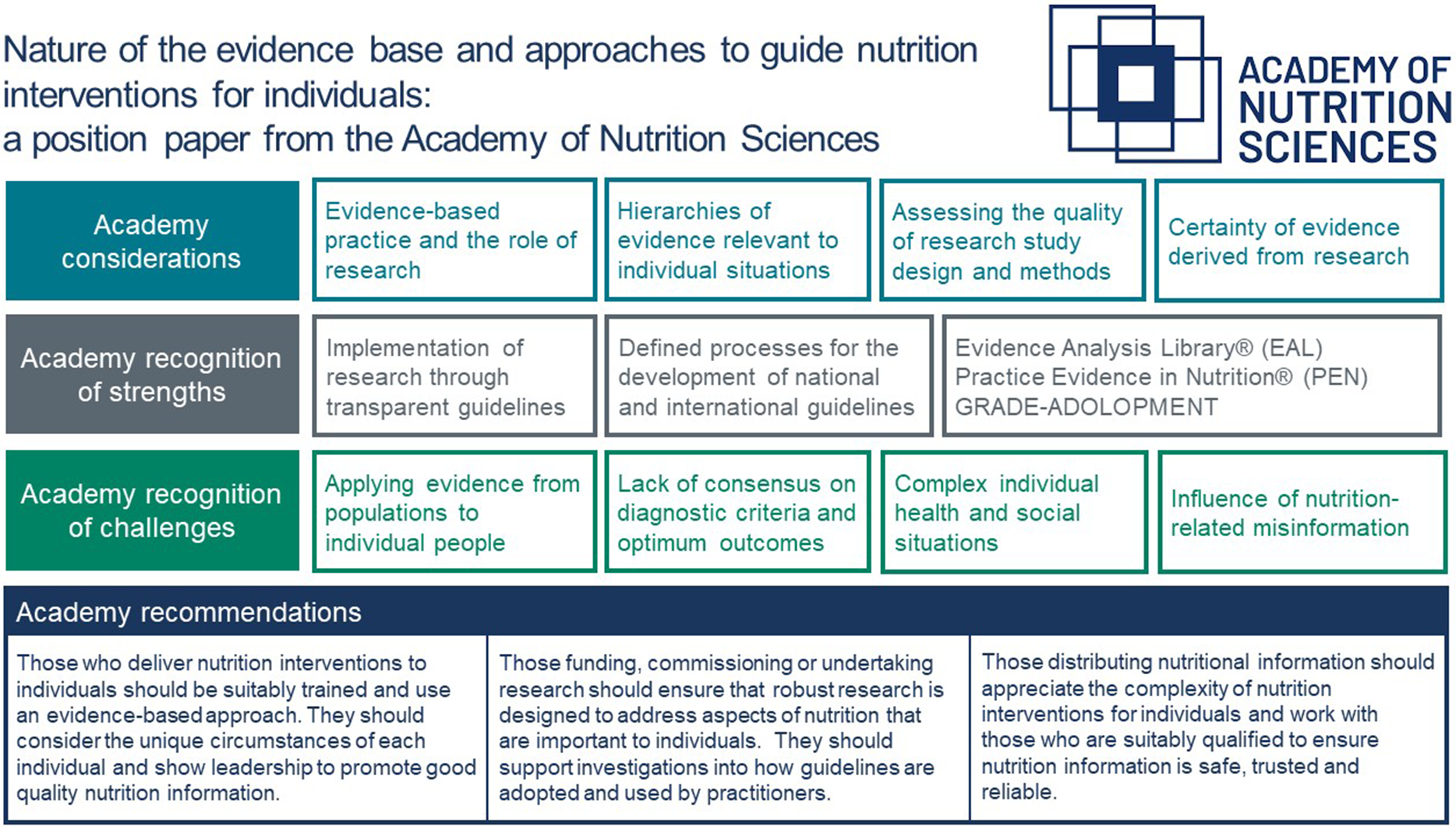
This Position Paper from the Academy of Nutrition Sciences is the third in a series which describe the nature of the scientific evidence and frameworks that underpin nutrition recommendations for health. This paper focuses on evidence which guides the application of dietary recommendations for individuals. In some situations, modified nutrient intake becomes essential to prevent deficiency, optimise development and health, or manage symptoms and disease progression. Disease and its treatment can also affect taste, appetite and ability to access and prepare foods, with associated financial impacts. Therefore, the practice of nutrition and dietetics must integrate and apply the sciences of food, nutrition, biology, physiology, behaviour, management, communication and society to achieve and maintain human health. Thus, there is huge complexity in delivering evidence-based nutrition interventions to individuals. This paper examines available frameworks for appraising the quality and certainty of nutrition research evidence, the development nutrition practice guidelines to support evidence implementation in practice and the influence of other sources of nutrition information and misinformation. The paper also considers major challenges in applying research evidence to an individual and suggests consensus recommendations to begin to address these challenges in the future. Our recommendations target three groups; those who deliver nutrition interventions to individuals, those funding, commissioning or undertaking research aimed at delivering evidence-based nutrition practice, and those disseminating nutritional information to individuals.
To determine the appropriateness of three widely used formulas estimating 24-h urinary Na (24hUNa) from spot urine samples in the Chinese population.
Design:
Systematic review and meta-analysis.
Setting:
Literature review was conducted to identify studies for estimating 24hUNa using the Kawasaki, Tanaka and INTERSALT formulas simultaneously in PubMed, Embase and the Cochrane library databases. The mean difference (MD) and correlation coefficients (r) between measures and estimates from different formulas were assessed.
Participants:
Information extraction and quality assessment were performed in thirteen studies involving 8369 subjects.
Results:
Two studies which affected the overall robustness were excluded in the ‘leave-one-out’ sensitivity analyses. Within the final meta-analysis included eleven studies and 7197 participants, 36·07 mmol/d (95 %CI 16·89, 55·25) of MD was observed in the Kawasaki formula, and –19·62 mmol/d (95 %CI –37·37, –1·87) in the Tanaka formula and –35·78 mmol/d (95 %CI –50·76, –20·80) in the INTERSALT formula; a pooled r-Fisher’s Z of 0·39 (95 %CI 0·32, 0·45) in the Kawasaki formula, 0·43 (95 %CI 0·37, 0·49) in the Tanaka formula and 0·36 (95 %CI 0·31, 0·42) in the INTERSALT formula. Subgroup analyses were conducted to explore the possible factors affecting the accuracy of the formula estimation from three mainly aspects: population types, Na intake levels and urine specimen types.
Conclusions:
The meta-analysis suggested that the Tanaka formula performed a more accurate estimate in Chinese population. Time of collecting spot urine specimens and Na intake level of the sample population might be the main factors affecting the accuracy of the formula estimation.
FoodRx is a 12-month healthy food prescription incentive program for people with type 2 diabetes (T2DM) and experiences of household food insecurity. In this study, we aimed to explore potential users’ prospective acceptability (acceptability prior to program use) of the design and delivery of the FoodRx incentive and identify factors influencing prospective acceptability.
Design:
We used a qualitative descriptive approach and purposive sampling to recruit individuals who were interested or uninterested in using the FoodRx incentive. Semi-structured interviews were guided by the theoretical framework of acceptability, and corresponding interview transcripts were analysed using differential qualitative analysis guided by the socioecological model.
Setting:
Individuals living in Alberta, Canada.
Participants:
In total, fifteen adults with T2DM and experiences of household food insecurity.
Results:
People who were interested in using the FoodRx incentive (n 10) perceived it to be more acceptable than those who were uninterested (n 5). We identified four themes that captured factors that influenced users’ prospective acceptability: (i) participants’ confidence, views and beliefs of FoodRx design and delivery and its future use (intrapersonal), (ii) the shopping routines and roles of individuals in participants’ social networks (interpersonal), (iii) access to and experience with food retail outlets (community), and (iv) income and food access support to cope with the cost of living (policy).
Conclusion:
Future healthy food prescription programs should consider how factors at all levels of the socioecological model influence program acceptability and use these data to inform program design and delivery.
Ecuador has a high prevalence of household food insecurity (HFI) and is undergoing nutritional and epidemiologic transition. Evidence from high-income countries has reported negative or null associations between HFI and physical activity (PA) in children. It remains uncertain whether the same is true of those from low- and middle-income countries like Ecuador whose environmental and socio-demographic characteristics are distinct from those of high-income countries. We aimed to investigate the association of HFI with PA, sedentary behaviour (SB) and anthropometric indicators in children.
Design:
Cross-sectional analysis of data from the nationally representative 2018 Ecuadorian National Health and Nutrition Survey. Data were collected on HFI, PA, SB, socio-demographic characteristics and measured height and weight. Unadjusted and adjusted linear, log-binomial and multinomial logistic regression analyses assessed the relationship of HFI with PA, SB, stunting and BMI-for-age.
Setting:
Ecuador.
Participants:
23 621 children aged 5–17 years.
Results:
Marginal and moderate-severe HFI was prevalent in 24 % and 20 % of the households, respectively. HFI was not associated with PA, SB, stunting nor underweight. Moderate-severe HFI was associated with a lower odds of overweight and obesity. However, adjustment for household assets attenuated this finding for overweight (adjusted OR:0·90, 95 % CI: 0·77, 1·05) and obesity (adjusted OR: 0·88, 95 % CI: 0·71, 1·08).
Conclusion:
HFI is a burden in Ecuadorian households, but is not associated with PA, SB nor anthropometric indicators in children aged 5–17 years. However, a concerning prevalence of insufficient PA was reported, emphasising the critical need for evidence-based interventions aimed at promoting PA and reducing SB.
Within the UK, dietary fibre intakes are well below recommended intakes and associated with increased risk of obesity. This study aimed to explore the views of parents and children on barriers and facilitators to increasing fibre intakes and improving diets, alongside investigating the appropriateness of intervention components to overcome modifiable barriers.
Design:
Qualitative study including semi-structured interviews and focus groups informed by the Theoretical Domains Framework (TDF) and the Capability-Opportunity-Motivation-Behaviour (COM-B) model.
Participants:
Year 5 children (aged 9–10-years) and parents, recruited through London primary schools
Results:
A total of twenty-four participants (eleven parents and thirteen children) took part. Five key themes were identified as barriers and facilitators, namely lack of (and improving) knowledge, social factors (including parent–child conflicts, limited time for food preparation, influence of peer and family members), current eating habits, influence of the school, community and home environment in shaping eating behaviours, and the importance of choice and variety in finding foods that are healthy and tasty. Parents strongly supported school-based dietary interventions to enable consistent messaging at home and school and help support dietary behaviour change. Practical sessions (such as workshops to strengthen knowledge, taste tests and food swap ideas) were supported by parents and children.
Conclusions:
By using a theory-driven approach to explore the barriers and facilitators to increasing fibre intake, this research identified important themes and modifiable barriers to behaviour change and identifies acceptable intervention components to overcome barriers and bring about sustained dietary behaviour change in primary school children.
To analyse the direct and indirect associations of experience of racial discrimination on dietary patterns (DP), obesity and abdominal obesity.
Design:
This is a cross-sectional population-based study. The main exposure was self-reported experiences of racial discrimination (Experiences of Discrimination scale). The mediator variables were the DP: healthy, Brazilian traditional, sugar and carbohydrates, and fast food. The outcomes were obesity (BMI ≥ 30 kg/m2) and abdominal obesity (waist circumference ≥ 88 cm for women; ≥ 102 cm for men). Structural equation modelling was applied.
Setting:
Porto Alegre, Brazil.
Participants:
Totally, 400 adults aged between 20 and 70 years were participated.
Results:
The mean age of participants was 47·2 years (sd = 13·9), and 75 % were women. Experiencing racial discrimination had a positive direct effect on obesity (healthy DP: β = 0·153, P < 0·05; Brazilian DP: β = 0·156, P < 0·05; sugar and carbohydrates DP: β = 0·156, P < 0·05; and fast-food DP: β = 0·153, P < 0·05) and abdominal obesity (healthy DP: β = 0·206, P < 0·01; Brazilian DP: β = 0·210, P < 0·01; sugar and carbohydrates DP: β = 0·204, P < 0·01; and fast-food DP: β = 0·204, P < 0·01). The experience of racial discrimination did not have a direct effect on DP, nor did it exert an indirect effect on obesity and abdominal obesity through any DP.
Conclusions:
A higher experience of racial discrimination is associated with obesity and abdominal obesity, independent of diet.
To compare the initial and the updated versions of the front-of-pack label Nutri-Score (related to the nutritional content) with the NOVA classification (related to the degree of food processing) at the food level.
Design:
Using the OpenFoodFacts database – 129,950 food products – we assessed the complementarity between the Nutri-Score (initial and updated) with the NOVA classification through a correspondence analysis. Contingency tables between the two classification systems were used.
Settings:
The food offer in France.
Participants:
Not applicable.
Results:
With both versions (i.e. initial and updated) of the Nutri-Score, the majority of ultra-processed products received medium to poor Nutri-Score ratings (between 77·9 % and 87·5 % of ultra-processed products depending on the version of the algorithm). Overall, the update of the Nutri-Score algorithm led to a reduction in the number of products rated A and B and an increase in the number of products rated D or E for all NOVA categories, with unprocessed foods being the least impacted (–3·8 percentage points (–5·2 %) rated A or B and +1·3 percentage points (+12·9 %) rated D or E) and ultra-processed foods the most impacted (–9·8 percentage points (–43·4 %) rated A or B and +7·8 percentage points (+14·1 %) rated D or E). Among ultra-processed foods rated favourably with the initial Nutri-Score, artificially sweetened beverages, sweetened plant-based drinks and bread products were the most penalised categories by the revision of Nutri-Score while low-sugar flavoured waters, fruit and legume preparations were the least affected.
Conclusion:
These results indicate that the update of the Nutri-Score reinforces its coherence with the NOVA classification, even though both systems measure two distinct health dimensions at the food level.
We aim to understand the effects of hydration changes on athletes’ neuromuscular performance, on body water compartments, fat-free mass hydration and hydration biomarkers and to test the effects of the intervention on the response of acute dehydration in the hydration indexes. The H2OAthletes study (clinicaltrials.gov ID: NCT05380089) is a randomised controlled trial in thirty-eight national/international athletes of both sexes with low total water intake (WI) (i.e. < 35·0 ml/kg/d). In the intervention, participants will be randomly assigned to the control (CG, n 19) or experimental group (EG, n 19). During the 4-day intervention, WI will be maintained in the CG and increased in the EG (i.e. > 45·0 ml/kg/d). Exercise-induced dehydration protocols with thermal stress will be performed before and after the intervention. Neuromuscular performance (knee extension/flexion with electromyography and handgrip), hydration indexes (serum, urine and saliva osmolality), body water compartments and water flux (dilution techniques, body composition (four-compartment model) and biochemical parameters (vasopressin and Na) will be evaluated. This trial will provide novel evidence about the effects of hydration changes on neuromuscular function and hydration status in athletes with low WI, providing useful information for athletes and sports-related professionals aiming to improve athletic performance.
Different starch-to-protein ratios were compared among neutered and spayed domiciled cats. Male and female obese and non-obese cats were fed kibble diets ad libitum for 4 months high in starch (HS (38 % crude protein (CP)): starch 32 %, protein 38 %; DM basis) or high in protein (HP (55 % CP): starch 19 %, protein 55 %) but similar in energy and fat in a crossover design. Physical activity was evaluated using an accelerometer, and body composition (BC), energy expenditure (EE) and water turnover (WT) using the doubly labelled water method. Results were compared in a 2 diet × 2 sex × 2 body condition factorial arrangement. Cats fed the HS (38 % CP) diet maintained a constant body weight, but lean mass (LM) tended to be reduced in female obese but to be increased in male non-obese (P < 0·08) and increased in female non-obese cats (P = 0·01). The HP (55 % CP) diet induced an increase in cat body weight and LM (P < 0·05) without altering BC proportion. EE tended to be higher in males (351 (se 8) kJ/kg0·67/d) than females (330 (se 8) kJ/kg0·67/d; P = 0·06), was unaffected by diet or BC, decreased as age increased (R2 0·44; P < 0·01) and increased as physical activity increased (R2 0·58; P < 0·01). WT was higher for the HP (55 % CP) diet (P < 0·01) and increased with EE (R2 0·65; P < 0·01). The HS (38 % CP) diet favoured body weight control during 4 months of ad libitum feeding. Caution is necessary to balance protein in diets of female obese cats over 5 years, as they may have low energy and food intake, with LM loss.
Pulses are a healthy, sustainable, low cost food, but consumption levels are low for a variety of reasons, including practical and cooking concerns. This work aimed to explore barriers and facilitators towards pulse consumption and increasing consumption, and the potential value of cooking suggestions and recipes for changing these perceptions. Two qualitative studies were undertaken. In Study 1, 21 participants (10 males, 11 females, of a range of ages, cooking responsibilities, and experiences with pulses) were interviewed both before and after receiving cooking suggestions and recipes. In Study 2, 12 participants (2 males, 10 females, as above) were interviewed once after trying recipes. Interviews were audio-recorded, transcribed, and analysed using thematic analysis. Seven themes described barriers and facilitators towards pulse consumption: ‘Enjoyment and Sensory properties’; ‘Benefits and Recommendations’; ‘Practical Concerns’; ‘Cooking Concerns’; ‘Compatibility with current diet’; ‘Personal Influences’; and ‘External Influences’. Some similar themes also referred to increasing consumption: ‘Willingness’; ‘Awareness, Knowledge of Benefits’; ‘Knowledge of Cooking and Practical Concerns’; and ‘Compatibility with current diet’. Cooking suggestions and recipe use resulted in themes on ‘Awareness’; ‘Willingness, Trying New Things’; ‘Small Changes’; and facilitators associated with ‘Enjoyment, Sensory Properties, Practical Concerns, Benefits’ and ‘Knowledge, Cooking Ideas and Confidence, Incorporation, Cooking Solutions’. Barriers related to ‘Risk and Preconceptions’; ‘Awareness, but’ inaction and additional considerations were also found. Our findings demonstrate a positive role for pulse consumption for increased experience, familiarity, and confidence with preparing, cooking, and consuming these healthy and sustainable foods.
Access to adequate food is one of the Human Rights set out in international law and hence its delivery (through policy) is the role of government. ‘Food policy’ cannot be the role of a single government department, however, since regulations must take care of public goods (e.g. public health and protecting the natural environment) while also creating an economic environment attractive to private sector participation. From the mid-20th century, much of food policy was driven by a need to encourage the production base, but more recently the importance of considering food policy through the lens of nutritional requirements is increasingly recognised, alongside the importance of minimising environmental damage. This review paper draws on experience of working with policymakers (in particular the Scottish Government) and of active participation in an EC-commissioned project. It highlights the need for the research community to invest time and resources in understanding what evidence policymakers are asking for and to consider that alongside evidence from those who will be impacted by the policy (stakeholders). Examples of effective ways of engaging stakeholders and policy communities simultaneously are outlined and the paper provides some thoughts on the boundaries between the science and policy communities and how to bridge them. The Case Study also highlights the importance of evidence to inform prioritisation and consultation at a local level when aiming to meet multiple policy goals nationally.
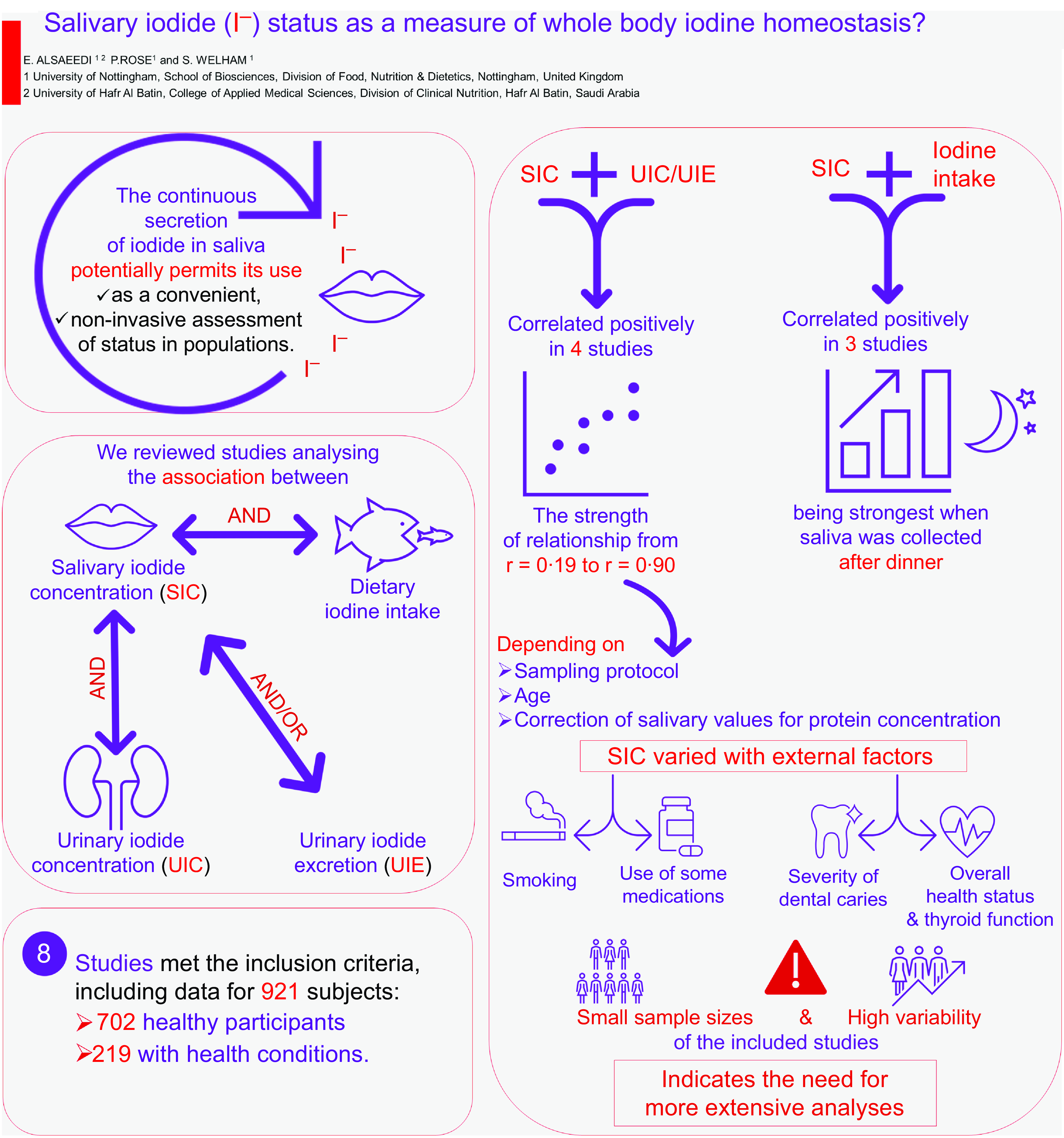
Iodine is a trace element required to produce the thyroid hormones, which are critical for development, growth and metabolism. To ensure appropriate population iodine nutrition, convenient and accurate methods of monitoring are necessary. Current methods for determining iodine status either involve a significant participant burden or are subject to considerable intra-individual variation. The continuous secretion of iodide in saliva potentially permits its use as a convenient, non-invasive assessment of status in populations. To assess its likely effectiveness, we reviewed studies analysing the association between salivary iodide concentration (SIC) and dietary iodine intake, urinary iodide concentration (UIC) and/or 24-h urinary iodide excretion (UIE). Eight studies conducted in different countries met the inclusion criteria, including data for 921 subjects: 702 healthy participants and 219 with health conditions. SIC correlated positively with UIC and/or UIE in four studies, with the strength of relationship ranging from r = 0·19 to r = 0·90 depending on sampling protocol, age, and if salivary values were corrected for protein concentration. Additionally, SIC positively correlated with dietary intake, being strongest when saliva was collected after dinner. SIC varied with external factors, including thyroid function, use of some medications, smoking and overall health status. Evidence provided here supports the use of SIC as a viable, low-burden method for determining iodine status in populations. However, small sample sizes and high variability indicates the need for more extensive analyses across age groups, ethnicities, disease states and dietary groups to clarify the relative accuracy and reliability in each case and standardise procedure.
The aim of this study was to assess whether adding Ca2+ to aggregate or native forms of β-lactoglobulin alters gut hormone secretion, gastric emptying rates and energy intake in healthy men and women. Fifteen healthy adults (mean ± sd: 9M/6F, age: 24 ± 5 years) completed four trials in a randomised, double-blind, crossover design. Participants consumed test drinks consisting of 30 g of β-lactoglobulin in a native form with (NATIVE + MINERALS) and without (NATIVE) a Ca2+-rich mineral supplement and in an aggregated form both with (AGGREG + MINERALS) and without the mineral supplement (AGGREG). Arterialised blood was sampled for 120 min postprandially to determine gut hormone concentrations. Gastric emptying was determined using 13C-acetate and 13C-octanoate, and energy intake was assessed with an ad libitum meal at 120 min. A protein × mineral interaction effect was observed for total glucagon-like peptide-1 (GLP-1TOTAL) incremental AUC (iAUC; P < 0·01), whereby MINERALS + AGGREG increased GLP-1TOTAL iAUC to a greater extent than AGGREG (1882 ± 603 v. 1550 ± 456 pmol·l−1·120 min, P < 0·01), but MINERALS + NATIVE did not meaningfully alter the GLP-1 iAUC compared with NATIVE (1669 ± 547 v. 1844 ± 550 pmol·l−1·120 min, P = 0·09). A protein × minerals interaction effect was also observed for gastric emptying half-life (P < 0·01) whereby MINERALS + NATIVE increased gastric emptying half-life compared with NATIVE (83 ± 14 v. 71 ± 8 min, P < 0·01), whereas no meaningful differences were observed between MINERALS + AGGREG v. AGGREG (P = 0·70). These did not result in any meaningful changes in energy intake (protein × minerals interaction, P = 0·06). These data suggest that the potential for Ca2+ to stimulate GLP-1 secretion at moderate protein doses may depend on protein form. This study was registered at clinicaltrials.gov (NCT04659902).
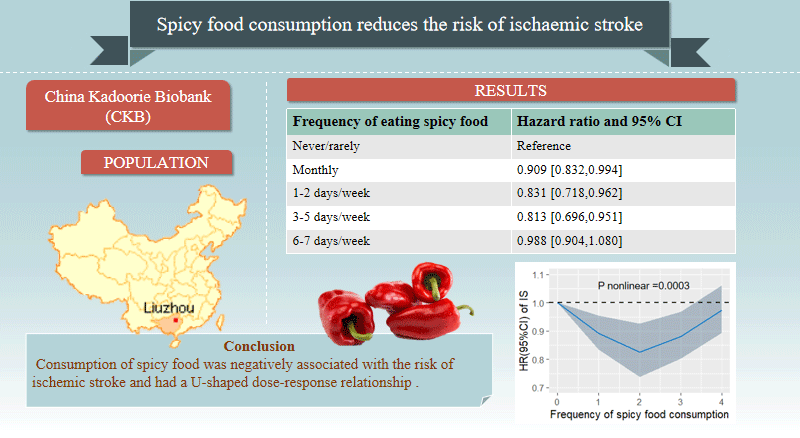
Previous studies revealed that consuming spicy food reduced mortality from CVD and lowered stroke risk. However, no studies reported the relationship between spicy food consumption, stroke types and dose–response. This study aimed to further explore the association between the frequency of spicy food intake and the risk of stroke in a large prospective cohort study. In this study, 50 174 participants aged 30–79 years were recruited. Spicy food consumption data were collected via a baseline survey questionnaire. Outcomes were incidence of any stroke, ischaemic stroke (IS) and haemorrhagic stroke (HS). Multivariable-adjusted Cox proportional hazard models estimated the association between the consumption of spicy food and incident stroke. Restricted cubic spline analysis was used to examine the dose–response relationship. During the median 10·7-year follow-up, 3967 strokes were recorded, including 3494 IS and 516 HS. Compared with those who never/rarely consumed spicy food, those who consumed spicy food monthly, 1–2 d/week and 3–5 d/week had hazard ratio (HR) of 0·914 (95 % CI 0·841, 0·995), 0·869 (95 % CI 0·758, 0·995) and 0·826 (95 % CI 0·714, 0·956) for overall stroke, respectively. For IS, the corresponding HR) were 0·909 (95 % CI 0·832, 0·994), 0·831 (95 % CI 0·718, 0·962) and 0·813 (95 % CI 0·696, 0·951), respectively. This protective effect showed a U-shaped dose–response relationship. For obese participants, consuming spicy food ≥ 3 d/week was negatively associated with the risk of IS. We found the consumption of spicy food was negatively associated with the risk of IS and had a U-shaped dose–response relationship with risk of IS. Individuals who consumed spicy food 3–5 d/week had a significantly lowest risk of IS.
The aim of this review is to provide an overview of the history in support of the role of dietary saturated fatty acids (SFA) in the development of cardiovascular disease (CVD), and the controversy and consensus for the evidence in support of guidelines to remove and replace SFA with unsaturated fatty acids. The review will also examine the existence, origins, and implications for CVD risk of variability in serum LDL-cholesterol in response to these guidelines. While the quality of supporting evidence for the efficacy of restricting SFA on CVD risk has attracted controversy, this has helped to increase understanding of the inter-relationships between SFA, LDL-cholesterol and CVD, and reinforce confidence in this dietary recommendation. Nevertheless, there is significant inter-individual variation in serum LDL-C in response to this dietary change. The origins of this variation are multi-factorial and involve both dietary and metabolic traits. If serum biomarkers of more complex metabolic traits underlying LDL-responsiveness can be identified, this would have major implications for the targeting of these dietary guidelines to LDL-responders, to maximise the benefit to their cardiovascular health.
To describe the food consumption, nutrition knowledge and nutritional assessment of childbearing age women and their children, living in rural villages in Madagascar. The results presented are related to the Tany Vao research study.
Design:
A cross-sectional pilot study.
Setting:
The study was carried out in Ampanitosoha village on Nosy Mitsio island in Madagascar.
Participants:
32 women (14–49 years) and 36 children and adolescents (2–17 years).
Results:
70 % of the women lacked nutrition knowledge and did not reach the Minimum Dietary Diversity Index for Women cut-off. The median BMI was 21·1 kg/m2 but 55·2 % of the women exceeded the cut-off for waist-to-hip ratio, 51·7 % for waist-to-height ratio and 81·2 % for mid-upper arm circumference (MUAC). Almost all had adequate intake of energy, protein and carbohydrates, while 27·6 % had excessive fat intake and 75·9 % of added sugars. Over half of the women did not meet the micronutrients Reference Daily Intake (RDI). For children, the MUAC z-score was lower for boys than for girls (P-value = 0·041).
Conclusions:
These results underline the importance of increasing women’s nutritional knowledge to promote healthy pregnancy and lactation. Moreover, it is fundamental to provide people living in rural areas with sustainable tools to improve dietary diversity and support long-term health.
This study aimed to investigate the association between n-3 PUFA and lung function. First, a cross-sectional study was conducted based on the National Health and Nutrition Examination Survey (NHANES) 2007–2012 data. n-3 PUFA intake was obtained from 24-h dietary recalls. A multivariable linear regression model was used to assess the observational associations of n-3 PUFA intake with lung function. Subsequently, a two-sample Mendelian randomisation (MR) was performed to estimate the potential causal effect of n-3 PUFA on lung function. Genetic instrumental variables were extracted from published genome-wide association studies. Summary statistics about n-3 PUFA was from UK Biobank. Inverse variance weighted was the primary analysis approach. The observational study did not demonstrate a significant association between n-3 PUFA intake and most lung function measures; however, a notable exception was observed with significant findings in the highest quartile for forced vital capacity (FVC) and % predicted FVC. The MR results also showed no causal effect of circulating n-3 PUFA concentration on lung function (forced expiratory volume in one second (FEV1), β = 0·01301, se = 0·01932, P = 0·5006; FVC, β = −0·001894, se = 0·01704, P = 0·9115; FEV1:FVC, β = 0·03118, se = 0·01743, P = 0·07359). These findings indicate the need for further investigation into the impact of higher n-3 PUFA consumption on lung health.
To examine whether targeted determinants mediated the effects of the HEalth In Adolescents (HEIA) intervention on fruit and vegetable (FV) consumption and explore if these mediating effects were moderated by sex, parental education or weight status.
Design:
Cluster-randomised controlled trial.
Setting:
The HEIA study (2007–2009) was a Norwegian 20-month multi-component school-based intervention to promote healthy weight development. FV consumption and targeted determinants were self-reported at baseline, mid-way (8 months) and post-intervention (20 months).
Participants:
Adolescents (11–13-year-old) in twenty-five control schools (n 746) and twelve intervention schools (n 375).
Results:
At post-intervention, more adolescents in the intervention group compared with the control group had knowledge of the FV recommendations (OR: 1·4, 95 % CI 1·1, 1·9) and reported a decreased availability of vegetables at home (β: –0·1, 95 % CI –0·2, 0·0). Availability/accessibility of FV at home, availability of vegetables at dinner, taste preferences for different types of FV and knowledge of the FV recommendations were positively associated with the consumption of FV. However, none of the post-intervention determinants significantly mediated the intervention effects on FV consumption. Although no moderating influences by sex, parental education or weights status were observed on the mediating effects, exploratory analyses revealed significant moderations in the b-paths.
Conclusions:
Since none of the targeted determinants could explain the increase in FV consumption, it remains unclear why the intervention was effective. Reporting on a wide range of mediators and moderators in school-based interventions is needed to reveal the pathways through which intervention effects are achieved.