To save content items to your account,
please confirm that you agree to abide by our usage policies.
If this is the first time you use this feature, you will be asked to authorise Cambridge Core to connect with your account.
Find out more about saving content to .
To save content items to your Kindle, first ensure no-reply@cambridge.org
is added to your Approved Personal Document E-mail List under your Personal Document Settings
on the Manage Your Content and Devices page of your Amazon account. Then enter the ‘name’ part
of your Kindle email address below.
Find out more about saving to your Kindle.
Note you can select to save to either the @free.kindle.com or @kindle.com variations.
‘@free.kindle.com’ emails are free but can only be saved to your device when it is connected to wi-fi.
‘@kindle.com’ emails can be delivered even when you are not connected to wi-fi, but note that service fees apply.
It is uncertain whether dietary intake of mushrooms rich in dietary fibre and several antioxidants is associated with a lower risk of dementia. We sought to examine prospectively the association between mushroom intake and the risk of disabling dementia. We performed a prospective study involving 3750 people aged 40 to 64 years residing in three communities who participated in an annual cardiovascular risk survey from 1985 to 1999. Cases of incident disabling dementia were surveyed from 1999 to 2020. We calculated the hazard ratios (HR) and 95 % CI for incident total dementia according to mushroom intake among participants with or without a history of stroke. During a mean 16·0 years’ follow-up in 3739 eligible participants, 670 people developed disabling dementia. For women, mushroom intake was inversely associated with the risk of total dementia and the association was confined to dementia without a history of stroke. The multivariable HR (95 % CI) for total dementia in women were 0·81 (0·62, 1·06) for mushroom intake of 0·1–14·9 g/d and 0·56 (0·42, 0·75) for mushroom intake above 15·0 g/d (Pfor trend = 0·003) compared with no intake. The corresponding HR (95 % CI) for dementia without a history of stroke were 0·66 (0·47, 0·93) and 0·55 (0·38, 0·79) (Pfor trend = 0·01). In men, no associations were observed between mushroom intake and the risk of disabling dementia. Among Japanese women, dietary mushroom intake was associated with a lower risk of disabling dementia.
The Global Dietary Database (GDD) expanded its previous methods to harmonise and publicly disseminate individual-level dietary data from nutrition surveys worldwide.
Design:
Analysis of cross-sectional data.
Setting:
Global.
Participants:
General population.
Methods:
Comprehensive methods to streamline the harmonisation of primary, individual-level 24-h recall and food record data worldwide were developed. To standardise the varying food descriptions, FoodEx2 was used, a highly detailed food classification and description system developed and adapted for international use by European Food Safety Authority (EFSA). Standardised processes were developed to: identify eligible surveys; contact data owners; screen surveys for inclusion; harmonise data structure, variable definition and unit and food characterisation; perform data checks and publicly disseminate the harmonised datasets. The GDD joined forces with FAO and EFSA, given the shared goal of harmonising individual-level dietary data worldwide.
Results:
Of 1500 dietary surveys identified, 600 met the eligibility criteria, and 156 were prioritised and contacted; fifty-five surveys were included for harmonisation and, ultimately, fifty two were harmonised. The included surveys were primarily nationally representative (59 %); included high- (39 %), upper-middle (21 %), lower-middle (27 %) and low- (13 %) income countries; usually collected multiple recalls/ records (64 %) and largely captured both sexes, all ages and both rural and urban areas. Surveys from low- and lower-middle v. high- and upper-middle income countries reported fewer nutrients (median 17 v. 30) and rarely included nutrients relevant to diet-related chronic diseases, such as n-3 fatty acids and Na.
Conclusions:
Diverse 24-h recalls/records can be harmonised to provide highly granular, standardised data, supporting nutrition programming, research and capacity development worldwide.
The dual burden of malnutrition is characterised by the coexistence of undernutrition alongside overweight/obesity and diet-related noncommunicable diseases. It is a paradox which disproportionately affects women and is applicable to those who become pregnant after weight loss surgery. Obesity before and during pregnancy is associated with increased risk of adverse perinatal outcomes in both mother and child. Overall lifestyle interventions targeting weight loss in the preconception period have not proven effective, with people, and women in particular, increasingly seeking weight loss surgery. In women with severe obesity, surgery may normalise hormonal abnormalities and improve fertility. In those who become pregnant after surgery, evidence suggests a better overall obstetric outcome compared to those with severe obesity managed conservatively; however, there is heightened risk of maternal nutritional deficiencies and infants born small for gestational age. Specifically, pregnancy soon after surgery, in the catabolic phase when rapid weight loss is occurring, has the potential for poor outcomes. Lifelong micronutrient supplementation is required, and there is considerable risk of malnutrition if nutritional aftercare guidelines are not adhered to. It is therefore recommended that pregnancy is delayed until a stable weight is achieved and is supported by individualised advice from a multidisciplinary team. Further research is required to better understand how weight loss surgery affects the chances of having a healthy pregnancy and to ultimately improve nutritional management and patient care. In this review, we aim to summarise the evidence and guidance around nutrition during pregnancy after weight loss surgery.
To investigate adolescents’ experiences with the food selection at the sport arena.
Design:
Four focus group interviews were conducted with 4–6 participants each. Interviews were recorded and transcribed verbatim. The transcripts were coded in NVivo and the analysis was guided by thematic analysis.
Setting:
Adolescents from handball and football clubs in Oslo and Viken, Norway, participated in the study.
Participants:
A total of nine boys (11–14 years old) and ten girls (11–14 years old) participated in the study.
Results:
We identified four main themes: interest for healthy food; experiences with the food selection at the sports arena; factors influencing participants’ food choices at the sports arena and expectations related to a healthy food selection at the sports arena. Adolescents across the focus groups experienced the food selection at the sports arena as unhealthy. Price, marketing and availability of unhealthy food were important factors that influenced their food choices at the sports arena. The trainer appeared to motivate the participants to eat healthy.
Conclusions:
Participants wished for a healthier food selection at the sports arena. Cost of food emerged as a factor that influenced their food choices. Our study also indicates that marketing of unhealthy food and beverages should be restricted, to influence adolescence food choice towards healthier alternatives.
The aim of this study was to investigate the social and environmental factors involved in the food decision-making processes of families living on lower incomes on the Island of Ireland.
Design:
A qualitative design was employed for this study, using photovoice and creative mapping methods. Parents were requested to take photos and draw maps of their food environments. Interviews were then conducted with parents, using the materials produced by parents as a cue to discuss their food environments, influences and decision-making processes around food choices.
Setting:
The participants were interviewed online via Microsoft Teams.
Participants:
The participants were parents or guardians of children between the ages of 2 and 18 who self-defined as ‘living on a tight budget’.
Results:
Twenty-eight participants were recruited and interviewed for this study, including twelve parents in Northern Ireland and sixteen in the Republic of Ireland. The findings were mapped on to Bronfenbrenner’s Ecological Systems Theory and showed that multiple, overlapping and intersecting factors at the individual, micro-, meso-, exo-, macro- and chrono-system were implicated in family food choices. Upstream factors in particular, including structural, policy and commercial determinants, appear to be significant drivers of behaviour.
Conclusions:
While the findings suggest that a complex range of factors are involved in family food choices, it is clear that policy measures and regulations are needed to stave off the impacts of rising social inequality and food poverty. Health promoters should strive to find non-stigmatising interventions to bridge the nutritional divide experienced by lower-income families.
This study assesses the relationship between adverse childhood experiences (ACE) occurring before the age of 18 years and patterns of fast-food consumption and sugary beverage consumption in adulthood. The study also examines how perceived stress and socio-economic status (SES) (college educational attainment and income) in adulthood mediate this relationship.
Design:
Using data from the National Longitudinal Study of Adolescent to Adulthood Health (N 8599), multinomial logistic regression analyses were carried out to assess the association between ACE and unhealthy dietary behaviours in adulthood. Karlson–Holm–Breen mediation analysis is used to determine the mediating effects of SES and perceived stress.
Setting:
Persons living in the USA in 2016–2018.
Participants:
Adults (n 8599) aged 33–44 years.
Results:
The findings show an association between four or more ACE and high fast-food (relative risk ratio (RRR) = 1·436, 95 % CI = 1·040, 1·983) and high sugary beverage consumption (RRR = 1·435, 95 % CI = 1·002, 2·055). The association between ACE and high fast-food consumption is partially mediated by college educational attainment, and the association between ACE and high sugary beverage consumption is partially mediated by perceived stress and college educational attainment.
Conclusions:
ACE can have long-term consequences for unhealthy dietary behaviours in adulthood, and this relationship is partially due to a lower likelihood of higher perceived stress and college educational attainment among ACE-exposed persons. Future research is needed to understand further the influence of ACE on dietary patterns over the life course.
The objective of this commentary is to provide an overview of the rationale and objectives of the Researching the Obesogenic Food Environment (ROFE) project that was conducted in Ghana and South Africa.
Design:
Narration has been used to describe the main objectives, phases as well as the methods used for the conduct of this project.
Setting:
The project described in this commentary was conducted in Khayelitsha and Mount Frere in South Africa and Ahodwo and Ejuratia for Ghana.
Participant:
Participants of the study described here include households in South Africa and Ghana, stakeholders and policymakers, and various actors within the food chain in both countries.
Results:
The ROFE findings provide a good understanding of the extent of the impact of the food environment on consumption, characteristics of value chains of healthy and unhealthy foods, as well as the potential for improved governance and policy that is relevant to the region. The supplement provides the opportunity to share the extensive findings of the ROFE project. Nine papers that describe the process and findings of the three phases of the ROFE project have been presented. Some of the papers focus on phases of the ROFE, while others cut across different phases and explore the linkages between the phases. Briefly descriptions of key findings of some of the papers in the supplement are provided.
Conclusion:
Together, the findings of the ROFE study presented in this supplement have increased understanding of how communities in SA and Ghana interact with their food supplies and have led to identification of specific opportunities to improve food supply policies, in ways that create incentives for the production and consumption of healthy, relative to unhealthy foods.
Healthy dietary patterns such as the Mediterranean diet (MeDi), Dietary Approaches to Stop Hypertension (DASH) and the Mediterranean-DASH Intervention for Neurodegenerative Delay (MIND) have been evaluated for their potential association with health outcomes. However, the lack of standardisation in scoring methodologies can hinder reproducibility and meaningful cross-study comparisons. Here we provide a reproducible workflow for generating the MeDi, DASH and MIND dietary pattern scores from frequently used dietary assessment tools including the 24-h recall tool and two variations of FFQ. Subjective aspects of the scoring process are highlighted and have led to a recommended reporting checklist. This checklist enables standardised reporting with sufficient detail to enhance the reproducibility and comparability of their outcomes. In addition to these aims, valuable insights in the strengths and limitations of each assessment tool for scoring the MeDi, DASH and MIND diet can be utilised by researchers and clinicians to determine which dietary assessment tool best meets their needs.
Carbonated soft-drink consumption is detrimental to multiple facets of adolescent health. However, little is known about temporal trends in carbonated soft-drink consumption among adolescents, particularly in non-Western countries. Therefore, we aimed to examine this trend in representative samples of school-going adolescents from eighteen countries in Africa, Asia and the Americas. Cross-sectional data from the Global School-based Student Health Survey 2009–2017 were analysed. Carbonated soft-drink consumption referred to drinking carbonated soft-drinks at least once per day in the past 30 d. The prevalence of carbonated soft-drink consumption was calculated for each survey, and crude linear trends were assessed by linear regression models. Data on 74 055 students aged 12–15 years were analysed (mean age 13·9 (sd 1·0) years; 49·2 % boys). The overall mean prevalence of carbonated soft-drink consumption was 42·1 %. Of the eighteen countries included in the study, significant decreasing, increasing and stable trends of carbonated soft-drink consumption were observed in seven, two and nine countries, respectively. The most drastic decrease was observed in Kuwait between 2011 (74·4 %) and 2015 (51·7 %). Even in countries with significant decreasing trends, the decrease was rather modest, while some countries with stable trends had very high prevalence across time (e.g. Suriname 80·5 % in 2009 and 79·4 % in 2016). The prevalence of carbonated soft-drink consumption was high in all countries included in the present analysis, despite decreasing trends being observed in some. Public health initiatives to reduce the consumption of carbonated soft-drink consumption among adolescents are urgently required.
Iodine and thyroid hormones (TH) transport in the placenta are essential for fetal growth and development, but there is little research focus on the human placenta. The research aimed to investigate iodine and TH transport mechanisms in the human placenta. The placenta was collected from sixty healthy pregnant women. Urinary iodine concentration (UIC), serum iodine concentration (SIC), placenta iodine storage (PIS) and the concentration of serum and placenta TH were examined. Five pregnant women were selected as insufficient intake (II), adequate intake (AI) and above requirements intake (ARI) groups. Localisation/expression of placental sodium/iodide symporter (NIS) and Pendrin were also studied. Results showed that PIS positively correlated with the UIC (R = 0·58, P < 0·001) and SIC (R = 0·55, P < 0·001), and PIS was higher in the ARI group than that in the AI group (P = 0·017). NIS in the ARI group was higher than that in the AI group on the maternal side of the placenta (P < 0·05). NIS in the II group was higher than that in the AI group on the fetal side (P < 0·05). In the II group, NIS on the fetal side was higher than on the maternal side (P < 0·05). Pendrin was higher in the II group than in the AI group on the maternal side (P < 0·05). Free triiodothyronine (r = 0·44, P = 0·0067) and thyroid-stimulating hormone (r = 0·75, P < 0·001) between maternal and fetal side is positively correlated. This study suggests that maternal iodine intake changes the expression of NIS and Pendrin, thereby affecting PIS. Serum TH levels were not correlated with placental TH levels.
Ultra-processed plant-based foods, such as plant-based burgers, have gained in popularity. Particularly in the out-of-home (OOH) environment, evidence regarding their nutritional profile and environmental sustainability is still evolving. Plant-based burgers available at selected OOH sites were randomly sampled in Amsterdam, Copenhagen, Lisbon and London. Plant-based burgers (patty, bread and condiment) (n 41) were lab analysed for their energy, macronutrients, amino acids and minerals content per 100 g and serving and were compared with reference values. For the plant-based burgers, the median values per 100 g were 234 kcal, 20·8 g carbohydrates, 3·5 g dietary fibre and 12·0 g fat, including 0·08 g TFS and 2·2 g SFA. Protein content was 8·9 g/100 g, with low protein quality according to amino acid composition. Median Na content was 389 mg/100 g, equivalent to 1 g salt. Compared with references, the median serving provided 31% of energy intake based on a 2000 kcal per day and contributed to carbohydrates (17–28%), dietary fibre (42%), protein (40%), total fat (48%), SFA (26%) and Na (54%). One serving provided 15–23% of the reference values for Ca, K and Mg, while higher contributions were found for Zn, Mn, P and Fe (30–67%). The ultra-processed plant-based burgers provide protein, dietary fibre and essential minerals and contain relatively high levels of energy, Na and total fats. The amino acid composition indicated low protein quality. The multifaceted nutritional profile of plant-based burgers highlights the need for manufacturers to implement improvements to better support healthy dietary habits, including reducing energy, Na and total fats.
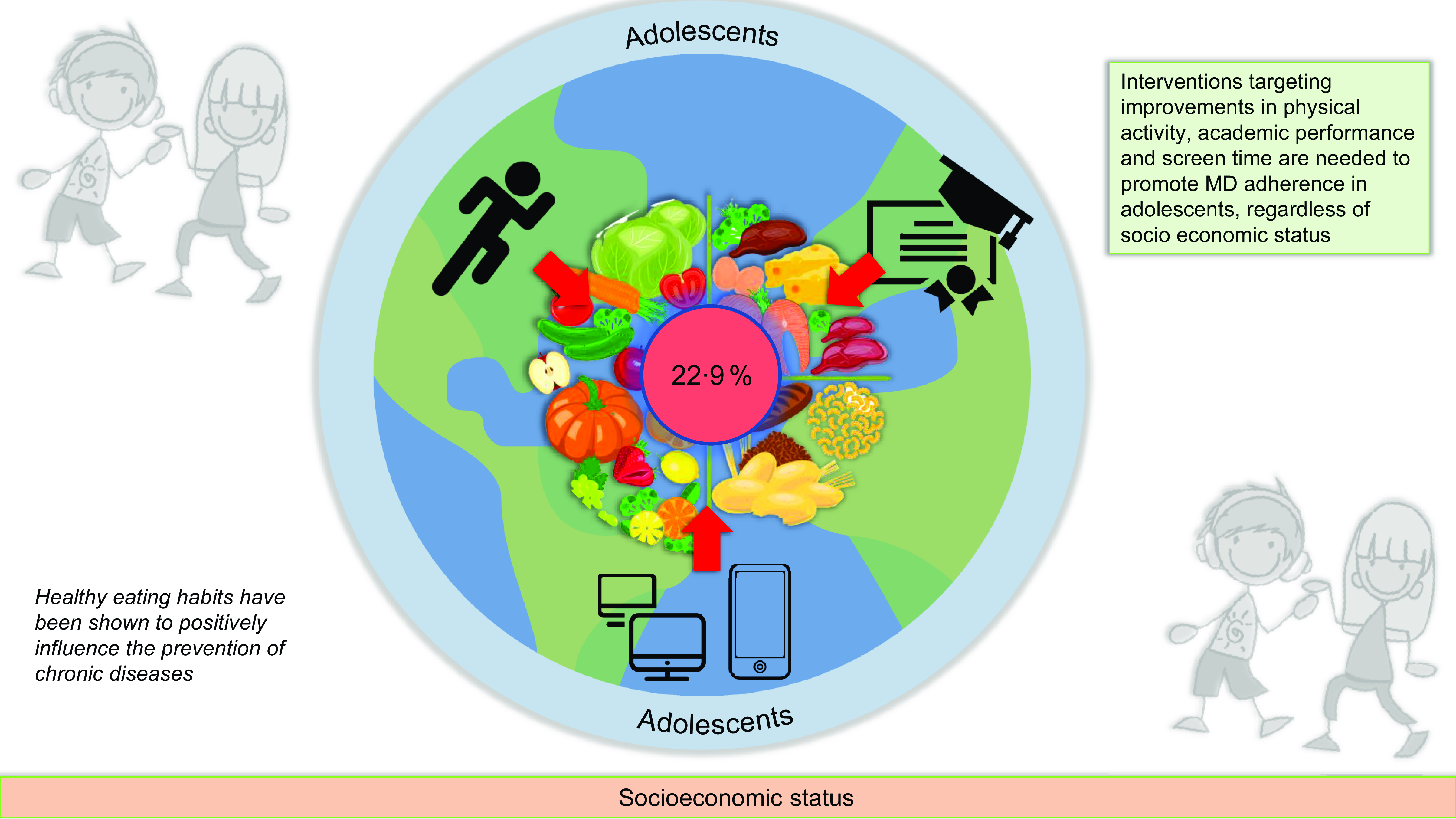
The present study examined the association of BMI, fat mass, physical activity engagement (PA), maximal oxygen consumption (VO2max), screen time and academic performance (AP) with Mediterranean diet (MD) adherence in a sample of high socio-economic status (SES) children.
Design:
A non-randomised design was used. A multilinear regression model was developed using backward elimination. Analysis included variables pertaining to age, BMI, VO2max, fat percentage, AP, PA engagement and screen time. All participants had a high SES and so this variable was not included as a predictor. Data met the assumptions required for multiple regressions in terms of linearity, homoscedasticity, normality, independence and non-multicollinearity.
Setting:
Two state and three mixed funding schools in Granada, Spain.
Participants:
Data were collected from 244 children aged between 10 and 12 years.
Results:
Better AP, higher PA engagement and lower screen time were found to be predictive of MD adherence. These variables explained 22·9 % of the variance in data measuring adolescent MD adherence.
Conclusions:
The present study suggests that, in addition to SES, PA, AP and screen time are important components to consider when targeting improvements in MD adherence in children. It is, therefore, concluded that interventions targeting improvements in PA, AP and screen time are needed to promote MD adherence in children, regardless of SES.
Diet quality is significantly impacted by social and environmental factors. People experiencing socio-economic disadvantage face inequitable barriers to accessing nutritious foods and health services, resulting in significant health disparities. This study aimed to explore the barriers faced by organisations that provide food support to people experiencing disadvantage as well as to identify potential strategies to enhance this support for improved well-being of clients.
Design:
Semi-structured interviews using an exploratory approach and inductive thematic analysis.
Setting:
Australia.
Participants:
Individuals from organisations involved in the provision of food support for people experiencing disadvantage aged ≥16 years.
Results:
Two major themes were identified from thirteen interviews. ‘Dignity and respect for clients’ serves as a guiding principle for food-related services across all organisations, while ‘food’ was a point of connection and a potential gateway to additional support pathways. Five additional subthemes included ‘food as a platform to reduce social isolation, foster connection and promote participation’, challenges with ‘servicing clients with diverse experiences and needs’, ‘dependence on staff and volunteers with varying knowledge and skillsets’, ensuring ‘adequate access to services, resources and facilities’ and ‘necessity of community collaboration’.
Conclusions:
This study highlights the unique position of organisations involved in food support to identify client-specific needs and implement broader holistic health support. Future interventions should prioritise dignity, respect and social connection in design. Organisations require an adequately trained, sustainable workforce, with shared or enhanced services, resources and facilities, and greater community coordination with other services to maximise effectiveness.
Obesity can increase the risk of postoperative complications. Despite increased demand for patients living with obesity to lose weight prior to common surgical procedures, the impact of intentional weight loss on surgical outcomes is largely unknown. We aimed to conduct a pilot study to assess the feasibility of a full-scale randomised controlled trial (RCT) to examine the effect of preoperative dietitian-led Very Low Calorie Diet (VLCD) Clinic on surgical outcomes in gynaecology and general surgeries. Between August 2021 and January 2023, a convenience sample of adults living with obesity (BMI ≥ 30 kg/m2) awaiting gynaecology, laparoscopic cholecystectomy and ventral hernia repair procedures were randomised to dietitian-led VLCD (800–1000 kcal using meal replacements and allowed foods), or control (no dietary intervention), 2–12 weeks preoperatively. Primary outcome was feasibility (recruitment, adherence, safety, attendance, acceptability and quality of life (QoL)). Secondary outcomes were anthropometry and 30-d postoperative outcomes. Outcomes were analysed as intention-to-treat. Fifty-one participants were recruited (n 23 VLCD, n 28 control), mean 48 (sd 13) years, 86 % female, and mean BMI 35·8 (sd 4·6) kg/m2. Recruitment was disrupted by COVID-19, but other thresholds for feasibility were met for VLCD group: high adherence without unfavourable body composition change, high acceptability, improved pre/post QoL (22·1 ± 15 points, < 0·001), with greater reductions in weight (–5·5 kg VLCD v. −0·9 kg control, P < 0·05) waist circumference (–6·6 cm VLCD v. +0·6 control, P < 0·05) and fewer 30-d complications (n 4/21) than controls (n 8/22) (P > 0·05). The RCT study design was deemed feasible in a public hospital setting. The dietitian-led VLCD resulted in significant weight loss and waist circumference reduction compared with a control group, without unfavourable body composition change and improved QoL.
Whole-body tissue protein turnover is regulated, in part, by the postprandial rise in plasma amino acid concentrations, although minimal data exist on the amino acid response following non-animal-derived protein consumption. We hypothesised that the ingestion of novel plant- and algae-derived dietary protein sources would elicit divergent plasma amino acid responses when compared with vegan- and animal-derived control proteins. Twelve healthy young (male (m)/female (f): 6/6; age: 22 ± 1 years) and 10 healthy older (m/f: 5/5; age: 69 ± 2 years) adults participated in a randomised, double-blind, cross-over trial. During each visit, volunteers consumed 30 g of protein from milk, mycoprotein, pea, lupin, spirulina or chlorella. Repeated arterialised venous blood samples were collected at baseline and over a 5-h postprandial period to assess circulating amino acid, glucose and insulin concentrations. Protein ingestion increased plasma total and essential amino acid concentrations (P < 0·001), to differing degrees between sources (P < 0·001), and the increase was further modulated by age (P < 0·001). Postprandial maximal plasma total and essential amino acid concentrations were highest for pea (2828 ± 106 and 1480 ± 51 µmol·l−1) and spirulina (2809 ± 99 and 1455 ± 49 µmol·l−1) and lowest for chlorella (2053 ± 83 and 983 ± 35 µmol·l−1) (P < 0·001), but were not affected by age (P > 0·05). Postprandial total and essential amino acid availabilities were highest for pea, spirulina and mycoprotein and lowest for chlorella (all P < 0·05), but no effect of age was observed (P > 0·05). The ingestion of a variety of novel non-animal-derived dietary protein sources elicits divergent plasma amino acid responses, which are further modulated by age.
To measure the effects of health-related food taxes on the environmental impact of consumer food purchases in a virtual supermarket.
Design:
This is a secondary analysis of data from a randomised controlled trial in which participants were randomly assigned to a control condition with regular food prices (n 152), an experimental condition with a sugar-sweetened beverage (SSB) tax (n 131) or an experimental condition with a nutrient profiling tax based on Nutri-Score (n 112). Participants were instructed to undertake their typical weekly grocery shopping for their households. Primary outcome measures were three environmental impact indicators: greenhouse gas (GHG) emissions, land use and blue water use per household per week. Data were analysed using linear regression analyses.
Setting:
Three-dimensional virtual supermarket.
Participants:
Dutch adults (≥ 18 years) who were responsible for grocery shopping in their household (n 395).
Results:
GHG emissions (–7·6 kg CO2-eq; 95 % CI –12·7, –2·5) and land use (–3·9 m2/year; 95 % CI –7·7, –0·2) were lower for the food purchases of participants in the nutrient profiling tax condition than for those in the control condition. Blue water use was not affected by the nutrient profiling tax. Moreover, the SSB tax had no significant effect on any of the environmental impact indicators.
Conclusions:
A nutrient profiling tax based on Nutri-Score reduced the environmental impact of consumer food purchases. An SSB tax did not affect the environmental impact in this study.
To investigate whether financial constraint and perceived stress modify the effects of food-related taxes on the healthiness of food purchases.
Design:
Moderation analyses were conducted with data from a trial where participants were randomly exposed to: a control condition with regular food prices, an sugar-sweetened beverage (SSB) tax condition with a two-tiered levy on the sugar content in SSB (5–8 g/100 ml: €0·21 per l and ≥8 g/100 ml: €0·28 per l) or a nutrient profiling tax condition where products with Nutri-Score D or E were taxed at a 20 percent level. Outcome measures were overall healthiness of food purchases (%), energy content (kcal) and SSB purchases (litres). Effect modification was analysed by adding interaction terms between conditions and self-reported financial constraint or perceived stress in regression models. Outcomes for each combination of condition and level of effect modifier were visualised.
Setting:
Virtual supermarket.
Participants:
Dutch adults (n 386).
Results:
Financial constraint or perceived stress did not significantly modify the effects of food-related taxes on the outcomes. Descriptive analyses suggest that in the control condition, the overall healthiness of food purchases was lowest, and SSB purchases were highest among those with moderate/high levels of financial constraint. Compared with the control condition, in a nutrient profiling tax condition, the overall healthiness of food purchases was higher and SSB purchases were lower, especially among those with moderate/high levels of financial constraint. Such patterns were not observed for perceived stress.
Conclusion:
Further studies with larger samples are recommended to assess whether food-related taxes differentially affect food purchases of subgroups.
Observational evidence linking dietary n-3 PUFA intake and health outcomes is limited by a lack of robust validation of dietary intake using blood n-3 PUFA levels and potential confounding by fish oil supplement (FOS) use. We investigated the relationship between oily fish intake, FOS use and plasma n-3 PUFA levels in 121 650 UK Biobank (UKBB) participants. Ordinal logistic regression models, adjusted for clinical and lifestyle factors, were used to quantify the contribution of dietary oily fish intake and FOS use to plasma n-3 PUFA levels (measured by NMR spectroscopy). Oily fish intake and FOS use were reported by 38 % and 31 % of participants, respectively. Increasing oily fish intake was associated with a higher likelihood of FOS use (P < 0·001). Oily fish intake ≥ twice a week was the strongest predictor of high total n-3 PUFA (OR 6·7 (95 % CI 6·3, 7·1)) and DHA levels (6·6 (6·3, 7·1). FOS use was an independent predictor of high plasma n-3 PUFA levels (2·0 (2·0, 2·1)) with a similar OR to that associated with eating oily fish < once a week (1·9 (1·8, 2·0)). FOS use was associated with plasma n-3 PUFA levels that were similar to individuals in the next highest oily fish intake category. In conclusion, FOS use is more common in frequent fish consumers and modifies the relationship between oily fish intake and plasma n-3 PUFA levels in UKBB participants. If unaccounted for, FOS use may confound the relationship between dietary n-3 PUFA intake, blood levels of n-3 PUFAs and health outcomes.