To save content items to your account,
please confirm that you agree to abide by our usage policies.
If this is the first time you use this feature, you will be asked to authorise Cambridge Core to connect with your account.
Find out more about saving content to .
To save content items to your Kindle, first ensure no-reply@cambridge.org
is added to your Approved Personal Document E-mail List under your Personal Document Settings
on the Manage Your Content and Devices page of your Amazon account. Then enter the ‘name’ part
of your Kindle email address below.
Find out more about saving to your Kindle.
Note you can select to save to either the @free.kindle.com or @kindle.com variations.
‘@free.kindle.com’ emails are free but can only be saved to your device when it is connected to wi-fi.
‘@kindle.com’ emails can be delivered even when you are not connected to wi-fi, but note that service fees apply.
There is serious concern for the future of a wide range of birds in Java and elsewhere in Indonesia due to both loss of habitat and trapping for the cagebird trade (the so-called “Asian Songbird Crisis”). Despite this concern, few data on presence and abundance of key species exist. We provide such data on 184 bird species from over two years of biodiversity surveys from 37 sites on 12 mountains in West and Central Java. Many of these species are heavily traded, endemic, and globally threatened. Several of the threatened endemics, notably Javan Trogon and Javan Cochoa, were often recorded, in terms of both geographical spread and numerical abundance. Rufous-fronted Laughingthrush, Spotted Crocias, and Orange-spotted Bulbul, believed to be threatened by trapping for the songbird trade, appear to remain fairly widespread. By contrast, Brown-cheeked Bulbul, Chestnut-backed (Javan) Scimitar-babbler, Javan Oriole, and especially Javan Blue-flycatcher, recorded on just a single occasion, and Javan Green Magpie, which we failed to record with certainty, now appear to be extremely rare. Our encounter rates, while not pinned to specific mountains for security reasons, represent an important baseline against which future changes in abundance can be gauged.
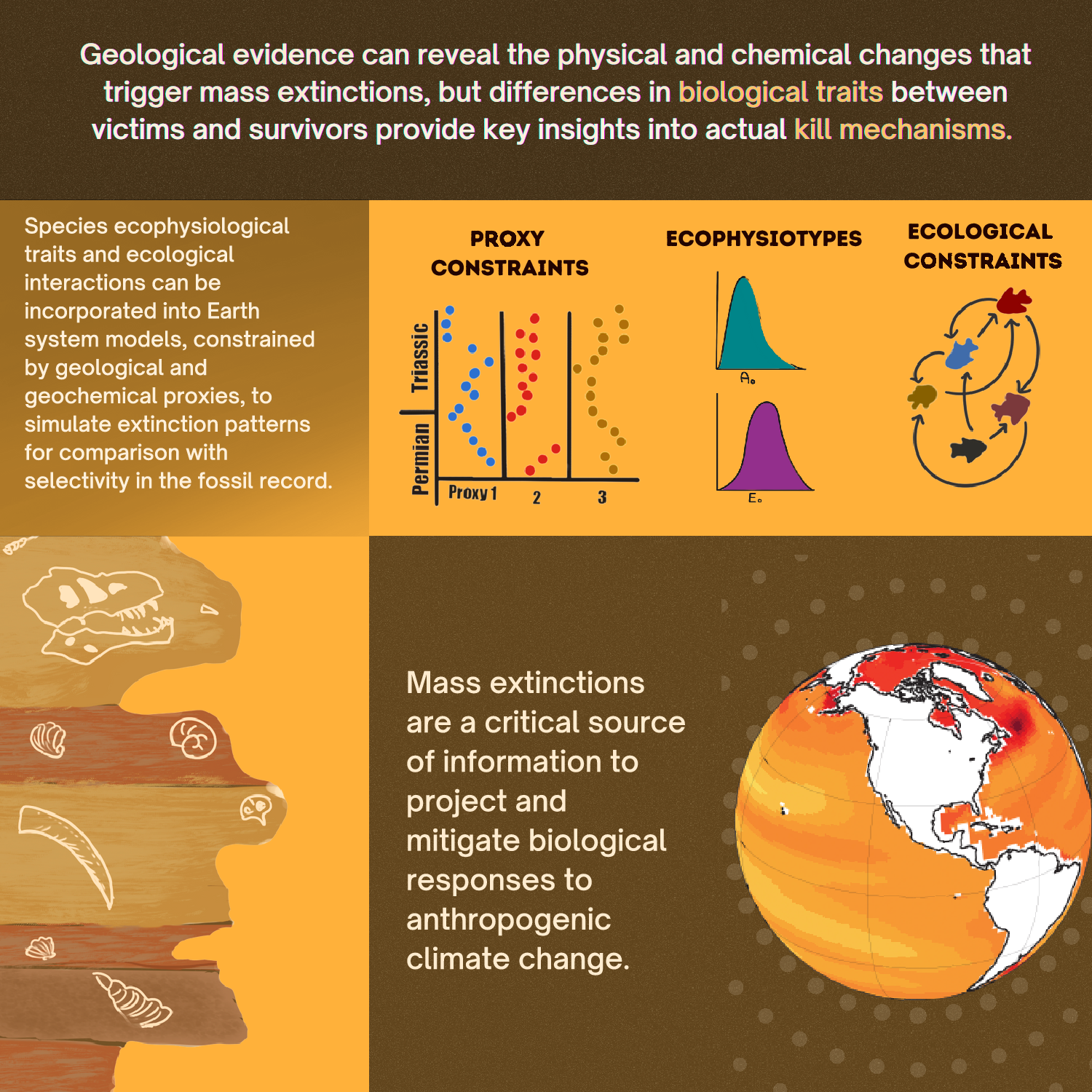
A central question in the study of mass extinction is whether these events simply intensify background extinction processes and patterns versus change the driving mechanisms and associated patterns of selectivity. Over the past two decades, aided by the development of new fossil occurrence databases, selectivity patterns associated with mass extinction have become increasingly well quantified and their differences from background patterns established. In general, differences in geographic range matter less during mass extinction than during background intervals, while differences in respiratory and circulatory anatomy that may correlate with tolerance to rapid change in oxygen availability, temperature, and pH show greater evidence of selectivity during mass extinction. The recent expansion of physiological experiments on living representatives of diverse clades and the development of simple, quantitative theories linking temperature and oxygen availability to the extent of viable habitat in the oceans have enabled the use of Earth system models to link geochemical proxy constraints on environmental change with quantitative predictions of the amount and biogeography of habitat loss. Early indications are that the interaction between physiological traits and environmental change can explain substantial proportions of observed extinction selectivity for at least some mass extinction events. A remaining challenge is quantifying the effects of primary extinction resulting from the limits of physiological tolerance versus secondary extinction resulting from the loss of taxa on which a given species depended ecologically. The calibration of physiology-based models to past extinction events will enhance their value in prediction and mitigation efforts related to the current biodiversity crisis.
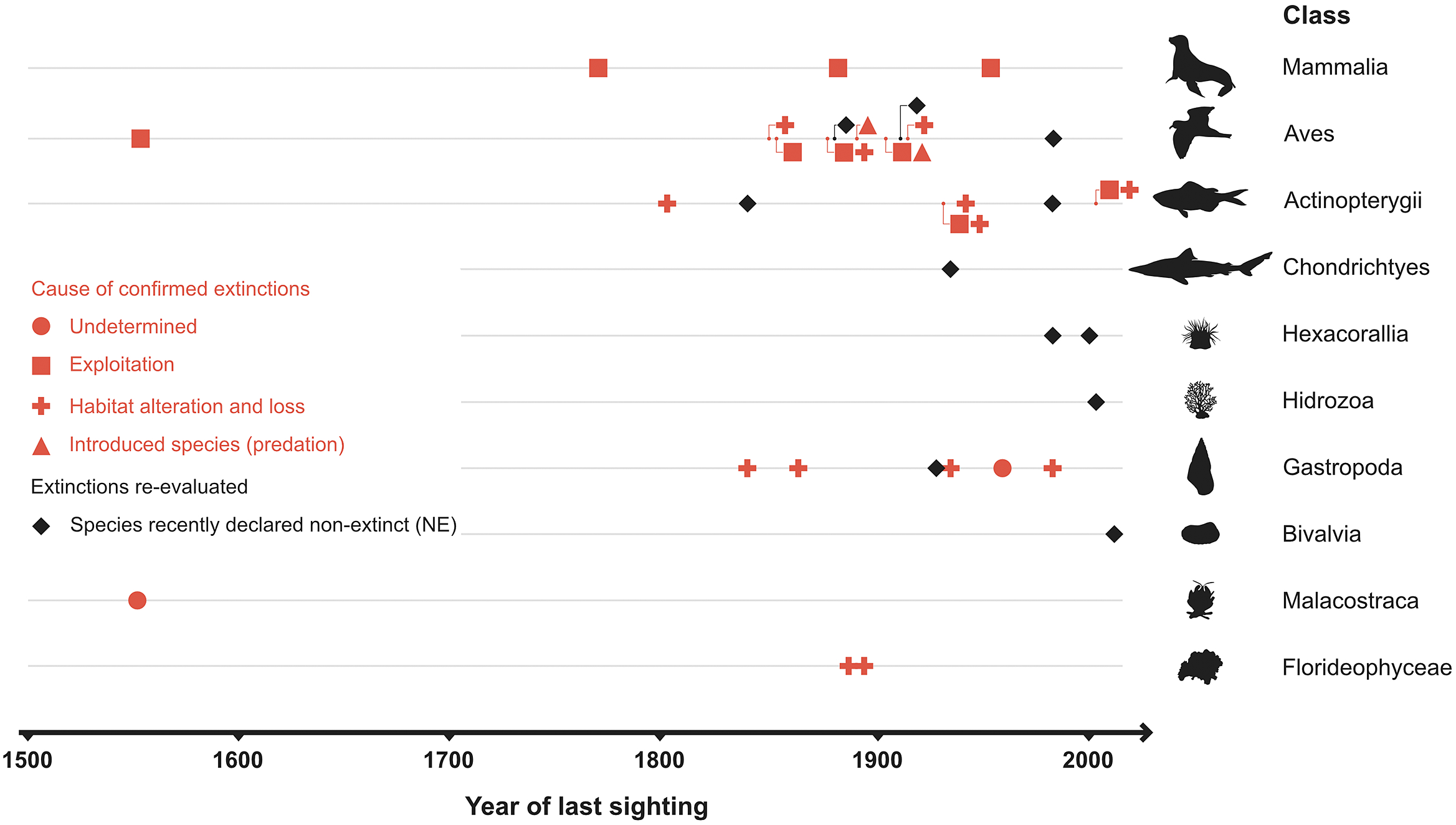
Between 20 and 24 marine extinctions, ranging from algal to mammal species, have occurred over the past 500 years. These relatively low numbers question whether the sixth mass extinction that is underway on land is also occurring in the ocean. There is, however, increasing evidence of worldwide losses of marine populations that may foretell a wave of oncoming marine extinctions. A review of current methods being used to determine the loss of biodiversity from the world’s oceans reveals the need to develop and apply new assessment methodologies that incorporate standardized metrics that allow comparisons to be made among different regions and taxonomic groups, and between current extinctions and past mass extinction events. Such efforts will contribute to a better understanding of extinction risk facing marine flora and fauna, as well as the ways in which it can be mitigated.
Information about population sizes, trends, and habitat use is key for species conservation and management. The Buff-breasted Sandpiper Calidris subruficollis (BBSA) is a long-distance migratory shorebird that breeds in the Arctic and migrates to south-eastern South America, wintering in the grasslands of southern Brazil, Uruguay, and Argentina. Most studies of Nearctic migratory species occur in the Northern Hemisphere, but monitoring these species at non-breeding areas is crucial for conservation during this phase of the annual cycle. Our first objective was to estimate trends of BBSA at four key areas in southern Brazil during the non-breeding season. We surveyed for BBSA and measured vegetation height in most years from 2008/09 to 2019/20. We used hierarchical distance sampling models in which BBSA abundance and density were modelled as a function of vegetation height and corrected for detectability. Next, we used on-the-ground surveys combined with satellite imagery and habitat classification models to estimate BBSA population size in 2019/20 at two major non-breeding areas. We found that abundance and density were negatively affected by increasing vegetation height. Abundance fluctuated five- to eight-fold over the study period, with peaks in the middle of the study (2014/15). We estimated the BBSA wintering population size as 1,201 (95% credible interval [CI]: 637–1,946) birds in Torotama Island and 2,232 (95% CI: 1,199–3,584) in Lagoa do Peixe National Park during the 2019/20 austral summer. Although no pronounced trend was detected, BBSA abundance fluctuated greatly from year to year. Our results demonstrate that only two of the four key areas hold high densities of BBSA and highlight the positive effect of short grass on BBSA numbers. Short-grass coastal habitats used by BBSA are strongly influenced by livestock grazing and climate, and are expected to shrink in size with future development and climatic changes.
Based on censuses in 2021 and 2022 of Bristle-thighed Curlews Numenius tahitiensis on 10 atolls of French Polynesia, the species has declined by c.50% over the last two decades. While the species has recently been down-listed from “Vulnerable” to “Near Threatened”, these new data would qualify it for an “Endangered” Red List status. The non-breeding population on Tuamotu numbers approximately 1,000 curlews and up to 1,500 individuals in all of Eastern Polynesia. On uninhabited islands, the expansion of copra (coconut pulp) exploitation has caused long-term disturbance for curlews, increased predation by pet dogs, and introduced or reinforced non-native rat populations. Climate change, particularly sea-level rise, will add to changes in land use that shrink the suitable habitat for Bristle-thighed Curlews in French Polynesia. As this study shows, obtaining population trends for species breeding in remote areas may best be achieved through surveys at key non-breeding sites.
This study provides the first record of the beaded sea cucumber Euapta lappa at Madeira Island. A single individual was observed during a nocturnal scuba dive at 17 m depth, presumably feeding. After having its previous northern limit in the North-east Atlantic at the Selvagens Islands, this record expands the known distribution and northern limit of this tropical species by about 300 km. This new record of yet another tropical species expanding its range northwards can be seen as another indication of the ongoing tropicalization in the marine environment of Macaronesia in the North-east Atlantic.
Beaks are one of the most important sclerochronological structures used to study the age and growth of cephalopods, in particular Octopus vulgaris Cuvier, 1797. The present study provides results of ageing of 128 O. vulgaris (56–239 mm dorsal mantle length, DML; 121–5974 g total weight, TW) collected in the southern Moroccan Mediterranean coasts between Fnideq and Jebha. The number of increments corresponding to the age (days since hatching) varied from 137–368 in females and from 129–382 in males. There was a significant correlation between beak and somatic growth. The correlation coefficients of the growth curves DML-Age and TW-Age were similar for both power and exponential models: DML = 0.185Age1.188 (R2 = 0.547), DML = 35.933e0.005Age (R2 = 0.546), TW = 0.00002Age3.260 (R2 = 0.532), TW = 29.56e0.014Age (R2 = 0.541). The average width of the increments was similar between females and males. It varied significantly with season and stage of sexual maturity. Comparison of the growth curve with those estimated by other authors showed that Moroccan Mediterranean O. vulgaris grew faster than that of Sardinia (Italy) and slower than that of the Mauritanian coast.
The Blue-throated Hillstar Oreotrochilus cyanolaemus is a recently described hummingbird endemic to the southern Andes of Ecuador. This “Critically Endangered” species faces multiple conservation problems; thus, acquiring basic ecological information is a key step for guiding sound and integral conservation actions. We performed a series of expeditions throughout the cordillera Chilla-Tioloma-Fierro Urco to gain new data about its ecology, abundance, breeding, and distribution. From November 2019 to March 2020, we surveyed a total of 161.6 km searching for O. cyanolaemus, and gathered data on encounter rates, microhabitats used, and flower resources used. From November 2020 to January 2021 we studied the breeding ecology of the species. Occurrence records of O. cyanolaemus were used to build a species distribution model, based on climatic variables and the normalised difference vegetation index (NDVI). We found that the species is relatively more abundant in the western and central portion of its distribution range. Males were found using more shrubby habitats than females, who used more open habitats. They visited flowers of 11 plant species, with Chuquiraga jussieui and Puya ssp. being the most frequently used flowers. Nests were found in caves and rocky walls, and only one out of three active nests was successful. The distribution model indicated that the species has a potential distribution range of 62.7 km2. This manuscript is the first comprehensive evaluation of the ecological requirements of the species, and the information provided has important potential for use as a conservation guide for the species and its habitats.
The Amathole forest complex is the breeding stronghold of the endemic and vulnerable Cape Parrot Poicephalus robustus, and is also one of only two forest complexes in South Africa formally harvested for timber. The aim of this study was to determine if formal harvesting of indigenous trees, primarily the two yellowwood species Afrocarpus falcatus and Podocarpus latifolius, in 9 of 16 Amathole forests has had any effect on the presence of Cape Parrots and three primary nest-excavating species, as well as on parrot breeding. The study used logging data from the past 25 years (1997–2021) as well as data collected by acoustic recording units over two breeding seasons from 2019 to 2021. Cape Parrots were present in 15 of 16 forests, but breeding calls were identified in only seven forests: five in logged and two in unlogged forests. Fourteen of the forests harboured all three primary excavators: Knysna Woodpecker Campethera notata, Olive Woodpecker Dendropicos griseocephalus, and Red-fronted Tinkerbird Pogoniulus pusillus. The last two species were absent from the adjacent Mount Thomas and Kologha forests, respectively, in which parrots were present, but no breeding calls were recorded. Logging of yellowwoods was not found to affect parrot breeding. However, due to the overlap between preferred parrot breeding sites and preferred trees for harvesting, we recommend that harvesting in the five harvested forest blocks where parrot breeding occurs be limited to tree falls, with no standing dead, dying, or damaged trees harvested, to ensure that potential nesting trees are not harvested.
Of the 21 species recorded from the greater Azores region during the HMS ‘Challenger’ Expedition, 12 were newly introduced during the late 19th century. The respective types of these species are fixed, and eight species are redescribed based on scanning electron microscope analysis (Notoplites bilobus, Raxifabia minuta, Hemicyclopora canalifera, Smittoidea oratavensis comb. nov., Buskea ovalis comb. nov., Buskea fayalensis comb. nov., Celleporina ansata comb. nov. and Reteporella atlantica comb. nov.). Another four species are merely dealt with shortly either because the material is insufficiently preserved for a thorough revision (Columnella gracilis, Carbasea pedunculata), or because the species have recently been revised already (Notoplites clausus, Microporella hastigera). Moreover, two Azorean species that were introduced by later workers are synonymized with ‘Challenger’ species: S. oratavensis is considered a senior synonym of Smittia ensifera, and Lekythopora laciniosa is synonymized with C. ansata.
Landscape changes affect species abundance and drive biodiversity loss. Here we explored if habitat amount and patch aggregation shape the abundance of forest passerines within the south-western Palaearctic (Morocco). As forests in this region are affected by increasing drought and temperature, we also forecasted their trends according to current predictions of climate change and explored how landscape changes could affect bird distribution. We recorded geo-referenced occurrences of seven forest passerines that were modelled with a set of environmental variables with Maxent to predict their distribution. The occurrence probabilities provided by the models were used as surrogates for the current distribution of habitat amount and patch aggregation within the country. In addition, 190 500-m line transects scattered within the country were used to estimate local bird abundance. Results showed that bird abundance recorded in line transects was positively correlated with habitat amount and patch aggregation of landscape around transects. This supports the idea that changes in these landscape metrics affect the abundance of the study species. Climate-change projections suggest that habitat amount and patch aggregation will decline in southern sectors but will be maintained or will increase at higher elevations. Given their relationship to abundance, these landscape changes suggest that forest birds will have to shift to the northernmost and elevated sectors. These results showed that landscape management can play an important role in the conservation of rear-edge populations of forest birds and suggest that any increase in forest amount and connectivity will improve bird resilience under a global change scenario.
The sicklefin devil ray (Mobula tarapacana) is a large, pelagic ray which is listed as Endangered by the International Union for Conservation of Nature (IUCN). Mobula tarapacana is thought to have a circumglobal, yet patchy distribution, and has not been verified extant off the eastern USA. Here, we report 180 sightings of M. tarapacana with a total of 361 individuals, collated across five datasets from aerial survey operations and incidental sightings in the waters off the US East Coast and Gulf of Mexico, between 1996 and 2022. This study extends the northern range of M. tarapacana in the Gulf of Mexico to 29°N, and in the Atlantic to 40°N. Seasonal trends were observed off the north-eastern coast of the USA, with M. tarapacana only present in the summer months. Measurements from high resolution digital aerial imagery found M. tarapacana off the New York coast to be adults and subadults with an average disc width of 268 cm (±25, range 232–316 cm). This study provides important spatial and temporal data for management, as well as informing areas for future research on M. tarapacana in the western Atlantic.
Fragmentation and rapid conversion of forested landscapes to farmland and human settlements in Upper Assam, India has led to the isolation of western hoolock gibbon (Hoolock hoolock) families in fragmented patches of village areas. Many families have perished due to resource scarcity and conflict with development; however, the villages of Barekuri area in Upper Assam have retained a substantial number of gibbon families for many years. We monitored the population (nine families) from 2011 to 2017 and present long-term data on social organisation and its dynamics in Barekuri area. We recorded eight births, nine deaths and four dispersals in the population. Five of the nine deaths were due to electrocution that reduced the population size from 29 individuals in nine groups in 2011 (3.22 ± SD 0.67) to 24 in seven groups in 2017 (3.29 ± SD 0.76), with a mean group size of 3.67 ± SD 0.85 which did not differ over the years. Female inter-birth intervals and ages at first reproduction are comparable with those in wild populations. Both males and females took the opportunity to form groups and breed, and male replacement and female surrogacy indicate flexibility in a pair-bond. Our observations thus support a growing knowledge of variability in the social organisation of gibbons.
Insects are the most abundant and diverse group of animals on Earth. They are critical to ecosystem function in terrestrial and aquatic systems, yet they are one of the most understudied groups of organisms. Only a small proportion of the more than five million insect species have been assessed by the IUCN Red List. For most of these species, there is not enough evidence to know what is happening to their populations. In fact, for most insect species globally, there is very little data available on where they live, how they live and what environmental conditions they need to persist in the long term. A number of threats affect insect biology and life cycles generally, including climate change, habitat clearing, invasive species, use of broad-spectrum pesticides, and pollution of soil and waterways. These threats should be addressed immediately to prevent further declines in insect populations. To understand insects better, greater investment in research and documentation of the world’s insect diversity is urgently needed.
Local awareness and cultural value of threatened species are regarded as integral components of conservation programmes, but pro-environmental attitudes do not necessarily prevent negative human interactions with threatened species. The history of cultural attitudes towards gibbons in China provides an important case study about long-term conservation effectiveness of positive biodiversity values. Animals readily identifiable as gibbons are frequently recorded in Chinese culture from the Zhou Dynasty onward. Gibbons were interpreted as symbols of the supernatural and celebrated in Chinese literature and art. They were also regarded as positive moral exemplars embodying virtuous filial Confucian values, and were equated with the concept of junzi, a noble person who strives after virtue and inspires by example. However, positive cultural associations had little effect in preventing the historical loss of gibbon populations across nearly all of China. Historical records also document exploitation of gibbons for medicinal and other uses, and gibbon declines likely reflect historical conflict with economic demands for local subsistence in marginalised low-income communities. Positive cultural values may therefore be insufficient to prevent species losses if they are outweighed by economic pressures, and awareness may not contribute to positive behavioural change if it does not address drivers of negative human–wildlife interactions.
The conservation status of the taxa in this book is measured using the criteria of the Red List of Threatened Species™. The Red List is overseen by the International Union for Conservation of Nature (IUCN), and categorises species according to extinction risk. This chapter summarises the history of the Red List and explains the criteria used to assess species’ extinction risk, as well as the quality control procedures in place today. This chapter also introduces a new part of the Red List, formalised in 2021: The Green Status of Species, a set of metrics which assess species’ progress towards functional recovery across its range and the impact of conservation actions.
In Chapter 1 it was emphasised that the first cellular life forms to evolve were bacteria, and that photosynthetic bacteria called cyanobacteria released oxygen through photosynthesis and thus set in train the conditions which allowed the many forms of aerobic life to evolve.