To save content items to your account,
please confirm that you agree to abide by our usage policies.
If this is the first time you use this feature, you will be asked to authorise Cambridge Core to connect with your account.
Find out more about saving content to .
To save content items to your Kindle, first ensure no-reply@cambridge.org
is added to your Approved Personal Document E-mail List under your Personal Document Settings
on the Manage Your Content and Devices page of your Amazon account. Then enter the ‘name’ part
of your Kindle email address below.
Find out more about saving to your Kindle.
Note you can select to save to either the @free.kindle.com or @kindle.com variations.
‘@free.kindle.com’ emails are free but can only be saved to your device when it is connected to wi-fi.
‘@kindle.com’ emails can be delivered even when you are not connected to wi-fi, but note that service fees apply.
Although it feels like we live in a time of seeming hopelessness, this pioneering book illustrates what language can teach us about the practice, logic, and feasibility of hope in the twenty-first century. Silva and Lee highlight how people living in Brazilian urban peripheries, who have grown accustomed to unrelenting prejudice and violence on an everyday basis, use language to survive and imagine futures that are worth aspiring to. In so doing, this book foregrounds how language becomes a matter of survival for these communities. It provides a thorough theorization of how language can produce conditions of hope, moving away from the idea of language merely as a tool of communication and toward something that can meaningfully impact social realities. Innovative and engaging, it is essential reading for researchers and students in applied linguistics, sociolinguistics and linguistic anthropology. This title is also available as open access on Cambridge Core.
In communities across the US, people wrestle with which languages to use, and who gets to decide. Despite more than 67 million US residents using a language other than English at home, over half of the states in the US have successfully passed English-only policies. Drawing on archives and interviews, this book tells the origin story of the English-only movement, as well as the stories of contemporary language policy campaigns in four Maryland county governments, giving a rare glimpse into what motivates the people who most directly shape language policy in the US. It demonstrates that English-only policies grow from more local levels, rather than from nationalist ideologies, where they are downplayed as harmless community initiatives, but result in monolingual approaches to language remaining increasingly pervasive. This title is part of the Flip it Open Programme and may also be available Open Access. Check our website Cambridge Core for details.
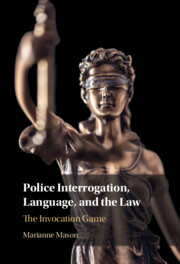
Recent calls for justice reform have put a spotlight on how the police enforce the law in the United States. How a person's constitutional rights may be legally thwarted during police interrogation, however, has not been part of any meaningful discussion on police reform. This novel book examines the intersections of the law and policing discourse through the detailed analysis of a large corpus of United States federal court rulings, starting with Miranda v. Arizona (1966). It covers a wide range of topics, including the history of police interrogation in the United States, the role of federal law in handicapping a person's ability to invoke their right to counsel, and the invocation game of police interrogation that may lead a variety of suspects to change their discursive preferences. It highlights the need for American police interrogation reform, exploring the paths taken by other jurisdictions outside of the United States. This title is part of the Flip it Open programme and may also be available on open access. Check our website, Cambridge Core, for details.
Chapter 1 examines the steps that are attendant to custodial interrogation in the United States. Many of these steps, and what they entail, are not readily known to the general public. Hence, to contextualize the corpus, Chapter 1 starts with a brief overview of what constitutes custodial interrogation, leading to a description of the federal court system that reviewed the cases. This examination will provide insights into the inner workings of the federal courts and the role of the judges in the federal court system. Chapter 1 also provides a brief overview of the common grounds for appeals in cases reviewing potential Miranda violations, as well as definitions for the terminology often referred to in the chapters. The chapter concludes with a brief analysis on the three key themes of the book: the legal foundation of police interrogation, the strategic features of invoking counsel in custodial settings, and tackling police interrogation reform in the United States.
Chapter 3 delves into commonly used police interrogation techniques in the United States, such as behavioral analysis approaches to interrogation (the Reid technique) and other rapport-based methods featured in the High Value Detainee Interrogation Group (HIG) Report (2016). This chapter focuses on some of the interrogation methods used by police, law enforcement agencies of the United States federal government (e.g., FBI, DEA), and the military to interrogate custodial suspects and evaluates how these methods fit with the Miranda rights and a suspect’s ability to invoke counsel in a custodial setting. How interrogators approach the Miranda rights stage of an interrogation across the book’s corpus, and potentially across interviewing styles, provides insights into the possible connection between the law and how interviewing styles are used and implemented in the United States. Chapter 3 also raises additional considerations when discussing any interrogation or interviewing style, in light of current United States law.
Chapter 4 provides the theoretical framework for suspects’ invocations for counsel in the book’s corpus. The analysis will focus on the discursive features of suspects’ invocations for counsel during custodial interrogation, as well as the sequences of talk that follow the suspects’ invocations. This part of the analysis will use applied game theory, specifically hypergame theory, to describe police-suspect exchanges after a suspect invokes counsel. The model of the invocation game of police interrogation extends signal analysis from simple signaling games into extended conversations based on strategic objectives. This application of game theory to the invocation stage of an interrogation shows how an interrogator can manipulate a custodial suspect to change their preference to invoke counsel due to the ambiguities created by case law, which designates interrogators as arbiters of what constitutes an unequivocal invocation of the right to counsel, and stylized by formal training that encourages interrogators to engage in strategic discourse with suspects to maintain the possibility of obtaining statements.
Chapter 5 provides a statistical analysis of the legal rulings that comprise the book’s corpus. The analysis looks at the possible relationships between the variables that make up the corpus, including types of invocations for counsel, types of suspects (e.g., juveniles, L2 speakers), and the judges’ presidential appointments, among an array of other legal and linguistic factors, and the judges’ rulings on the legal standing of the suspects’ invocations for counsel. To frame the discussion and understand the seeming disconnect between suspects’ invocations for counsel and the application of the law, the chapter provides a description of the corpus, the entry and selection of variables, and the research questions posed. The findings of the analysis provide further evidence of the effect of judicial rulings on the suspects/defendants’ legal journey. Given the potential significant role of suspects’ statements in the conviction of a crime, this chapter also includes a discussion on whether a ruling that suppresses such statements is enough to reverse a lower court’s ruling on the use of such statements and/or its content in court.
Chapter 2 explores how law enforcement’s ability to engage discursively with suspects and other lay persons is limited by the law. Judicial rulings regarding suspects’ rights during custodial interrogation, such as the right to counsel, provide insights into how the United States federal court system, led by the main court of the land the Supreme Court of the United States, views suspects’ constitutional rights, on the one hand, and the societal benefit of police officers being able to conduct criminal investigations, on the other. The chapter discusses the evolution of the right to counsel in the federal courts, since the seminal Miranda v. Arizona (1966) ruling, and the insights this history provides in framing the law as a facilitator or, alternatively, a deterrent to suspects invoking their right to counsel, prior to the onset of custodial interrogation. This analysis of opinions from the Court, circuit courts, district courts, and a few military courts, that make up the book’s corpus, will shed light on how judges have viewed the role of police in society, through time, and whether some in the judiciary consider the Miranda ruling as overreaching in its ‘intended’ constitutional protections.
Chapter 6 will explore paths to moving forward with police interrogation reform in the United States, parting from the lessons of other countries that have undertaken reform, such as the United Kingdom, Australia, Norway, and Canada, while focusing on three key areas: 1) police interrogation techniques, 2) the interview of vulnerable populations, and 3) changes in case law related to the reading of rights, invocation of rights, the use of trickery and deception, as well as the use of confessions to build and prosecute a criminal case. The goal of the chapter is to consider ways in which the issues presented in this book can be revisited to change the current state of police interrogation in the United States. This will require changes across the board: legislative, legal, police interviewing training, and also an acknowledgment of the role of cognitive, cultural, and sociolinguistic factors in police-suspect discursive interactions. A change of perspective on the presence of counsel in the interview room is also explored, looking at other jurisdictions outside of the United States which provide access to counsel to custodial suspects.
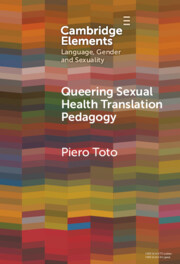
Sexual health campaigns to tackle the rise in sexually transmitted infections in England are at the core of sexual health charities' and grassroots organizations' work. Some of them collaborated with the author's translation students to produce inclusive translations of their sexual health content (website and multimedia content). The role of translation and localization within multicultural contexts can be seen as 'social activism' promoting sexual health and community engagement, with a view to providing wider healthcare access and information using inclusive language. This Element presents students' approaches to sexual health translation, using language as a vessel for change and striking a balance between clients' expectations, translation industry best practices, and socio-educational needs. The data analysis of the students' experiences will make the case for wider embedding of queer pedagogy approaches into the translation curriculum.
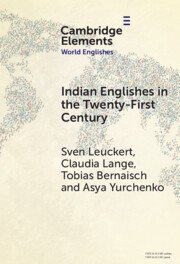
English fulfils important intra- and international functions in 21st century India. However, the country's size in terms of area, population, and linguistic diversity means that completely uniform developments in Indian English (IndE) are unlikely. Using sophisticated corpus-linguistic and statistical methods, this Element explores the unity and diversity of IndE by providing studies of selected lexical and morphosyntactic features that characterise Indian English(es) in the 21st century. The findings indicate a degree of incipient 'supralocalisation', i.e. a spread of features beyond their place of origin, cutting through the typological Indo-Aryan vs. Dravidian divide.