To save content items to your account,
please confirm that you agree to abide by our usage policies.
If this is the first time you use this feature, you will be asked to authorise Cambridge Core to connect with your account.
Find out more about saving content to .
To save content items to your Kindle, first ensure no-reply@cambridge.org
is added to your Approved Personal Document E-mail List under your Personal Document Settings
on the Manage Your Content and Devices page of your Amazon account. Then enter the ‘name’ part
of your Kindle email address below.
Find out more about saving to your Kindle.
Note you can select to save to either the @free.kindle.com or @kindle.com variations.
‘@free.kindle.com’ emails are free but can only be saved to your device when it is connected to wi-fi.
‘@kindle.com’ emails can be delivered even when you are not connected to wi-fi, but note that service fees apply.
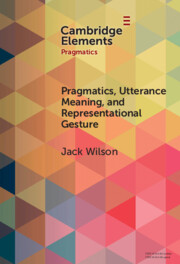
Humans produce utterances intentionally. Visible bodily action, or gesture, has long been acknowledged as part of the broader activity of speaking, but it is only recently that the role of gesture during utterance production and comprehension has been the focus of investigation. If we are to understand the role of gesture in communication, we must answer the following questions: Do gestures communicate? Do people produce gestures with an intention to communicate? This Element argues that the answer to both these questions is yes. Gestures are (or can be) communicative in all the ways language is. This Element arrives at this conclusion on the basis that communication involves prediction. Communicators predict the behaviours of themselves and others, and such predictions guide the production and comprehension of utterance. This Element uses evidence from experimental and neuroscientific studies to argue that people produce gestures because doing so improves such predictions.
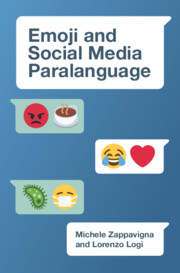
Emoji are now ubiquitous in our interactions on social media. But how do we use them to convey meaning? And how do they function in social bonding? This unique book provides a comprehensive framework for analysing how emoji contribute to meaning-making in social media discourse, alongside language. Presenting emoji as a visual paralanguage, it features extensive worked examples of emoji analysis, using corpora derived from social media such as Twitter and TikTok, to explore how emoji interact with their linguistic co-text. It also draws on the author's extensive work on social media affiliation to consider how emoji function in social bonding. The framework for analysing emoji is explained in an accessible way, and a glossary is included, detailing each system and feature from the system networks used as the schemas for undertaking the analysis. It is essential reading for anyone wishing to investigate the role of emoji in digital communication.
In the Conclusion, we outline a series of methodological and ethical considerations for scholars interested in researching the intersections of language and hope, particularly as they are practiced and manifested among marginalized and disenfranchised communities. Faveladas/os reveal a great deal of awareness of the extractivist tendencies of field research and their critical stance in advancing an agenda for sociolinguistic scholarship that is reflexive to more responsible, sustainable, and dialogic practices vis-à-vis interlocutors’ agendas and ethical concerns. Further, because we attend to knowledge about language produced by everyday people, we emphasize the need to be mindful of alternative and unconventional forms of knowledge production toward an ongoing understanding of the ways in which language can lead to hopeful futures. In short, insofar that hope demands that we reorient our view of the future and temporality more broadly, an understanding of language as hope demands that we reorient our assumptions of what counts as producing legitimate knowledge about language.
This chapter investigates scaling in the work of hope. We foreground how hope is not merely an abstract aspiration but a principled, time-oriented praxis by showcasing how hope can be meaningfully pursued when scaled through pedagogical work. Our cases include the central NGOS/activist groups in our ethnography, namely Instituto Raízes em Movimento, Instituto Marielle Franco, and Coletivo Papo Reto. We examine, for instance, the case of how Raízes em Movimento appropriates and rescales the trope of “circulando,” a policing practice premised on the criminalization of faveladas/os. We afterwards examine the case of artistic and organizational responses to the historical and contemporary silencing of Blacks in Brazil, examining the case of Favela Não Se Cala alongside the activist work of the Instituto Marielle Franco. We then look to the work of Coletivo Papo Reto who perform pedagogical work representing the transformative ethos of papo reto activist register. This collective work highlights the teachable–scalable–dimensions of hope through sociolinguistic action, by which hope comes to be rescaled from mere abstraction toward a form of social change.
The Introduction describes the fundamental objective of the book, which is to discuss what language can teach us about the practice of hope into the 21st century. Hope has always been critical to human survival, but the surge of right-wing populism, racism and ethnocentrism around the world spells hopelessness for many communities, including those whose backgrounds are subject to increased discrimination and precarization. Meanwhile, those in periphery contexts have lived in perpetual conditions of seeming hopelessness. Yet, they have not merely succumbed to despair but found creative ways of surviving material inequities. One key resource that faveladas/os have relied upon to hope is imagining language, temporality, digital technologies, and cooperation toward challenging past inequities and establishing socially equitable futures. They have also been very critical about the dynamics of knowledge production, including extractivist practices of academic scholars. These instances point to the importance of subjects’ reflexivity and practical work in producing conditions of hope.
This chapter outlines a theorization of language as hope. We begin with an understanding of language not merely as a fixed language system to communicate reality as such, but as an inherently flexible and negotiable practice that can reconstitute realities, in the sense of “languaging” (see Li, 2018). We approach languaging in relation to various conceptualizations of hope, beginning with Ernst Bloch’s (1986) pioneering account of hope as both an affect and a principle of explanation. As an affect, “Hope goes out of itself, makes people broad instead of confining them” (p. 3). Temporally, hope orients people to the “Not-Yet-Being,” towards expansion and potentiality. This view of hope is complemented with various treatments within the social sciences and in sociolinguistics more specifically. In so doing, we propose that those who must grapple with enveloping challenges predicated on regimes of violence and economic dispossession do not merely succumb to hopelessness but instead have found ways to recast temporality, engage in tactical cooperation, and reimagine sociolinguistic resources in and through their everyday languaging toward the production of hope.
When we finished writing this book, on October 31, 2022, Jair Bolsonaro had just lost the presidential election to Luiz Inácio Lula da Silva by a thin margin of 2 million votes. A story familiar to U.S. Americans of voter suppression tormented many Brazilians, as Bolsonaro had used institutions such as the Polícia Rodoviária Federal, or the Federal Highway Police, to prevent people in Brazil’s poor Northeast, who mostly voted for Lula, from reaching the voting booth. His administration also adopted measures such as using the public bank Caixa Econômica Federal to offer loans to people on low incomes – one of the segments which was mainly pro Lula – with hardly any guarantees of repayment. Many other extralegal means of keeping Bolsonaro in power were rehearsed by his administration and supporters.
This chapter focuses on how hope demands an ever-shifting reorientation to time. We engage more fully with the case of Marielle Franco, a Black lesbian councilwoman from a favela who was brutally assassinated in 2018. Her spectral presence became an icon of hope for the dispossessed. We trace her “presence” in the range of protests and demonstrations that erupted following her death. We additionally analyze ethnographic accounts of women who were influenced by Marielle, online archives of their speeches, and news articles and social media material that circulated in the months following her murder. Additionally, we show how hope in Marielle’s communicative practice had an important pedagogic dimension in that she led others in the cultivation of adequate virtues, affects, and ideologies for surviving historical inequities and formations of violence. We thus illustrate how hope demands a reorientation to time–a disruption of the teleological time of progress, inverting taken-for-granted relations of causality. Temporality, in this sense, is “metaleptic” in that the past may belatedly inform the present, thereby not necessarily relying on chronology, linearity, or progress.
The purpose of this chapter is to advance the introduction and provide sociohistorical context necessary to understand the complexities of language and hope in Brazil. While Brazil is one of the world’s wealthiest nations it is simultaneously notorious for having one of the largest and rapidly increasing rates of class and income inequality in the world (Loureiro, 2000). In addition, while it is known for having the largest population of peoples of the African diaspora (Parra et al., 2003), it is also known for its longstanding history of anti-Black violence (Afolabi, 2009; Butler, 1998; Twine, 1997). Nowhere are the stratifications along social, economic, and racial lines more concentrated than in the favelas across the state. While the favelas, from this perspective, are spaces of seeming hopelessness, they are also locations of intense cultural production, everyday creativity, and most crucially, survival and hope. Critically, as we will demonstrate, the ways in which faveladas/os practice language and enact hope offer important lessons on the feasibility of hope into the 21st century.