To save content items to your account,
please confirm that you agree to abide by our usage policies.
If this is the first time you use this feature, you will be asked to authorise Cambridge Core to connect with your account.
Find out more about saving content to .
To save content items to your Kindle, first ensure no-reply@cambridge.org
is added to your Approved Personal Document E-mail List under your Personal Document Settings
on the Manage Your Content and Devices page of your Amazon account. Then enter the ‘name’ part
of your Kindle email address below.
Find out more about saving to your Kindle.
Note you can select to save to either the @free.kindle.com or @kindle.com variations.
‘@free.kindle.com’ emails are free but can only be saved to your device when it is connected to wi-fi.
‘@kindle.com’ emails can be delivered even when you are not connected to wi-fi, but note that service fees apply.
The bilingual advantage hypothesis, which associates bilingualism with benefits in executive functioning (EF), has been challenged by studies demonstrating inconsistent results. Considering explicit calls to revise the hypothesis, research has turned toward understanding which specific bilingualism-related aspects might impact bilinguals’ EF. Notably, patterns of everyday language use, referred to as interactional contexts in the adaptive control hypothesis (ACH), have emerged as a prominent factor modulating the association between bilingualism and EF. This scoping review synthesizes findings from 49 studies investigating interactional contexts and bilinguals’ EF. The results indicate that the current literature is highly heterogeneous regarding the operationalization, measurement, experimental manipulations of interactional contexts, the EF tasks employed and sample characteristics. This variability limits definitive conclusions about the adaptation of bilinguals’ EF to the demands of interactional contexts. More studies with comparable research designs and clearer predictions on the associations between EF domains and bilinguals’ language-use patterns are needed.
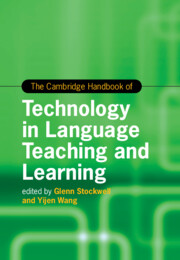
The use of technology in various language teaching and learning contexts has become increasingly commonplace in recent years. This has resulted in an enormous range of choices for teachers and researchers in the field, but at the same time, it has also become more and more difficult for those who are new to using technology for language teaching and researching to keep up with these changes. This handbook provides a wide-ranging, accessible overview of technology in language teaching and learning by leading experts in the field from around the world. The chapters are split into six thematic parts, covering a multitude of subject areas whilst also highlighting the relationships between the topics covered. Showcasing the diversity and complexity of the field in a comprehensive yet approachable manner, it is essential reading for academic researchers and graduate students, as well as pre-service and in-service teachers in various global contexts.
The purpose of this study was to examine the impact of acoustic filtering and modality on speech-in-noise recognition for Spanish-English late bilinguals (who were exposed to English after their 5th birthday) and English monolinguals. All speech perception testing was conducted in English. Speech reception thresholds (SRTs) were estimated at 50% recognition accuracy in an open-set sentence recognition task in the presence of speech-shaped noise (SSN) in both low-pass and no-filter conditions. Consonant recognition was assessed in a closed-set identification task in SSN in four conditions: low-pass and no-filter stimuli presented in auditory-only (AO) and audiovisual (AV) modalities. Results indicated that monolinguals outperformed late bilinguals in all conditions. Late bilinguals and monolinguals were similarly impacted by acoustic filtering. Some data indicated that monolinguals may be more adept at integrating auditory and visual cues than late bilinguals. Theoretical and practical implications are discussed.
Changes in the characterization of communicative competence, especially in the context of large-scale testing, are typically driven by an evolving understanding of real-world communication and advancements in test construct theories. Recent advances in AI technology have fundamentally altered the way language users communicate and interact, prompting a reassessment of how communicative competence is defined and how language tests are constructed.
In response to these significant changes, an AI-mediated interactionalist approach is proposed to expand communicative competence. This approach advocates for extending the traditional concept of communicative competence to encompass AI digital literacy skills and broadened cognitive and linguistic capabilities. These skills enable effective AI tool usage, as well as the interpretation and application of AI-generated outputs and feedback, to improve communication. Embedding these competencies into language assessments ensures alignment with contemporary communication dynamics, enhancing the relevance of language assessments, and preparing learners for navigating AI-augmented communication environments.
While high-stakes testing faces considerable challenges in adopting this expanded construct, low-stakes formative assessments, where scores do not influence critical decisions about individuals and where opportunities exist to rectify errors in score-based actions, if any, provide a fertile ground for exploring the integration of AI tools into assessments. In these contexts, educators can explore giving learners access to various AI tools, such as editing and generative tools, to enhance assessment practices. These explorations can start to address some of the conceptual challenges involved in applying this expanded construct definition in high-stakes environments and contribute to resolving practical issues.
Human language is increasingly written rather than just spoken, primarily due to the proliferation of digital technology in modern life. This trend has enabled the creation of generative artificial intelligence (AI) trained on corpora containing trillions of words extracted from text on the internet. However, current language theory inadequately addresses digital text communication’s unique characteristics and constraints. This paper systematically analyzes and synthesizes existing literature to map the theoretical landscape of digitized language. The evidence demonstrates that, parallel to spoken language, features of written communication are frequently correlated with the socially constructed demographic identities of writers, a phenomenon we refer to as “digital accents.” This conceptualization raises complex ontological questions about the nature of digital text and its relationship to social identity. The same line of questioning, in conjunction with recent research, shows how generative AI systematically fails to capture the breadth of expression observed in human writing, an outcome we call “homogeneity-by-design.” By approaching text-based language from this theoretical framework while acknowledging its inherent limitations, social scientists studying language can strengthen their critical analysis of AI systems and contribute meaningful insights to their development and improvement.
Over the past two decades, English has become a key medium of instruction in higher education in non-native English contexts, especially Asian countries. Extant research highlights the rapid expansion of English-medium instruction (EMI) and challenges in policy implementation, revealing tensions between different language policy levels (i.e., macro, meso and micro). Thus, a multilevel analysis is needed to understand these tensions. This review examines factors influencing EMI adoption in China, Japan, Malaysia, and Nepal, focusing on policy implementation by educators and students. Findings show that EMI adoption is driven by English's role as a global lingua franca and the permeation of neoliberal ideologies at the macro policymaking level. Such a macro-level endorsement of monolingual EMI has resulted in micro-level inequalities for students, with resistance manifested through multilingual practices, such as translanguaging, in the classroom. The discrepancies between language policies and practices highlight the necessity of reassessing the adequacy of monolingual EMI policies and the importance of adopting a multilingual policy framework. The article concludes with a critical discussion of the trends observed in these contexts and recommends several policy directions for the future.
Chapter 4 discusses the different modes of teaching that teachers can employ in class: direct, discussion, activity, enquiry, collaborative and group approaches are all examined in detail, with the advantages and disadvantages of each mode considered and practical advice given on when and where to employ them within a pupil-centred environment. The predominance of particular modes in class is examined, and the importance of teachers using a wide range is stressed, in addition to a discussion of what each mode is particularly suited to achieving. The chapter also examines Resource-Based Learning and Task Based Language Teaching in detail.
Chapter 11 looks at how skills and competences necessary for successful language learning can be developed in the language classroom through the use of drama, music and games. Developing an understanding of the culture and literature of countries where the foreign language is spoken and what is appropriate at different ages and stages of learning is also examined in this chapter. The use of music and rhyme helps to embed the foreign language in learners’ minds, promoting pedagogical diversity and consolidating learning, particularly with regards to pronunciation, fluency, listening comprehension, memorisation of vocabulary and grammatical structures, as well as increasing cultural awareness. Drama and games can motivate learners and create a relaxed atmosphere where language skills can develop, thus promoting learner interaction, improving skills and consolidating knowledge.
Chapter 3 emphasises the importance of developing skills among pupils progressively throughout language learning and discusses how each skill complements the others to improve overall communicative competence. Practical advice on how to develop each individual skill is given, as well as how to create multi-skill and multi-task activities. Tasks designed to give student teachers practice in developing these individual skills are included. The development of reading skills is given particular attention, as this is an area which can affect the others if not given due care and consideration.
Chapter 2 examines historical and current approaches to the learning and teaching of foreign languages and considers the features of each approach. The term ‘post-method’ and whether we are in a period that can be described as such are discussed before a consideration of why foreign languages are learned. A very important aspect of foreign language learning and teaching is how to increase exposure to the target language and how to promote target language use amongst pupils. Through analysis of commonly perceived problems associated with language teaching, advice will be given to help teachers develop strategies to stay in, or increase their use of, the target language.
Chapter 6 builds on unit planning and analyses the fundamentals of modern foreign languages lesson planning and the features of a successful lesson. It emphasises the importance of planning learning across a series of lessons and walking through your planning in advance. Successful lesson planning must be based on a sound knowledge of pedagogy and teachers need to know the most effective ways of learning and teaching languages. This in turn needs to be coupled with skilled use of the appropriate modes of teaching used at the appropriate time. This all needs to happen within a planned framework, which allows and supports pupils’ development and progress across a sequence of learning goals. Chapter 6 gathers these factors together and leads student teachers through the essential steps of effective lesson planning.
It is very important that teaching and learning activities and assessment are designed to cater for the needs of schools and pupils. Chapter 8 looks at the connection between learning and assessment and includes approaches and strategies for both formative and summative assessment. How to plan for and manage assessment of learners’ progress is examined in detail with practical advice on how to do this in a structured way. How to use assessment for learning within a framework of formative assessment is detailed, including self-assessment and peer-assessment techniques with practical examples for use in class. The development of metacognitive strategies in learners is explored and advice is given on how to promote and develop this in learners in stages. The importance of giving regular feedback to pupils on their learning is also emphasised. Techniques and suggestions in this chapter can be adapted for different classes and year groups.