To save content items to your account,
please confirm that you agree to abide by our usage policies.
If this is the first time you use this feature, you will be asked to authorise Cambridge Core to connect with your account.
Find out more about saving content to .
To save content items to your Kindle, first ensure no-reply@cambridge.org
is added to your Approved Personal Document E-mail List under your Personal Document Settings
on the Manage Your Content and Devices page of your Amazon account. Then enter the ‘name’ part
of your Kindle email address below.
Find out more about saving to your Kindle.
Note you can select to save to either the @free.kindle.com or @kindle.com variations.
‘@free.kindle.com’ emails are free but can only be saved to your device when it is connected to wi-fi.
‘@kindle.com’ emails can be delivered even when you are not connected to wi-fi, but note that service fees apply.
Ultrasonic sonochemistry and pulsed laser ablation in liquids (LAL) are modern techniques for materials synthesis that are in different ways linked to the formation and collapse of cavitation bubbles. We provide an overview of the physics of laser-induced and acoustically driven bubble oscillations and then describe how the high pressures and temperatures associated with ablation and bubble collapse, as well as emitted shock waves, take part in material synthesis inside and around the bubble. Emphasis is placed on the mechanisms of sonochemical synthesis and modification, and on a step-by-step account of the events from laser ablation through interaction of ablation products with the surrounding liquid up to the modification or aggregation of particles within the bubble. Both sonochemistry and LALs yield nanostructured materials and colloidal nanoparticles with unique properties. The synthesis process has been demonstrated to be scalable.
A quantum computer can outperform classical computers for certain tasks. The general challenge to realize a quantum computer is to solve decoherence, which is due to coupling of a quantum state with the local environment. One possible way to overcome decoherence is to use a topological quantum state. Topologically protected states are expected to have long coherence times. In a topological quantum computer, the information is carried by nonlocal Majorana states. Such states can be engineered in a semiconductor nanowire, which has strong spin–orbit interactions, coupled to a superconductor. The first signatures of Majorana states have been observed recently. In order to substantiate the existence of Majorana states and use them as qubits, an exchange—or braiding—operation of these states has to be performed. The current challenge is to improve the quality of the materials and interfaces. Recent progress toward improved Majorana signals using materials science advances is reviewed in this article.
This article focuses on the acoustic-wave enhancement of chemisorption and surface reactions. Acoustic waves generated by a piezoelectric phenomenon on ferroelectric crystals by the application of radio frequency electric power produce periodic lattice distortions at the surface. The effects of surface acoustic waves (SAWs) and the resonance oscillation (RO) of bulk acoustic waves on thin films of metals or metal oxides are described herein. Both SAWs and RO can modify the work functions of thin Ag, Au, or Pd films, and this effect is highly dependent on the surface structures. These changes in the work function can, in turn, affect the adsorptive characteristics of the metals as well as surface reactions and properties such as catalysis. The importance of periodic lattice displacement vertical to the surface is examined in this article, and the acoustic-wave enhancement of metal and metal oxide surfaces as a means of tuning electronic states and chemical properties is discussed.
The coupling of acoustic energy with materials structures and processes is at the core of such current and emerging application areas as ultrasound-enabled materials characterization, structuring, and processing. High concentration of acoustic energy, such as upon the collapse of a cavitation bubble, has been shown to provide conditions for the synthesis of unusual material phases and structures, while intriguing reports on acoustic activation of surface diffusion, desorption, and catalysis hold high promise for applications where heating must be avoided or rapid switching of surface conditions is required. Some of the recent scientific and technical advances in the general area of acoustically enabled materials synthesis, processing, and characterization are reviewed in this issue of MRS Bulletin. Additional discussion of experimental data and computational results providing insights into the fundamental mechanisms and channels of the acoustic energy coupling to atomic-scale surface features and adsorbates is also provided in this article.
Structure–property relationships are the foundation of materials science and are essential for predicting material response to driving forces, managing in-service material degradation, and engineering materials for optimal performance. Elastic, thermal, and acoustic properties provide a convenient gateway to directly or indirectly probe materials structure across multiple length scales. This article will review how using the laser-induced transient grating spectroscopy (TGS) technique, which uses a transient diffraction grating to generate surface acoustic waves and temperature gratings on a material surface, nondestructively reveals the material’s elasticity, thermal diffusivity, and energy dissipation on the sub-microsecond time scale, within a tunable subsurface depth. This technique has already been applied to many challenging problems in materials characterization, from analysis of radiation damage, to colloidal crystals, to phonon-mediated thermal transport in nanostructured systems, to crystal orientation and lattice parameter determination. Examples of these applications, as well as inferring aspects of microstructural evolution, illustrate the wide potential reach of TGS to solve old materials challenges and to uncover new science. We conclude by looking ahead at the tremendous potential of TGS for materials discovery and optimization when applied in situ to dynamically evolving systems.
Laser-induced acoustic desorption (LIAD) enables the desorption of nonvolatile and/or thermally labile neutral compounds, such as asphaltenes, saturated hydrocarbons in base-oil fractions and biomolecules, from a metal surface into a mass spectrometer. This is a “gentle” evaporation technique and causes minimal fragmentation to the desorbed neutral molecules, including oligonucleotides and polypeptides. LIAD can be coupled with a wide range of ionization methods to facilitate analysis of the desorbed analytes by using many different types of mass spectrometers, including Fourier transform ion cyclotron resonance, linear quadrupole ion trap and quadrupole time-of-flight instruments. The development and improvement of LIAD remains an active research area with diverse goals such as better desorption efficiencies, minimized analyte fragmentation and greater versatility. This article details the theory, experimental methods, applications, and future directions of LIAD in combination with mass spectrometry.
Linear elastic moduli of solids with similar chemical compositions usually vary fairly insignificantly. However, for a broad class of apparently similar materials, their higher-order (nonlinear) moduli may differ by many times or even by orders of magnitude. Besides their large magnitude, nonlinear effects often demonstrate qualitative/functional features inconsistent with predictions of the classical theory of nonlinear elasticity based on consideration of weak lattice (atomic) nonlinearity. The latter is mostly applicable to ideal crystals and flawless amorphous solids, whereas the presence of structural heterogeneities can drastically modify the acoustic nonlinearity of materials without appreciable variation in the linear elastic properties. Despite often rather nontrivial/nonstraightforward relationships between microstructural features of the material and the resultant “nonclassical” acoustic nonlinearity, the extremely high structural sensitivity makes utilization of nonlinear acoustic effects attractive for a broad range of diagnostic applications that have been emerging in recent years in various areas—from seismic sounding and nondestructive testing to materials characterization down to the nanoscale.
In this paper, we will report about the implementation of the self-consistent Kröner–Eshelby model for the calculation of X-ray elastic constants for general, triclinic crystal symmetry. With applying appropriate symmetry relations, the point groups of higher crystal symmetries are covered as well. This simplifies the implementation effort to cover the calculations for any crystal symmetry. In the literature, several models can be found to estimate the polycrystalline elastic properties from single crystal elastic constants. In general, this is an intermediate step toward the calculation of the polycrystalline response to different techniques using X-rays, neutrons, or ultrasonic waves. In the case of X-ray residual stress analysis, the final goal is the calculation of X-ray Elastic constants. Contrary to the models of Reuss, Voigt, and Hill, the Kröner–Eshelby model has the benefit that, because of the implementation of the Eshelby inclusion model, it can be expanded to cover more complicated systems that exhibit multiple phases, inclusions or pores and that these can be optionally combined with a polycrystalline matrix that is anisotropic, i.e., contains texture. We will discuss a recent theoretical development where the approaches of calculating bounds of Reuss and Voigt, the tighter bounds of Hashin–Shtrikman and Dederichs–Zeller are brought together in one unifying model that converges to the self-consistent solution of Kröner–Eshelby. For the implementation of the Kröner–Eshelby model the well-known Voigt notation is adopted. The 4-rank tensor operations have been rewritten into 2-rank matrix operations. The practical difficulties of the Voigt notation, as usually concealed in the scientific literature, will be discussed. Last, we will show a practical X-ray example in which the various models are applied and compared.
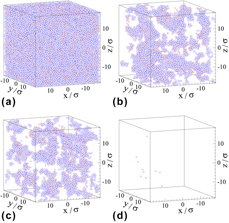
The influence of repeated thermal cycling on mechanical properties, structural relaxation, and evolution of the potential energy in binary glasses is investigated using molecular dynamics simulations. The authors consider a binary mixture annealed with different cooling rates and then exposed to one thousand thermal cycles at constant pressure. It is found that during the first few hundred transient cycles, the potential energy minima after each cycle gradually decrease and the structural relaxation proceeds through collective, irreversible displacements of atoms. With increasing cycle number, the amplitudes of the volume and potential energy oscillations are significantly reduced, and the potential energy minima saturate to a constant value that depends on the thermal cycling amplitude and the initial cooling rate. In the steady state, the glasses thermally expand and contract but most of the atoms return to their cages after each cycle, similar to limit cycles found in periodically driven amorphous materials. The results of tensile tests demonstrate that the elastic modulus and the yielding peak, evaluated after the thermal treatment, acquire maximum values at a particular thermal cycling amplitude, which coincides with the minimum of the potential energy.