To save content items to your account,
please confirm that you agree to abide by our usage policies.
If this is the first time you use this feature, you will be asked to authorise Cambridge Core to connect with your account.
Find out more about saving content to .
To save content items to your Kindle, first ensure no-reply@cambridge.org
is added to your Approved Personal Document E-mail List under your Personal Document Settings
on the Manage Your Content and Devices page of your Amazon account. Then enter the ‘name’ part
of your Kindle email address below.
Find out more about saving to your Kindle.
Note you can select to save to either the @free.kindle.com or @kindle.com variations.
‘@free.kindle.com’ emails are free but can only be saved to your device when it is connected to wi-fi.
‘@kindle.com’ emails can be delivered even when you are not connected to wi-fi, but note that service fees apply.
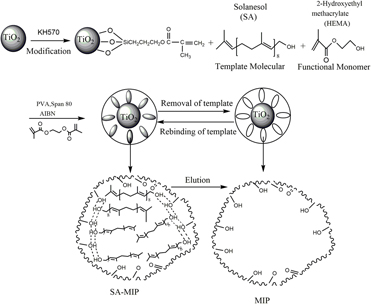
Surface molecularly imprinted polymer of solanesol (SA-SMIP) was prepared by reversed phase suspension polymerization using modified titanium dioxide (TiO2) as carrier, and operation conditions were investigated and optimized. Structures of modified TiO2 and SA-SMIP obtained at optimal conditions were characterized by Fourier transform infrared spectrometer adopting original TiO2 and non-surface molecularly imprinted polymer as reference. The SA-SMIP synthesized under optimal conditions displayed an excellent recognition of SA from the mixture of SA and triacontanol. The maximum separation degree of SA was 2.90. Finally, the adsorption kinetics and isotherm were investigated and analyzed. Adsorption kinetics results indicated that the adsorption of SA-SMIP to SA was a pseudo-second order process, and the adsorption of beginning and later stages was controlled by homogeneous particle diffusion and adsorption reaction process, respectively. Adsorption isotherm results documented hereby were two sorts of bonding sites, complete imprinted cavities and defective imprinted cavities. The adsorption for two bonding sites could be well lined up with the Langmuir model.
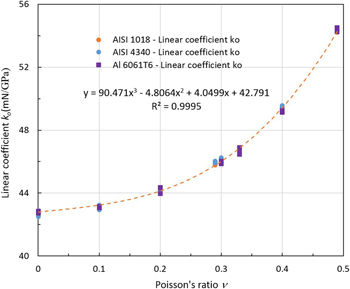
Nanoindentation is commonly used to determine the mechanical properties of the engineering materials. Young’s modulus of a bulk material can be extracted from the load–depth data obtained from an indentation test with a prescribed Poisson’s ratio that is unknown for a new material. The effect of Poisson’s ratio on material’s mechanical property characterization remains unknown. In this paper, finite element analysis was used to simulate nanoindentation testing on specimens of low-carbon steel AISI1018, steel alloy AISI4340, and aluminum alloy 6061T6 with a cylindrical flat-tip indenter. The effects of Poisson’s ratio on measurements of indentation load versus depth curves, Young’s modulus, hardness, and pile-up of the specimens were investigated and formulated. The Poisson ratio ranging from 0 to 0.49 was considered. It was found that the linear part at the beginning of the indentation loading process from the load versus depth curve was proportional to the Young’s modulus and significantly affected by the Poisson’s ratio. The indentation pile-up was also sensitive to the Poisson’s ratio. Combining the formulas from this work with the Hertzian contact equation, the Young’s modulus and the Poisson’s ratio can be determined simultaneously.
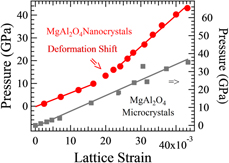
Ceramics are strong but brittle. According to the classical theories, ceramics are brittle mainly because dislocations are suppressed by cracks. Here, the authors report the combined elastic and plastic deformation measurements of nanoceramics, in which dislocation-mediated stiff and ductile behaviors were detected at room temperature. In the synchrotron-based deformation experiments, a marked slope change is observed in the stress–strain relationship of MgAl2O4 nanoceramics at high pressures, indicating that a deformation mechanism shift occurs in the compression and that the nanoceramics sample is elastically stiffer than its bulk counterpart. The bulk-sized MgAl2O4 shows no texturing at pressures up to 37 GPa, which is compatible with the brittle behaviors of ceramics. Surprisingly, substantial texturing is seen in nanoceramic MgAl2O4 at pressures above 4 GPa. The observed stiffening and texturing indicate that dislocation-mediated mechanisms, usually suppressed in bulk-sized ceramics at low temperature, become operative in nanoceramics. This makes nanoceramics stiff and ductile.
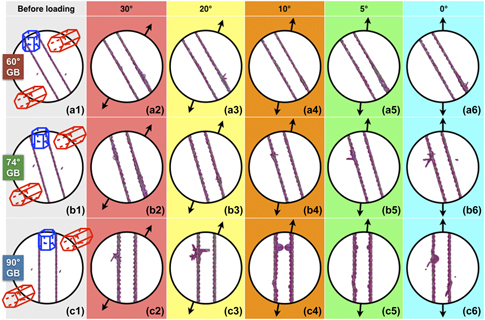
In this work, molecular dynamics simulations to explore the crack propagation and fracture behavior of Cu/Nb metallic nanolayered composites (MNCs) were performed. The results of this study are consistent with the previous experimental results, which illustrated that cracks in Cu and Nb layers may exhibit different propagation paths and distances under the isostrain loading condition. The analysis reveals that the interface can increase the fracture resistance of the Nb layer in Cu/Nb MNCs by providing the dislocation sources to generate the plastic strain at the front of the crack. Increasing the layer thickness can enhance the fracture resistance of both Cu and Nb layers, as the critical stress for activating the dislocation motion decreases with the increment of the layer thickness. In addition, grain boundaries (GBs) in polycrystalline Cu/Nb samples would decrease the fracture resistance of Nb layer by promoting the crack propagate along the GBs, i.e., intergranular fracture, while the effect of interface and layer thickness on the fracture resistance of MNCs will not be altered by introducing the GBs in MNCs.
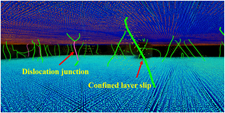
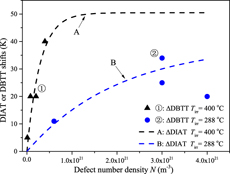
Post-irradiation plastic strain spreading in ferritic grains is investigated by means of three-dimensional dislocation dynamics simulations, whereby dislocation-mediated plasticity mechanisms are analyzed in the presence of various disperse defect populations, for different grain size and orientation cases. Each simulated irradiation condition is then characterized by a specific “defect-induced apparent straining temperature shift” (ΔDIAT) magnitude, reflecting the statistical evolutions of dislocation mobility. It is found that the calculated ΔDIAT level closely matches the ductile-to-brittle transition temperature shift (ΔDBTT) associated with a given defect dispersion, characterized by the (average) defect size D and defect number density N. The noted ΔDIAT/ΔDBTT correlation can be explained based on plastic strain spreading arguments and applicable to many different ferritic alloy compositions, at least within the range of simulation conditions examined herein. This systematic study represents one essential step toward the development of a fully predictive, dose-dependent fracture model, adapted to polycrystalline ferritic materials.
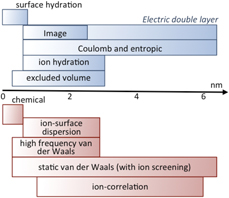
Oriented attachment (OA) is a particle-based crystallization pathway in which nanocrystals self-assemble in solution and attach along certain crystallographic direction often forming highly organized three-dimensional crystal morphologies. The pathway offers the potential for a general synthetic approach of hierarchical nanomaterials, in which multiscale structural control is achieved by manipulating the interfacial nucleation and self-assembly of nanoscale building blocks. Here, the current status of the development of a predictive theoretical framework for modeling crystallization by OA is reviewed. A particular emphasis is made on recent developments in understanding the microscopic details of solvent-mediated forces that drive nanocrystal reorientation and alignment for face-selective attachment. Interactions arising from the correlated solvent dynamics at particle interfaces emerge as the main sources of long-range face-specific interparticle forces and short-range torque for fine particle alignment into lattice matching configuration. These findings shift the focus of the experimental and theoretical research of OA onto the detailed study of interfacial solvent structure and dynamics.
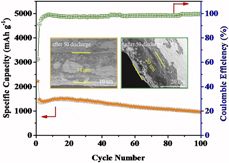
In this work, atomic layer deposition (ALD), as a novel strategy, has been applied to deposit MgO on nano-sized porous Si (pSi) dendrites obtained by etching Al–Si alloy for LIBs. The reversible specific capacity of pSi@MgO electrode is 969.4 mA h/g after 100 cycles at 100 mA/g between 0.01 and 1.5 V, and it presents the discharge specific capacities of 1253.0, 885.5, 642.4, 366.2, and 101.4 mA h/g at 100, 500, 1000, 2000, and 5000 mA/g, respectively. What is more, it delivers a high reversible capacity of 765.1 mA h/g even at 500 mA/g after 200 cycles. The performance improvement can be attributed to the protection of the MgO layer and built-in space of porous Si for volume expansion upon cycling. These results illustrate that ALD derived coating is a powerful strategy to enhance electrical properties of anode materials with huge volume change for lithium-ion batteries.
This paper is devoted to the study of formation mechanism of metal solid solutions during the thermolysis of single-source precursors in Co–Pt systems with a wide range of superstructural ordering. It is shown that the thermal decomposition of [Pt(NH3)4][Co(C2O4)2(H2O)2]·2H2O salt in helium is critically different from that under hydrogen atmospheres. Thermal degradation under the helium atmosphere is followed by a gradual reduction of platinum and cobalt, and at each thermolysis temperature only one phase is present. At 380 °C an equiatomic Co0.50Pt0.50 solid solution is formed (a = 3.749 (4) Å, Fm−3m space group, V/Z = 13.17 Å3, crystallite size: 5–7 nm). When the precursor is decomposed under a hydrogen atmosphere, the process proceeds mainly through the simultaneous reduction of the platinum and cobalt atoms, and at each temperature section two metal phases are present. The formation of the close to equiatomic Co0.50Pt0.50 solid solution (a = 3.782 (4) Å, Fm−3m space group, V/Z = 13.52 Å3, crystallite size: 7–9 nm) occurs at 450 °C. The calculations of crystallite sizes are confirmed by transmission electron microscopy data.
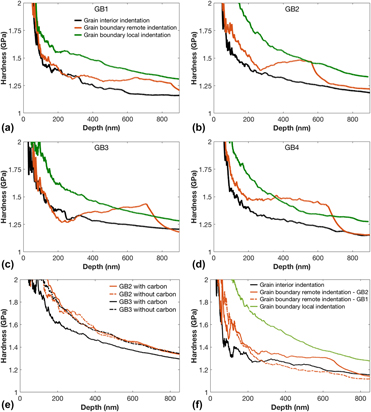
The extrinsic indentation size effect (ISE) is utilized to analyze the depth-dependent hardness for Berkovich indentation of non-uniform dislocation distributions with one and two dimensional deformation gradients and is then extended to indentation results at grain boundaries. The role of the Berkovich pyramid orientation and placement relative to the grain boundary on extrinsic ISE is considered in terms of slip transmission at yield and plastic incompatibility during post-yield deformation. The results are interpreted using a local dislocation hardening mechanism originally proposed by Ashby, combined with the Hall–Petch equation. The Hall–Petch coefficient determined from the extrinsic ISE of the grain boundary is found to be consistent with the published values for pure Fe and mild steel. A simple, linear continuum strain gradient plasticity model is used to further analyze the results to include contributions from a non-uniform distribution in plastic strain and dislocation density.
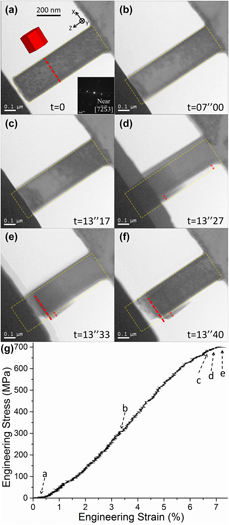
In our previous study, we observed a lack of $\left\{ {10\bar{1}2} \right\}$ twinning in a deformed Mg–Y alloy, which contributed to the observed yield “symmetry.” However, the effects of texture and grain size on polycrystalline deformation made it difficult to fully understand why twinning was not active. Therefore, we report herein in-depth study by in situ transmission electron microscopy, i.e., in situ TEM. The in situ deformation of nano-sized Mg–Y pillars revealed that prismatic slip was favored over twinning, namely, the critical stress required to activate prismatic slip was lower than that for twinning. This finding diametrically differs from that reported in other nano/micro-pillar deformation studies, where twinning is always the dominant deformation mechanism. By measuring the critical stresses for basal, prismatic, and pyramidal slip systems, this in situ TEM study also sheds light on the effects of the alloying element Y on reducing the intrinsic plastic anisotropy in the Mg matrix.
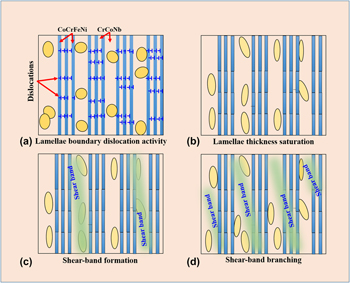
High-entropy composites (HECs) were subjected to severe straining by high-pressure torsion (HPT) to evaluate their influence on the evolution of microstructure and deformation behavior. Severe straining leads to a homogeneously strained microstructure and inhomogeneous micro-shear bands in these HECs. Nb addition in HECs varies the microstructure from single phase to eutectic, and the Vickers microhardness in HPT HECs increases to 7.45 GPa. Nb addition up to x = 0.80 in as-cast HECs improves the strength of these materials at the expense of its plasticity. Nevertheless, severe straining provides a better combination of strength and ductility without sacrificing its plasticity. Such improvement in properties is attributed to the evolved microstructural features, formation of “transformation-shear bands (T-SBs)” and “deformation-shear bands (D-SBs)” at severe straining. This assures the homogeneous deformation by shear banding and suggests that shear banding is the dominant deformation mechanism when the lamellar spacing becomes saturated upon severe straining.
Advancements in computer technology have enabled three-dimensional (3D) reconstruction, data-stitching, and manipulation of 3D data obtained on X-ray imaging systems such as micro-computed tomography (μ-CT). Likewise, intuitive evaluation of these 3D datasets can be enhanced by recent advances in virtual reality (VR) hardware and software. Additionally, the generation, viewing, and manipulation of 3D X-ray diffraction datasets, such as pole figures employed for texture analysis, can also benefit from these advanced visualization techniques. We present newly-developed protocols for porting 3D data (as TIFF-stacks) into a Unity gaming software platform so that data may be toured, manipulated, and evaluated within a more-intuitive VR environment through the use of game-like controls and 3D headsets. We demonstrate this capability by rendering μ-CT data of a polymer dogbone test bar at various stages of in situ mechanical strain. An additional experiment is presented showing 3D XRD data collected on an aluminum test block with vias. These 3D XRD data for texture analysis (χ, ϕ, 2θ dimensions) enables the viewer to visually inspect 3D pole figures and detect the presence or absence of in-plane residual macrostrain. These two examples serve to illustrate the benefits of this new methodology for multidimensional analysis.
Employing atomic-scale simulations, the response of a high-angle grain boundary (GB), the soft/hard GB, against external loading was systematically investigated. Under tensile loading close to the hard orientation, strain-induced dynamic recrystallization was observed to initiate through direct soft-to-hard grain reorientation, which was triggered by stress mismatch, inhibited by surface tension from the soft-hard GB, and proceeded by interface ledges. Such grain reorientation corresponds with expansion and contraction of the hard grain along and perpendicular to the loading direction, respectively, accompanied by local atomic shuffling, providing relatively large normal strain of 8.3% with activation energy of 0.04 eV per atom. Tensile strain and residual dislocations on the hard/soft GB facilitate the initiation of dynamic recrystallization by lowering the energy barrier and the critical stress for grain reorientation, respectively.
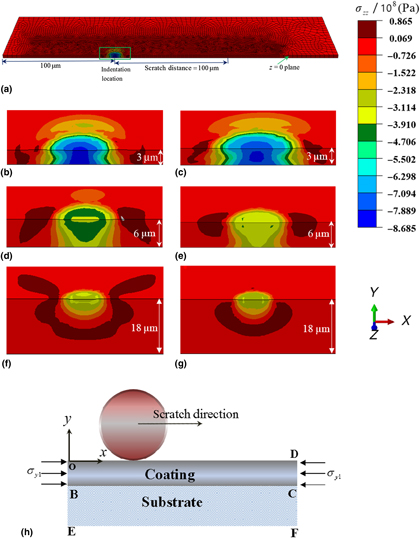
Indentation and scratch models are proposed to numerically investigate effects of compressive prestress on film's mechanical responses. In indentation, normal stress distributions are strongly dependent on film thickness; the applied force and the maximum normal stresses with a prestress are much larger than without prestress. For various film thicknesses the change in the normal force in scratch between the non-prestressed and prestressed films is 4%–23%. The scratch friction coefficient is larger with prestress than without prestress. With biaxial or uniaxial prestress the material becomes more difficult to deform or to slide at the contact surface compared with cases without prestress.