To save content items to your account,
please confirm that you agree to abide by our usage policies.
If this is the first time you use this feature, you will be asked to authorise Cambridge Core to connect with your account.
Find out more about saving content to .
To save content items to your Kindle, first ensure no-reply@cambridge.org
is added to your Approved Personal Document E-mail List under your Personal Document Settings
on the Manage Your Content and Devices page of your Amazon account. Then enter the ‘name’ part
of your Kindle email address below.
Find out more about saving to your Kindle.
Note you can select to save to either the @free.kindle.com or @kindle.com variations.
‘@free.kindle.com’ emails are free but can only be saved to your device when it is connected to wi-fi.
‘@kindle.com’ emails can be delivered even when you are not connected to wi-fi, but note that service fees apply.
Gain a detailed understanding of the fundamental concepts of chemistry and their engineering applications with this fully revised second edition. Catering to the needs of first and second semester undergraduate students from all branches of engineering taking courses on engineering chemistry, it offers new material on topics such as periodic properties, structure and bonding, gaseous states, ionic equilibrium, oxidation and reduction, Werner's coordination theory, Sidgwick coordination theory, valence bond theory, crystal field theory, bonding in coordination compounds, and isomerism in coordination compounds. Lucid language and an easy-to-learn approach help students to understand the basic concepts, use them to construct engineering materials, and solve problems associated with them. Each chapter is further strengthened by numerous examples and review questions.
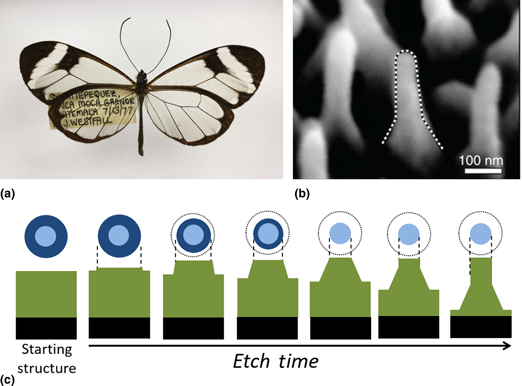
The remarkable broadband and omnidirectional anti-reflectivity observed in the glasswing butterfly arises from the random array of nanopillars present on their wings. In the present study, analogous structures have been replicated on transparent substrates using a scalable, low-cost method that exploits surface dewetting of silver thin films on silica substrates to form an etch mask. Directional etching was applied with high selectivity between Ag and SiO2 using CHF3, allowing large aspect ratios to be achieved with 20 min etches. Single-sided nanostructuring of glass by this method improved the transmission of light by 2–8% for viewing angles of 25°, 45°, and 65°.
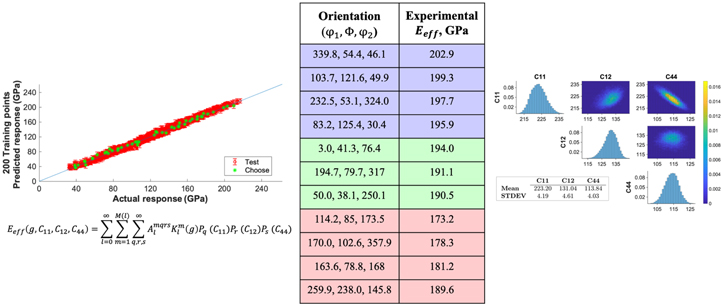
This prospective offers a new Bayesian framework that could guide the systematic application of the emerging toolsets of machine learning in the efforts to address two of the central bottlenecks encountered in materials innovation: (i) the capture of core materials knowledge in reduced-order forms that allow one to rapidly explore the vast materials design spaces, and (ii) objective guidance in the selection of experiments or simulations needed to identify the governing physics in the materials phenomena of interest. The framework builds on recent advances in the low-dimensional representation of the statistics describing the material's hierarchical structure.
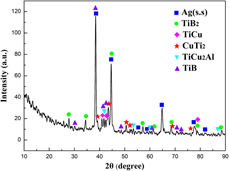
AlMgB14–TiB2 ceramic was successfully brazed to TC4 alloy with inactive AgCu filler alloy. X-ray diffractometer, SEM, and energy-dispersive spectrometer were used to study interfacial microstructure and shear strength of the joints under different brazing temperatures. The results indicated that the typical microstructure of the TC4/AlMgB14–TiB2 joint was TC4/Ti(s.s) + Ti2Cu/Ti2Cu/TiCu/TiCu2Al/Ag(s.s) + Cu(s.s)/TiB whiskers/TiB2 reaction layer/AMBT. By increasing the brazing temperature, the thickness of the TC4 diffusion layer was improved, whereas that of the brazing seam decreased remarkably. When the brazing temperature was increased to 880 °C, the brazing seam was composed of Ti–Cu intermetallic Ag(s.s) with a few Cu(s.s), TiCu2Al distributed. Meanwhile, the formation of a continuous TiB2 reaction layer at the interface of the AMBT and brazing filler facilitated the improvement of joint shear strength. The joint with the maximum shear strength of 46.7 MPa was obtained while brazing at 880 °C for 10 min.
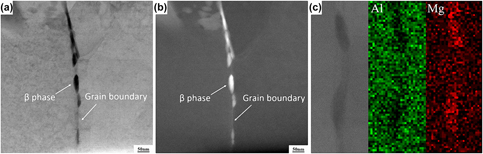
This article mainly focuses on stabilization treatments that influence stress corrosion resistance of an AA5383-H15 alloy after undergoing sensitization treatment at 100 °C/168 h. The results show that without stabilization of the sensitized AA5383-H15 alloy, the β precipitates are distributed continuously like a mesh at grain boundary, and this is the main cause of intergranular corrosion failure. However, applying 3 different stabilization treatments (220 °C/3 h, 250 °C/3 h, and 280 °C/3 h) to the AA5383-H15 alloy shows a dramatic decrease in the β phase precipitation routes along the grain boundaries after the sensitization treatment, and thus an effective improvement in the corrosion resistance performance of AA5383-H15 alloys. Of all the stabilization treatments, the application of 250 °C/3 h stabilization treatment is found to be most effective. Applying 250 °C/3 h stabilization treatment facilitated partial recrystallization of the matrix, leading to suppress the continuous precipitation of the β phase along the grain boundaries during sensitization but instead precipitate in discontinuous mesh-like distribution, which can decrease its sensitivity to stress corrosion.
Aging treatment plays an important role in strengthening of 2198 Al–Li alloy. Through a serious of heat treatment processes, a large amount of precipitates emerge, mainly observed to be θ′(Al2Cu), Al3Zr, and T1(Al2CuLi), among which, T1 turns to be the most important precipitate that contributes to the strengthening of 2198 Al–Li alloy. While the temperature of the aging process is 175 °C, the density and size of T1 phase keep increasing through the process and reach peak in about 18 h. T1 phase tends to have a certain orientation relationship of ${\left( {0001} \right)_{{{\rm{T}}_1}}}//{\left\{ {111} \right\}_{{\rm{Al}}}}$, ${\left\langle {1010} \right\rangle _{{{\rm{T}}_{\rm{1}}}}}//{\left\langle {110} \right\rangle _{{\rm{Al}}}}$ and may have different kinds of multilayered structures. In most of the multilayered structures, the distance between two adjacent copper-rich laths is less than that in classical single-layered phase. Thus, it can be inferred that the microstructure of T1 phase might change in the process of developing from single-layered structure to multilayered structure. In addition, the interactions between different phases become relatively frequent when the density of T1 phase reaches a threshold.


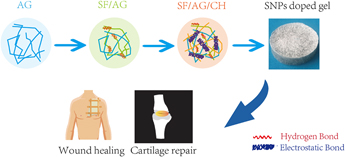
The antibacterial hydrogels can be widely used in the biomedical area owing to their excellent properties. The main limitation of antibacterial hydrogels is their poor mechanical strength. In this study, the novel hydrogels were fabricated with a mixture of silk fibroin (SF), chitosan (CH), agarose (AG), and silver nanoparticles (SNPs) via facile reaction condition without inorganic substances. The mechanical property of these fabricated hydrogels can be modulated by the concentration of SF or AG. The rheological studies demonstrated enhanced elasticity of CH-doped hydrogels. Because of the presence of CH and Ag in hydrogels, the antimicrobial property against gram-positive and gram-negative bacteria was exhibited. Cytocompatibility test proved the very low toxic nature of the hydrogels. In addition, these composite hydrogels have a smaller porosity, higher swelling ratio, and good compatibility, indicating their great potential for biomedical application.
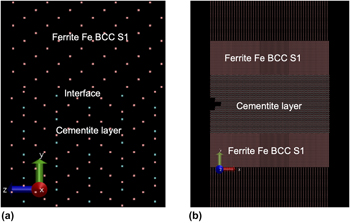
Nanoscale models are very small but involve multiple physics, multiscales, confinement, high rates, etc. These make the numerical simulation of intrinsic and extrinsic size effects difficult for the ferrite/cementite layered structure of carbon steel. In this work, a “new” simulation approach is proposed with “hypothesis” as the key to make the on-going simulation simple, physically sound, and the related atomistically based simulation productive. Using this refreshed approach, which is based on the traditional scientific philosophy, size effects that are related to interface structure and the layer thickness on failure due to thermomechanical coupling are investigated. Among interesting findings, it proves that the peak stress in the strain–stress curve as the characteristic parameter to describe the size effects on failure of thermomechanical coupling is not fully accurate, and a multiplication form of energy barrier with fast decaying function of thermal activation energy should be used in the size-dependent failure initiation criterion. This makes developing guidelines available for designing interface sizes at nanoscale.
In this work, graphene and graphene oxide were synthesized by the modified Hummers method. In order to use graphene in dye-sensitized solar cell (DSSC), TiO2–graphene was prepared by a simple chemical method and used in the DSSC photoanode at different concentrations of graphene to investigate DSSC performance. Utilizing the FE-SEM images, it was observed that accumulation of TiO2 nanoparticles disappeared and a different distribution of nanoparticles was formed on the graphene sheet. Moreover, the UV-vis spectra showed that TiO2–graphene nanocomposites can absorb a wide range of light in comparison with pure TiO2. Structural characterization of TiO2–graphene nanocomposites is confirmed by the FT-IR and Raman analysis. The results have shown that in the presence of graphene, the DSSC performance significantly improved by reducing the recombination. In addition, it has been shown that excess graphene concentration is not proper for DSSC performance. The best result for TiO2–graphene nanocomposite was obtained when the concentration of 1.5% graphene was applied.
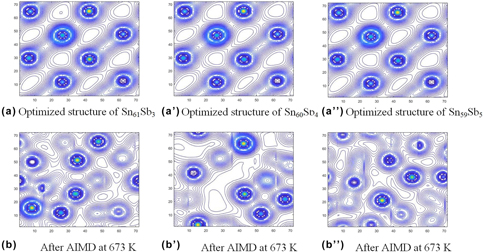
Sn–Sb alloy is an ideal candidate for lead-free solder; however, its performance has been inferior to that of Sn–Pb alloy. Here, the authors used ab initio molecular dynamics simulation to investigate the interatomic interaction in Sn–Sb-based lead-free solders. By calculating the electron density distribution, bond population, and partial density of states, the authors found that the Sn–Sb bonds are a mixture of nonlocalized metal and localized covalent bonds. The covalent bond between Sn and Sb is easy to break at higher temperatures, so Sn–Sb (6.4 wt%) had better fluidity than other studied Sn–Sb alloys. Furthermore, adding Cu or Ag into Sn–Sb alloys can decrease the strength of covalent bonds and stabilize the metal bonds, which improves the metallicity and wettability of the Sn–Sb–Cu and Sn–Sb–Cu–Ag systems when the temperature increases. These results are all in good agreement with experimental findings and have significant value for the development of new solder alloys.
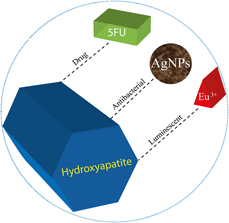
In this work, a multifunctional system was developed in which antibacterial and luminescent properties were inserted into the matrix of hydroxyapatite (HAp) and its efficiency as a support for an antineoplastic drug was evaluated, aiming its application in the treatment of osseous diseases. The precipitation method was used for the synthesis of HAp, EuCl3 was used for the incorporation of Eu3+ as imaging agents, silver nanoparticles (AgNPs) with antimicrobial function were used, and a model of drug, 5-fluorouracil (5FU) was used. The developed material is characterized by several techniques, where crystalline peaks attributed to HAp were identified in the X-ray diffractogram, whereas the luminescence spectrum of the material presented emissions attributed to the Eu3+ ion. The identification and the uniform distribution of AgNPs, 5FU, and Eu3+ were confirmed by mapping the sample using energy-dispersive spectroscopy. The measurements indicated that 82% (±2.8) of 5FU was incorporated into the HAp matrix, and a gradual and increasing release of it as a function of time was observed. Assays carried out for different bacteria confirmed the antimicrobial action of the samples and the efficiency of the drug inserted into the matrix. An in vitro assay showed the bioactivity of the material and its potential to bind to living osseous tissue.
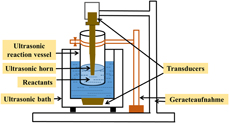
The hydroxyapatite nanoparticles (nHAPs) were synthesized rapidly by the self-assembled dual-frequency ultrasonic method. The ultrasonic time and power effect on the morphology and phase composition of nHAPs were investigated through field-emission scanning electron microscopy (FE-SEM), X-ray diffraction, energy dispersive spectrometer (EDS) spectrometer, and Fourier transform infrared spectroscopy, which showed that the most uniform nanoparticles were obtained when the ultrasonic time was 30 min and the ultrasonic power was 280 W. Cytotoxicity and hemolysis tests showed that an indistinctive cytotoxic effect was within the concentration of 25–400 μg/mL and the hemolytic ratio was below 2.0% at concentration of 25–200 μg/mL, respectively, revealing a good biocompatibility of nHAPs. By loading tetracycline hydrochloride onto nHAPs spheres, the drug release results showed that the drug loading and encapsulation efficiency were (26.34 ± 2.99)% and (52.68 ± 5.98)%, respectively. The drug-loaded sample shows a slow-release property, indicating that nHAPs may be promising as drug carriers.
Structural variation of LiMn1.5Ni0.5O4 spinel cathode during the Li+ extraction/insertion reaction was studied using operando X-ray diffraction. It was found that the reaction in the voltage range from 3.5 to 4.9 V consisted of two consecutive two-phase reactions, where three spinel phases of LiMn1.5Ni0.5O4, Li0.5Mn1.5Ni0.5O4 and Mn1.5Ni0.5O4 were identified and the lattice volume change in the whole reaction was evaluated as 6%. The reactions were symmetric and reversible under low-current conditions, but some asymmetries were detected during high current operation. Furthermore, a two-phase reaction between cubic and tetragonal phases was observed in the low-voltage reaction at 2.1–3.5 V, where the lattice volume change was approximately 4.9%. The rate-determining step was discussed based on these operando results.
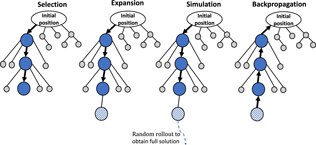
Materials design and discovery can be represented as selecting the optimal structure from a space of candidates that optimizes a target property. Since the number of candidates can be exponentially proportional to the structure determination variables, the optimal structure must be obtained efficiently. Recently, inspired by its success in the Go computer game, several approaches have applied Monte Carlo tree search (MCTS) to solve optimization problems in natural sciences including materials science. In this paper, we briefly reviewed applications of MCTS in materials design and discovery, and analyzed its future potential.
High-temperature X-ray diffraction with concurrent gas chromatography (GC) was employed in the study of iron disulfide (FeS2) cathode pellets disassembled from thermal batteries. When FeS2 cathode materials were analyzed in an air environment, reaction of the KCl and LiCl salt phases led to the formation of Li2(SO4) and KFe2S3 phases beginning at ~230 °C. These phases subsequently reacted to generate various forms of potassium iron sulfates in the 280–500 °C range, with the final products resulting in a β-Fe2O3 phase and K2(SO4). Independent simultaneous thermal analysis coupled with mass spectroscopy (MS) augmented the diffraction results and supported the overall picture of FeS2 decomposition. Both gas analysis measurements (i.e. GC and MS) from the independent experiments confirmed the formation of SO2 off-gas species during the breakdown of the FeS2. In contrast, characterization of the same cathode material under inert conditions showed the persistence of the initial FeS2 phase throughout the entire temperature range of analysis.
X-ray diffraction-X-ray fluorescence (XRD-XRF) data sets obtained from surface scans of synthetic samples have been analysed by means of different data clustering algorithms, with the aim to propose a methodology for automatic crystallographic and chemical classification of surfaces. Three data clustering strategies have been evaluated, namely hierarchical, k-means, and density-based clustering; all of them have been applied to the distance matrix calculated from the single XRD and XRF data sets as well as the combined distance matrix. Classification performance is reported for each strategy both in numerical form as the corrected Rand index and as a visual reconstruction of the surface maps. Hierarchical and k-means clustering offered comparable results, depending on both sample complexity and data quality. When applied to XRF data collected on a two-phases test sample, both algorithms allowed to obtain Rand index values above 0.8, whereas XRD data collected on the same sample gave values around 0.5; application to the combined distance matrix improved the correlation to about 0.9. In the case of a more complex multi-phase sample, it has also been found that classification performance strongly depends on both data quality and signal contrast between different regions; again, the adoption of the combined dissimilarity matrix offered improved classification performance.
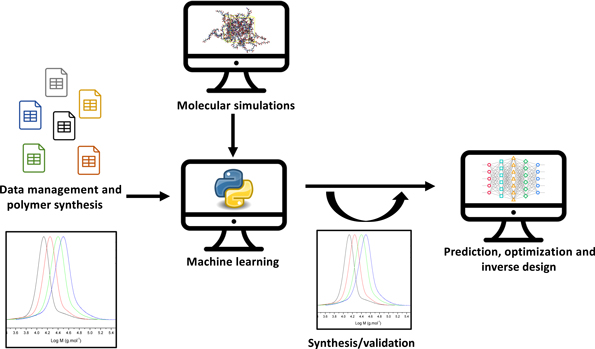
In this perspective, the authors challenge the status quo of polymer innovation. The authors first explore how research in polymer design is conducted today, which is both time consuming and unable to capture the multi-scale complexities of polymers. The authors discuss strategies that could be employed in bringing together machine learning, data curation, high-throughput experimentation, and simulations, to build a system that can accurately predict polymer properties from their descriptors and enable inverse design that is capable of designing polymers based on desired properties.
The novelty of this study was to investigate for the first time in literature the influence of Bombyx mori silkworm cocoon’s age on the properties of silk fibroin-based materials, during all stages of cocoon processing to obtain the fibroin film. The study started with the premise that the cocoon age could cause modifications on fibroin properties during processing and, consequently, a possible interference on the characteristics of the final product. Characterizations were performed using batches of cocoons produced in different years, named C0 (fresh cocoons) and C6 (six-year-old cocoons). The influence of cocoon’s aging was observed on dialyzed dispersion regarding the molecular weight, particle size, and conformation. C6 films showed a more crystalline structure and higher thermal resistance than C0 films. The findings reported in this work are relevant for the reproducibility of fibroin-based materials, and the cocoon age is a key factor that should be considered in the preparation of fibroin-based materials.
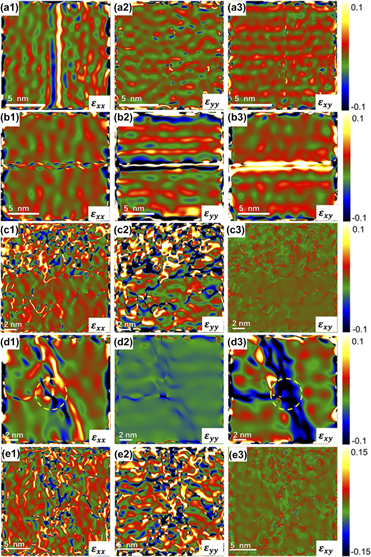
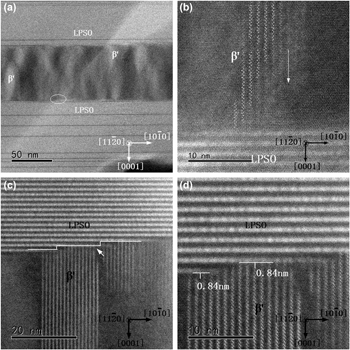
This paper reports on an atomic-scale investigation into the β′ precipitates and the long-period stacking ordered phase (LPSO) in Mg–5Y–2.5Ni–0.5Zr (at.%) alloy, using Cs-corrected high angle annular dark field-scanning transmission electron microscopy (HAADF-STEM). The results displayed that the 18R-type and 14H-type LPSO phases coexisted in the as-cast and the solid solution states, and the 18R-type and 14H-type LPSO structures were thermal stable. After aging treatment, the aging peak hardness reached 138 HV at 225 °C for 48 h. The significant increase in hardness was attributed to the formation of the metastable β′ phase. The lattice parameters of a and b axes for β′ phases are a = 0.65 nm, b = 2.20 nm, and c = 0.52 nm by HAADF-STEM. The interaction between the LPSO phase and the β′ can be found. The atomic-scale interactions between the LPSO and β′ phases are divided into two parts: under-aging and peak-aging conditions between the building blocks.
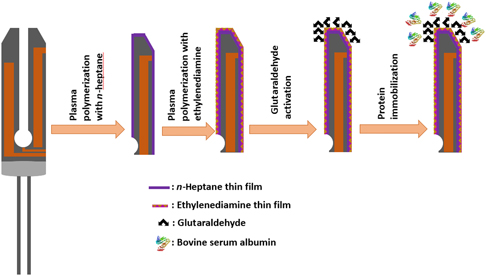
Due to the lack of the stability of amine films, a promising transducer, quartz-tuning fork (QTF) prongs were modified by a bi-layer film of plasma-polymerized n-heptane (hep) and then by ethylenediamine (EDA), respectively. For this purpose, the authors investigate the stability of amine-rich thin films both in air and aqueous medium. EDA films were deposited on QTF substrates by using an RF plasma system. The final amine-rich thin film was used to immobilize biologic recognition element. Model protein studies were showed that selected thin films could be adapted to QTF transducers to be used as a biosensor template.