Refine search
Actions for selected content:
212053 results in Engineering
Modified design of sub-reflector with dielectric cylindrical keeper to enhance gain in axially displaced ellipse reflector with dual polarization
-
- Journal:
- International Journal of Microwave and Wireless Technologies / Volume 17 / Issue 4 / May 2025
- Published online by Cambridge University Press:
- 16 July 2025, pp. 613-619
-
- Article
- Export citation
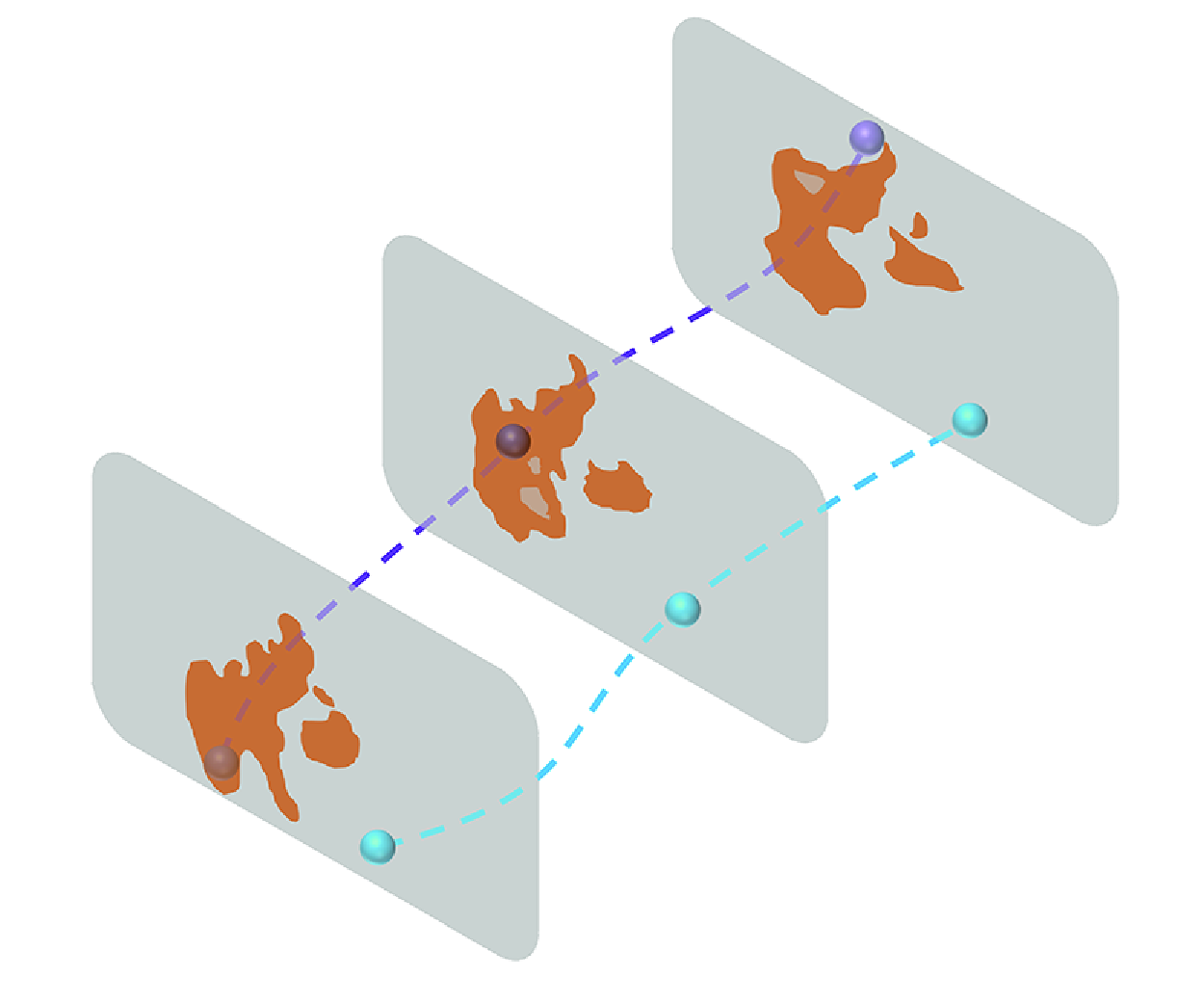
How large-scale flow structures affect particle transport in wall turbulence
-
- Journal:
- Journal of Fluid Mechanics / Volume 1015 / 25 July 2025
- Published online by Cambridge University Press:
- 16 July 2025, A23
-
- Article
- Export citation
-
This study investigates the transport of particles in turbulent channel flow with friction Reynolds number $Re_\tau = 1000$ by direct numerical simulation. We focus on how large-scale flow structures, namely the $Qs$ structures (Lozano-Durán et al. 2012, J. Fluid Mech., vol. 694, pp. 100–130), affect the wall-normal transport of particles. Despite occupying less than $10\,\%$ of the physical domain, our results highlight the critical role played by $Qs$ structures in the particle transport, namely that the particle number and momentum flux inside the $Qs$ structures are substantially higher than outside. The fraction of particle wall-normal momentum flux inside $Qs$ structures is considerably larger than their volume fraction, suggesting highly efficient transport inside the $Qs$ structures. This prominent role played by $Qs$ structures in the transport of inertial particles is more effective by diminishing the inertia of particles. Notably, the long-distance transport of particles in the wall-normal direction is driven primarily by the continuous effect of $Qs$ structures. In summary, our findings advance the understanding of the effects of $Qs$ structures on particle transport, and demonstrate their significant role in the process.


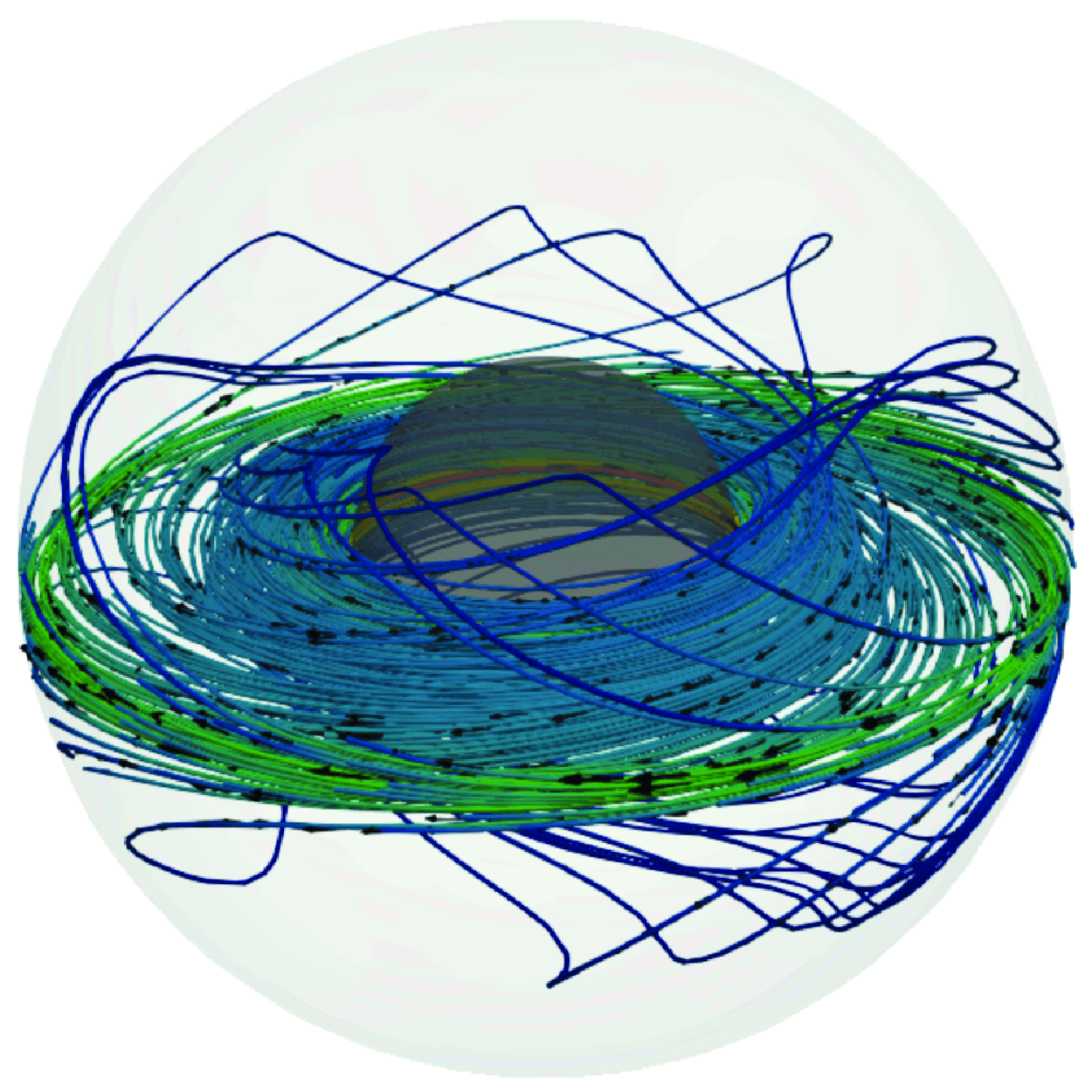
Electromagnetically driven magnetized spherical Couette flow
-
- Journal:
- Journal of Fluid Mechanics / Volume 1015 / 25 July 2025
- Published online by Cambridge University Press:
- 16 July 2025, A25
-
- Article
- Export citation
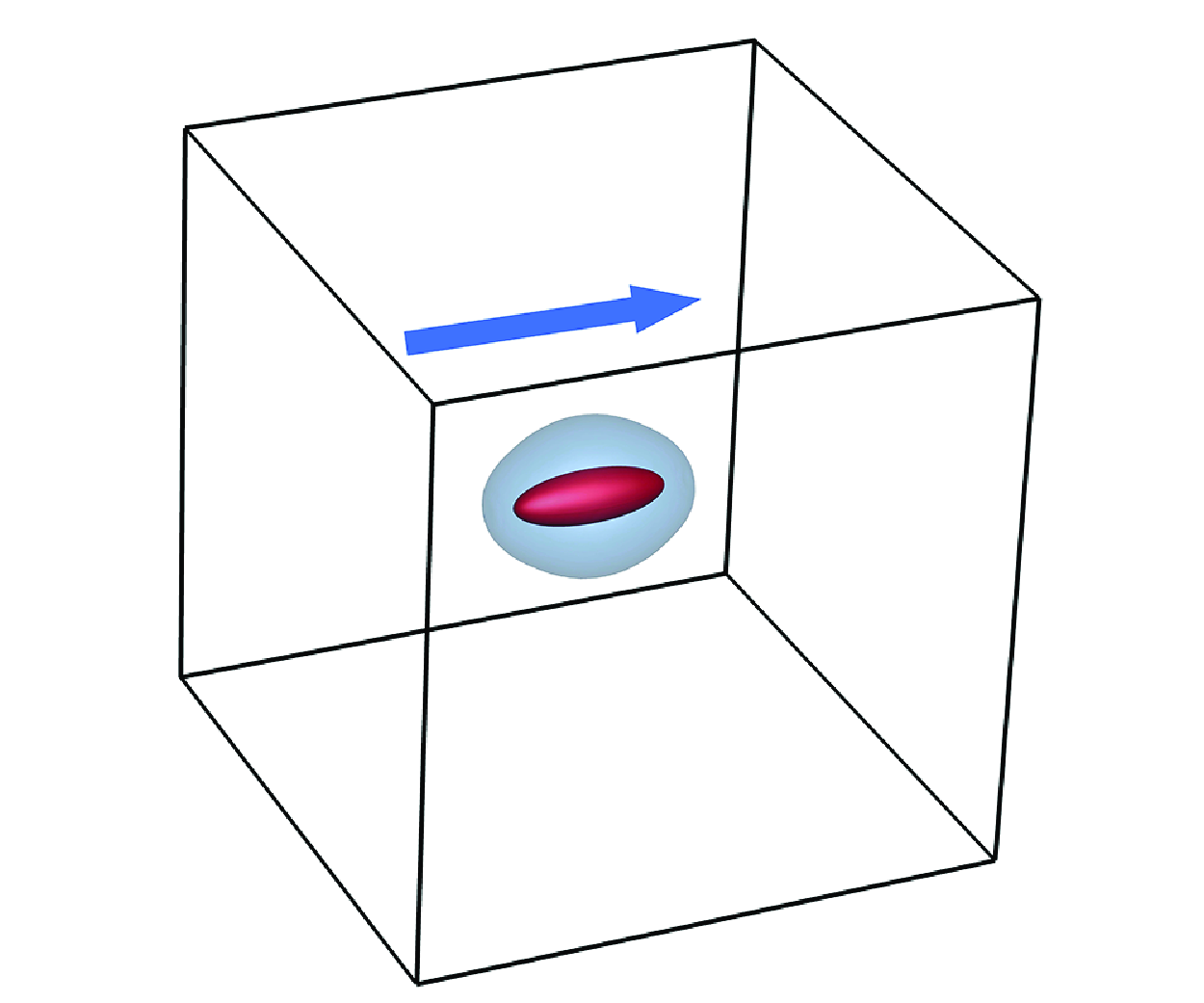
Swimming and mixing of an ellipsoidal squirmer in a viscoplastic fluid
-
- Journal:
- Journal of Fluid Mechanics / Volume 1015 / 25 July 2025
- Published online by Cambridge University Press:
- 16 July 2025, A12
-
- Article
-
- You have access
- Open access
- HTML
- Export citation
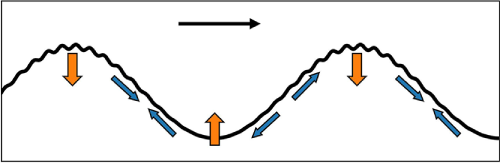
Revisiting the hydrodynamic modulation of short surface waves by longer waves
-
- Journal:
- Journal of Fluid Mechanics / Volume 1015 / 25 July 2025
- Published online by Cambridge University Press:
- 16 July 2025, A20
-
- Article
-
- You have access
- Open access
- HTML
- Export citation
-
Hydrodynamic modulation of short ocean surface waves by longer ambient waves significantly influences remote sensing, interpretation of in situ wave measurements and numerical wave forecasting. This paper revisits the wave crest and action conservation laws and derives steady, nonlinear, analytical solutions for the change of short-wave wavenumber, action and gravitational acceleration due to the presence of longer waves. We validate the analytical solutions with numerical solutions of the full crest and action conservation equations. The nonlinear analytical solutions of short-wave wavenumber, amplitude and steepness modulation significantly deviate from the linear analytical solutions of Longuet-Higgins & Stewart (1960 J. Fluid Mech. vol. 8, no. 4, pp. 565–583) and are similar to the nonlinear numerical solutions by Longuet-Higgins (1987 J. Fluid Mech. vol. 177, pp. 293–306) and Zhang & Melville (1990 J. Fluid Mech. vol. 214, pp. 321–346). The short-wave steepness modulation is attributed 5/8 to wavenumber, 1/4 due to wave action and 1/8 due to effective gravity. Examining the homogeneity and stationarity requirements for the conservation of wave action reveals that stationarity is a stronger requirement and is generally not satisfied for very steep long waves. We examine the results of Peureux et al. (2021 J. Geophys. Res.: Oceans vol. 126, no. 1, e2020JC016735) who found through numerical simulations that the short-wave modulation grows unsteadily with each long-wave passage. We show that this unsteady growth only occurs for homogeneous initial conditions as a special case and not generally. The proposed steady solutions are a good approximation of the nonlinear crest-action conservation solutions in long-wave steepness $\lesssim 0.2$. Except for a subset of initial conditions, the solutions to the nonlinearised crest-action conservation equations are mostly steady in the reference frame of the long waves.

Streaming and diffusion in the cochlea
-
- Journal:
- Journal of Fluid Mechanics / Volume 1015 / 25 July 2025
- Published online by Cambridge University Press:
- 16 July 2025, A15
-
- Article
- Export citation
A soft 3-DOF interaction force measurement system for estimating the biomechanical effects of a soft wearable robot on the human joint
-
- Journal:
- Wearable Technologies / Volume 6 / 2025
- Published online by Cambridge University Press:
- 15 July 2025, e32
-
- Article
-
- You have access
- Open access
- HTML
- Export citation
Mechanisms underlying the generation and generalisation of the surface layer – ERRATUM
-
- Journal:
- Journal of Fluid Mechanics / Volume 1014 / 10 July 2025
- Published online by Cambridge University Press:
- 15 July 2025, E3
-
- Article
-
- You have access
- Open access
- HTML
- Export citation
Ka-band thin-film compact cascaded reflective-type phase shifter exploiting CVD-grown-graphene diode
-
- Journal:
- International Journal of Microwave and Wireless Technologies , First View
- Published online by Cambridge University Press:
- 15 July 2025, pp. 1-9
-
- Article
- Export citation
-
This paper presents the design, implementation, and characterization of a compact two-stage analog phase-shifter for the Ka-band, based on thin-film technology. The design utilizes a reflective-type configuration, employing four metal-insulator-graphene diodes as reflective loads. The fabricated prototype is realized on an 8-µ m-thick flexible polyimide substrate and occupies less than 0.7 mm2 of chip area including the contact pads. Performance evaluation of the fabricated circuit reveals an S11 of better than −13 dB and an S21 of −3.3 dB with a tolerance of ± 0.5 dB across the frequency band from 28 to 36 GHz, along with a tunable phase difference ( $\Delta\phi$) exceeding 70∘. The introduced flexible thin-film technology promotes the realization of flexible cost-effective beam steering for smart surfaces implementations for communication and biomedical applications.

Wind-farm wake recovery mechanisms in conventionally neutral boundary layers
-
- Journal:
- Journal of Fluid Mechanics / Volume 1015 / 25 July 2025
- Published online by Cambridge University Press:
- 15 July 2025, A5
-
- Article
- Export citation
-
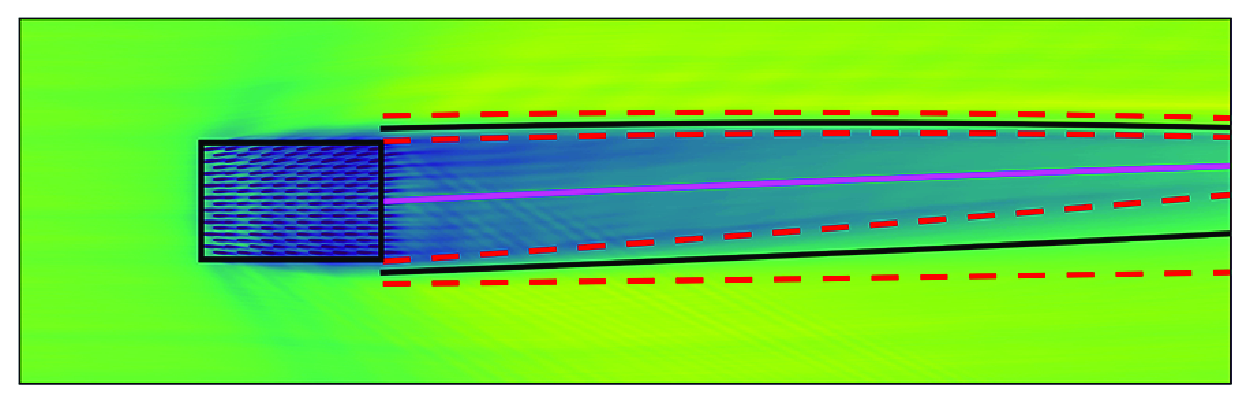
Synthetic-aperture radar images and mesoscale models show that wind-farm wakes differ from single-turbine wakes. For instance, wind-farm wakes often narrow and do not disperse over long distances, contrasting the broader and more dissipating wakes of individual turbines. In this work, we aim to better understand the mechanisms that govern wind-farm wake behaviour and recovery. Hence we study the wake properties of a $1.6$ GW wind farm operating in conventionally neutral boundary layers with capping-inversion heights $203$, $319$, $507$ and $1001$ m. In shallow boundary layers, we find strong flow decelerations that reduce the Coriolis force magnitude, leading to an anticlockwise wake deflection in the Northern Hemisphere. In deep boundary layers, the vertical turbulent entrainment of momentum adds clockwise-turning flow from aloft into the wake region, leading to a faster recovery rate and a clockwise wake deflection. To estimate the wake properties, we propose a simple function to fit the velocity magnitude profiles along the spanwise direction. In the vertical direction, the wake spreads up to the capping-inversion height, which significantly limits vertical wake development in shallow-boundary-layer cases. In the horizontal direction and for shallow boundary layers, the wake behaves as two distinct mixing layers located at the lateral wake edges, which expand and turn towards their low-velocity side, causing the wake to narrow along the streamwise direction. A detailed analysis of the momentum budget reveals that in deep boundary layers, the wake is predominantly replenished through turbulent vertical entrainment. Conversely, in shallow boundary layers, wakes are mostly replenished by mean flow advection in the spanwise direction.


The effect of gravity on bubble–particle collisions in turbulence
-
- Journal:
- Journal of Fluid Mechanics / Volume 1015 / 25 July 2025
- Published online by Cambridge University Press:
- 15 July 2025, A4
-
- Article
-
- You have access
- Open access
- HTML
- Export citation
High-precision coupled method for interior ballistics of gun with self-sealing band
-
- Journal:
- The Aeronautical Journal / Volume 129 / Issue 1341 / November 2025
- Published online by Cambridge University Press:
- 15 July 2025, pp. 3004-3029
-
- Article
- Export citation
A 0.82 μm, 105 W diode-pumped thulium-doped all-silica-fiber laser
- Part of
-
- Journal:
- High Power Laser Science and Engineering / Volume 13 / 2025
- Published online by Cambridge University Press:
- 14 July 2025, e58
-
- Article
-
- You have access
- Open access
- HTML
- Export citation
Multilayer signal-interference fourth-order high-selectivity dual-band bandpass filter with multiple transmission zeros
-
- Journal:
- International Journal of Microwave and Wireless Technologies / Volume 17 / Issue 4 / May 2025
- Published online by Cambridge University Press:
- 14 July 2025, pp. 595-602
-
- Article
-
- You have access
- Open access
- HTML
- Export citation

Attenuation mechanism of wall-bounded turbulence by heavy finite-size particles
-
- Journal:
- Journal of Fluid Mechanics / Volume 1014 / 10 July 2025
- Published online by Cambridge University Press:
- 14 July 2025, A30
-
- Article
-
- You have access
- Open access
- HTML
- Export citation

A novel Kadomtsev–Petviashvili type model for nonlinear internal waves with horizontally two-dimensional shear currents and Earth’s rotation
-
- Journal:
- Journal of Fluid Mechanics / Volume 1015 / 25 July 2025
- Published online by Cambridge University Press:
- 14 July 2025, A3
-
- Article
- Export citation
-
Inspired by the need to theoretically understand the naturally occurring interactions between internal waves and mesoscale phenomena in the ocean, we derive a novel model equation from the primitive rotational Euler equations using the multi-scale asymptotic expansion method. By applying the classic balance $\epsilon =\mu ^2$ between nonlinearity (measured by $\epsilon$) and dispersion (measured by $\mu$), along with the assumption that variations in the transverse direction are of order $\mu$, which is smaller than those in the propagation direction, we arrive at terms from the classic Kadomtsev–Petviashvili equation. However, when incorporating background shear currents in two horizontal dimensions and accounting for Earth’s rotation, we introduce three additional terms that, to the best of the authors’ knowledge, have not been addressed in the previous literature. Theoretical analyses and numerical results indicate that these three terms contribute to a tendency for propagation in the transverse direction and an overall variation in wave amplitudes. The specific effects of these terms can be estimated qualitatively based on the signs of the coefficients for each term and the characteristics of the initial waves. Finally, the potential shortcomings of this proposed equation are illuminated.


Open energy services: forecasting and optimization as a service for energy management applications at scale
- Part of
-
- Journal:
- Data-Centric Engineering / Volume 6 / 2025
- Published online by Cambridge University Press:
- 14 July 2025, e35
-
- Article
-
- You have access
- Open access
- HTML
- Export citation
Understanding the perspectives of older adults and physiotherapists on home-based lower-limb exoskeletons
-
- Journal:
- Wearable Technologies / Volume 6 / 2025
- Published online by Cambridge University Press:
- 14 July 2025, e31
-
- Article
-
- You have access
- Open access
- HTML
- Export citation
Numerical investigation of magnetic pole angle on the aerodynamic heating and force properties of hypersonic magnetohydrodynamic in two-dimensional axisymmetric geometry
-
- Journal:
- The Aeronautical Journal / Volume 129 / Issue 1341 / November 2025
- Published online by Cambridge University Press:
- 14 July 2025, pp. 3305-3326
-
- Article
- Export citation
Inter-scale energy transfer and interaction in a turbulent channel flow with randomly distributed wall roughness
-
- Journal:
- Journal of Fluid Mechanics / Volume 1015 / 25 July 2025
- Published online by Cambridge University Press:
- 14 July 2025, A2
-
- Article
- Export citation
