Refine search
Actions for selected content:
212053 results in Engineering
12 - Beyond the mean/variance model
-
- Book:
- Financial Data Science
- Published online:
- 17 December 2025
- Print publication:
- 17 July 2025, pp 311-336
-
- Chapter
- Export citation
14 - Text analytics
-
- Book:
- Financial Data Science
- Published online:
- 17 December 2025
- Print publication:
- 17 July 2025, pp 371-396
-
- Chapter
- Export citation
3 - Data models and estimation
-
- Book:
- Financial Data Science
- Published online:
- 17 December 2025
- Print publication:
- 17 July 2025, pp 31-80
-
- Chapter
- Export citation
Contents
-
- Book:
- Financial Data Science
- Published online:
- 17 December 2025
- Print publication:
- 17 July 2025, pp vii-xii
-
- Chapter
- Export citation
6 - Linear regression models
-
- Book:
- Financial Data Science
- Published online:
- 17 December 2025
- Print publication:
- 17 July 2025, pp 131-164
-
- Chapter
- Export citation
13 - Financial networks
-
- Book:
- Financial Data Science
- Published online:
- 17 December 2025
- Print publication:
- 17 July 2025, pp 337-370
-
- Chapter
- Export citation
Crystal structure of RbCdVO4 from X-ray laboratory powder diffraction
-
- Journal:
- Powder Diffraction / Volume 40 / Issue 3 / September 2025
- Published online by Cambridge University Press:
- 17 July 2025, pp. 179-182
-
- Article
- Export citation
Vortex modes in acoustofluidic cylindrical resonators
-
- Journal:
- Journal of Fluid Mechanics / Volume 1015 / 25 July 2025
- Published online by Cambridge University Press:
- 17 July 2025, A34
-
- Article
- Export citation
2 - Data representation and visualization
-
- Book:
- Financial Data Science
- Published online:
- 17 December 2025
- Print publication:
- 17 July 2025, pp 7-30
-
- Chapter
- Export citation
Reviews
-
- Book:
- Financial Data Science
- Published online:
- 17 December 2025
- Print publication:
- 17 July 2025, pp ii-ii
-
- Chapter
- Export citation
Controlling heat transport and flow structure in vertical convection using the thermoelectric effect
-
- Journal:
- Journal of Fluid Mechanics / Volume 1015 / 25 July 2025
- Published online by Cambridge University Press:
- 17 July 2025, A31
-
- Article
- Export citation
-
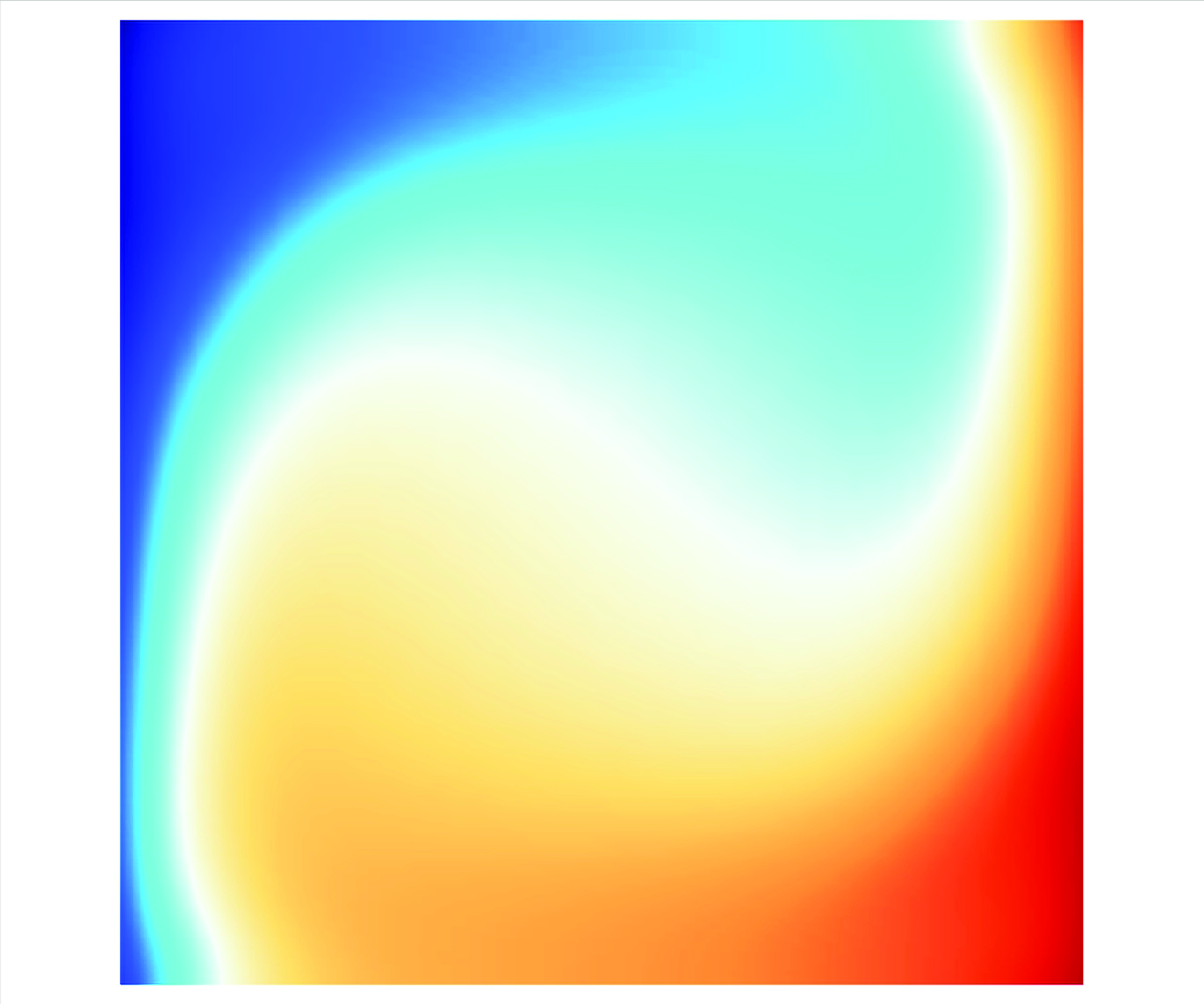
Direct numerical simulations have been conducted to explore the coupling effect of the thermoelectric effect and vertical convection (VC) in a square cavity composed of liquid lithium and stainless steel under different Hartmann numbers at $Ra=10^5$. By leveraging thermoelectric phenomena, an innovative approach is proposed to actively modulate heat transfer efficiency. The core concept lies in modulating the intensity of large-scale circulation (LSC) in VC systems through the torque generated by the interaction between thermoelectric currents and magnetic fields via Lorentz forces. The findings reveal that when the torque aligns with the direction of LSC induced by pure buoyancy, both momentum and heat transfer are enhanced. However, due to the magnetic damping itself, this enhancement is not sustained indefinitely, resulting in a trend of initial increase followed by decline in both momentum and heat transfer efficiency. Conversely, when the magnetic field direction is reversed, causing the Lorentz force torque to oppose the buoyancy-driven circulation, both momentum and heat transfer efficiency diminish until the flow reverses. By varying the magnetic field intensity, three distinct flow regimes are identified: the buoyancy-dominated regime, the thermoelectric-dominated regime and the magnetic-damping-dominated regime. The transition between the buoyancy-dominated regime and thermoelectric-dominated regime – specifically, the onset of flow reversal – is analysed through a boundary-layer–bulk–boundary-layer coupling model. This model enables precise prediction of the critical $Ha$ based on the torque balance between buoyancy forces and thermoelectrically induced Lorentz forces, and demonstrates close agreement with numerical simulations.


Closed-loop versus open-loop “remind-to-move” treatment using wearables for hemiparetic upper extremity in patients after stroke: A proof-of-concept study
-
- Journal:
- Wearable Technologies / Volume 6 / 2025
- Published online by Cambridge University Press:
- 17 July 2025, e33
-
- Article
-
- You have access
- Open access
- HTML
- Export citation
Near-inertial echoes of ageostrophic instability in submesoscale filaments
-
- Journal:
- Journal of Fluid Mechanics / Volume 1015 / 25 July 2025
- Published online by Cambridge University Press:
- 17 July 2025, A17
-
- Article
-
- You have access
- Open access
- HTML
- Export citation
-
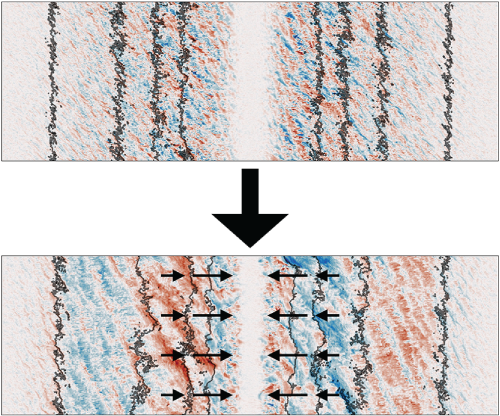
Ocean submesoscales, flows with characteristic size $10\,\text{m}{-}10\,\text{km}$, are transitional between the larger, rotationally constrained mesoscale and three-dimensional turbulence. In this paper, we present simulations of a submesoscale ocean filament. In our case, the filament is strongly sheared in both vertical and cross-filament directions, and is unstable. Instability indeed dominates the early behaviour with a fast extraction of kinetic energy from the vertically sheared thermal wind. However, the instability that emerges does not exhibit characteristics that match the perhaps expected symmetric or Kelvin–Helmholtz instabilities, and appears to be non-normal in nature. The prominence of the transient response depends on the initial noise, and for large initial noise amplitudes, saturates before symmetric instability normal modes are able to develop. The action of the instability is sufficiently rapid – with energy extraction from the mean flow emerging and peaking within the first inertial period ( $\sim\! 18\ \text{h}$) – that the filament does not respond in a geostrophically balanced sense. Instead, at all initial noise levels, it later exhibits vertically sheared near-inertial oscillations with higher amplitude as the initial minimum Richardson number decreases. Horizontal gradients strengthen only briefly as the fronts restratify. These unstable filaments can be generated by strong mixing events at pre-existing stable structures; we also caution against inadvertently triggering this response in idealised studies that start in a very unstable state.


Linking emitted drops to collective bursting bubbles across a wide range of bubble size distributions
-
- Journal:
- Journal of Fluid Mechanics / Volume 1015 / 25 July 2025
- Published online by Cambridge University Press:
- 17 July 2025, A8
-
- Article
-
- You have access
- Open access
- HTML
- Export citation
-
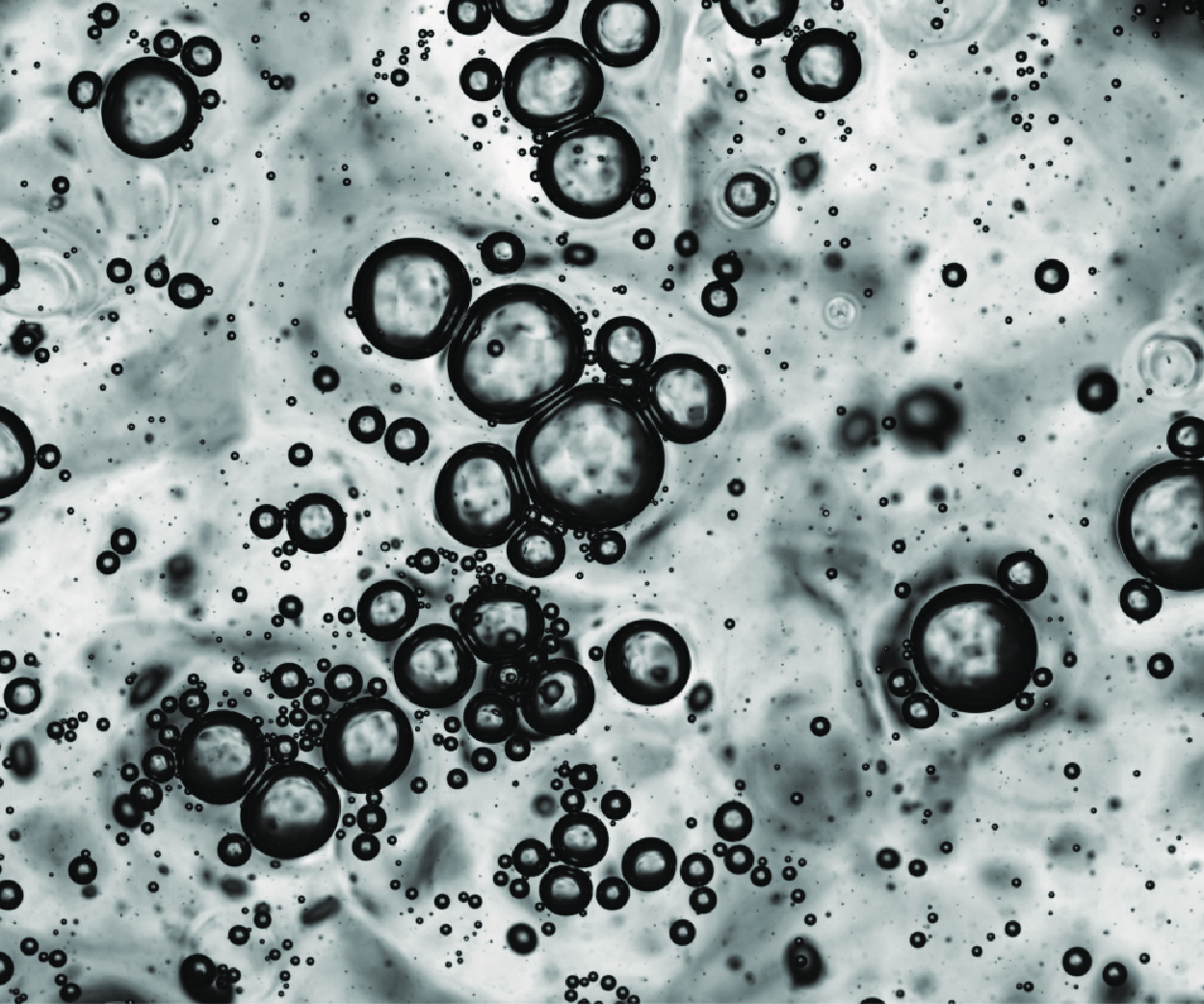
Bubbles entrained by breaking waves rise to the ocean surface, where they cluster before bursting and release droplets into the atmosphere. The ejected drops and dry aerosol particles, left behind after the liquid drop evaporates, affect the radiative balance of the atmosphere and can act as cloud condensation nuclei. The remaining uncertainties surrounding the sea spray emissions function motivate controlled laboratory experiments that directly measure and link collective bursting bubbles and the associated drops and sea salt aerosols. We perform experiments in artificial seawater for a wide range of bubble size distributions, measuring both bulk and surface bubble distributions (measured radii from $30\,\unicode{x03BC} \mathrm{m}$ to $5\,\mathrm{mm}$), together with the associated drop size distribution (salt aerosols and drops of measured radii from $50\,\mathrm{nm}$ to $500\,\unicode{x03BC} \mathrm{m}$) to quantify the link between emitted drops and bursting surface bubbles. We evaluate how well the individual bubble bursting scaling laws describe our data across all scales and demonstrate that the measured drop production by collective bubble bursting can be represented by a single framework integrating individual bursting scaling laws over the various bubble sizes present in our experiments. We show that film drop production by bubbles between $100\,\unicode{x03BC} \mathrm{m}$ and $1\,\mathrm{mm}$ describes the submicron drop production, while jet drop production by bubbles from $30\,\unicode{x03BC} \mathrm{m}$ to $2\,\mathrm{mm}$ describes the production of drops larger than $1\,\unicode{x03BC} \mathrm{m}$. Our work confirms that sea spray emission functions based on individual bursting processes are reasonably accurate as long as the surface bursting bubble size distribution is known.


4 - Principal component analysis and low-rank approximation
-
- Book:
- Financial Data Science
- Published online:
- 17 December 2025
- Print publication:
- 17 July 2025, pp 81-110
-
- Chapter
- Export citation
8 - Nonlinear classifiers and kernel methods
-
- Book:
- Financial Data Science
- Published online:
- 17 December 2025
- Print publication:
- 17 July 2025, pp 193-214
-
- Chapter
- Export citation
10 - Optimization tools
-
- Book:
- Financial Data Science
- Published online:
- 17 December 2025
- Print publication:
- 17 July 2025, pp 245-272
-
- Chapter
- Export citation
Wave- and potential-driven instabilities in orbital pilot-wave dynamics
-
- Journal:
- Journal of Fluid Mechanics / Volume 1015 / 25 July 2025
- Published online by Cambridge University Press:
- 17 July 2025, A26
-
- Article
-
- You have access
- Open access
- HTML
- Export citation
11 - Mean/variance portfolio optimization
-
- Book:
- Financial Data Science
- Published online:
- 17 December 2025
- Print publication:
- 17 July 2025, pp 273-310
-
- Chapter
- Export citation
Chimney instability of rotating Leidenfrost drops
-
- Journal:
- Journal of Fluid Mechanics / Volume 1015 / 25 July 2025
- Published online by Cambridge University Press:
- 17 July 2025, A6
-
- Article
- Export citation
-
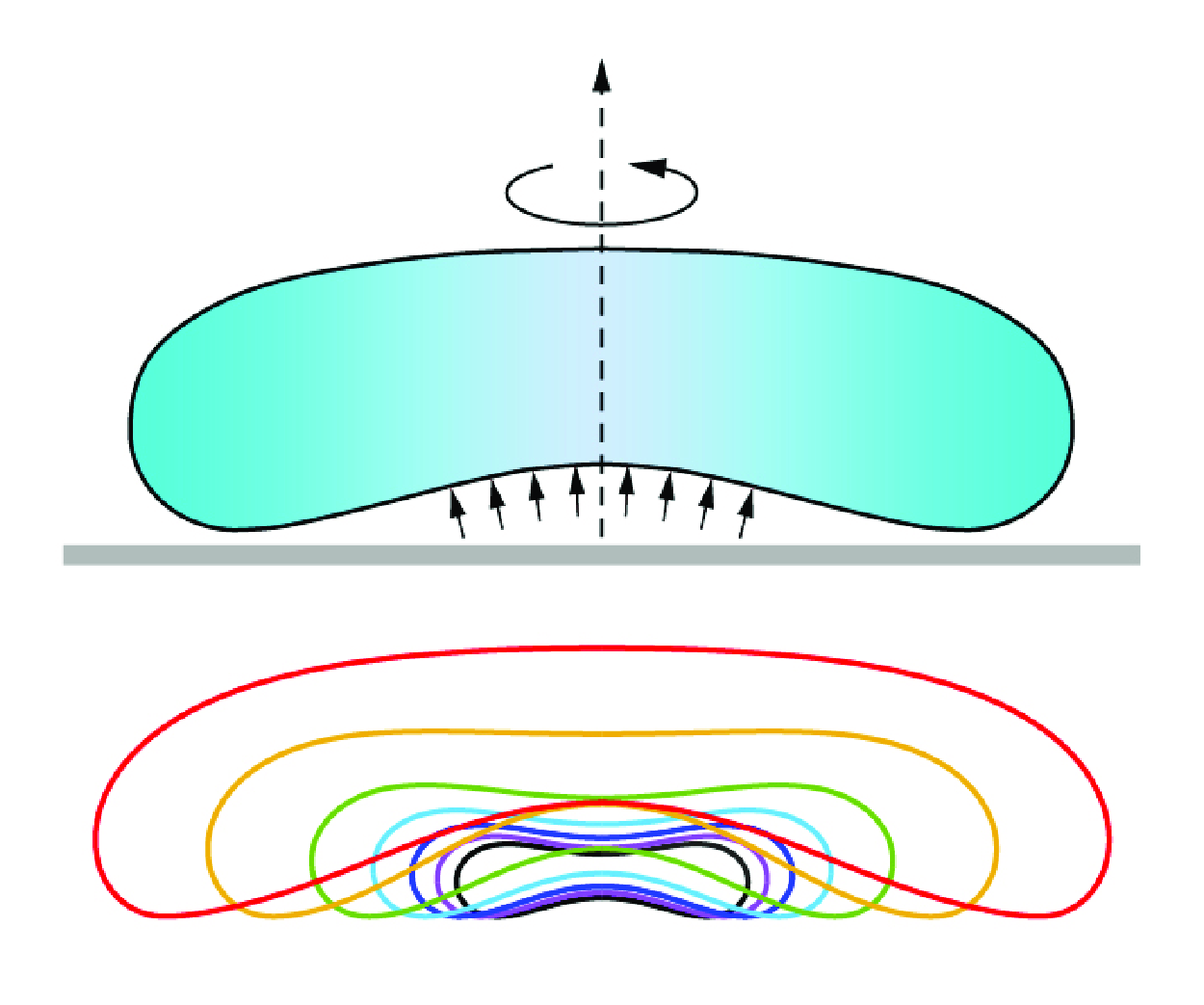
The Leidenfrost effect occurs when drops are deposited on a highly superheated solid surface, creating a thin vapour film through rapid evaporation that levitates the drops. For drop with a radius exceeding a critical value, a vapour bubble forms and bursts from its bottom centre, a phenomenon known as chimney instability. Despite extensive investigation, the impact of Leidenfrost drop’s rotation on its chimney instability has remained unexplored. This study addresses this gap by providing both numerical and approximate solutions to the theoretical models. We identify two distinct regimes where either gravitational force or centrifugal force is the primary driver of chimney instability. These regimes are characterised by a non-dimensional rotation number, Ro, which represents the ratio between centrifugal force and gravitational force. Our findings reveal clear scaling laws that relate the critical geometrical parameters (radius, volume and height of the drop) for chimney instability to Ro, demonstrating that rotation can induce chimney instability in smaller drops. The scaling laws are elucidated through pressure perturbation analyses under a virtual perturbation to the drop profile at the critical state for chimney instability. Additionally, by varying the evaporation number $Ev$, we demonstrate that while increased superheat reduces the critical radius in the absence of rotation, the scaling laws related to Ro for a rotating drop remain unaffected. Building on these insights, we present a master curve in a simplified form that accurately predicts the critical state for chimney instability under various angular velocities, gravitational accelerations and superheat conditions.

