Refine search
Actions for selected content:
212053 results in Engineering

Undulatory underwater swimming: linking vortex dynamics, thrust and wake structure with a biorobotic fish
-
- Journal:
- Journal of Fluid Mechanics / Volume 1015 / 25 July 2025
- Published online by Cambridge University Press:
- 23 July 2025, A53
-
- Article
- Export citation

Ill posedness in shallow multi-phase debris-flow models
-
- Journal:
- Journal of Fluid Mechanics / Volume 1015 / 25 July 2025
- Published online by Cambridge University Press:
- 23 July 2025, A52
-
- Article
-
- You have access
- Open access
- HTML
- Export citation

Characterisation of sea ice kinematics over oceanic eddies
-
- Journal:
- Journal of Fluid Mechanics / Volume 1015 / 25 July 2025
- Published online by Cambridge University Press:
- 23 July 2025, A51
-
- Article
-
- You have access
- Open access
- HTML
- Export citation

Newtonian-like behaviour of starting vortex flow in superfluid helium at high Reynolds numbers
-
- Journal:
- Journal of Fluid Mechanics / Volume 1015 / 25 July 2025
- Published online by Cambridge University Press:
- 23 July 2025, A57
-
- Article
-
- You have access
- Open access
- HTML
- Export citation
-
We study experimentally the starting vortices shed by airfoils accelerating uniformly from rest in superfluid helium-4 (He II). The vortices behave apparently as if they were moving in a classical Newtonian fluid, such as air or water. Specifically, the starting vortex positions obtained from the experimental data are found to be very close to those computed numerically in a Newtonian fluid, at sufficiently small times, when self-similar behaviour is expected to occur, and for Reynolds numbers ranging between approximately $5 \times 10^2$ and $5 \times 10^5$. The result indicates neatly that turbulent flows of He II can be very similar to classical flows of Newtonian fluids, when thermal effects can be neglected and at sufficiently large flow scales, i.e. the study demonstrates that He II could also be employed to study classical Newtonian flows.


Internal shear layers generated by a vertically oscillating cylinder in unbounded and bounded rotating fluids
- Part of
-
- Journal:
- Journal of Fluid Mechanics / Volume 1015 / 25 July 2025
- Published online by Cambridge University Press:
- 22 July 2025, A38
-
- Article
- Export citation
-
In rotating fluids, the viscous smoothing of inviscid singular inertial waves leads to the formation of internal shear layers. In previous works, we analysed the internal shear layers excited by a viscous forcing (longitudinal libration) in a spherical shell geometry (He et al., 2022 J. Fluid Mech. 939, A3; He et al., 2023 J. Fluid Mech. 974, A3). We now consider the stronger inviscid forcing corresponding to the vertical oscillation of the inner boundary. We limit our analysis to two-dimensional geometries but examine three different configurations: freely propagating wave beams in an unbounded domain and two wave patterns (a periodic orbit and an attractor) in a cylindrical shell geometry. The asymptotic structures of the internal shear layers are assumed to follow the similarity solution of Moore & Saffman (1969 Phil. Trans. R. Soc. Lond. A, 264, 597–634) in the small viscous limit. The two undefined parameters of the similarity solution (singularity strength and amplitude) are derived by asymptotically matching the similarity solution with the inviscid solution. For each case, the derivation of the latter is achieved either through separation of variables combined with analytical continuation or the method of characteristics. Global inviscid solutions, when obtained, closely match numerical solutions for small Ekman numbers far from the critical lines, while viscous asymptotic solutions show excellent performance near those lines. The amplitude scalings of the internal shear layers excited by an inviscid forcing are found to be divergent as the Ekman number $E$ decreases, specifically $O(E^{-1/6})$ for the critical-point singularity and $O(E^{-1/3})$ for attractors, in contrast to the convergent scalings found for a viscous forcing.


Interfacial arrest in buoyant viscoplastic injections
-
- Journal:
- Journal of Fluid Mechanics / Volume 1015 / 25 July 2025
- Published online by Cambridge University Press:
- 22 July 2025, A45
-
- Article
-
- You have access
- Open access
- HTML
- Export citation
-
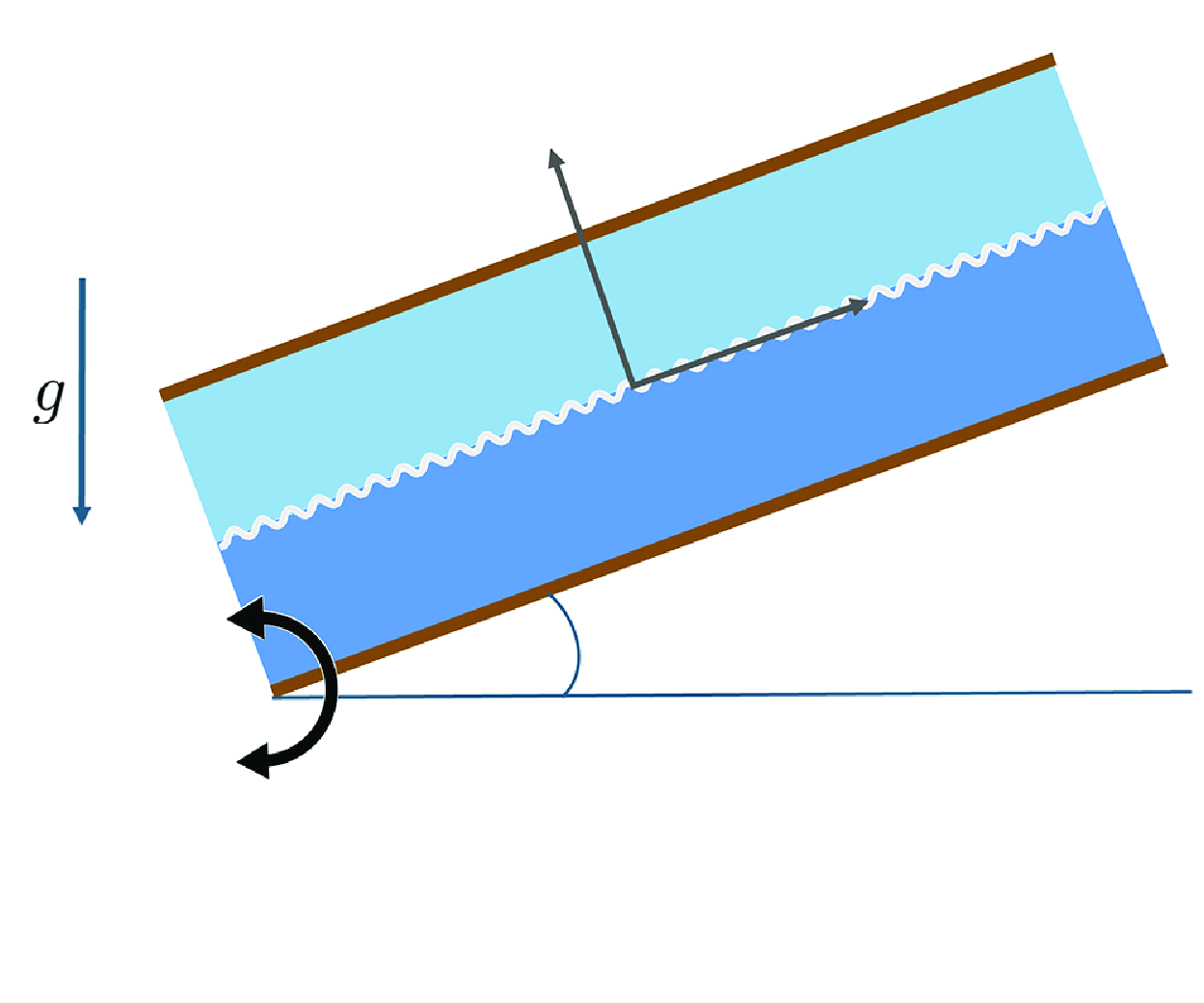
We study buoyant miscible injections of dense viscoplastic fluids into lighter Newtonian fluids in inclined closed-end pipes, at the high-Péclet-number regime. We integrate experiments involving camera imaging and ultrasound Doppler velocimetry, and computational fluid dynamics simulations, to provide a detailed analysis of interfacial dynamics, flow phases/regimes, velocity field, yielded and unyielded zones, and interfacial arrest mechanisms. The flow dynamics is governed by Reynolds ( $Re$), Froude ( $Fr$) and Bingham ( $B$) numbers, the viscosity ratio ( $M$), inclination angle ( $\beta$), or their combinations, such as $\chi \equiv 2Re/Fr^2$. As the interface evolves, our results reveal a transition from an inertial-dominated phase, characterised by linear front advancement at the injection velocity, to a viscoplastic-dominated phase, marked by deceleration and eventual interfacial arrest governed by the yield stress. The critical transition length between these phases $(\mathcal{L} \approx 1.26 Fr^{0.14})$ is determined by a balance between inertial and buoyant stresses. Experimental findings confirm buoyancy-driven slumping in our flows, consistent with the theoretical yield number criterion ( $Y \equiv B/\chi$), with maximum interfacial arrest lengths scaling as $L_s \sim 1/Y$. These results also classify arrested and unhalted interfacial flow regimes on a plane involving ${\chi \cos (\beta )}/{B}$ and $Y$. Furthermore, we demonstrate that the interfacial arrest mechanism arises from interactions between buoyancy, rheology and geometry, as diminishing shear stresses promote unyielded zone expansion near the interface, progressively encompassing the viscoplastic layer and halting flow when stresses fall below the yield stress.


Stability analysis of time-periodic shear flow generated by an oscillating density interface
-
- Journal:
- Journal of Fluid Mechanics / Volume 1015 / 25 July 2025
- Published online by Cambridge University Press:
- 22 July 2025, A27
-
- Article
-
- You have access
- Open access
- HTML
- Export citation
-
We consider the conceptual two-layered oscillating tank of Inoue & Smyth (2009 J. Phys. Oceanogr. vol. 39, no. 5, pp. 1150–1166), which mimics the time-periodic parallel shear flow generated by low-frequency (e.g. semi-diurnal tides) and small-angle oscillations of the density interface. Such self-induced shear of an oscillating pycnocline may provide an alternate pathway to pycnocline turbulence and diapycnal mixing in addition to the turbulence and mixing driven by wind-induced shear of the surface mixed layer. We theoretically investigate shear instabilities arising in the inviscid two-layered oscillating tank configuration and show that the equation governing the evolution of linear perturbations on the density interface is a Schrödinger-type ordinary differential equation with a periodic potential. The necessary and sufficient stability condition is governed by a non-dimensional parameter $\beta$ resembling the inverse Richardson number; for two layers of equal thickness, instability arises when $\beta \,{\gt}\,1/4$. When this condition is satisfied, the flow is initially stable but finally tunnels into the unstable region after reaching the time marking the turning point. Once unstable, perturbations grow exponentially and reveal characteristics of Kelvin–Helmholtz (KH) instability. The modified Airy function method, which is an improved variant of the Wentzel–Kramers–Brillouin theory, is implemented to obtain a uniformly valid, composite approximate solution to the interface evolution. Next, we analyse the fully nonlinear stages of interface evolution by modifying the circulation evolution equation in the standard vortex blob method, which reveals that the interface rolls up into KH billows. Finally, we undertake real case studies of Lake Geneva and Chesapeake Bay to provide a physical perspective.


Design and development of fluidic frequency-agile polarization-dependent FSS using FDM-based 3D-printing
-
- Journal:
- International Journal of Microwave and Wireless Technologies / Volume 17 / Issue 4 / May 2025
- Published online by Cambridge University Press:
- 22 July 2025, pp. 721-730
-
- Article
- Export citation
A simple approach for designing quad-band rat-race couplers using modified T-shaped structures
-
- Journal:
- International Journal of Microwave and Wireless Technologies / Volume 17 / Issue 4 / May 2025
- Published online by Cambridge University Press:
- 22 July 2025, pp. 603-612
-
- Article
-
- You have access
- Open access
- HTML
- Export citation
A greedy initialiser based meta-heuristic approach for planning unmanned aerial vehicles
-
- Journal:
- The Aeronautical Journal / Volume 129 / Issue 1339 / September 2025
- Published online by Cambridge University Press:
- 22 July 2025, pp. 2622-2647
-
- Article
- Export citation
-
The unpredictable benefits and low operational costs of unmanned aerial vehicles (UAVs) compared to their conventional counterparts caused a tremendous change in commercial and military concepts, and different solutions to problems regarding modern aerial vehicles were tried to further improve flight and job performances. One of the most challenging problems about the UAVs is known as the path planning problem, and a solution should satisfy some objectives related to the enemy anti-air weapons, fuel or battery consumption, and manoeuvre capability of the UAV being operated optimally. Immune plasma algorithm (IP algorithm or IPA) is a recent meta-heuristic optimiser, and its competitive performance has been validated over a set of engineering problems. In this study, a greedy initialiser that is responsible for generating a population of IPA was first introduced. Also, the treatment schema of the IPA was completely redesigned for more robust and detailed search characteristics without requiring either IPA-specific control parameters or their subtle configurations. The new IPA-based path planner, called greedy initialiser IPA (gintIPA), was tested by using three battlefields and 12 test cases belonging to them, and the obtained results were compared with the results of the well-known meta-heuristic techniques. Comparative studies showed that gintIPA is capable of planning more robust and safe UAV paths than other techniques for $91.6$ of all test cases. The proposed greedy initialiser gives a chance to start optimisation with qualified individuals and the newly designed treatment schema improving both exploitation and exploration routines significantly contributes to the gintIPA when outperforming other path planners.


Nonlinear optimals and their role in sustaining turbulence in channel flow
-
- Journal:
- Journal of Fluid Mechanics / Volume 1015 / 25 July 2025
- Published online by Cambridge University Press:
- 22 July 2025, A50
-
- Article
-
- You have access
- Open access
- HTML
- Export citation
-
We investigate the energy transfer from the mean profile to velocity fluctuations in channel flow by calculating nonlinear optimal disturbances, i.e. the initial condition of a given finite energy that achieves the highest possible energy growth during a given fixed time horizon. It is found that for a large range of time horizons and initial disturbance energies, the nonlinear optimal exhibits streak spacing and amplitude consistent with direct numerical simulation (DNS) at least at ${Re}_\tau = 180$, which suggests that they isolate the relevant physical mechanisms that sustain turbulence. Moreover, the time horizon necessary for a nonlinear disturbance to outperform a linear optimal is consistent with previous DNS-based estimates using eddy turnover time, which offers a new perspective on how some turbulent time scales are determined.

Design of an ankle exoskeleton with twisted string actuation for running assistance
-
- Journal:
- Wearable Technologies / Volume 6 / 2025
- Published online by Cambridge University Press:
- 22 July 2025, e34
-
- Article
-
- You have access
- Open access
- HTML
- Export citation
An eight-element conformal MIMO antenna for 5G-enabled Internet of Medical Things (IoMT) communications
-
- Journal:
- International Journal of Microwave and Wireless Technologies / Volume 17 / Issue 4 / May 2025
- Published online by Cambridge University Press:
- 22 July 2025, pp. 710-720
-
- Article
- Export citation

Wireless Communication
- Theory and Applications
-
- Published online:
- 21 July 2025
- Print publication:
- 16 January 2017
-
- Textbook
- Export citation
The onset of outer-layer self-similarity in turbulent boundary layers
-
- Journal:
- Journal of Fluid Mechanics / Volume 1015 / 25 July 2025
- Published online by Cambridge University Press:
- 21 July 2025, A37
-
- Article
-
- You have access
- Open access
- HTML
- Export citation
-
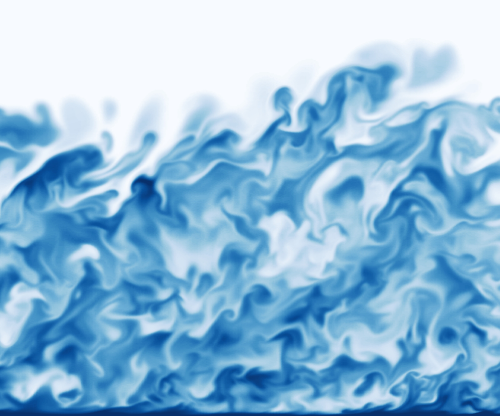
In this study, changes in the mean flow of a compressible turbulent boundary layer spatially evolving from low to ‘moderate’ Reynolds numbers are examined. All discussions are based on literature data and a direct numerical simulation (DNS) of a supersonic boundary layer specifically designed to be effectively free of spurious inflow effects in the range $4000 \lessapprox Re_\theta \lessapprox 5000$, which enables discussion of sensitive properties such as the turbulent wake. Most noticeably, the DNS data show the formation of a distinct ‘bend’ in the friction coefficient distribution reflected in sudden deviation from established low-Reynolds-number correlations. As will be shown, the bend is related to the surprisingly abrupt saturation of the turbulent wake, marking the change from low- to moderate-Reynolds-number behaviour; in previous studies, this trend was potentially obscured by data scatter in experiments and/or insufficient domain length in DNS. Moreover, the influence of the wake saturation on the formation of the early logarithmic overlap layer is assessed, which, if fully developed, leads to the onset of high-Reynolds-number behaviour further downstream.

Turbulent drag reduction over air-fed hydrophobic surfaces with longitudinal grooves
-
- Journal:
- Journal of Fluid Mechanics / Volume 1015 / 25 July 2025
- Published online by Cambridge University Press:
- 21 July 2025, A48
-
- Article
- Export citation

Initial perturbation dependence on Richtmyer–Meshkov instability with reshock
-
- Journal:
- Journal of Fluid Mechanics / Volume 1015 / 25 July 2025
- Published online by Cambridge University Press:
- 21 July 2025, A44
-
- Article
- Export citation
-
The Richtmyer–Meshkov instability at gas interfaces with controllable initial perturbation spectra under reshock conditions is investigated both experimentally and theoretically. A soap-film method is adopted to generate well-defined single-, dual- and triple-mode air/SF $_6$ interfaces. By inserting an acrylic block into the test section, a reflected shock with controllable reshock timing is created. The results reveal a complex relationship between the post-reshock perturbation growth rate and the pre-reshock interface morphology. For single-mode interfaces, the post-reshock growth rate exhibits a strong dependence on pre-reshock conditions. In contrast, for multi-mode interfaces, this dependence weakens significantly due to mode-coupling effects. It is found that, following reshock, each fundamental mode develops independently and later is significantly influenced by mode-coupling effects. Based on this finding, we propose an empirical model that matches the initial linear growth rate and the asymptotic growth rate, accurately predicting the evolution of fundamental modes from early to late stages across all three configurations. Furthermore, a theoretical formula is derived, linking the empirical coefficient in the model of Charakhch’An (2020 J. Appl. Mech. Tech. Phys. vol. 41, no. 1, pp. 23–31) to the initial perturbation. This provides a unified framework to explain the varying dependence of post-reshock growth rates on pre-reshock morphology observed in previous experiments.


Decay of plane shock waves in equilibrium flows
-
- Journal:
- Journal of Fluid Mechanics / Volume 1015 / 25 July 2025
- Published online by Cambridge University Press:
- 21 July 2025, A41
-
- Article
- Export citation
-
A new model is presented for the decay of plane shock waves in equilibrium flows with an arbitrary equation of state. A fundamental challenge for the accurate prediction of shock propagation using analytical modelling is to account for the coupling between a shock’s motion and the post-shock flow. Our model accomplishes this by neglecting only higher-order perturbations to the second velocity gradient, $u_{xx}$, in the incident simple wave. The second velocity gradient is generally small and exactly zero for centred expansion waves in a perfect gas, so neglecting its effect on the shock motion provides an accurate closure criterion for a shock-change equation. This second-order shock-change equation is derived for a general equation of state. The model is tested by comparison with numerical simulations for three problems: decay by centred waves in a perfect gas, decay by centred waves in equilibrium air and decay by the simple wave generated from the constant deceleration of piston in a perfect gas. The model is shown to be exceptionally accurate for a wide range of conditions, including small $\gamma$ and large shock Mach numbers. For a Mach 15 shock in equilibrium air, model errors are less than 2 % in the first 60 % of the shock’s decay. The analytical results possess a simple formulation but are applicable to fluids with a general equation of state, enabling new insight into this fundamental problem in shock wave physics.


A multiscale model for bubble nucleation thresholds on solid walls in the presence of nanometre-sized defects
-
- Journal:
- Journal of Fluid Mechanics / Volume 1015 / 25 July 2025
- Published online by Cambridge University Press:
- 21 July 2025, A47
-
- Article
- Export citation

Control of hypersonic boundary-layer transition by suppressing fundamental resonance using surface heating
-
- Journal:
- Journal of Fluid Mechanics / Volume 1015 / 25 July 2025
- Published online by Cambridge University Press:
- 21 July 2025, A49
-
- Article
- Export citation
