To save content items to your account,
please confirm that you agree to abide by our usage policies.
If this is the first time you use this feature, you will be asked to authorise Cambridge Core to connect with your account.
Find out more about saving content to .
To save content items to your Kindle, first ensure no-reply@cambridge.org
is added to your Approved Personal Document E-mail List under your Personal Document Settings
on the Manage Your Content and Devices page of your Amazon account. Then enter the ‘name’ part
of your Kindle email address below.
Find out more about saving to your Kindle.
Note you can select to save to either the @free.kindle.com or @kindle.com variations.
‘@free.kindle.com’ emails are free but can only be saved to your device when it is connected to wi-fi.
‘@kindle.com’ emails can be delivered even when you are not connected to wi-fi, but note that service fees apply.
In this chapter, I explore the aesthetic and cultural appeal of imperial Greek declamations that stage scenes of resistance, focussing on Polemo’s two declamations on the Battle of Marathon. I argue that in an era when ‘spectacular resistance’ (steadfast and ultimately in some sense triumphant resistance to oppression) was in vogue, as seen in the careers of figures such as Peregrinus the Cynic, Apollonius of Tyana, and early Christian martyrs, such declamations allowed elites to enjoy some of the glamour and rhetorical possibilities that spectacular resistance normally offered only to the powerless; there is a parallel here with the great play that Aelius Aristides and Polemo made of their struggles with illness. In particular, these declamations offered opportunities to indulge in the exuberant ‘Asian’ rhetorical style very fashionable at the time; moreover, artistic (rather than real) resistance allowed for the selection, full narration, and endless replay of the most attractive scenes. Finally, I suggest that the ‘controversial’ nature of the genre, in which counterarguments are always implied, and, in the case of Polemo’s duelling declamations, actually present, allowed Polemo simultaneously to present himself as in some degree superior to the trope of spectacular resistance.
The use of local languages is sometimes considered a marker of resistance to Roman power or culture. However, we show that continued use of local languages cannot necessarily be equated with resistance, nor is it easy to identify the use of language or script in particular inscriptions as driven by a desire to express resistance. This chapter discusses how (and whether) it is possible to know when resistance is involved in language use in the Roman Empire and examines case studies of inscriptional evidence pertaining to the use of Faliscan, Oscan, Paelignian, Venetic, Celtiberian, and Hebrew. We propose that many of them were written to present a ‘non-Roman’ rather than an ‘anti-Roman’ identity, and that ‘non-Roman’ identity could stand alongside both acceptance of Rome and violence resistance to its political hegemony.
Roman rhetoric, deployed as a legal and political tool and as a means of generating social capital, presupposes that the words of the speaker or writer initiate a dynamic, socially efficacious process of reception, and that that process is the real point of speaking or writing at all. Words shape audience reactions; and yet they can’t tightly and precisely control them. The text taken on its own proffers meaning in potentia only. It’s actualized in the reactions of its readers. But readers are multiple, never the reader. Communities of readers are always ad hoc and at best imperfectly coherent, and the consequent instabilities of reception open a space for the articulation of heterodox sexual identities. It is these less stable but potentially more productive aspects of preterition—and with them an expanded understanding of the device that goes beyond the textbook definition—that this book will consider, as they inform a select group of medieval texts whose readerships extended from late antiquity to the fourteenth century and beyond. Contemporary queer theory offers a useful framework through which to analyze these potentially subversive receptions of canonical texts.
Lucian’s Imagines, the literary portrait of Panthea, mistress of the emperor Lucius Verus, offers rich material for resistant readings of the relation between Greek-educated subject and Roman ruler in the second century. Yet the fact that any potential critique of power in it is expressed through means provided by and consonant with Roman power makes any resistance in it difficult to pin down. This chapter compares the Imagines with another second-century literary portrait of power, the self-portrait of Marcus Aurelius, Verus’ co-emperor, in Book One of the Meditations. These portraits of fragmented identities are executed with the same combinatory technique: Panthea’s body and soul are the sum of the best picks from Greek paideia, and the emperor’s self is the sum of the exempla provided by the people in his life. But this commonality highlights, by contrast, the irreconcilability of the respective models and purposes, which makes the Imagines’ neglect of its contemporary world stand out more sharply as a sign of resistance.
This chapter focuses on the romance of Apollonius of Tyre, a late antique text that is perhaps the successor of a lost Hellenistic original. At the very outset of that work—whose Nachleben extends from a fragmentary eleventh-century Old English translation, through Gower’s Confessio Amantis, to the Shakespearean Pericles, Prince of Tyre—circumlocution of the incestuous rape that sets the plot in motion structures the entire narrative around a double bind of desire that cannot be named but is signified in the silences that continually call the reader’s attention to it. Preterition is both repeatedly performed by the characters themselves and governs the entire work as a kind of master narratological trope, akin to the unconscious logic of dreams as understood by Freud and Lacan.
The question of whether a supreme authority can perform resistance – a notion presupposing confrontation with a force that is equal, if not superior – is here addressed through the case study of Emperor Julian’s opposition to Christianity. During the year and a half of his rule, Julian engaged in attempts to control the religious life of the Roman Empire, seeking to reverse the religious agenda pursued by his Christian predecessors Constantine and Constantius II. His writings, however, do not voice a top-down approach to religious confrontation, but rather deploy forms of expression that are traditionally associated with subaltern dissidents, such as humour and figured speech. Julian’s literary choices point to his self-perception – and self-narrative – as grappling with forces that were greater than his contingent position of authority. In particular, the positioning of his response to Christianity in the field of philosophy (Against the Galileans) betrays his alertness to contemporary narratives of Christianity as the system of knowledge that had displaced the philosophical schools of Greece and Rome. To this claim, Julian reacted with a defence of Greek philosophy and religion against what he perceived as Christianity’s aggressive and power-endorsed intrusion in the spheres of theology, philosophy, and interpretation of history.
The Sibylline Oracles, Greek hexameters blending history, eschatological prophecy, and moral advice for various nations, are ascribed to the pagan prophetess Sibyl but were in fact composed and updated by Jews and then Christians from the second century BCE onwards. Many oracles feature an explicitly anti-Roman tone. Considering modern labels for the collection, from ‘missionary’ to ‘apocalyptic’ literature, this chapter evaluates a range of reasons to consider the growth of the corpus as an example of resistance to Roman rule, bearing in mind how (subtly) ‘resistance literature’ is usually said to operate. First, both the ascription of the oracles to the Sibyl, so appropriating what had become a Roman tool of power and knowledge, and the use of archaic Greek hexameters may be considered forms of ‘compositional resistance’ whereby authoritative genres are inverted. The Sibyllists’ wish to control forms of language and knowledge dominant in their society may also be deduced through close analysis of their language and styles. Our examination then moves to the level of content or theme (‘contextual resistance’), subdivided into the characteristically Sibylline topics of schematised history, eschatological anticipation about Nero, and forms of recommended behaviour. It is shown that biblical and Roman models are invoked and turned against Rome.
In this epilogue, we consider first the language of resistance and how its rhetoric encodes a complex and competing set of positionalities: it is hard, we argue, to distinguish between cultural resistance and cultural difference. This process is especially complex in the Roman Empire, where cultural conflict between Roman and Greek, for example, has to negotiate the surprising dynamics of cultural authority where the colonisers privilege the culture of the conquered, and where Christianity is a major vector in the changing nature of resistance over time. This opening discussion leads to six ways in which the case of the Roman Empire offers a particularly productive and challenging model for contemporary resistance studies, which shows a way forward from this volume: first, resistance from marginalised groups and the possibility of institutional rejection of dominant culture; second, resistance from within the elite; third, resistance as a multidirectional process which is testimony to the fragility of imperial self-assertion; fourth, the resistance between classes, and especially slaves to masters; fifth, how the imaginary of resistance – its narratives and tropes – functions; sixth, how resistance has its own historical account which shifts from public acts of resistance to models of inwardness.
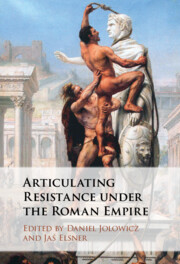
This book explores the many strategies by which elite Greeks and Romans resisted the cultural and political hegemony of the Roman Empire in ways that avoided direct confrontation or simple warfare. By resistance is meant a range of responses including 'opposition', 'subversion', 'antagonism', 'dissent', and 'criticism' within a multiplicity of cultural forms from identity-assertion to polemic. Although largely focused on literary culture, its implications can be extended to the world of visual and material culture. Within the volume a distinguished group of scholars explores topics such as the affirmation of identity via language choice in epigraphy; the use of genre (dialogue, declamation, biography, the novel) to express resistant positions; identity negotiation in the scintillating and often satirical Greek essays of Lucian; and the place of religion in resisting hegemonic power.