To save content items to your account,
please confirm that you agree to abide by our usage policies.
If this is the first time you use this feature, you will be asked to authorise Cambridge Core to connect with your account.
Find out more about saving content to .
To save content items to your Kindle, first ensure no-reply@cambridge.org
is added to your Approved Personal Document E-mail List under your Personal Document Settings
on the Manage Your Content and Devices page of your Amazon account. Then enter the ‘name’ part
of your Kindle email address below.
Find out more about saving to your Kindle.
Note you can select to save to either the @free.kindle.com or @kindle.com variations.
‘@free.kindle.com’ emails are free but can only be saved to your device when it is connected to wi-fi.
‘@kindle.com’ emails can be delivered even when you are not connected to wi-fi, but note that service fees apply.
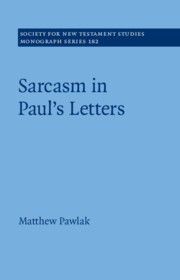
This chapter investigates the possibility of sarcasm in several passages, including Paul’s paradoxical discussion of divine foolishness (1 Cor 1:18–2:5), his setting Corinthian privilege against apostolic suffering in 4:8–13, and the interpretive crux of 11:19. Other potential sarcasm occurs in relation to the letter’s ‘Corinthian slogans’ (1 Cor 6:12; 8:1–13; 10:23). Critical thinking on how closely or loosely these slogans represent the Corinthians’ actual words or positions is employed to determine which slogans may be considered sarcastic.
In this book, Matthew Pawlak offers the first treatment of sarcasm in New Testament studies. He provides an extensive analysis of sarcastic passages across the undisputed letters of Paul, showing where Paul is sarcastic, and how his sarcasm affects our understanding of his rhetoric and relationships with the Early Christian congregations in Galatia, Rome, and Corinth. Pawlak's identification of sarcasm is supported by a dataset of 400 examples drawn from a broad range of ancient texts, including major case studies on Septuagint Job, the prophets, and Lucian of Samosata. These data enable the determination of the typical linguistic signals of sarcasm in ancient Greek, as well as its rhetorical functions. Pawlak also addresses several ongoing discussions in Pauline scholarship. His volume advances our understanding of the abrupt opening of Galatians, diatribe and Paul's hypothetical interlocutor in Romans, the 'Corinthian slogans' of First Corinthians, and the 'fool's speech' found within Second Corinthians 10-13.
The introduction gives an overview of the book’s aim and the conceptual approach to its topic. The subject is the particular way in which the Greeks, in the context of their general project of understanding the world, have made sense of their past. That means it is about history as an element of Greek culture. The concept with which the subject is dealt with is that of intentional history, which is based on the theories of Maurice Halbwachs and Aleida and Jan Assmann on collective memory and social remembrance. With ‘intentional history’, I refer to that part of history that is relevant to the collective identity of social groups of all sizes. This concept allows statements to be made across cultures and epochs and thus makes it possible to draw a connection from antiquity to modernity.
Chapter 1 elucidates Bacchides’ interface between communicative media, arguing that it exemplifies how modes of correspondence work in the Plautine universe, and investigates the kinetic force of communication by proxy within the plot. It also considers the textual ruse devised by Chrysalus, with special attention to the dictation-cum-scheming scene at Bacch. 714-60. This onstage portrayal of epistolary composition is an unicum both amongst the Plautine letter plays and across classical literature in that it provides a rare glimpse of letter writing in action. The scene of writing is also rich with metatheatrical and metapoetic imagery, illustrating a main premise of this book, viz. that writing in Plautus is a source of creativity and comic power inside the play that reflects the playwright’s poetic enterprise outside of it.
Chapter 1 focuses on the social groups, the communicative constellations, and the media in which intentional history took shape. Texts in which the first-person plural, the collective ‘we’, was used, were particularly characteristic of this. In this way, they brought the historical events into a direct connection with the current audience. It is identical, as it were, with the past actors. These were his ancestors. The Greeks had countless poems and chants of this kind, which were found primarily in the epics of Homer and Hesiod. Especially among the elites who enjoyed such chants at their symposia, the idea prevailed that in this way their achievements would also be known in the future. As a result, the Greeks did not differentiate between mythical and (in our sense) historical events, and remembrance was also directed towards posterity. At the same time, the texts were firmly anchored in social and religious communication and thus part of life. This went so far that many citizens took part in performances of poetic works themselves (in choirs, for example), thus being themselves involved in the creation of intentional history.
Chapter 3 launches with Pseudolus’ opening scene which revolves around a letter. I explore Phoenicium’s epistle to discern how it determines Pseudolus’ comic course as well as audience expectations about what lies ahead, and consider what a letter composed by a meretrix reveals about literacy and the symbolism of writing on the Plautine stage. Next is the play’s protracted indeterminacy, which flies in the face of its textual exposition. Why is Pseudolus uncertain about how to proceed when he himself recites the letter that so clearly sets out the comic plot? The answer lies in this comedy’s claim to dramatic innovation. Pseudolus tells us that its epistolary interception is new to the comic stage, a nova res which inspires in the schemer a novum consilium that neither he nor we expect. But the play repeatedly undercuts its own novelty, a paradox reified in the element around which its innovation revolves – the stolen letter. I perform a close analysis of the false delivery scene in which this text is put into action, reading for its epistolarity but also laying bare the internal replication it effects and the resultant mise-en-abyme.
Chapter 4 is primarily devoted to the influence of rhetoric on historiography. Here, too, the struggle for truth remains at the center, albeit in a dialectical relationship to the fictional, which Gorgias, the first great theoretician of rhetoric, was already aware of. Since the most important representatives of this new historiographical approach, Ephorus and Theopompus, have only survived in fragments, the first focus is on Isocrates, who was considered their teacher. His handling of history can be analyzed surprisingly clearly, and he shows a closeness to the rational-critical method, not least in his striving for truth and the awareness of the difficulties of searching for it. After a closer interpretation of the above-mentioned historians in this sense, the chapter treats another new tendency of historiography in the Hellenistic epoch. In the so-called tragic historiography, the representation of history again approaches the poetic. The striving for truth is now directed towards the most vivid representation of the real event, as if the recipient had been present at it.
Chapter 3 studies the beginnings of Greek historiography against the background of the intentional history described in the first two chapters. This clearly shows the innovative character of the new genre. The decisive factor for this was the influence of the new philosophical thinking that had initially developed in Ionia. The emphasis on rational procedures and the search for true knowledge was in the foreground, coupled with the curiosity of the researcher. The numerous stories of the Greeks were critically questioned by intellectuals of this provenance (e.g., Xenophanes, Hecataeus). Herodotus also felt obliged to the new rational-philosophical method, but at the same time he integrated many of the traditional stories into his new type of historical work. The critical direction then culminates in Thucydides, who in his own way and with the logic of power connects the present and the past. He was only too aware that he had strayed very far from traditional views of the past, and he himself underscored it very clearly.