To save content items to your account,
please confirm that you agree to abide by our usage policies.
If this is the first time you use this feature, you will be asked to authorise Cambridge Core to connect with your account.
Find out more about saving content to .
To save content items to your Kindle, first ensure no-reply@cambridge.org
is added to your Approved Personal Document E-mail List under your Personal Document Settings
on the Manage Your Content and Devices page of your Amazon account. Then enter the ‘name’ part
of your Kindle email address below.
Find out more about saving to your Kindle.
Note you can select to save to either the @free.kindle.com or @kindle.com variations.
‘@free.kindle.com’ emails are free but can only be saved to your device when it is connected to wi-fi.
‘@kindle.com’ emails can be delivered even when you are not connected to wi-fi, but note that service fees apply.
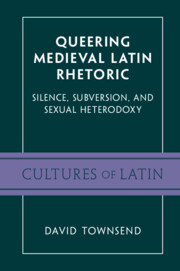
This book reflects on what medieval Latin authors don't say about the sex nobody had-or maybe some had-and about how they don't say it. Their silences are artfully constructed, according to a rhetorical tradition reaching back to classical practice and theory. The strategy of preterition calls attention to something scandalous precisely by claiming to pass over it. Because it gestures toward what's missing from the text itself, it epitomizes a destabilizing reliance on audience reaction that informs the whole of classical rhetoric's technology of persuasion. Medieval Latin preterition invites our growing awareness, when we attend to it closely, that silence is not single, but that silences are multiple. Their multiplicity consists not in what preterition is, but in what it does. Preterition's multiple silences enabled subversive interpretations by individuals and communities marginalized under dominant regimes of sexuality-as they still do today.
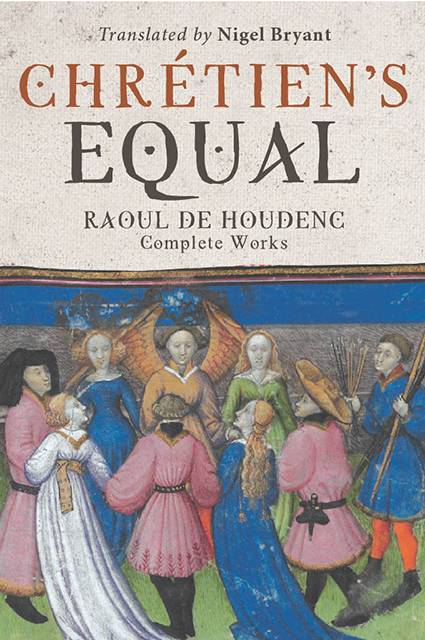
By his contemporaries, Raoul de Houdenc was 'mentioned in the same breath as Chrétien de Troyes as one of the masters of French poetry' (Keith Busby, The New Arthurian Encyclopaedia).
The Greeks often saw Egypt as a model of long-term cultural stability; in fact, Egyptian history is full of ruptures – periods of instability or external invasions – and a major theme in Egyptian literature is the methods by which such threats to continuity were resisted. This chapter looks at several modes of resistance illustrated by Greco-Egyptian literature of the first millennium. It looks at three topics: first, heroes of the Egyptian resistance to Persia (in Herodotus and the Inaros Cycle); secondly, resistance narratives in the Ptolemaic Period: the story of Nectanebo’s Dream (which probably presented the Ptolemies as re-establishing legitimate kingship in Egypt after the Persians) and the apocalyptic Oracles of the Potter and the Lamb (probably directed at the ‘Typhonian’ Ptolemies). The chapter closes by looking at Manetho’s narrative of Egyptian resistance to the foreign Hyksos rulers, which corresponds to events in the mid-second millennium BCE and the foundation of the New Kingdom. It asks whether Manetho’s narrative should be interpreted as reflecting contemporary concerns with foreign rule and resistance to it.
This chapter argues that Lucian’s dialogue Timon is best understood as responding to and critiquing polis politics in the Imperial period. Through a number of thinly veiled references to contemporary honorific culture, and in particular to the controversial super-benefactor Herodes Atticus, Lucian makes clear that the target of his satire is not Roman rule itself, but rather the behaviour of the citizens within the Greek cities who were the greatest winners from Roman rule. These individuals had become wealthy and influential through participating in Roman hegemony and now felt that the duties and obligations which membership of a polis imposed on its citizens no longer applied to them, thus threatening the very fabric of polis life. This breaking of the social contract was an abiding concern for polis society, and indeed Lucian makes extensive intertextual use of Classical works addressing precisely this question. The Timon thus not only illustrates the continuing vitality of polis politics in the Imperial period, but also the extent to which the political values which poleis continued to foster were themselves a central part of Greek cultural identity in the Imperial period.
Because dialogue represents philosophy happening in the context of interpersonal relationships, it is a natural place to investigate power dynamics, both displays of power and displays of resistance. But in literature, unlike in life, the power dynamics are completely within the control of one person, the author, who can script the situation as he chooses. In this chapter, I argue that there was a change in the rules of comportment found in literary dialogues between the first and fourth centuries CE that can be traced through paying close attention first to the appearance and then to the development of a new character in these discussions – a judge. A shared embrace of forensic rhetoric to express philosophical antagonism existed across changing modes of judgement in the Roman Empire. I argue that this forensic dialogic mode was introduced as a mode of sublimation of political energy, as a rerouting of resistance into a safer domain of scholastic antagonism.
A thirteenth-century gloss on Walter of Châtillon’s Alexandreis dutifully approves the author’s omission of incriminatory detail as in line with the poem’s declared panegyric aims, even as it expounds a phrase in the text that alludes obliquely to Alexander’s scandalous behavior. What the glossator fails to register is that if Walter really wants to praise Alexander, he’s here been singularly incompetent at it. But a reader who has a rather more positive view of the possibility of world conquerors mixing it up with Persian toy-boys has ample space here to imagine it happening. Such a reader can plausibly seize precisely on the poem’s general celebration of Alexander in their reading of the supposedly derogatory allusion. Perhaps, to the mind of such a reader, Walter is suggesting that what Alexander gets up to in the privacy of the royal tent is nobody else’s business.
In this introduction, we establish a framework for resistance studies as it relates to the ancient Mediterranean world, and especially to Rome as an imperial power. The first section explores the changing scope of resistance studies over the past century and how the three principal twentieth-century discussions of resistance by Classicists have been framed by Nazi Germany, the French colonial experience in Africa seen from the viewpoint of early postcolonialism, and the activities of McCarthyite America in the Cold War. It also sets out the range of theoretical and methodological approaches to resistance that recur throughout the volume. The second sections consists of discussion and summaries of the contributions. The third section offers Augustine as a case study of reading resistance at the level of an individual’s identity formation. The fourth section discusses the question of imperial Greek existence under Rome and ends with a case study of Pausanias.
This chapter argues that Chariton’s Chaereas and Callirhoe is exceptional among the extant novels for its ideological entanglement with Rome, a status in no small part a result of the author’s opening proclamation to be from the city of Aphrodisias in Asia Minor, a ciuitas libera and perennially loyal pet of the Roman emperors. The first section of this chapter suggests that the novel’s fictional status affords it a degree of licence to ‘speak truth to power’, evidence of which can often be found in details that do not quite make sense (‘glitches in the matrix’). The second section mobilises a range of theoretical models from resistance studies to argue that one such detail, the presence of ‘Phrygian pirates’, represents a sideswipe at Roman military and imperial pretensions. The third section presses the interpretative potential of Chariton’s claim to be from Aphrodisias and argues that, although a strongly local text, it is irredeemably enmeshed in the politics of the Mediterranean world. The fourth section explores how the public use of Phrygian iconography in Aphrodisias as a strategy of ‘kinship diplomacy’ with Rome contrasts with the negative connotations of ‘Phrygian’ in Chariton’s novel, which indicates that even a city as openly pro-Roman as Aphrodisias was capable of expressing dissent.
In the devotional works of Aelred of Rievaulx, a rhetorical trope that properly characterizes the oblique indictment of vice functions instead to draw the reader toward awareness of unfulfilled and quite literally unspeakable possibilities of men dwelling together in a blessedness of charity that welcomes embodied desire as a resource of the spirit. Aelred’s gestures toward the unspoken, throughout the corpus of his devotional writings, open up a space where ointment, mingled with unabashedly shed tears, drips over the feet of the enfleshed Christ, where the devotee licks the dust from his feet, where the companions of the twelve-year old Jesus swoon over his beauty, and where men united in the common life of a monastic community long in their imaginations for physical embrace, in imitation of the Beloved Disciple.
The representation of an Amazon queen’s fantasized body turns attention to what is concealed by Amazon dress. These celanda function as a somatized preterition of Amazon customs that incites readerly speculation around their social meaning within an imagined society. Together with unanswered questions about the variantly gendered body and its meanings, the alterity of her physical presence invites the reader to entertain utopian alternative organizations of gendered identity grounded in a sexually variant perspective at the margin of the text’s fictional world. The preteritive attention paid to her experience and the world view of her society thus opens up the possibility of an "Amazon reading" of Alexander himself, and by extension an Amazon reading of the epic that celebrates his exploits. With the possibility of Amazon reading comes as well the possibility of solidarity among those who read like Amazons, a solidarity effected not by any commonality of essential identity, but by their willingness to read the text’s preteritions against the grain of a sanctioned, "straight" interpretation informed by the received cultural values of an "ideal" audience.
Plutarch’s parallel structure of the Lives, pitting a Greek protagonist against a Roman hero, offers a fascinating array of interpretative possibilities where cultural and political resistance to Rome and Roman imperialism are two of its more interesting manifestations. This chapter suggests that Plutarch’s text, encoded with devices of figured speech (e.g. allegory, irony and innuendo), was meant to be read and understood by two distinct audiences simultaneously: a Greek readership and a Roman one. Thus, on one hand, to his Roman readers Plutarch can implicitly present the flaws of historical Greeks, which may come out through the overarching comparison, and which his typical Hellenocentric addressees might miss. On the other hand, the reading and circulation of Plutarch’s text would also constitute a sophisticated form of resistance to the contemporary imperial environment. The text therefore contains non-conformist elements which Roman readers completely overlooked. Two such subversive elements directed against Rome are discussed: (a) cultural resistance, with the employment of cross-cultural irony to propose the mismatch of Greek paideia in (barbaric) Rome; (b) political resistance through a subtle reading of the past, in particular the grafting of the Greco-Persian Wars onto the imperial reality and through a sophisticated comment on one instance of Greek active opposition to Rome.