To save content items to your account,
please confirm that you agree to abide by our usage policies.
If this is the first time you use this feature, you will be asked to authorise Cambridge Core to connect with your account.
Find out more about saving content to .
To save content items to your Kindle, first ensure no-reply@cambridge.org
is added to your Approved Personal Document E-mail List under your Personal Document Settings
on the Manage Your Content and Devices page of your Amazon account. Then enter the ‘name’ part
of your Kindle email address below.
Find out more about saving to your Kindle.
Note you can select to save to either the @free.kindle.com or @kindle.com variations.
‘@free.kindle.com’ emails are free but can only be saved to your device when it is connected to wi-fi.
‘@kindle.com’ emails can be delivered even when you are not connected to wi-fi, but note that service fees apply.
John Marincola’s research has thoughtfully explored the negotiation of authority in Herodotus’ Histories, revealing the extent to which the narrator is a highly intrusive one who organizes and steers the reader’s progression through the text.1 In Authority and Tradition in Ancient Historiography, he demonstrated how Herodotus’ first-person verbs mediate historical memory for his audience and in doing so draw upon the authority of performers of wisdom evident in fifth-century intellectual culture.2 This work also gestured toward the alternative means by which the Histories could generate expertise effects but did not have the scope to go beyond the narrator’s self-representation. This chapter will contribute to this project by surveying the rhetorical function of the narratee through the second person and impersonal ‘one’, and I will argue that its embedding of virtual experience into the text contributes to the work’s construction of authority.
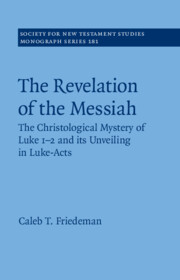
In the first two chapters of Luke, characters acknowledge Jesus as Messiah, Son of God, and Lord. Lukan characters also speak of John going before the Lord God, suggesting that Jesus might be the Lord in view, and connect Jesus with Old Testament YHWH passages. These features have made Luke 1-2 a key locus for discussions of Lukan Christology, generating speculation as to whether Luke presents Jesus as divine. However, they also create an apparent incongruity with the body of the Gospel. In Luke 3 and elsewhere, human characters are initially ignorant that Jesus is Messiah, Son of God, and Lord. Moreover, Jesus' divinity – if Luke affirms it – does not seem to be recognized until after the resurrection. In this study, Caleb Friedeman advances a new model for understanding the Christological relationship between Luke 1-2 and the rest of Luke-Acts, in which Luke presents these opening chapters as a Christological mystery.
In the first two chapters of Luke, characters acknowledge Jesus as Messiah, Son of God, and Lord. Lukan characters also speak of John the Baptist going before the Lord God, suggesting that Jesus might be the Lord in view, and connect Jesus with Old Testament YHWH passages. These features have made Luke 1–2 a key locus for discussions of Lukan Christology, raising the question of whether Luke presents Jesus as divine. However, they also create an apparent incongruity with the body of the Gospel. In Luke 3 and elsewhere, human characters are initially ignorant that Jesus is Messiah, Son of God, and Lord. Moreover, Jesus’ divinity – if Luke affirms it – does not seem to be recognized until after the resurrection. In this study, Caleb T. Friedeman advances a new model for understanding the christological relationship between Luke 1–2 and the rest of Luke-Acts, in which Luke presents these opening chapters as a christological mystery.
In the first two chapters of Luke, characters acknowledge Jesus as Messiah, Son of God, and Lord. Lukan characters also speak of John the Baptist going before the Lord God, suggesting that Jesus might be the Lord in view, and connect Jesuswith Old Testament YHWH passages. These features have made Luke 1–2 a key locus for discussions of Lukan Christology, raising the question of whether Luke presents Jesus as divine. However, they also create an apparent incongruity with the body of the Gospel. In Luke 3 and elsewhere, human characters are initially ignorant that Jesus is Messiah, Son of God, and Lord. Moreover, Jesus’ divinity – if Luke affirms it – does not seem to be recognized until after the resurrection. In this study, Caleb T. Friedeman advances a new model for understanding the christological relationship between Luke 1–2 and the rest of Luke-Acts, in which Luke presents these opening chapters as a christological mystery.
In the first two chapters of Luke, characters acknowledge Jesus as Messiah, Son of God, and Lord. Lukan characters also speak of John the Baptist going before the Lord God, suggesting that Jesus might be the Lord in view, and connect Jesus with Old Testament YHWH passages. These features have made Luke 1–2 a key locus for discussions of Lukan Christology, raising the question of whether Luke presents Jesus as divine. However, they also create an apparent incongruity with the body of the Gospel. In Luke 3 and elsewhere, human characters are initially ignorant that Jesus is Messiah, Son of God, and Lord. Moreover, Jesus’ divinity – if Luke affirms it – does not seem to be recognized until after the resurrection. In this study, Caleb T. Friedeman advances a new model for understanding the christological relationship between Luke 1–2 and the rest of Luke-Acts, in which Luke presents these opening chapters as a christological mystery.
The first scholarly English translations of thirteen vital texts that elucidate the central role mountains have played across nearly five centuries of Germanophone cultural history.