To save content items to your account,
please confirm that you agree to abide by our usage policies.
If this is the first time you use this feature, you will be asked to authorise Cambridge Core to connect with your account.
Find out more about saving content to .
To save content items to your Kindle, first ensure no-reply@cambridge.org
is added to your Approved Personal Document E-mail List under your Personal Document Settings
on the Manage Your Content and Devices page of your Amazon account. Then enter the ‘name’ part
of your Kindle email address below.
Find out more about saving to your Kindle.
Note you can select to save to either the @free.kindle.com or @kindle.com variations.
‘@free.kindle.com’ emails are free but can only be saved to your device when it is connected to wi-fi.
‘@kindle.com’ emails can be delivered even when you are not connected to wi-fi, but note that service fees apply.
In his ‘concluding perspectives’, the author first emphasises the differences between current and ancient ways of dealing with history in view of modern notions of history and the science of history. But he also draws attention to the fact – and cites respective remarks by a renowned historian (Angelos Chaniotis) on the director of the film Alexander the Great, Oliver Stone – that even in our times the elements of the true and the fictitious can be fruitfully combined when it comes to the adequate representation of history. Intentional or not – what brings history to life and keeps it alive is narration.
Chapter 4 is oriented around a letter-making signet ring whose imprint makes Curculio’s forged text “real.” Its agency, however, is not confined to epistolary deception, and this chapter unpacks the anulus’ potent theatrical agency by elucidating its operation in excess of human design. I shift my focus in exploring the metatheatrical portrait generated by Curculio’s epistolary motif. Whereas Chapters 1 through 3 consider the common ability of letters and scripts to evoke absent people, here I look at the power of these media to conjure up faraway places. Both epistles and dramatic texts bring “here” to “there” (or vice versa), a capacity enacted in Curculio’s composition of a letter at Epidaurus which encapsulates his encounter in Caria and flaunted in the choragus’ tour that blurs the line between theatrical and experiential space. Finally, this chapter returns to questions of innovation and artistic dependence. Curculio’s missive invites us to reflect on the impossibility of originality for the author on the outside when an author on the inside makes the play by recomposing yet another author’s text. A coda considers the play’s seal as related to the literary sphragis.
The main subject of Chapter 2 is the motifs and the content of the Greeks’ myth-historical tales and songs. The Greeks’ past was very clearly structured: the main axis was the battle for Troy with the generations before and after. The more distant past led back to the origin of the world, gods, and men. On the other hand, the stories have led to the present day. Concepts of kinship, mediated by genealogies, played an essential role. This was connected with stories of migrations, colonisation, expulsions, and re-migrations. These narratives served as elements in order to structure the past, to constitute familiarity and difference, to explain relations of friendship or enmity, among the Greeks themselves and in relation to foreigners. We cannot see these stories of migration as evidence for older ‘historical’ events. But they reflect very clearly the dynamics of their time of origin, the time of the so-called Great Colonization. The identity-forming power of the Greek myth-history lay precisely in the fact that it re-located its own experiences into the past. What they had constructed themselves appeared to the Greeks as their past.
Chapter 5 looks at the failed epistolary exchanges in Epidicus and Trinummus. When these plays’ letters are sabotaged by the complicated workings of epistolary time, the plots inscribed within disappear, making them the apparent opposite of the embedded texts explored in earlier chapters. Rather than mise-en-abymes that reflect back upon the comedy a copy of itself, the letters in Epidicus and Trinummus represent dramatic alternatives to the present performance whose rejection is reified via the epistolary motif. Neither play, then, is strictly a letter play. But by the textual eschewal which diverts each comedy’s plot onto a different (or seemingly different) course, both Epidicus and Trinummus demonstrate the metatheatrical and metapoetic valences of the letters in Plautus.
Chapter 2 begins by examining the correspondence between lovers Toxilus and Lemniselenis, using it to further investigate the metatheatrical dynamics of written correspondence on the Plautine stage and to consider the love letter qua category of epistolary writing. Next, it considers the ruse enacted via forgery. Relying on the same letter-as-script and letter-as-scheme metaphor active in Bacchides, Persa establishes an association between writing and belief to meditate on the nature of theatrical illusion. This chapter continues, then, to unpack the synergy between performance and text in Plautus but it focuses on the other end of the epistolary and dramatic processes via analysis of Persa’s onstage reading scene, which generates a simultaneously theatrical and anti-theatrical vision of an actor reading his lines on stage. Finally, I concentrate on Persa’s deception which replicates the content of the larger play it inhabits, delving deeper into the mechanics of mise-en-abymes to show how Plautus employs embedded text and internal dramaturgy to address the problem of creative originality, prompting us to question whose play we are watching.
In Shakespeare’s Twelfth Night Act ii, scene v, chambermaid Maria plays an epistolary trick on her fellow servant. She forges a text to make the pompous steward Malvolio believe that his fantasy of rising above his station and marrying their mistress Olivia has become reality.1 The dupe is imagining just this as he comes into the garden where the deceptive document, which will literally spell out his daydream, has been planted. Maria and her accomplices, Sir Toby, Sir Andrew and Fabian, watch from a hiding place and comment as the spectacle unfolds. It all begins the moment Malvolio picks up the text and reads the address written on its exterior (ii.v.69–80)
Six Plautine prologues1 and six Terentian prologues are our earliest unequivocal proof of original titulature in ancient drama.2 The twelve titles these provide are also the only securely author-sanctioned titles we have for the entire republican period until Cicero.3 While any authorial title is revelatory, the titles of Roman comedies are especially so; we have just seen that the title of a translation can convey information about its relationship to the source text. Juxtaposed with “Thesauros”, “Trinummus” gave us a key to understanding not only how the playwright conceptualizes his own play but also how he has reconceptualized a Greek play.4 Plautus’ titular changes, then, are meaningful and we should be paying more attention – not least because the poet does not always give his translation a new name: of ten comedies in the corpus whose originals we know for sure,5 only six have new titles.6 What is the difference between plays with changed names and those whose Greek names have just been translated into Latin? Are the former more Plautine than the latter? Is Mercator closer to Emporos than Stichus is to Adelphoi?
In this volume an international group of scholars revisits the themes of John Marincola's ground-breaking Authority and Tradition in Ancient Historiography. The nineteen chapters offer a series of case studies that explore how ancient historians' approaches to their projects were informed both by the pull of tradition and by the ambition to innovate. The key themes explored are the relation of historiography to myth and poetry; the narrative authority exemplified by Herodotus, the 'father' of history; the use of 'fictional' literary devices in historiography; narratorial self-presentation; and self-conscious attempts to shape the historiographical tradition in new and bold ways. The volume presents a holistic vision of the development of Greco-Roman historiography and the historian's dynamic position within this practice.
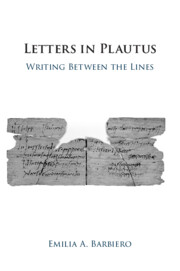
The letters in Plautus are potent tools for making and thinking about Plautine comedy inside Plautine comedy. Emilia Barbiero demonstrates that Plautus' embedded letters reify the internal performance and evince its theatricality by means of the epistolary medium's script-like ability to precipitate presence in absence. These missives thus serve as emblems of the dramatic script, and in their onstage composition and recitation they cast a portrait of the plays' textual origins into the plays themselves. But by virtue of their inscription with a premise which is identical to that of the comedies they inhabit, the Plautine letters also reproduce the relationship between the playwright's Greek models and his Latin translations: the mirror effect created by a dramatic text inscribed, read and realized within a dramatic text whose plot it also duplicates generates a mise-en-abyme which ultimately serves to contemplate problems of novelty and literary ownership that beset Plautus' literary endeavor.
In this concise but stimulating book on history and Greek culture, Hans-Joachim Gehrke continues to refine his work on 'intentional history', which he defines as a history in the self-understanding of social groups and communities – connected to a corresponding understanding of the other – which is important, even essential, for the collective identity, social cohesion, political behaviour and the cultural orientation of such units. In a series of four chapters Gehrke illustrates how Greeks' histories were consciously employed to help shape political and social realities. In particular, he argues that poets were initially the masters of the past and that this dominance of the aesthetic in the view of the past led to an indissoluble amalgamation of myth and history and lasting tension between poetry and truth in the genre of historiography. The book reveals a more sophisticated picture of Greek historiography, its intellectual foundations, and its wider social-political contexts.
Chapter 4 analyses epigrams and objects between 100 ?? and ?? 100, and discusses how objects and texts engage with one another in expressing the idea of carpe diem. Rarely studied Greek epigrams from the Garland of Philip and texts by the Latin authors Martial, Pliny the Elder, and Petronius point to exciting interplay between the textuality of epigrams and the presence of objects. Besides more conventional literary sources, the analysis also includes numerous artworks and inscriptions. Particular attention is paid to cups, such as the well-known Boscoreale cups, as well as to gems. This interdisciplinary chapter makes a strong case for studying literature alongside other forms of cultural production.