To save content items to your account,
please confirm that you agree to abide by our usage policies.
If this is the first time you use this feature, you will be asked to authorise Cambridge Core to connect with your account.
Find out more about saving content to .
To save content items to your Kindle, first ensure no-reply@cambridge.org
is added to your Approved Personal Document E-mail List under your Personal Document Settings
on the Manage Your Content and Devices page of your Amazon account. Then enter the ‘name’ part
of your Kindle email address below.
Find out more about saving to your Kindle.
Note you can select to save to either the @free.kindle.com or @kindle.com variations.
‘@free.kindle.com’ emails are free but can only be saved to your device when it is connected to wi-fi.
‘@kindle.com’ emails can be delivered even when you are not connected to wi-fi, but note that service fees apply.
addresses the question how one develops the correct (or incorrect) thought and feelings, a crux in Aristotelian scholarship, and how exactly thought and feeling become interdependent in the good person. When Aristotle says that thoughtfulness (phronēsis) comes mostly by teaching and that virtue of character comes by habituation, it may sound as if there are two processes taking place separately, one in relation to thinking and one in relation to feeling, with the process in relation to feeling coming first. I disagree, and show how virtues of thought like comprehension (sunesis) and consideration (gnōmē) emerge in habituation along with the correct feelings. I also discuss how one may become bad, using the case of Neoptolemus in Sophocles’ play Philoctetes, discussed by Aristotle in Nicomachean Ethics VII, to show how a young person’s thought and feeling can become interdependent even if they are thrown off track by pernicious influences like those of the lying Odysseus in this play. Finally, I argue that shame is not a separate stage in moral development.
Origen here represents Christian notions of angelification, although brief consideration is given to antecedents, namely Clement of Alexandria and the Valentinians. Origen, like Empedocles, offered a cosmic story of fall and redemption. According to Origen, humans are “cooled” intellects whose natural state is to burn with love for God. A species upgrade is part of humanity’s evolutionary design, but it takes intense moral labor. Origen offers the most speculation on the nature of angels, the original consubstantiality of angels and souls, how angels and souls fell from divine Love, and the moral means of their return.
Chapter 4 is about choice (prohairesis), an Aristotelian innovation. This is the central chapter of the book, drawing together the threads of the previous chapters. Aristotle says that virtue of character is a disposition involving choice and he defines choice as desiderative thought or thoughtful desire. He is here emphasizing each side of choice, thought, and desire. I argue that choice can belong to good, bad, and akratic people, but my main aim is to show how thought and desire are interdependent in the case of the good person. To that end, I analyze the type of thought involved in the choice of the good person – deliberation – showing that it cannot be adequately explained without mentioning virtue and hence desire and feelings. Conversely, I show that the type of desire involved, which I argue takes up the motivation both of wish (which I argue is in the rational part of the soul) and the feelings, requires thought. I conclude with some examples of choice, showing how from one point of view virtue makes the goal right, and from another it makes what contributes to the goal right. That is because virtue of character and thoughtfulness are intertwined.
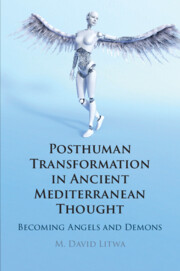
This introduction distinguishes angelification (becoming an angel) from angelomorphism (becoming like an angel), although it acknowledges ambiguity. After briefly discussing angelification in modern literature and film, it defines both angels and daimones in the ancient sense, discusses the analogous concept of a hero, and distinguishes angelification and daimonification from the broader concept of deification in the ancient world.
I discuss Aristotle’s account of the psyche (soul) in book 1 chapter 13 of the Nicomachean Ethics, his further distinction between theoretical and practical thinking in Nicomachean Ethics VI 1, and the famous function argument of Nicomachean Ethics I 7. I also address Aristotle’s unclarity about how to characterize desire, and his skepticism about parts of the psyche in de Anima III 9. This leads to a brief discussion of Plato’s division of the psyche in Republic IV and the Phaedrus, and whether both Plato’s and Aristotle’s divisions lead to problems concerning the unity of motivation. This discussion begins to set the stage for my interpretation of Aristotelian prohairesis (often translated as “choice”), the characteristic motivation of the good person. As we shall see, the phenomenon of choice straddles different parts of the Aristotelian psyche in a way that Plato never envisaged in his own account of the psyche.
I provide an overview of which the main thesis is that Aristotle’s view of thought and feelings is sui generis, different from Kantian and Humean style views of motivation. Aristotle’s doctrine of the mean is introduced, along with a discussion of philosophical method and a synopsis of chapters.
There is not just a desire but a profound human need for enhancement - the irrepressible yearning to become better than ourselves. Today, enhancement is often conceived of in terms of biotechnical intervention: genetic modification, prostheses, implants, drug therapy - even mind uploading. The theme of this book is an ancient form of enhancement: a physical upgrade that involves ethical practices of self-realization. It has been called 'angelification' - a transformation by which people become angels. The parallel process is 'daimonification', or becoming daimones. Ranging in time from Hesiod and Empedocles through Plato and Origen to Plotinus and Christian gnostics, this book explores not only how these two forms of posthuman transformation are related, but also how they connect and chasten modern visions of transhumanist enhancement which generally lack a robust account of moral improvement.
Is beauty simply subjective, or does it have an “objective” foundation and referent? Is art simply self-referential, or can it be a mediation of ontological values? Modern art and aesthetics offer contradictory replies to these questions; but the Platonic tradition of metaphysical realism offers an integration of the arts with intelligibility and value that would otherwise be lacking.
Chapter 4 of De mundo concludes the first, ‘scientific’ part of the treatise, which contains a description of the universe. Chapter 4 deals with the phenomena that belong to the science of meteorology as the ancients understood it, which included not only all kinds of precipitation, cloud formations, wind and thunder, but also phenomena such as shooting stars, earthquakes, tides and volcanic eruptions. Chapter 4 of De mundo shows similarity with Aristotle’s Meteorology in theory and general structure, but there are notable differences – the construction of the wind rose, omission of the Milky Way, and the inclusion of a lunar tide theory – which seem to indicate another source for this chapter. This is also indicated by the compendium style of Chapter 4: instead of offering causal explanations of the meteorological phenomena, the author proceeds by dividing them into groups and then briefly describing each member of every group. Some scholars have argued that the source of this chapter of De mundo is Posidonius’ treatise on meteorology. Despite some striking similarities, reasons are given against accepting this thesis. It is suggested that an earlier compendium of meteorology, combining Peripatetic and Stoic elements, was the principal source of Chapter 4 of De mundo.
This chapter highlights the formative role of Platonism in the making of Christian doctrine. It argues that Platonism’s greatest substantive influences on Christian Trinitarian theology lay in the area of participation metaphysics, as well as in inspiring the more general theological dictum of divine immateriality and intelligibility. Early Christian authors discussed include: Athenagoras, Theophilus, Clement of Alexandria, Marius Victorinus, Augustine, Theodoret, Cyril of Alexandria, Gregory of Nyssa, and Eunomius. The claim that the Christian creator–creature distinction competed with the Platonic intelligible–sensible distinction is examined and rejected.
This chapter considers the often overlooked historical contributions and contemporary importance of traditions of Christian Platonism within the development of the natural sciences. After introducing key conceptual elements, it considers the salience of Christian Platonic approaches for a variety of scientific fields including mathematics, biology, psychology, and ecology.”
The introduction presents the nature and scope of De mundo and explains the objectives of the present volume. De mundo is a protreptic work aiming to present philosophy as a study of the universe and its relation to God. For that reason, it sets out to explain the world in terms of what makes it an orderly arrangement, a kosmos. The work’s central thesis is that the orderly arrangement of the universe is due to God and that it is hence crucial to have a proper conception of God and his causal relation to the universe in order to fully appreciate the universe, its structure and the phenomena that occur in it. Unlike most scholarly work done on this text, the present volume does not focus on the question of authenticity and dating, but on its content and philosophy. However, the introduction does explain at some length why De mundo should not be ascribed to Aristotle, although the author clearly aimed to present a picture of the world and God that is essentially Aristotelian. The introduction is accompanied by an overview of the argument presented in De mundo.