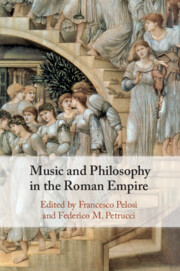
Music and Philosophy in the Roman Empire

-
Select format
-
- Publisher:
- Cambridge University Press
- Publication date:
- November 2020
- December 2020
- ISBN:
- 9781108935753
- 9781108832274
- 9781108940955
- Dimensions:
- (228 x 152 mm)
- Weight & Pages:
- 0.59kg, 368 Pages
- Dimensions:
- (229 x 152 mm)
- Weight & Pages:
- 0.52kg, 368 Pages
- Subjects:
- Classical Studies, Music, Ancient Philosophy, Music: General Interest
You may already have access via personal or institutional login- Subjects:
- Classical Studies, Music, Ancient Philosophy, Music: General Interest
Show more authors 
You may already have access via personal or institutional login
Book description
Is music just matter of hearing and producing notes? And is it of interest just to musicians? By exploring different authors and philosophical trends of the Roman Empire, from Philo of Alexandria to Alexander of Aphrodisias, from the rebirth of Platonism with Plutarch to the last Neoplatonists, this book sheds light on different ways in which music and musical notions were made a crucial part of philosophical discourse. Far from being mere metaphors, notions such as harmony, concord and attunement became key philosophical tools in order to better grasp and conceptualise fundamental notions in philosophical debates from cosmology to ethics and from epistemology to theology. The volume is written by a distinguished international team of contributors.
Reviews
‘the collection is welcome and will serve as an excellent entry point to important thought about music linked directly to the antique roots of modern philosophy. Because there are no musical examples and the references to classical languages are translated into idiomatic English, laypersons - even those unfamiliar with the classical period - should not meet obstacles or have accessibility problems. Readers, whether in classics or in music, will find these essays invaluable for making inroads into a period long overlooked in music history. Highly recommended.’
M. Dineen Source: Choice Connect
‘This is a wonderful collection of papers, which shows how significant the model of music was in late antiquity for understanding a number of philosophical issues.’
George Karamanolis Source: Greek and Roman Musical Studies
Contents
Contents
References
Metrics
Altmetric attention score
Full text views
Full text views helpTotal number of HTML views: 0
Total number of PDF views: 0 *
 Loading metrics...
* Views captured on Cambridge Core between #date#. This data will be updated every 24 hours.
Usage data cannot currently be displayed.
Accessibility standard: Unknown
Why this information is here
This section outlines the accessibility features of this content - including support for screen readers, full keyboard navigation and high-contrast display options. This may not be relevant for you.
Accessibility Information
Accessibility compliance for the PDF of this book is currently unknown and may be updated in the future.