
Skip to main content Accessibility help
×
  • Cited by 6
    • Show more authors
    • You may already have access via personal or institutional login
    • Select format
    • Publisher:
      Cambridge University Press
      Publication date:
      08 January 2021
      07 January 2021
      ISBN:
      9781107323544
      9781107041899
      Dimensions:
      (229 x 152 mm)
      Weight & Pages:
      0.42kg, 188 Pages
      Dimensions:
      Weight & Pages:
    You may already have access via personal or institutional login
  • Selected: Digital
    Add to cart View cart Buy from Cambridge.org

    Book description

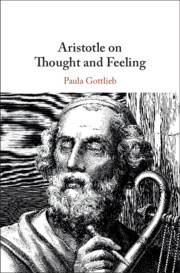
    Aristotle's discussion of the motivation of the good person is both complicated and cryptic. Depending on which passages are emphasized, he may seem to be presenting a Kantian style view according to which the good person is and ought to be motivated primarily by reason, or a Humean style view according to which desires and feelings are or ought to be in charge. In this book, Paula Gottlieb argues that Aristotle sees the thought, desires and feelings of the good person as interdependent in a way that is sui generis, and she explains how Aristotle's concept of choice (prohairesis) is an innovative and pivotal element in his account. Gottlieb's interpretation casts light on Aristotle's account of moral education, on the psychology of good, bad and half-bad (akratic) people, and on the aesthetic and even musical side to being a good person.

    Reviews

    'Paula Gottlieb's examination of the inter-penetration of thought and feeling in Aristotle's conception of a virtuous person is essential reading both for specialists and for anyone interested in virtue ethics. Her opposition to interpretations that liken Aristotle to Hume or Kant is thorough, judicious, and convincing.'

    Richard Kraut - Northwestern University

    'This book is an excellent, eminently readable, and scholarly choice for the reader seeking both a well-argued general description of Aristotle's Ethics and an examination of its many puzzling details. Includes excellent bibliographical references. Highly Recommended.'

    P. A. Streveler Source: Choice

    ‘… an illuminating, synoptic study of Aristotle’s theory of human motivation…’

    Corinne Gartner Source: Journal of the History of Philosophy

    Refine List

    Actions for selected content:

    Select all | Deselect all
    • View selected items
    • Export citations
    • Download PDF (zip)
    • Save to Kindle
    • Save to Dropbox
    • Save to Google Drive

    Save Search

    You can save your searches here and later view and run them again in "My saved searches".

    Please provide a title, maximum of 40 characters.
    ×

    Contents

    Metrics

    Altmetric attention score

    Full text views

    Total number of HTML views: 0
    Total number of PDF views: 0 *
    Loading metrics...

    Book summary page views

    Total views: 0 *
    Loading metrics...

    * Views captured on Cambridge Core between #date#. This data will be updated every 24 hours.

    Usage data cannot currently be displayed.

    Accessibility standard: Unknown

    Why this information is here

    This section outlines the accessibility features of this content - including support for screen readers, full keyboard navigation and high-contrast display options. This may not be relevant for you.

    Accessibility Information

    Accessibility compliance for the PDF of this book is currently unknown and may be updated in the future.
