To save content items to your account,
please confirm that you agree to abide by our usage policies.
If this is the first time you use this feature, you will be asked to authorise Cambridge Core to connect with your account.
Find out more about saving content to .
To save content items to your Kindle, first ensure no-reply@cambridge.org
is added to your Approved Personal Document E-mail List under your Personal Document Settings
on the Manage Your Content and Devices page of your Amazon account. Then enter the ‘name’ part
of your Kindle email address below.
Find out more about saving to your Kindle.
Note you can select to save to either the @free.kindle.com or @kindle.com variations.
‘@free.kindle.com’ emails are free but can only be saved to your device when it is connected to wi-fi.
‘@kindle.com’ emails can be delivered even when you are not connected to wi-fi, but note that service fees apply.
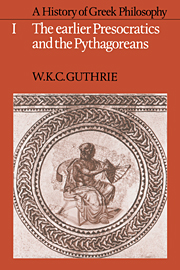
All volumes of Professor Guthrie's great history of Greek philosophy have won their due acclaim. The most striking merits of Guthrie's work are his mastery of a tremendous range of ancient literature and modern scholarship, his fairness and balance of judgement and the lucidity and precision of his English prose. He has achieved clarity and comprehensiveness.
This Element discusses Heidegger's early (1924–1931) reading and critique of Hegel, which revolve around the topic of time. The standard view is that Heidegger distances himself from Hegel by arguing that whereas he takes time to be 'originarily' Dasein's 'temporality,' Hegel has a 'vulgar' conception of time as 'now-time' (the succession of formal nows). The Element defends the thesis that while this difference concerning the nature of time is certainly a part of Heidegger's 'confrontation' with Hegel, it is not its kernel. What Heidegger aspired to convey with his Hegel-critique is that they have a divergent conception of man's understanding of being (ontology). Whereas Heidegger takes ontology to be grounded in temporality, Hegel thinks it is grounded in 'the concept,' which has a dimension ('logos') manifesting eternity or timelessness. It is argued, contra Kojève, that Heidegger's reading (but not necessarily his critique) of Hegel is, in an important respect, correct.
This is a new edition of the fragments of 'Anonymus Iamblichi', the mysterious Greek author excerpted by Iamblichus in chapter 20 of Protrepticus. The fragments are an important but overlooked source for early Greek ethical and political thought. Among other things, they criticize traditional forms of social benefaction, and they offer a strikingly modern approach to the analysis of society and economy revolving around the concept of pistis ('trust'). The text and translation are supplemented by a lengthy introduction, which analyses the language and style of the fragments and explores them in the literary and philosophical context of early Socratic literature. The detailed commentary discusses issues pertaining to text and interpretation.
In this major new study, Tyler Huismann connects Aristotle's natural philosophy to modern theories of causation and provides fresh interpretations of classic issues. He links two of the most important notions in Aristotle's philosophy, accidents and causes, and using the concept of accidental causation as a guide, argues for ground-breaking proposals on some of the most foundational areas of Aristotle's thought: the relation between substances and accidents, the nature of efficient causation, the workings of 'qua,' the possibility of uncaused events, and the role of accidental causation in the natural world. Structured around close readings of Aristotle's Physics and Metaphysics and informed by contemporary theories of causation, Huismann's book offers students an accessible treatment of some of Aristotle's core texts, and provides specialists with a series of provocative interpretations.
In Book 4 of Plato's Republic, Socrates introduces what is regarded by scholars as the Platonic account of justice, according to which it is essentially internal and self-regarding, a matter of relations among the parts of a city or soul. In this book, Roslyn Weiss contends that there is another notion of justice, as other-regarding and external, which is to be found in a series of conversations in Book 1 between Socrates and three successive interlocutors. Weiss considers the relationship between justice as conceived in Book 1 and Book 4, and carefully examines what can be learned from each of the arguments. Her close analysis of Book 1 brings to light what Socrates really believed about justice, and extracts and explores this Book's many insights concerning justice—at both the political and the personal level.
This chapter addresses an inevitable question: How are later books of the Republic, and specifically Book 4, related to Book 1? It contends that justice as conceived in Book 1 is “external,” concerned with how one entity regards and treats another, and so is at odds with the novel definition of justice in Book 4, according to which it is “internal,” a matter of what happens within a single entity, whether a city or a soul. It is argued that in Book 4, Socrates, having been tasked with persuading Glaucon and Adeimantus that there is profit in being just, identifies a reward for being just, namely, the harmonious internal state of city and soul. Although he briefly calls this healthy and therefore desirable condition “justice,” he more frequently and aptly identifies it as “moderation.” This chapter makes the case that it is the account of justice found in Book 1 that more closely reflects Socrates’ (or Plato’s) understanding of it.
This chapter begins by exploring the dramatic elements of the dialogue’s brief but rich opening scene, which introduces the bully Polemarchus and sets up the dialogue’s alliances: Glaucon–Socrates and Polemarchus–Adeimantus. It then examines Cephalus’ turn to justice in the nick of time – as death approaches – and his surprising belief that without wealth a man has no alternative but to be unjust. It analyzes the objections Socrates raises to Cephalus’ conception of justice as payment of debts to men and gods, and suggests that the examples Socrates uses in his challenge to Cephalus are not simple exceptions to the rule but rather shift the conception of justice away from mechanical rule-following to the responsibility one incurs – when circumstances place one in a position of responsibility – to protect others from harm. The relationship between Cephalus and Polemarchus, father and son, is described and assessed, as is the relationship between their distinct views of justice.
This chapter establishes the philosophical value of Republic 1 and challenges the widely held assumption that the later books, 2–10, represent Plato’s real views. It notes that some scholars, seeing Rep. 1 as lacking gravitas – in both style and content – think it was originally not even part of the Republic; others see it as introducing ideas to be developed later; a third group sees it as introduced only to be rebuffed. The case is made for reading the Republic forward – that is, reading what comes later in light of Rep. 1, rather than reading Rep. 1 in light of what comes later: Reading in this way makes it possible to doubt the sincerity of some of Socrates’ later proposals – in particular, the idea that justice is internal. An argument is made for taking seriously, philosophically, the dramatic elements of Rep. 1, including its humor. Finally, the views of Rep. 1’s three interlocutors are related to one another.