To save content items to your account,
please confirm that you agree to abide by our usage policies.
If this is the first time you use this feature, you will be asked to authorise Cambridge Core to connect with your account.
Find out more about saving content to .
To save content items to your Kindle, first ensure no-reply@cambridge.org
is added to your Approved Personal Document E-mail List under your Personal Document Settings
on the Manage Your Content and Devices page of your Amazon account. Then enter the ‘name’ part
of your Kindle email address below.
Find out more about saving to your Kindle.
Note you can select to save to either the @free.kindle.com or @kindle.com variations.
‘@free.kindle.com’ emails are free but can only be saved to your device when it is connected to wi-fi.
‘@kindle.com’ emails can be delivered even when you are not connected to wi-fi, but note that service fees apply.
This chapter discusses the first level of noetic contemplation. Both psychic and noetic level are subdivided into two levels, which could be termed contemplation “from below” and “from within” a given macrocosmic level. The first stage of noetic contemplation is looking at Intellect “from below”, that is, from the level of the World Soul and by our faculty of reason. We Intellect “as another” and in a partial way (seeing particular Forms). It is only when we ascend from that phase to noetic contemplation proper that we see, so to speak, our own face or we see the seer, which is our own intellect participating horizontally in Intellect. We also see the Forms through sensible things when we look at the world. Instead of rejecting the sensible, we embrace it, seeing the sensible things better, because now we are seeing them in and through their noetic archetypes. The whole world is within us, but the difference between the seer and the seen is overcome, and we see that we are the world.
This chapter discusses the first level of contemplation, namely, psychic contemplation. The point of departure is Plotinus’ view of perception as a multi-level activity and his claim that we perceive external things by virtue of internal images. In the realm of affective experience, we also co-create our emotions rather than receive them passively. The fall is a distortion of the states of knowing (perceptions) and the states of loving (affects) as well as of the sense of the body, the world, and the self. In the first phases of contemplative ascent, virtues purify our experience of the self, and we begin to overcome the sense of the world as external and our emotional enslavement to it. The result is peace and freedom. The analysis of perception and affective experience shows that for Plotinus contemplation is a natural state of our soul. It is not adding something which is not there but recovering our awareness of what is already going on when we perceive experience affects or relate to our body.
This chapter discusses the fall of the soul as the process in which a microcosmic being cuts himself off from the macrocosmic realms by self-limiting excessive emphasis on the potential elements of his own being: the indefinite “I”, the movement of loving and the difference of knowing. The result of the fall is our exclusive identification with our body, but the body is not necessarily either the cause of it or the embodiment is the result of the fall. In light of the third, triadic principle of selfhood, the fall is described by Plotinus in three ways, as (1) the limitation and fragmentation of the self, (2) the quasi-spatial externalisation of what is known, and (3) the temporalisation of what is loved. The fall of the self results in the sense of the deadness of reality and the reducing of ourselves to a thing among things. The fall of knowing results in seeing everything as external to the seer, while the fall of loving results in feeling that what we desire is not here, but has to be pursued in the future (or is lost forever in the past).
The goal of Plotinus’ philosophy is not a conceptual and discursive description of reality, but the return of the fallen soul to the intelligible world and then to the Good. Because of that he emphasizes not only the practical dimension of philosophy, but also the importance of the individual philosopher who is undertaking the spiritual journey. The thesis of the book is presented: Plotinus’ metaphysics is a balanced combination of two co-existing perspectives: the third-person perspective (an objective,conceptual, scientific account of reality) and the first-person perspective (a subjective, intuitive,contemplative experience of it). This is grounded in the literature (Schwyzer, Hadot, Rappe, Clark,Banner), but this volume goes far beyond the claim that contemplation and spiritual exercises are a significant element of Plotinus’ philosophy. They constitute an entire, key dimension of it.
[I] Q. Mucius augur multa narrare de C. Laelio socero suo memoriter et iucunde solebat, nec dubitare illum in omni sermone appellare sapientem. ego autem a patre ita eram deductus ad Scaeuolam sumpta uirili toga ut quoad possem et liceret a senis latere numquam discederem. itaque multa ab eo prudenter disputata, multa etiam breuiter et commode dicta memoriae mandabam fierique studebam eius prudentia doctior.
The preface falls into two parts. In the first (1–3), C. establishes his source for the dialogue he is about to recount: he claims to have heard it in 88 bce from his mentor Q. Mucius Scaevola Augur, who recounted to a group of friends a conversation on the topic of friendship that he and C. Fannius had with their father-in-law C. Laelius Sapiens in 129. Just as Scaevola had allegedly retained Laelius’ words, so too C. claims to report Scaevola’s account from memory. In the second part (4–5), the author turns to the work’s dedicatee, his friend Atticus, and explains his rationale in setting up the dialogue the way he has, with a venerable speaker from an earlier generation discoursing on a topic with expertise and authority. Thus, just as in C.’s earlier De senectute the old man Cato discusses old age, in Amic. Laelius – renowned for his friendship with the younger Scipio – talks about friendship. And just as C. had dedicated De senectute to Atticus as an old man to an old man, he now writes for the same dedicatee as one friend to another, encouraging him to immerse himself fully in the fiction of the dialogue and hear “Laelius” speak.
Cicero wrote his Laelius de amicitia (Amic.) in the fall of 44 bce, at a time when he was becoming increasingly drawn into the turbulent political events precipitated by the assassination of Julius Caesar on 15 March. He was 62 years old and could look back on a distinguished career as a statesman, orator, and author of rhetorical and philosophical works but – as so often during his life – he found himself deeply concerned about the state of the Roman commonwealth. Disregard for the republican political process, competing factions and individuals, and the growing threat of violence and civil war meant that Cicero had to fear not only for the well-being of the res publica but also for his own. His concerns were only too justified: before the end of the following year, Cicero was dead, murdered at the behest of the newly established Second Triumvirate.
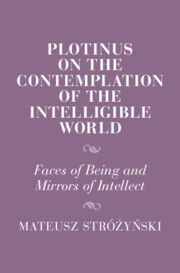
In this study, Mateusz Stróżyński offers an experiential and practical way of understanding Plotinus' thought and philosophy through a focus on the act of contemplation. He argues that contemplation, or direct seeing of the principles of reality, is not merely a part of Plotinus' thought, but rather a significant dimension of it. Moreover, he argues that Plotinus understands metaphysics as a conceptual and propositional description of reality from a third-person perspective, as well as an expression of an experience of that reality from a first-person perspective. Stróżyński focuses on the first phase of the journey to the Good, namely, on the contemplation of the intelligible world: Nature, Soul, and Intellect. He describes the fall of the soul and her return through the lens of the so-called “Great Kinds”: Being, Movement, Rest, Difference, and Identity. Stróżyński also shows how this concept, derived from Plato's Sophist, is creatively used by Plotinus to explain both the loss and the restoration of our ability to contemplate through philosophical practice.
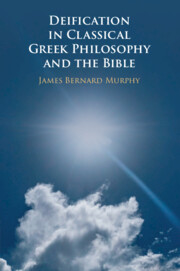
To be human is to strive to be better, and we cannot be better without knowing what is best. In ancient Greek philosophy and the Bible, what is best is god. Plato and Aristotle argue that the goal of human life is to become as much like god as is humanly possible. Despite its obvious importance, this theme of assimilation to god has been neglected in Anglo-American scholarship. Classical Greek philosophy is best understood as a religious quest for divinity by means of rational discipline. By showing how Greek philosophy grows out of ancient Greek religion and how the philosophical quest for god compares to the biblical quest, we see Plato and Aristotle properly as major religious thinkers. In their shared quest for divine perfection, Greek philosophy and the Bible have enough in common to make their differences deeply illuminating.
Ever since antiquity, scholars of Plato have been evenly divided between those who identify Plato’s supreme god with a form (usually, the form of the good) and those who identify Plato’s supreme god with a soul (usually, the soul of the cosmos). But Plato never aims to give us a science of god; he aims to show us how to become like god. I distinguish three Platonic ascents to the divine: a metaphysical ascent to the form of the good; a cosmological ascent to the cosmic soul; and a religious ascent to the proper civic cult. These three ascents form a nested hierarchy, such that the cosmological ascent presupposes the metaphysical ascent, while the religious ascent presupposes the cosmological ascent. The metaphysical and cosmological ascents culminate in the religious ascent because becoming like god for Plato is a civic project. A philosopher can save herself only by saving her city.