To save content items to your account,
please confirm that you agree to abide by our usage policies.
If this is the first time you use this feature, you will be asked to authorise Cambridge Core to connect with your account.
Find out more about saving content to .
To save content items to your Kindle, first ensure no-reply@cambridge.org
is added to your Approved Personal Document E-mail List under your Personal Document Settings
on the Manage Your Content and Devices page of your Amazon account. Then enter the ‘name’ part
of your Kindle email address below.
Find out more about saving to your Kindle.
Note you can select to save to either the @free.kindle.com or @kindle.com variations.
‘@free.kindle.com’ emails are free but can only be saved to your device when it is connected to wi-fi.
‘@kindle.com’ emails can be delivered even when you are not connected to wi-fi, but note that service fees apply.
This chapter examines the reception of the Meditations in early modern Europe, focusing primary on the period from the first publication of the Meditations in 1559 to the end of the eighteenth century. In particular it discusses the way in which the text was read as either a generic source of ancient moral maxims or a serious work of Stoic philosophy. Key figures in the early modern debate include Isaac Casaubon, his son Meric, Thomas Gataker, the Cambridge Platonists Henry More and Ralph Cudworth, Anthony Ashley Cooper, the third Earl of Shaftesbury, Francis Hutcheson, and on the Continent Joannes Franciscus Buddeus and Johann Jakob Brucker.
This chapter uses Diogenes Laertius’ doxographical overview of Stoic natural philosophy as a starting point to examine the role of physics in Marcus Aurelius’ Meditations. Contrary to a common misconception, all the central aspects of Stoic physics, except for some more technical issues, are well represented. The chapter discusses Marcus Aurelius’ treatment of the telos-formula of ‘living according to nature’; the two fundamental Stoic principles of reality, god and matter; the scale of nature; and the relation between Providence, fate, necessity, change, human action, and freedom. Marcus Aurelius’ distinctive touch comes through in certain areas of emphasis, such as the centrality of sociability, human and divine, or the many implications of the view that the processes of change that also entail human mortality actually constitute the order of the universe.
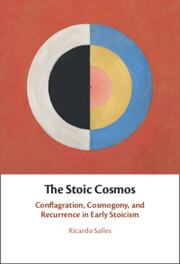
Stoic cosmology held that our cosmos is periodically destroyed and restored. In this, it is unique compared to earlier cosmologies. Ricardo Salles offers a detailed reconstruction of the philosophical ideas behind this thesis which explains its uniqueness and how it competes with earlier cosmologies. The reconstruction is based on a rigorous analysis of the evidence, made accessible to non-specialists who are familiar with the history of ancient philosophy but do not specialise in Stoicism. Furthermore, the book reveals how the Stoics combined their meteorology, their cosmology, their physics and their metaphysics to explain natural phenomena, thereby illustrating how different disciplines can interact in ancient philosophy. It also refers to central questions in the interpretation of Stoicism, such as the role of the Stoic god in cosmology.
The Meditations of the second-century Roman emperor Marcus Aurelius is consistently one of the best-selling philosophy books among the general public. Over the years it has also attracted famous admirers, from the Prussian king Frederick the Great to US President Bill Clinton. It continues to attract large numbers of new readers, drawn to its reflections on life and death. Despite this, it is not the sort of text read much by professional philosophers or even, until recently, taken especially seriously by specialists in ancient philosophy. It is a highly personal, easily accessible, yet deceptively simple work. This volume, written by leading experts and aimed at non-specialists, examines the central philosophical ideas in the work and assesses the extent to which Marcus is committed to the philosophy of Stoicism. It also considers how we ought to read this unique work and explores its influence from its first printed publication to today.
Cicero's last dialogue, De amicitia, is a work of stylistic brilliance containing the fullest examination of the values and problems of friendship to survive from the Greco-Roman world. How do we make (and lose) friends? If a conflict arises between personal affection and ethical behavior, how do we decide what is right? What kinds of people make the most suitable friends? Written in 44 BCE, De amicitia provides both a striking analysis of the conflicts between personal and civic loyalty and a strong statement about the close links between friendship, wisdom, and virtue. In the first full commentary on De amicitia in more than a century, Katharina Volk and James Zetzel provide an illuminating guide to the dialogue, explaining language and style, philosophy, and historical context. An appendix contains a text with commentary of Cicero's famous correspondence with Matius about political and personal loyalty after the assassination of Caesar.
In the third chapter, I focus on the concept of self-motion, which is tied to the definition of soul in Plato. Aristotle famously criticises this view in De anima 1.3, showing that the soul is unmoved. I offer the first lengthy discussion of Proclus’ repudiation of Aristotle’s criticism which differs from other Neoplatonist responses. Most importantly, I demonstrate how Proclus develops his own views on self-motion by using Platonic and Aristotelian insights.
The first chapter deals with Proclus’ little studied treatise Elements of Physics where he sums up in an axiomatic manner Aristotle’s theory of motion from Physics VI, VIII and De caelo I. I demonstrate that Proclus’ project is embedded in an exegetical tradition and show how he omits certain parts of Aristotle’s works that might conflict with his Neoplatonist views. Additionally, I provide evidence for the view that Aristotle’s Posterior Analytics proved to be influential for the axiomatic structure of Proclus’ treatise.
The second chapter concerns the origin of motion in the universe. While Plato assumes a self-moving soul as origin, Aristotle posits an unmoved intellect. Proclus brings these two views together by regarding the unmoved intellect as ultimate source of motion and the self-moving soul as an intermediary entity. I demonstrate that his harmonisation effort goes beyond previous Platonist attempts due to the philosophical reasoning he provides. I also defend Proclus’ assumption of both unmoved intellect and self-moving soul as sources of motion against concerns brought up in scholarship.
The goal of this study was to offer a wide-ranging treatment of Proclus’ engagement with Aristotle and his criticism of Plato by focusing on the concept of motion. Thematically, my results can be summed up in six areas.
(1) My main conclusion is that Proclus does not share the view of an essential agreement between Aristotle and Plato – contrary to what is sometimes assumed in scholarship. This emerges most clearly in Proclus’ discussion of Aristotle’s metaphysical system and specifically Aristotle’s rejection of the One as well as deficient understanding of the intellect’s causality (Chapter 4). Proclus regards Aristotle as a defective imitator and epigone of Plato. Aristotelian and Platonic metaphysics do not agree on the types of principles they recognise. As I argued, Proclus’ interpretation of Aristotelian metaphysics is more sensible than Ammonius’ et al. who vainly strive to find the Aristotelian equivalent to the Platonic One. Crucially, this insight has implications for the historiography of late antique philosophy: not all post-Porphyrian Neoplatonists adhere to the harmony-doctrine.
The fourth chapter examines the problem of the causality of the unmoved mover. This issue is central in scholarship on Aristotle and goes back to late antiquity. I argue that here Proclus’ non-harmonist stance towards Aristotle emerges most strongly: not only did Aristotle fail to make the intellect an efficient cause of the cosmos’ being but his metaphysics generally is deficient, since he did not recognise the Platonic One as the highest principle. I contrast Proclus’ view with the position of Ammonius and Simplicius who see a complete agreement between Plato and Aristotle.
In this introduction, I outline Proclus’ relationship with Aristotle and provide an overview of the state of the art. I discuss Proclus’ views on the so-called harmony of Plato and Aristotle and contrast it with the views of other, contemporary Neoplatonists, showing that Proclus stands out as more critical of Aristotle. I show that the concept of motion provides a perfect avenue for understanding how Proclus sees the tension between Plato and Aristotle. Lastly, I explain how Proclus differentiates distinct levels of motion which also structure my discussion in the monograph.
This is a study of Proclus' engagement with Aristotle's theory of motion, with a specific focus on Aristotle's criticism of Plato. It refutes the often-held view that Proclus – in line with other Neoplatonists – adheres to the idea of an essential harmony between Plato and Aristotle. Proclus' views on motion, a central concept in his thought, are illuminated by examining his Aristotelian background. The results enhance our view of the reception and authority of Aristotle in late antiquity, a crucial period for the transmission of Aristotelian thought which immensely shaped the later reading of his work. The book also counteracts the commonly held view that late antique philosophers straightforwardly accepted Aristotle as an authority in certain areas such as logic or natural philosophy.