To save content items to your account,
please confirm that you agree to abide by our usage policies.
If this is the first time you use this feature, you will be asked to authorise Cambridge Core to connect with your account.
Find out more about saving content to .
To save content items to your Kindle, first ensure no-reply@cambridge.org
is added to your Approved Personal Document E-mail List under your Personal Document Settings
on the Manage Your Content and Devices page of your Amazon account. Then enter the ‘name’ part
of your Kindle email address below.
Find out more about saving to your Kindle.
Note you can select to save to either the @free.kindle.com or @kindle.com variations.
‘@free.kindle.com’ emails are free but can only be saved to your device when it is connected to wi-fi.
‘@kindle.com’ emails can be delivered even when you are not connected to wi-fi, but note that service fees apply.
Seeds of Solidarity is a study of British Guiana amid a wave of Caribbean uprisings that brought modern politics to colonial spaces during the 1930s. It explores the historical power of a movement forged by people at the edges of empire during economic, political, and environmental crises. African- and Indian-Guianese youth, women, and men who worked on sugar plantations led a series of labor uprisings, despite attempts to turn these racialized communities against each other. Rather than erasing identities, their 'overlapping diasporas' signify how solidary can emerge without sameness, and how this process challenged the British Empire and reshaped Caribbean politics. This important work unites Caribbean history, African Diaspora and South Asian Diaspora studies, histories of racial capitalism and labor movements, gender studies, and the politics of colonialism and empire in the post-indenture period. It offers a model of resistance in today's era of deepening racial and economic inequality, fascism, and climate emergency.
1940s African American literature sits between two of the best-known periods in Black writing. Adding more intricacy to its framing, this decade's literary output commences and ends with watershed creative accomplishments by canonical mainstays in the waiting like Zora Neale Hurston, Richard Wright, Gwendolyn Brooks, James Baldwin, and Ralph Ellison. However, this book shows that mid-century Black literary productivity is not a matter of a handful of canonical figures and instead, it illuminates overt and implicit collaboration as a hallmark of the age. It identifies perforation, aesthetic plurality, multi-generic virtuosity, and writerly professionalism as signposts for understanding mid-twentieth century Black literary productivity. It engages prior assessments that cast African American literature in the 1940s based on stylistic clashes and technical stasis. It restores Black writing's role as feature of American social progress in the space between the Great Depression and the mature Civil Rights Movement.
How do African leaders cooperate through regional intergovernmental organizations (RIOs) to manage political and security threats? Do the particular interests of heads of state really matter for explaining how these organizations address crises and intervene in their members' domestic affairs? Protective Clubs reveals how presidents across Africa cooperate in RIOs to protect themselves from threats, such as military coups. Cottiero argues that heads of state concerned with their personal survival often treat RIOs as bases for organizing, in essence, mutual protection clubs based on reciprocity. Leaders who cooperate and maintain 'good standing' with co-members are more likely to receive back-up during crises, while leaders who destabilized co-members are more likely to be abandoned or punished. Employing original datasets on security interventions and leader exile, interviews, and Nigerian presidential archive records, Protective Clubs shows how collusion among leaders matters not just for particular leaders, but for regional stability and democracy.
This book offers a new kind of analysis of Psellos' Chronographia as a rhetorical performance, as poesis, as a work in progress. It traces his developing techniques from the basic building blocks of the first two reigns to the intricate tragicomic structure of Constantine IX's; from the simple, finely judged scene in Basil II's tent to the spectacular mutual performance in the rebel Isaak's. The book focuses on role; on the interplay of genres, especially panegyric and the subgenres of drama; on metaphor; on psychology; on the visual and tactile. It contrasts Psellos' style with his more decorated orations and observes how his wide reading is metabolized into the particular and contemporary. At best, Psellos subjects his philosopher 'self' to scrutiny through the conflict and interplay of his feelings and roles in both commentary and agency; from this comes his tragicomic, empathetic, deeply ironic version of Byzantium.
This book explains variations in the effectiveness of vote buying. Current theory assumes that vote buying is effective, rotting democracy's foundations. Yet, evidence shows that it rarely succeeds. Against the Machine presents a partisan competition theory to explain why buying vote choices is typically ineffective, the conditions under which it occasionally succeeds, and why it persists despite meager electoral returns. Competitive elections arm voters with the psychological wherewithal to resist the influence of electoral gifts, deprive political machines of the information they need to target compliant clients, and reinforce belief in ballot secrecy. The success or failure of vote buying thus relies more on the capacity of opposition parties to compete rather than the prowess of political machines. Against the Machine provides a new account of vote buying that paints a more optimistic portrait of elections, voter behavior, and the chances for political accountability in new democracies.
How does the state deliver justice to citizens? Are certain groups disadvantaged whilst seeking help from law enforcement and the courts? This book charts, for the first time, the full trajectory of accessing justice in India's criminal justice system, highlighting a pattern of multi-stage discrimination and unequal outcomes for women seeking restitution from the state. To probe how discrimination can be combated, the book tests whether gender representation in law enforcement-in the form of all-female enclaves or women-only police stations-affects change. The book demonstrates how certain forms of representation can lead to unintended consequences. By utilizing a range of research designs, the book not only casts a light on justice delivery in the world's largest democracy, but also transports readers into the world of crime and punishment in India.
Drawing on methods from the history of emotions to study enslaved people's lives, Beth R. Wilson exposes the social, cultural and political role that emotion played in the US South. Exploring both individual and collective emotions, Wilson shows how enslaved people resisted white people's attempts to restrict their feelings and expressions by developing their own emotional ideals and expectations. Moving through case studies that examine a range of underexplored forms of testimony, the book introduces readers to slave narratives, letters, written interviews and recorded testimony to show that emotion was central to how enslaved people resisted, survived and remembered the system of slavery. Enslaved people's descriptions of their individual experiences of love, pain, grief and joy are woven throughout this study, which provides a framework that historians can use to paint a nuanced, detailed and empathetic picture of the complex emotional impact of slavery.
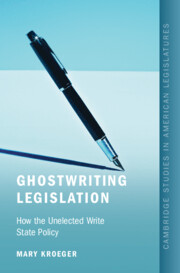
State legislators introduce more than 100,000 bills per year and the resulting statutes that become law govern every aspect of life and business in those states. But who exactly writes these laws? In Ghostwriting Legislation, Mary Kroeger delves into the central and often-overlooked role that interest groups, think tanks, companies, and bureaucrats play in writing state law. While legislators are not expected to draft and pass legislation without the input of outside actors, Kroeger argues that a democratic defect may arise if elected officials must rely substantially on non-legislators to craft high-quality bills. Ghostwriting Legislation explores the disconnect between legislative power and legislative capacity, providing key data and insights for those who care about democracy and the separation-of-power dynamics in state legislatures.
The 2024 nomination of Donald Trump was both predictable and wildly unusual. Parties almost never nominate someone who has previously lost the presidency - let alone a candidate who helped organize a riot and faced dozens of criminal indictments. Why, then, did Republicans nominate Trump for a third time? In this fascinating follow-up to Learning from Loss, leading scholar and political analyst Seth Masket conducted surveys and interviews with local Republican leaders across the country between 2021 and 2024. He finds that most were deeply wary of nominating Trump again but had lost any control they once had over their party to a passionate core of voters. The Elephants in the Room captures a political party in the act of making a fateful decision; attempts to understand what has happened within the Republican Party in recent years by focusing on the people most critical to it; and looks at how the party has changed, what we should be learning from it, and how the US political system has changed as result.
Whether due to climate change, drought, flooding, competing demands, or pollution, watersheds across the globe are under significant duress. To respond to these complex challenges, collaborative approaches to watershed governance have increasingly been adopted in the United States, but very few studies have yet to systematically assess their true effectiveness. This book addresses a significant gap in research by undertaking a comprehensive study of alternative, collaborative structures and whether these produce better water quality outcomes than traditional regulatory governance. Analyzing almost one quarter of US watersheds and examining both the revealed and perceived outcomes of watershed stakeholder collaboration, it is the first large-scale study on this topic. The insights the chapters provide will equip readers with a nuanced and generalizable understanding of the effectiveness of collaboration in natural resource management, which will be of great interest to researchers and practitioners in wide-ranging environmental and public policy roles.
Unlike conventional narratives of 'state failure' and its conceptual avatars, the volume analyses the remains of states whose populations had been torn apart by prolonged and violent conflicts and whose rulers lost the monopoly over the means of coercion and the capacity to implement public policies. Focusing on Lebanon since the civil war of the 1970s and 80s, Syria since the repression of the 'Arab spring' in 2011, and Iraq since the 1991 and 2003 wars, it provides a systematic explanation of the continuous, if precarious, survival of these states which draws on international recognition, access to resources, institutional arrangements, and societal ties alongside societal cleavages. In the process, States under Stress defends a definition of the state based on claims to statehood.
This book complements abundant research about immigrants by contributing novel data, knowledge, and theories about potential immigrants-those who might have immigrated but did not despite the benefits of migration to immigrants and origin and destination societies. The text examines three mechanisms that reduce or restrict immigration-governments denying visas, policies and social forces deterring many from applying for visas, and potential immigrants becoming disenchanted with immigration. Jacob expands the Push-Pull Model to a Push-Retain-Pull-Repel Model that accounts for why many remain ambivalently immobile. Narratives of might-have-been-immigrants reveal an (im)mobility paradox: factors facilitating migration-socio-economic resources and social ties-also hinder it. The book analyses denial, deterrence, and disenchantment from the perspective of countless people who do not immigrate due to one of these processes, revealing how they are socio-economically stratified with respect to each other and immigrants. This provokes a deeper, more global understanding of inequalities in migratory opportunities.
Ngugi wa Thiong'o in Context offers a compelling and comprehensive reading of the various contexts pivotal to Ngugi wa Thiong'o's practice as a writer. Ngugi drew a complex link between his role as a writer and the contexts within which his works are produced. The desire to come to terms with the past and the shifting historical process in his country is evident throughout his work. The volume shows that, for a writer whose work is steeped in biographical life experiences and historical events, context is even more special. It must be recovered through imagination and re-imagined as part of Ngugi's self-writing. One of the aims of this volume is to displace the notion of context as a reified site of retrieval and self-evident knowledge, and also to see how this sense of context offers readers of his vital writings new and disruptive ways of re-reading Ngugi's texts.
The sixth edition of Gender and Elections offers a systematic, lively, multi-faceted account of the role of gender in the electoral process through the 2024 elections. This timely, yet enduring, volume strikes a balance between highlighting the most important developments for women as voters and candidates in the 2024 elections and providing a more long-term, in-depth analysis of the ways that gender has helped shape the contours and outcomes of electoral politics in the United States. Individual chapters demonstrate the importance of gender in understanding and interpreting presidential, congressional, and state elections; voter participation, turnout, and choices; the role of social movements in elections; the participation of Black women and Latinas; the political history and success of LGBTQ+ women; the support of political parties and women's organizations; and candidate strategy. Without question, Gender and Elections is the most comprehensive, reliable, and trustworthy resource on the role of gender in electoral politics.
There is overwhelming evidence that the impacts of climate change are gender-differentiated and that women are the most negatively affected. Drawing on interviews with nearly 100 female activists and politicians from Algeria, Egypt, Iraq, Jordan, Lebanon, Mauritania, Morocco, Tunisia and Palestine, Lise Storm explores the implications of unequal female political representation for the climate crisis. Storm considers the voices of the women who are, or have been, involved in politics at the highest level. These women have experience with running for election, gender quotas, party politics, portfolio allocation, policy making, agenda setting and other such political dynamics and processes relating to power. This study sheds light on women's agency in climate debates and the impacts of the dynamics surrounding political representation. It adds new perspectives to the backgrounds of female MPs and activists and the drivers of their success – factors which influence how the global climate crisis is tackled locally in the region.