To save content items to your account,
please confirm that you agree to abide by our usage policies.
If this is the first time you use this feature, you will be asked to authorise Cambridge Core to connect with your account.
Find out more about saving content to .
To save content items to your Kindle, first ensure no-reply@cambridge.org
is added to your Approved Personal Document E-mail List under your Personal Document Settings
on the Manage Your Content and Devices page of your Amazon account. Then enter the ‘name’ part
of your Kindle email address below.
Find out more about saving to your Kindle.
Note you can select to save to either the @free.kindle.com or @kindle.com variations.
‘@free.kindle.com’ emails are free but can only be saved to your device when it is connected to wi-fi.
‘@kindle.com’ emails can be delivered even when you are not connected to wi-fi, but note that service fees apply.
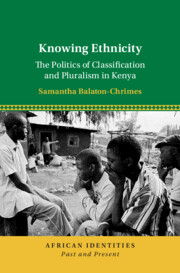
There is a widespread assumption that both ethnicity itself and ethnic conflict, are inevitable. Yet, we know very little about how ethnic identifications function in bureaucratic terms in Africa. The stakes of this problem are rapidly escalating in moves to digital identification and population knowledge systems. Focusing on Kenya, this study provides an urgently needed exploration of where ethnic classifications have come from, and where they might go. Through genealogies of tools of ethnic identification – maps, censuses, ID cards and legal categories for minorities and marginalised communities – Samantha Balaton-Chrimes challenges conventional understandings of classifications as legible. Instead, she shows them to be uncertain and vague in useful ways, opening up new modes of imagining how bureaucracy can be used to advance pluralism. Knowing Ethnicity holds important insights for policymakers and scholars of difference and governmentality in postcolonial societies, as well as African and ethnic politics.
Examining sectarian divergence in the early modern Middle East, this study provides a fresh perspective on the Sunni–Shi'i division. Drawing on Ottoman Turkish, Persian, and European sources, Ayşe Baltacıoğlu-Brammer explores the paradox of an Ottoman state that combined rigid ideological discourses with pragmatic governance. Through an analysis of key figures, events, periods, and policies, Boundaries of Belonging reveals how political, economic, and religious forces intersected, challenging simplistic sectarian binaries. Baltacıoğlu-Brammer provides a comprehensive historical account of Ottoman governance during the long sixteenth century, focusing on its relationship with non-Sunni Muslim subjects, particularly the Qizilbash. As both the founders of the Safavid Empire and the largest Shiʿi-affiliated group within the Ottoman realm, the Qizilbash occupied a crucial yet often misunderstood position. Boundaries of Belonging examines their role within the empire, challenging the notion that they were merely persecuted outsiders by highlighting their agency in shaping imperial policies, negotiating their status, and influencing the Ottoman–Safavid rivalry in Anatolia, Kurdistan, and Iraq, and western Iran.
As the 20th century recedes, how should its history be written? The 1920s and 1930s were a time of paradox, of great conflict and contradiction. If those years were the crucible of a new metropolitan modernity and its possibilities, what were the forward-moving forces and ideas? What were their effects and where did they lead? The Modernist Wish provides a comprehensive, non-hierarchical and integrated history of Europe's early 20th century across the whole of the continent. Uniting social, cultural-intellectual, and political history alongside military-strategic and geopolitical dimensions, Geoff Eley examines the distinctiveness of early-20th century modernity. He draws out the exceptional character of the interwar years and their longer-run social and political fallout, based in the excitements of metropolitan living, the progressive achievements of an industrialized machine world, and the material possibilities for fashioning new forms of selfhood. In presenting a truly European history for our time, this study encompasses both the grand narratives of large-scale transformations, and the everyday realities of individual lived experiences.
This important book illuminates the deeply intertwined histories of the Nicaragua Canal and the Afro-Indigenous Mosquito Coast, uncovering a compelling truth, long overshadowed by the triumphalist narrative of the Panama Canal. Focusing on British and US efforts to control the canal route through Nicaragua, Rajeshwari Dutt shows how imperial ambition, racial ideology, and local power struggles shaped one of Latin America's most contested infrastructure projects. She traces the role of racial language in imperial, colonial, and national agendas; the shifting dynamics of Anglo-American imperialism on the Mosquito Coast; and the violence embedded in the very pursuit of interoceanic connection. Methodologically, the book advances a practice of reading failure as a lens through which to understand the fragility of imperial projects and the contradictions that undermine their global ambitions. At its heart, The Link That Divides reveals a central paradox: that dreams of connection were built on – and undone by – the reality of division and exclusion.
The Messianic Jews of Ethiopia's Gambella region are Evangelical Christian Zionists who adhere to various Jewish practices and understand their faith as authentically emulating the faith of the first followers of Jesus Christ. Drawing on over a year of ethnographic research in this region, Yotam Gidron traces here the rise and evolution of Christian Zionist and Messianic Jewish faiths amongst Nuer communities in the Ethiopia-South Sudan borderlands. This study approaches processes of religious change from the perspective of believers, examining their pursuits of knowledge and transnational connectivity. In doing so, Gidron considers everyday dilemmas concerning spiritual mediation and truth, as they emerged in relation to church genealogies, Christian literacy, modes of prayer and praise, bloodlines, cattle, and the constitution of various human and divine relationships. As a result, he offers timely insights on spiritual and political life at the global margins, and on contemporary African attitudes towards Israel and the Middle East.
Considering a number of factors such as cross-linguistic influences, saliency and detectability of language cues, language complexity, and the interfaces involved, this book provides a systematic and coherent study of non-native grammars of Chinese. It covers a broad range of language aspects of Chinese as a non-native language, such as syntax, semantics, discourse, and pragmatics, as well as language phenomena specific to Chinese, such as classifiers, sentence final particles, the topic structure, and the ba-construction. It explores the effect on the linguistic structure of Chinese, when it is spoken as a second language by first-language speakers of English, Japanese, Korean, Thai, Spanish, Swedish, Russian and Palestinian Arabic, enabling the reader to understand the learners' mental representations of the underlying systems of the target language. New points of departure are also recommended for further research, making it essential reading for both Chinese language teaching practitioners, and academic researchers of non-native language acquisition.
With a focus on nineteenth-century Cuba, Víctor Goldgel Carballo conceptualizes the analytical category of racial doubt: the hesitation produced by divergent, contradictory, or ambiguous understandings of race. Racial doubt is the flip side of racialism, or of the assumption that social hierarchies are based on the existence of races, imagined as natural or prior to those hierarchies. Mapping key moments of a century that witnessed the peak of racial slavery, abolition, and the birth of the Black press, this book shows how captives, free people of color, and Afro-Cuban authors leveraged doubts to overcome racist sociopolitical structures. It interweaves analyses of literature, including poems by enslaved authors and a novel by a mixed-race journalist, with unpublished archival material, including testimonies of kidnapped Afrodescendants. Focusing on how people held multiple views of race simultaneously, it examines debates crucial to the history of the Americas, including color-blindness and shifting understandings of Blackness.
The Byzantine Abbot Symeon the New Theologian (949–1022) transgressed the homophobic norms of medieval Orthodox society. His longing for God was distinctly homoerotic, and he depicted union with the divine as a queer sort of marriage. His Orthodox theology of theosis, the deification of the entire person, meant that Symeon taught the salvation of all the parts of the body. But monks also desired the eradication of lust and the punishment of those who fell prey to it. Sermons and biblical commentary defined men who had sex with men as sodomites; and saints' lives warned of the consequences of same-sex desires. Those who renounced sex redirected their desire rather than eliminating it. Symeon's queer erotics shed light on other devotions distinctive to medieval Orthodoxy, including the veneration of saints and worship with icons. Monastic Desires makes a groundbreaking contribution to the history of sexuality and the history of Christianity.
From the Asvamedha sacrifice to the mounted police, modernist paintings to the medieval cavalry, oceanic trade to urban transport – horses have occupied a prominent position in almost every sphere of human history in South Asia. The Coveted Mount brings a holistic analysis of the compelling history of this human-nonhuman relationship from prehistory to the twenty-first century. The essays in this book unravel the role of the horse in gift exchanges, colonial cities, astrological knowledge, military campaigns, modern art, political culture, religious belief, veterinary sciences, and oceanic commerce. They do so by interpreting colonial records, ancient epics, epigraphic records, medieval coins, temple friezes, modern art, stone and terracotta sculptures, imperial chronicles, equestrian treatises, and wall paintings. In the process, the essays reveal South Asia's historical connections with the world. Overall, this richly illustrated book shows how, when, and why the horse became the coveted mount of South Asian societies
This formative period of EU law witnessed an intense struggle over the emergence of a constitutional practice. While the supranational institutions, including the European Commission, the European Court of Justice and the European Parliament, as well as EU law academics helped to develop and promote the constitutional practice, member state governments and judiciaries were generally reluctant to embrace it. The struggle resulted in an uneasy stalemate in which the constitutional practice was allowed to influence the doctrines, shape and functioning of the European legal order that now underpins the EU, but a majority of member state governments rejected European constitutionalism as the legitimating principle of the new EU formed on basis of the Treaty of Maastricht (1992). The struggle and eventual stalemate over the constitutional practice traced in this book accounts for the fragile and partial system of rule of law that exists in the EU today.
In The Resilience of the Old Regime, David Art reevaluates the so-called first wave of democratization in Western Europe through the lens of authoritarian resilience. He argues that non-democrats succeeded to a very large degree in managing, diverting, disrupting, and repressing democratic movements until the end of the First World War. This was true both in states political scientists have long considered either full democracies or democratic vanguards (such as the UK and Sweden), as well as in others (such as Germany and Italy) that appeared to be democratizing. He challenges both the Whiggish view that democracy in the West moved progressively forward, and the influential theory that threats of revolution explain democratization. Drawing on extensive historical sources and data, Art recasts European political development from 1832–1919 as a period in which competitive oligarchies and competitive authoritarian regimes predominated.
To defeat demagogues like Donald Trump, citizens must vote to defend democracy, otherwise it will not be there to defend them. Taking off from Max Weber's 'Vocation Lectures,' David Ricci's Defending Democracy therefore explores the idea of 'citizenship as a vocation,' which is a commitment to defending democracy by supporting leaders who will govern according to the Declaration of Independence's self-evident truths rather than animosity and polarizations. He examines the condition of democracy in states where it is endangered and where modern technology – television, internet, smart phones, social media, etc. – provides so much information and disinformation that we sometimes lack the common sense to reject candidates who have no business in politics. Arguing for the practice of good citizenship, Ricci observes that as citizens we have become the rulers of modern societies, in which case we have to fulfill our democratic responsibilities if society is to prosper.
During the Great Leap Forward (1958–62), the collectivization of the Chinese countryside had catastrophic results, but how did this short-lived political experiment reshape urban life? In the first English history of urban collectivization, Fabio Lanza explores the most radical attempts to remake cities under Mao. Examining the universalization of production, the collectivization of life, including communal canteens and nurseries, and women's liberation, intended to transform modern urban life along socialist lines, he shows how many residents, and women in particular, struggled to enact a radical change in their everyday lives. He argues that the daily reality of millions of city residents proved the limitations of an effort that tied emancipation to industrial labor and substituted subjugation to the assembly line for subjugation to the stove, confronting some of the crucial contradictions of the socialist revolution.
The Great Palace of Constantinople was the heart of Byzantium for almost a thousand years, serving as both a political and architectural model for Christendom and the Islamic world. Despite its historical significance, reconstructing its layout remains challenging due to the scarce amount of archaeological evidence. This Element synthesises the historical and topographical evolution of the palace, examining its architectural typologies and the role of ritual and artistic objects in representing imperial power. It also addresses key historiographical issues, such as the identification and dating of the Peristyle of the Mosaics, as well as its role in imperial ceremonies. The research is based on textual sources, archaeology, and graphic documentation, culminating in a virtual reconstruction through 3D imaging. By integrating these methodologies, this Element aims to offer a comprehensive understanding of the Great Palace, its influence, and its role as a central stage for Byzantine ceremonial and ideological expression.
In this tapestry of intersecting stories, including those of her own family, Rashauna Johnson charts the global transformation of a rural region in Louisiana from European colonialism to Jim Crow. From her ancestor Virgil to her cousin Veronica and her hand-sewn Mardi Gras memorial suit more than a century later, this history is one of triumphs and trauma, illustrating the ways people of African descent have created sites of endurance, belonging, and resistance. Johnson uses her grandmother's birthplace in East Feliciana as a prism to illuminate foundational, if fraught, aspects of US history including colonialism, slavery, war, citizenship, and unfinished freedom. The result is a portrait of the world in a family, a family in a region, and a region in the world that insists on the bristling and complicated relationships of people to place and creates a new understanding of what it means to be American.
How have European countries coped with the challenge of industrial capitalism and the rise of superpowers? Through an analysis of European integration from 1945 to the present day, Laurent Warlouzet argues that the European response was to create both new institutions and an original framework of governance for capitalism. Beyond the European case, he demonstrates that capitalism is not just a contest between free-markeeters and their opponents, those in favor of welfare and environmental policies, because there is a third camp which defends protectionism and assertive defence policies. Hence, the governance of capitalism has three foundational principles – liberty, solidarity and community. The book shows how Europeans including Thatcher, de Gaulle and Kohl have dealt with the challenges of nationalism and protectionism in the past, with their successes and failures providing valuable lessons for improving international relations today. This title is also available as open access on Cambridge Core.