To save content items to your account,
please confirm that you agree to abide by our usage policies.
If this is the first time you use this feature, you will be asked to authorise Cambridge Core to connect with your account.
Find out more about saving content to .
To save content items to your Kindle, first ensure no-reply@cambridge.org
is added to your Approved Personal Document E-mail List under your Personal Document Settings
on the Manage Your Content and Devices page of your Amazon account. Then enter the ‘name’ part
of your Kindle email address below.
Find out more about saving to your Kindle.
Note you can select to save to either the @free.kindle.com or @kindle.com variations.
‘@free.kindle.com’ emails are free but can only be saved to your device when it is connected to wi-fi.
‘@kindle.com’ emails can be delivered even when you are not connected to wi-fi, but note that service fees apply.
This book revisits a rich but overlooked field of Nepali literature and culture. Compared to the extensive research available on Nepal's South Asian neighbors, there is a notable scarcity of published scholarship devoted to Nepali literature and society. This book addresses the gap by offering groundbreaking scholarship by a global collective of researchers specializing in Himalayan Studies, South Asian Studies, Cultural Studies and Critical Theory. It offers a nuanced and complex picture of Nepali society and history, focusing on caste, geography, gender, sexuality and ethnicity as sites of discrimination, exclusion and othering. It exposes orientalist discourses which portray Nepal as a Himalayan Shangri La and it critiques neoliberal narratives which focus on Nepal's dismal developmental indices. Switching gears by exploring a diverse body of canonical and contemporary multi-genre literary works, the book presents an alternative picture of Nepal from the perspective of those silenced by nationalism, patriarchy and casteism.
Why are Latin Americans increasingly disillusioned with democracy, even as the region has made social progress? This book examines the paradox of widespread political discontent amid improvements in poverty reduction, education, and expanded rights. It shows how rising expectations and broken promises have generated social frustration and political reactions, which take two different forms: they can target all political elites (vertical discontent) or focus on opposing political coalitions (horizontal discontent). Each form poses unique challenges for democracy. Bringing together leading scholars in sociology and political science from Latin America and the United States, the volume offers a multidisciplinary and comparative perspective on the drivers of democratic erosion. Drawing on empirical case studies and a shared analytical framework, the book sheds light on the tensions between democratic aspirations and lived experiences, making it a valuable resource for understanding the forces reshaping Latin America's political landscape and the broader erosion of democracy.
Older than the pyramids, Sumerian was used in ancient Mesopotamia (Southern Iraq). It is probably the world's first written language, and survives on clay tablets in the cuneiform script, dating from c.3000 BCE to the beginning of the Common Era. It abounds in simple inscriptions, ideal for beginners, but also boasts a wealth of more advanced writings, such as fascinating mythological poetry. This comprehensive textbook equips students to read the full range of texts – including the special variety of the language known as Emesal. Drawing on the authors' experience in the classroom, it uses intuitive terminology and also makes extensive use of diagrams, which unravel the language's structures in an easy-to-learn way. The examples and readings are all taken from original sources. The learning journey is further supported by exercises (with key), a full sign list and glossary, and online recordings with 'approximate pronunciations'.
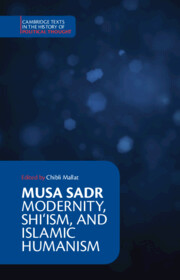
Musa Sadr was a leading force in Lebanese politics from the early 1960s until his disappearance in Libya in 1978. Like now, this was a time of turmoil, violence, and change in the Middle East. Sadr has been portrayed as primarily a charismatic man of action whose inspirational qualities led Lebanon's Shia Muslims to the centre of the political stage. This book also reflects his position as a thinker whose actions were firmly rooted in universal ethical and religious values, and for whom Islam was social philosophy as well as faith. With twelve texts taken from lectures or talks given by Sadr between 1966-1977, an introduction, and a chronology of Sadr's life, the book situates Sadr within currents of humanist intellectual thought. Detailed contextualising footnotes accompany the translations, highlighting the enduring relevance and topicality of Sadr's ideas.
Students are challenged to stay ahead in today's ever-changing political environment. This third edition comprehensive and accessible casebook, designed specifically for undergraduates, integrates both the political science and legal perspectives of American constitutional law. Covering developments from the constitution's drafting through to the presidency of Donald Trump, the book balances doctrinal analysis with historical and political context. Key updates include expanded discussions of judicial review, judicial power, nationwide injunctions, and the elimination of Chevron deference in administrative law. New material addresses Native American sovereignty, congressional investigatory powers, presidential authority and criminal liability, and the evolving balance of power in foreign affairs and war powers. Additional coverage explores presidential and congressional budget authority, impeachment, and state power within the federal system. The text examines pressing contemporary issues such as public health, property rights, substantive due process, and eminent domain, providing students with the essential tools to critically analyze constitutional law.
Three questions have usually been asked about the French Revolution: why did it happen? why was it so violent? and what was its legacy? These questions seem to beg other, more conceptually ambitious queries about causation, violence or legacies. This book aims to answer both sets of questions by bringing together events and ideas. Michael Sonenscher draws on neglected aspects of eighteenth-century intellectual and political life and thought to demonstrate the importance of ideas for making connections between historical explanation and historical narrative. Concisely synthesizing a broad range of established scholarship, Sonenscher utilises new and fresh information to explore why using ideas as evidence adds a dimension of novelty, possibility, expectation and choice to the social, cultural and political history of the French Revolution.This is history about what was expected, but did not happen, and what was unexpected, but really did.
What is tradition in American constitutional law, and what is its enduring appeal in American culture? In The Constitution of Practice, Marc O. DeGirolami presents and defends his theory of constitutional law, one rooted in our political, legal, and cultural experience. He argues that constitutional traditions are the ways in which we manifest, give concrete form to, and transmit political excellence across time. He explains how traditions also bind us to one another, strengthening the civic affection necessary to a democratic republic. Responding to several criticisms, the author discusses the relationship of constitutional method and American politics, evaluating traditionalism's political adhesion and its prospects in the coming decades. At a time when Americans increasingly do not trust their institutions, DeGirolami explores how a traditionalist approach to the Constitution can begin to repair the disaffection that many now feel for their legal institutions.
Americans of all political stripes are becoming increasingly frustrated with the partisanship of present-day politics. Democrats and Republicans alike claim mandates on narrow margins of victory and are quick to condemn their opponents as enemies of the public good. The Framers of the Constitution understood that such divisions are rooted in the political factions inherent in democracy. Their solutions were federalism, the separation of powers, bicameralism, judicial review and other structural constraints on majority rule. Over the course of US history some of those constraints have been eroded as American politics have become more democratic and less respectful of the liberties and freedoms the Framers sought to protect. American Factions advocates for a renewed understanding of the problem of political factions and a restoration of the Constitution's limits to revive a politics of compromise and bipartisanship.