Flip it Open aims to fund the open access publication of 128 titles through typical purchasing habits. Once titles meet a set amount of revenue, we have committed to make them freely available as open access books here on Cambridge Core and also as an affordable paperback. Just another way we're building an open future.
To save content items to your account,
please confirm that you agree to abide by our usage policies.
If this is the first time you use this feature, you will be asked to authorise Cambridge Core to connect with your account.
Find out more about saving content to .
To save content items to your Kindle, first ensure no-reply@cambridge.org
is added to your Approved Personal Document E-mail List under your Personal Document Settings
on the Manage Your Content and Devices page of your Amazon account. Then enter the ‘name’ part
of your Kindle email address below.
Find out more about saving to your Kindle.
Note you can select to save to either the @free.kindle.com or @kindle.com variations.
‘@free.kindle.com’ emails are free but can only be saved to your device when it is connected to wi-fi.
‘@kindle.com’ emails can be delivered even when you are not connected to wi-fi, but note that service fees apply.
I argue in Chapter 3 that the canon law precept of the marriage debt, which was formulated particularly by Augustine, Gratian, and Thomas Aquinas in the course of establishing marriage as a sacrament, indicates a mode by which power is exercised on and through the bodies and the wills of married parties. It is a mode by which individuals are enjoined to a voluntary subservience. The power that the loathly lady figure wields over the penitent knight in The Wife of Bath’s Tale leaves its subject formally free but freely compliant, aiming at the production of internal conditions rather than external constraints. The same dynamic shapes the plots of other medieval texts featuring the marriage debt, from Chaucer’s The Merchant’s Tale to the tales told on Days 2 and 8 of Boccaccio’s Decameron, all of which I consider as illustrative analogues. These texts identify marriage, and marital sex in particular, as a key site where debt makes subjects, where political power is enacted in and through the free wills of human beings.
Chapter 2 reads the late medieval romance of the spendthrift knight as an exemplum of economic faith. A character borrowed from folklore, the spendthrift knight falls into debt through excessive largesse, and consequently into exile from the aristocratic community. The plot of the spendthrift romance is organized around the protagonist’s debt recovery and eventual social triumph when newfound wealth allows him to reclaim the status he lost through penury. I argue that what makes these romances amenable to and generative of commercial values is their valorization of credit, typically expressed in the narratives as honour, trouthe, and faithfulness. Such faithfulness is manifest primarily in a willingness to take economic risks, variously extending and accepting credit, in cycles of exchange that end up generating profit for the knight and for his community. Belief as such in relations of social and material exchange, belief that defies strict rationality and that makes risk and sacrifice both possible and profitable, motivates gifts and market transactions alike, and binds individuals in creditor–debtor relationships that are both reciprocal and hierarchical.
In this book, I have shown some of the ways in which the penitential and sacramental theology of the later Middle Ages was not resistant to emerging capitalist forms and principles but rather contributed to their emergence, and I have argued that we can identify in medieval theology a distinctly capitalist spirit. This spirit is expressed precisely in those aspects of the “age of faith” that have usually been read as inimical to the market and to the rationalizing, secularizing forces of modernity. Belief in the incarnated Christ is a kind of monetary belief, even as the Redemption is an economic exchange that cannot be reduced to mere metaphor; likewise, the faith and trust on which financial credit relies are aspects of a non-rational, essentially religious belief in the trustworthiness of creditor and debtor alike. The sacramental theology of marriage, encapsulated in the marriage debt, seeks to govern desire in the domestic economy by producing self-governing subjects, subjects who, as Weber and Foucault would remind us, are the prerequisites of capitalism. The penitential practices required to measure vices and virtues, practices taught and modelled by penitential handbooks and by Piers Plowman, suggest the kind of rational, methodical conduct of life that Weber identified with Protestant ascesis, although Langland’s emphasis falls on the paradox of sin as a debt that must be paid but that cannot be paid. Langland’s attempt to imagine a Franciscan form of life in the general economy leads to his affirmation of common use; the final images of Christian communal life in the poem are images of a Pentecostal bureaucracy of labourers who manage the gifts and resources lent by God. In Piers Plowman, Langland makes the case for a monetized, bureaucratized social structure precisely in his desire to eschew covetous materialism. All of these texts exemplify the ways in which theological ideas can shape economic structures and realities; more specifically, they suggest ways in which capitalism as an economy of debt shares conceptual ground with the penitential economy of debt.
I consider the implications of this study for future research and policymaking, and I reflect on the legacies of the people and policies I discuss in the book. For instance, I discuss potential applications to healthcare policy, specifically around the opioid epidemic, and education policy. I also address how the themes of the book play out in my own everyday work as a teacher.
Chapter 1 uses the Middle English Charters of Christ to outline a medieval theory of money as debt. The charter lyrics pretend to be deeds, grants, or writs by which Christ cancels the debt owed to God by sinners, or, alternatively, bequeaths the kingdom of heaven to the faithful. In exchange for the remission or the inheritance, the charter stipulates that humankind owes a “rent” to Christ of love and the regular observance of the sacrament of penance. The form of the charter lyrics imitates the form of legal documents, using the verbal formulae and visual markers designed to ensure legal and documentary authenticity as a kind of spiritual guarantee: the lyrics are sincere forgeries. I argue that the kind of belief at work in this act of forgery is a monetary belief. The lyrics function as close analogues to money in that they measure debt and depend for their value on the creditor’s right to repayment. At the same time, like money, they depend for their operation on the community’s active willingness to participate in a shared fiction.
Many people have tried and failed to make English the only official language of the United States. In contrast to earlier studies of these national efforts, I argue that people in the English-only movement are really at their most successful when they focus on writing local language policies. Working in local governments and talking about the local community can make monolingualism seem practical at best, innocuous at worst. People who participate in the English-only movement are adept at drafting, copying, revising, sharing, and promoting language policies. At the same time, they are not a united front, in terms of either their motivations or their strategies. After introducing the topic, I address why English-only policies matter: They target people who are already marginalized, they oversimplify how language works, they are popular, and the strategies people use to write and promote these policies are ingenious. Finally, I discuss how I designed this study of the recent history of English-only policies using ethnography and other research methodologies.
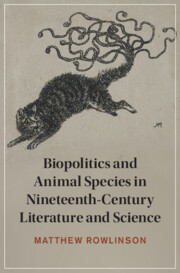
Principles of species taxonomy were contested ground throughout the nineteenth century, including those governing the classification of humans. Matthew Rowlinson shows that taxonomy was a literary and cultural project as much as a scientific one. His investigation explores animal species in Romantic writers including Gilbert White and Keats, taxonomies in Victorian lyrics and the nonsense botanies and alphabets of Edward Lear, and species, race, and other forms of aggregated life in Darwin's writing, showing how the latter views these as shaped by unconscious agency. Engaging with theoretical debates at the intersection of animal studies and psychoanalysis, and covering a wide range of science writing, poetry, and prose fiction, this study shows the political and psychic stakes of questions about species identity and management. This title is part of the Flip it Open Programme and may also be available Open Access. Check our website Cambridge Core for details.
Emotion Regulation and Parenting provides a state-of-the-art account of research conducted on emotion regulation in parenting. After describing the conceptual foundations of parenthood and emotion regulation, the book reviews the influence of parents' emotion regulation on parenting, how and to what extent emotion regulation influences child development, cross-cultural perspectives on emotion regulation, and highlights current and future directions. Drawing on contributions from renowned experts from all over the world, chapters cover the most important topics at the intersection of parenting and emotion regulation. Essentials are explored, as well as current, topical, and controversial issues, pointing both to what is known and what requires further research. This title is part of the Flip it Open Programme and may also be available Open Access. Check our website Cambridge Core for details.
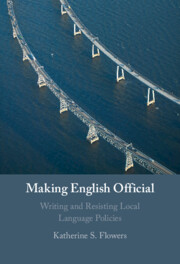
In communities across the US, people wrestle with which languages to use, and who gets to decide. Despite more than 67 million US residents using a language other than English at home, over half of the states in the US have successfully passed English-only policies. Drawing on archives and interviews, this book tells the origin story of the English-only movement, as well as the stories of contemporary language policy campaigns in four Maryland county governments, giving a rare glimpse into what motivates the people who most directly shape language policy in the US. It demonstrates that English-only policies grow from more local levels, rather than from nationalist ideologies, where they are downplayed as harmless community initiatives, but result in monolingual approaches to language remaining increasingly pervasive. This title is part of the Flip it Open Programme and may also be available Open Access. Check our website Cambridge Core for details.
Public debates on academic freedom have become increasingly contentious, and understandings of what it is and its purposes are contested within the academy, policymakers and the general public. Drawing on rich empirical interview data, this book critically examines the understudied relationship between academic freedom and its role in knowledge production across four country contexts - Lebanon, the UAE, the UK and the US - through the lived experiences of academics conducting 'controversial' research. It provides an empirically-informed transnational theory of academic freedom, contesting the predominantly national constructions of academic freedom and knowledge production and the methodological nationalism of the field. It is essential reading for academics and students of the sociology of education, as well as anyone interested in this topic of global public concern. This title is part of the Flip it Open Programme and may also be available Open Access. Check our website Cambridge Core for details.