Flip it Open aims to fund the open access publication of 128 titles through typical purchasing habits. Once titles meet a set amount of revenue, we have committed to make them freely available as open access books here on Cambridge Core and also as an affordable paperback. Just another way we're building an open future.
To save content items to your account,
please confirm that you agree to abide by our usage policies.
If this is the first time you use this feature, you will be asked to authorise Cambridge Core to connect with your account.
Find out more about saving content to .
To save content items to your Kindle, first ensure no-reply@cambridge.org
is added to your Approved Personal Document E-mail List under your Personal Document Settings
on the Manage Your Content and Devices page of your Amazon account. Then enter the ‘name’ part
of your Kindle email address below.
Find out more about saving to your Kindle.
Note you can select to save to either the @free.kindle.com or @kindle.com variations.
‘@free.kindle.com’ emails are free but can only be saved to your device when it is connected to wi-fi.
‘@kindle.com’ emails can be delivered even when you are not connected to wi-fi, but note that service fees apply.
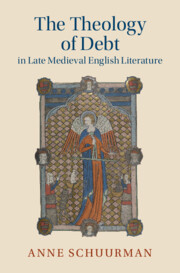
Exploring debt's permutations in Middle English texts, Anne Schuurman makes the bold claim that the capitalist spirit has its roots in Christian penitential theology. Her argument challenges the longstanding belief that faith and theological doctrine in the Middle Ages were inimical to the development of market economies, showing that the same idea of debt is in fact intrinsic to both. The double penitential-financial meaning of debt, and the spiritual paradoxes it creates, is a linchpin of scholastic and vernacular theology, and of the imaginative literature of late medieval England. Focusing on the doubleness of debt, this book traces the dynamic by which the Christian ascetic ideal, in its rejection of material profit and wealth acquisition, ends up producing precisely what it condemns. This title is part of the Flip it Open Programme and may also be available Open Access. Check our website Cambridge Core for details.
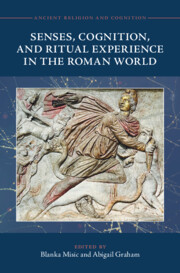
How do the senses shape the way we perceive, understand, and remember ritual experiences? This book applies cognitive and sensory approaches to Roman rituals, reconnecting readers with religious experiences as members of an embodied audience. These approaches allow us to move beyond the literate elites to examine broader audiences of diverse individuals, who experienced rituals as participants and/or performers. Case studies of ritual experiences from a variety of places, spaces, and contexts across the Roman world, including polytheistic and Christian rituals, state rituals, private rituals, performances, and processions, demonstrate the dynamic and broad-scale application that cognitive approaches offer for ancient religion, paving the way for future interdisciplinary engagement. This title is part of the Flip it Open Programme and may also be available Open Access. Check our website Cambridge Core for details.
How did the homesteads and reservations of the Prairies of Western North America influence German colonization, ethnic cleansing and genocide in Eastern Europe? Max Sering, a world-famous agrarian settlement expert, stood on the Great Plains in 1883 and saw Germany's future in Eastern Europe: a grand scheme of frontier settlement. Sering was a key figure in the evolution of Germany's relationship with its eastern frontier, as well as in the overall transformation of the German Right from the Bismarckian 1880s to the Hitlerian 1930s. 'Inner colonization' was the settlement of farmers in threatened borderland areas within the nation's boundaries. Focusing on this phenomenon, Frontiers of Empire complicates the standard thesis of separation between the colonizing country and the colonized space, and blurs the typical boundaries between colonizer and colonized subjects. This title is part of the Flip it Open Programme and may also be available Open Access. Check our website Cambridge Core for details.
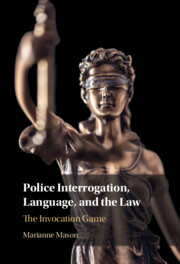
Recent calls for justice reform have put a spotlight on how the police enforce the law in the United States. How a person's constitutional rights may be legally thwarted during police interrogation, however, has not been part of any meaningful discussion on police reform. This novel book examines the intersections of the law and policing discourse through the detailed analysis of a large corpus of United States federal court rulings, starting with Miranda v. Arizona (1966). It covers a wide range of topics, including the history of police interrogation in the United States, the role of federal law in handicapping a person's ability to invoke their right to counsel, and the invocation game of police interrogation that may lead a variety of suspects to change their discursive preferences. It highlights the need for American police interrogation reform, exploring the paths taken by other jurisdictions outside of the United States. This title is part of the Flip it Open programme and may also be available on open access. Check our website, Cambridge Core, for details.
The immediate reason for which artefacts are not substances is arrived at only by means of the consideration of matter as parts and the focus on the relation of parts and whole, which is undertaken in this chapter. Indeed, artefacts fail to satisfy the substantiality criterion, according to which no substance is composed of parts present in it in actuality (Met. Z 13). I show that Aristotle regards living beings as constituted of parts in potentiality, while he conceives of artefacts as constituted of parts present in actuality. Because their parts are in actuality, artefacts are not as unified as substances, but because artefacts still possess an inherent form, they cannot be downgraded to mere heaps. Thus, artefacts are hylomorphic compounds, but not substances at all.
The Physics constitutes a fruitful starting point for our study of Aristotle’s metaphysics of artefacts. This chapter shows that we can glean from Aristotle’s Physics an account of artefacts that is not only compatible with, but also directly related to the account offered in the Metaphysics. This account chiefly consists of: (1) the art analogy and (2) the fundamental distinction between artefacts and natural beings. Another Aristotelian conceptual tool I discuss in this chapter and is provided by the Physics is the distinction between ‘artificially caused’ and ‘artefact’. This survey will accomplish two tasks: it will present typical artefacts (i.e. generally accepted members of artificial kinds that are brought about by art) and it will open space for the conceptual possibility that art might be able to bring about things that are not artefacts proper. By identifying the building blocks presented in the Physics and presupposed in the Metaphysics, this chapter also lays the foundations for the remainder of the book.
The introduction takes the reader into the history of oil in the Ecuadorean Amazon in the twentieth century. Zooming out from the testimony of a former oil worker, a historical overview sheds light on the dynamics of oil extraction in the region by national and international companies. This history is analyzed from the interdisciplinary perspective of the Environmental Humanities, combining archival and oral sources, sociological and anthropological concepts, and a mixed-methods approach. From this vantage point, the changes in the rainforest brought by the oil industry can be narrated as a fundamental metamorphosis of the landscape, its ecology, and its inhabitants. Drawing from Amazonian and European notions of metamorphosis, four dimensions of this process are particularly relevant for the historical analysis: conceptual, material, toxic, and social. The metamorphosis as metaphor offers a perspective on historical change in the Amazon as a process driven by the conflictive interaction between the rainforest ecosystem and the narrative and material manifestations of the oil industry.
Chapter 4 argues that those material objects that, in the Categories, would fall under the category of substance qualify as hylomorphic compounds (i.e. they have matter and form). It presents three arguments in defence of the thesis that artefacts have forms. The first argument is that artefacts undergo genuine unqualified coming-to-be (or substantial change), as opposed to the mere acquisition of a property by a substrate. Related to this argument is the crucial Aristotelian distinction between per se unity and accidental unity. The second argument is based on Aristotle’s application of the ekeininon-rule to artefacts, which reveals that the identity of an artificial object cannot be reduced to its matter. (The third argument is that Aristotle’s application of the synonymy principle to artefacts shows that the form in the mind of the artisan is identical to the form present in the actual artefact, insofar as it is thought, and that the artisan’s use of tools represents the stage at which the artefact’s form is in potentiality.
Chapter 5 inquires how the rainforests of Ecuador turned into a profoundly contaminated landscape between the 1970s and 1990s. Recurrent oil spills, discharges of toxic water into rivers, the burning of crude oil and of natural gas, and the use of simple earthen waste pits all contributed to a toxic metamorphosis of the Amazon region. An analysis of Texaco’s internal communication about environmental contamination from 1972 to 1980 gives insights into the intentionality of the company’s handling of hazardous waste. The toxic metamorphosis was the result of practices of externalization in the production and disposal of hazardous waste in the Ecuadorean oil industry. This chapter develops the concept of the toxic ghost acre as a mechanism of the externalization of costs onto the environment and the public health of local populations. The notion of toxic ghost acreage is useful to uncover the transnational and socio-ecological dynamics that turned the Amazon into a cheap sink for hazardous waste. The chapter ends by shedding light on the perpetuation of the toxic ghost acres in Ecuador through Texaco’s insufficient remediation programs in the 1990s.
This book concerns the ontological status of products of art (technê) in Aristotle, in particular material objects. It makes three main advances with respect to the existing literature: the first will be of interest to contemporary metaphysicians, the second to historians of philosophy, and the third to both contemporary metaphysicians and historians of philosophy. First, the metaphysics of artefacts is increasingly gaining the attention of contemporary metaphysicians, in particular among supporters of hylomorphism, who all refer to or draw on Aristotle. However, there is no consensus about the place of artefacts within Aristotle’s ontology; indeed, there is no consensus as to whether Aristotle articulates a single coherent account of artefacts in the first place. Hence, the first contribution made by this book is to offer a complete picture of Aristotle’s account of artefacts that is sensitive to current issues and that can therefore serve as a guide for the contemporary (neo-)Aristotelian debate. Second, when it comes to technê, historians of philosophy have primarily focused on the art analogy and Aristotle’s use of examples taken from the artificial realm.
Chapter 1 examines the steps that are attendant to custodial interrogation in the United States. Many of these steps, and what they entail, are not readily known to the general public. Hence, to contextualize the corpus, Chapter 1 starts with a brief overview of what constitutes custodial interrogation, leading to a description of the federal court system that reviewed the cases. This examination will provide insights into the inner workings of the federal courts and the role of the judges in the federal court system. Chapter 1 also provides a brief overview of the common grounds for appeals in cases reviewing potential Miranda violations, as well as definitions for the terminology often referred to in the chapters. The chapter concludes with a brief analysis on the three key themes of the book: the legal foundation of police interrogation, the strategic features of invoking counsel in custodial settings, and tackling police interrogation reform in the United States.
Chapter 3 delves into commonly used police interrogation techniques in the United States, such as behavioral analysis approaches to interrogation (the Reid technique) and other rapport-based methods featured in the High Value Detainee Interrogation Group (HIG) Report (2016). This chapter focuses on some of the interrogation methods used by police, law enforcement agencies of the United States federal government (e.g., FBI, DEA), and the military to interrogate custodial suspects and evaluates how these methods fit with the Miranda rights and a suspect’s ability to invoke counsel in a custodial setting. How interrogators approach the Miranda rights stage of an interrogation across the book’s corpus, and potentially across interviewing styles, provides insights into the possible connection between the law and how interviewing styles are used and implemented in the United States. Chapter 3 also raises additional considerations when discussing any interrogation or interviewing style, in light of current United States law.
Chapter 4 argues that those material objects that, in the Categories, would fall under the category of substance qualify as hylomorphic compounds (i.e. they have matter and form). It presents three arguments in defence of the thesis that artefacts have forms. The first argument is that artefacts undergo genuine unqualified coming-to-be (or substantial change), as opposed to the mere acquisition of a property by a substrate. Related to this argument is the crucial Aristotelian distinction between per se unity and accidental unity. The second argument is based on Aristotle’s application of the ekeininon-rule to artefacts, which reveals that the identity of an artificial object cannot be reduced to its matter. The third argument is that Aristotle’s application of the synonymy principle to artefacts shows that the form in the mind of the artisan is identical to the form present in the actual artefact, insofar as it is thought, and that the artisan’s use of tools represents the stage at which the artefact’s form is in potentiality.