To save content items to your account,
please confirm that you agree to abide by our usage policies.
If this is the first time you use this feature, you will be asked to authorise Cambridge Core to connect with your account.
Find out more about saving content to .
To save content items to your Kindle, first ensure no-reply@cambridge.org
is added to your Approved Personal Document E-mail List under your Personal Document Settings
on the Manage Your Content and Devices page of your Amazon account. Then enter the ‘name’ part
of your Kindle email address below.
Find out more about saving to your Kindle.
Note you can select to save to either the @free.kindle.com or @kindle.com variations.
‘@free.kindle.com’ emails are free but can only be saved to your device when it is connected to wi-fi.
‘@kindle.com’ emails can be delivered even when you are not connected to wi-fi, but note that service fees apply.
from
Part Three
-
Sharp Constants in Lieb–Thirring Inequalities
Rupert L. Frank, Ludwig-Maximilians-Universität München,Ari Laptev, Imperial College of Science, Technology and Medicine, London,Timo Weidl, Universität Stuttgart
In this chapter, we derive the currently best known bounds on the constants in the Lieb–Thirring inequality following Hundertman–Laptev–Weidl and Frank–Hundertmark–Jex–Nam. These arguments proceed by proving bounds for one-dimensional Schrödinger operators with matrix-valued potentials and then using the method of "lifting in dimension." In the final section, we summarize the results in the book and provide an overview of what is known about the sharp constants in the Lieb–Thirring and Cwikel–Lieb–Rozenblum inequalities.
Rupert L. Frank, Ludwig-Maximilians-Universität München,Ari Laptev, Imperial College of Science, Technology and Medicine, London,Timo Weidl, Universität Stuttgart
We show that any set of distinct homotopy classes of simple closed curves on the torus that pairwise intersect at most k times has size $k+O(\sqrt k \log k)$. Prior to this work, a lemma of Agol, together with the state of the art bounds for the size of prime gaps, implied the error term $O(k^{21/40})$, and in fact the assumption of the Riemann hypothesis improved this error term to the one we obtain $O(\sqrt k\log k)$. By contrast, our methods are elementary, combinatorial, and geometric.

This text is an introduction to the fields of experimental and theoretical particle physics and cosmology. The book focuses on three principal areas: supersymmetry, string theory, and astrophysics and cosmology. The chapters on supersymmetry introduce the basics of supersymmetry and its phenomenology, and cover dynamics, dynamical supersymmetry breaking, and electric–magnetic duality. The book then introduces general relativity and the big bang theory, and the basic issues in inflationary cosmologies. The section on string theory discusses the spectra of known string theories, and the features of their interactions. Material added in the second edition includes the pivotal Higgs discovery and the results of the WMAP and Planck experiments. This book will be of great interest to graduates and researchers in the fields of particle theory, string theory, astrophysics, and cosmology. It has been reissued as an Open Access publication on Cambridge Core.
This volume summarizes the many alternatives and extensions to Einstein's General Theory of Relativity, and shows how symmetry principles can be applied to identify physically viable models. The first part of the book establishes the foundations of classical field theory, providing an introduction to symmetry groups and the Noether theorems. A quick overview of general relativity is provided, including discussion of its successes and shortcomings, then several theories of gravity are presented and their main features are summarized. In the second part, the 'Noether Symmetry Approach' is applied to theories of gravity to identify those which contain symmetries. In the third part of the book these selected models are tested through comparison with the latest experiments and observations. This constrains the free parameters in the selected models to fit the current data, demonstrating a useful approach that will allow researchers to construct and constrain modified gravity models for further applications.
This volume provides a self-contained introduction to applications of loop representations, and the related topic of knot theory, in particle physics and quantum gravity. These topics are of considerable interest because they provide a unified arena for the study of the gauge invariant quantization of Yang-Mills theories and gravity, and suggest a promising approach to the eventual unification of the four fundamental forces. The book begins with a detailed review of loop representation theory and then describes loop representations in Maxwell theory, Yang-Mills theories as well as lattice techniques. Applications in quantum gravity are then discussed, with the following chapters considering knot theories, braid theories and extended loop representations in quantum gravity. A final chapter assesses the current status of the theory and points out possible directions for future research. First published in 1996, this title has been reissued as an Open Access publication on Cambridge Core.
The scattering of high-energy electrons from nuclear and nucleon targets provides a microscope for examining the structure of these tiny objects. The best evidence we have on what nuclei and nucleons actually look like comes from electron scattering. This 2001 book examines the motivation for electron scattering and develops the theoretical analysis of the process. It discusses our theoretical understanding of the underlying structure of nuclei and nucleons at appropriate levels of resolution and sophistication, and summarizes experimental electron scattering capabilities. Only a working knowledge of quantum mechanics and special relativity is assumed, making this a suitable textbook for graduate and advanced undergraduate courses. It will also provide a valuable summary and reference for researchers already working in electron scattering and other areas of nuclear and particle physics. This text has been reissued as an Open Access publication on Cambridge Core.
Supersymmetric models of particle physics predict new superpartner matter states for each particle in the Standard Model. These superpartners will have wide ranging implications, from cosmology to observations at high energy accelerators, such as CERN's LHC. In this 2006 text, the authors develop the basic concepts of supersymmetry and show how it can be incorporated into a theoretical framework for describing unified theories of elementary particles. They develop the technical tools of supersymmetry using four-component spinor notation familiar to high energy experimentalists and phenomenologists. The text takes the reader from an abstract formalism to a straightforward recipe for writing supersymmetric gauge theories of particle physics, and ultimately to the calculations necessary for practical applications at colliders and in cosmology. This is a comprehensive, practical and accessible introduction to supersymmetry for experimental and phenomenological particle physicists and graduate students. It has been reissued as an Open Access publication on Cambridge Core.
This book introduces the lattice approach to quantum field theory. The spectacular successes of this technique include compelling evidence that exchange of gauge gluons can confine the quarks within subnuclear matter. The lattice framework enables novel schemes for quantitative calculation and has caused considerable cross-disciplinary activity between elementary particle and solid state physicists. The treatment begins with the lattice definition of a path integral and ends on Monte Carlo simulation methods. Other topics include invariant group integration, duality, mean field theory and renormalization group techniques. The reader is assumed to have a basic background in relativistic quantum mechanics and some exposure to gauge theories.
This volume describes the Pomeron, an object of crucial importance in very high energy particle physics. Starting with a general description of the Pomeron within the framework of Regge theory, the emergence of the Pomeron within scalar field theory is discussed, providing a natural foundation on which to develop the more realistic case of QCD. The reggeization of the gluon is demonstrated and used to build the Pomeron of perturbative QCD. The dynamical nature of the Pomeron and its role in small-x deep inelastic scattering and in diffractive scattering is also examined in detail. The volume concludes with a study of the colour dipole approach to high energy scattering and the explicit role of unitarity corrections. This book will be of interest to theoretical and experimental particle physicists, and applied mathematicians. First published in 1997, this title has been reissued as an Open Access publication on Cambridge Core.
This 2004 book provides a pedagogical introduction to the perturbative and non-perturbative aspects of quantum chromodynamics (QCD). The text introduces the basic theory of QCD and its historical development, covering pre-QCD ideas of strong interactions such as the quark and parton models, the notion of colours and the S-matrix approach. The author then discusses gauge theory, techniques of dimensional regularization and renormalization, deep inelastic scattering and hard processes in hadron collisions, hadron jets and e+e– annihilations. Other topics include power corrections and the technologies of the Shifman–Vainshtein–Zakharov operating product expansion. The final parts of the book are devoted to modern non-perturbative approaches to QCD and the phenomenological aspects of QCD spectral sum rules. The book will be a valuable reference for graduate students and researchers in high-energy particle and nuclear physics, both theoretical and experimental. This book has been reissued as an Open Access publication on Cambridge Core.
Bringing together the key ideas from nonequilibrium statistical mechanics and powerful methodology from quantum field theory, this 2008 book captures the essence of nonequilibrium quantum field theory. Beginning with the foundational aspects of the theory, the book presents important concepts and useful techniques, discusses issues of basic interest, and shows how thermal field, linear response, kinetic theories and hydrodynamics emerge. It also illustrates how these concepts are applied to research topics including nonequilibrium phase transitions, thermalization in relativistic heavy ion collisions, the nonequilibrium dynamics of Bose-Einstein condensation, and the generation of structures from quantum fluctuations in the early Universe. This self-contained book is a valuable reference for graduate students and researchers in particle physics, gravitation, cosmology, atomic-optical and condensed matter physics. It has been reissued as an Open Access publication on Cambridge Core.
This 2002 book discusses the classical foundations of field theory, using the language of variational methods and covariance. It explores the limits of what can be achieved with purely classical notions, and shows how these have a deep and important connection with the second quantized field theory, which follows on from the Schwinger Action Principle. The book takes a pragmatic view of field theory, focusing on issues which are usually omitted from quantum field theory texts and cataloging results which are hard to find in the literature. Care is taken to explain how results arise and how to interpret them physically, for graduate students starting out in the field. An ideal supplementary text for courses on elementary field theory, group theory and dynamical systems, it is also a valuable reference for researchers working in these and related areas. It has been reissued as an Open Access publication on Cambridge Core.
Before matter as we know it emerged, the universe was filled with the primordial state of hadronic matter called quark–gluon plasma. This hot soup of quarks and gluons is effectively an inescapable consequence of our current knowledge about the fundamental hadronic interactions: quantum chromodynamics. This book covers the ongoing search to verify the prediction experimentally and discusses the physical properties of this novel form of matter. It begins with an overview of the subject, followed by a discussion of experimental methods and results. The second half of the book covers hadronic matter in confined and deconfined form, and strangeness as a signature of the quark-gluon phase. It is ideal as an introduction for graduate students, as well as providing a valuable reference for researchers already working in this and related fields. This title, first published in 2002, has been reissued as an Open Access publication on Cambridge Core.
Describing the fundamental theory of particle physics and its applications, this book provides a detailed account of the Standard Model, focusing on techniques that can produce information about real observed phenomena. It begins with a pedagogic account of the Standard Model, introducing essential techniques such as effective field theory and path integral methods. It then focuses on the use of the Standard Model in the calculation of physical properties of particles. Rigorous methods are emphasized, but other useful models are also described. The second edition has been updated to include theoretical and experimental advances, such as the discovery of the Higgs boson, our understanding of neutrinos, and the major advances in CP violation and electroweak physics. This book is valuable to graduate students and researchers in particle physics, nuclear physics and related fields. This edition, first published in 2014, has been reissued as an Open Access publication on Cambridge Core.
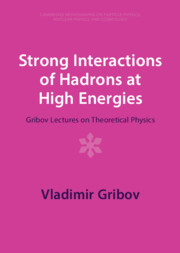
Vladimir Gribov was one of the founding fathers of high-energy elementary particle physics. This volume derives from a graduate lecture course he delivered in the 1970s. It provides graduate students and researchers with the opportunity to learn from the teaching of one of the twentieth century's greatest physicists. Its content is still deeply relevant to modern research, for example exploring properties of the relativistic theory of hadron interactions in a domain of peripheral collisions and large distances that quantum chromodynamics has barely approached. In guiding the reader step-by-step from the basics of quantum mechanics and relativistic kinematics to the most challenging problems of high-energy hadron interactions with simplifying models and physical analogies, it demonstrates general methods of addressing difficult problems in theoretical physics. Covering a combination of topics not treated elsewhere, this 2008 title has been reissued as an Open Access publication on Cambridge Core.
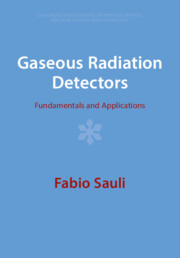
Widely used in high-energy and particle physics, gaseous radiation detectors are undergoing continuous development. The first part of this book provides a solid background for understanding the basic processes leading to the detection and tracking of charged particles, photons, and neutrons. Continuing then with the development of the multi-wire proportional chamber, the book describes the design and operation of successive generations of gas-based radiation detectors, as well as their use in experimental physics and other fields. Examples are provided of applications for complex events tracking, particle identification, and neutral radiation imaging. Limitations of the devices are discussed in detail. Including an extensive collection of data and references, this book is ideal for researchers and experimentalists in nuclear and particle physics. It has been reissued as an Open Access publication on Cambridge Core.
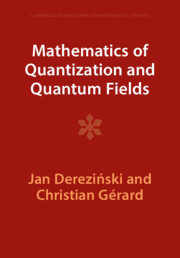
Unifying topics that are scattered throughout the literature, this book offers a definitive review of mathematical aspects of quantization and quantum field theory. It presents both basic and advanced topics of quantum field theory in a mathematically consistent way, focusing on canonical commutation and anti-commutation relations. It begins with a discussion of the mathematical structures underlying free bosonic or fermionic fields: tensors, algebras, Fock spaces, and CCR and CAR representations. Applications of these topics to physical problems are discussed in later chapters. Although most of the book is devoted to free quantum fields, it also contains an exposition of two important aspects of interacting fields: diagrammatics and the Euclidean approach to constructive quantum field theory. With its in-depth coverage, this text is essential reading for graduate students and researchers in mathematics and physics. This title, first published in 2013, has been reissued as an Open Access publication on Cambridge Core.