Refine search
Actions for selected content:
237328 results in Physics and Astronomy

Rectilinear drift and oscillation of a rotating cylinder placed in flow
-
- Journal:
- Journal of Fluid Mechanics / Volume 1011 / 25 May 2025
- Published online by Cambridge University Press:
- 13 May 2025, A32
-
- Article
-
- You have access
- Open access
- HTML
- Export citation
-
The system composed of a circular cylinder free to move along a transverse rectilinear path within a cross-current has often served as a canonical problem to study the vortex-induced vibrations (VIV) developing in the absence of structural restoring force, thus without structural natural frequency. The object of the present work is to extend the exploration of the behaviour of this system when the path is set to an arbitrary orientation, varying from the transverse to the streamwise direction, and the cylinder is forced to rotate about its axis. The investigation is conducted numerically at a Reynolds number equal to $100$, based on the body diameter and oncoming flow velocity, for structure to displaced fluid mass ratios down to $0.01$ and values of the rotation rate (ratio between body surface and oncoming flow velocities) ranging from $0$ to $1$. When the transverse symmetry is broken by the orientation of the trajectory or the forced rotation, the cylinder drifts along the rectilinear path, at a velocity that can be predicted by a quasi-steady approach. Three distinct regimes are encountered: a pure drift regime, where the body translates at a constant velocity, and two oscillatory regimes, characterised by contrasted forms of displacement fluctuation about the drifting motion, but both closely connected to flow unsteadiness. VIV, nearly sinusoidal, persist over a wide range of path orientations, for all rotation rates. On the other hand, irregular jumps of the body, triggered by the rotation and named saccades, emerge when the trajectory is aligned, or almost aligned, with the current. The two forms of response differ by their regularity, but also by their amplitudes and frequencies, which deviate by one or more orders of magnitude. The rotation attenuates both VIV and saccades. Yet, an increase of the rotation rate enhances the erratic nature of the saccade regime.


Close-contact melting on hydrophobic textured surfaces: confinement and meniscus effects
-
- Journal:
- Journal of Fluid Mechanics / Volume 1010 / 10 May 2025
- Published online by Cambridge University Press:
- 13 May 2025, A46
-
- Article
-
- You have access
- Open access
- HTML
- Export citation
-
We investigate the dynamics of close-contact melting (CCM) on ‘gas-trapped’ hydrophobic surfaces, with specific focus on the effects of geometrical confinement and the liquid–air meniscus below the liquid film. By employing dual-series and perturbation methods under the assumption of small meniscus deflections, we obtain numerical solutions for the effective slip lengths associated with velocity $\lambda$ and temperature $\lambda _t$ fields, across various values of aspect ratio $\Lambda$ (defined as the ratio of the film thickness $h$ to the structure’s periodic length $l$) and gas–liquid fraction $\phi$. Asymptotic solutions of $\lambda$ and $\lambda _t$ for $\Lambda \ll 1$ and $\Lambda \gg 1$ are derived and summarised for different surface structures, interface shapes and $\Lambda$, which reveal a different trend of $\lambda$ for $\Lambda \ll 1$ and depending on the presence of a meniscus. In the context of constant-pressure CCM, our results indicate that longitudinal grooves can enhance heat transfer under the effects of confinement and a meniscus when $\Lambda \lesssim 0.1$ and $\phi \lt 1 - 0.5^{2/3} \approx 0.37$. For gravity-driven CCM, the parameters of $l$ and $\phi$ determine whether the melting rate is enhanced, reduced or nearly unaffected. We construct a phase diagram based on the parameter matrix $(\log _{10} l, \phi )$ to delineate these three regimes. Lastly, we derive two asymptotic solutions for predicting the variation in time of the unmelted solid height.


Pseudo-turbulence induced by settling spheroids in a quiescent fluid
-
- Journal:
- Journal of Fluid Mechanics / Volume 1011 / 25 May 2025
- Published online by Cambridge University Press:
- 13 May 2025, A22
-
- Article
- Export citation
-
In this study, we investigate the sedimentation of spheroidal particles in an initially quiescent fluid by means of particle-resolved direct numerical simulations. Settling particles with three different shapes – oblate spheroid, sphere and prolate spheroid – but fixed Galileo number $Ga=80$ and density ratio $\gamma =2$ at volume fraction $\phi =1\%$ are considered. Oblate and prolate particles are found to form column-like clusters as a consequence of the wake-induced hydrodynamic interactions in the suspension. This effect, together with the change of particle orientation, enhances the mean settling velocity of the dispersed phase. In contrast, spherical particles do not exhibit clustering, and settle with hindered velocity in the suspension. Furthermore, we focus on the pseudo-turbulence induced by the settling particles. We report a non-Gaussian distribution of the fluid velocity and a robust $-3$ power law of the energy spectra. By scrutinizing the scale-by-scale budget, we find that the anisotropy of the particle-induced pseudo-turbulence is manifested not only by the uneven allocation of turbulence kinetic energy among the different velocity components, but also by the anisotropic distribution of energy in spectral space. The fluid–particle interactions inject energy into the vertical velocity component, thus sustaining the turbulence, while pressure redistributes the kinetic energy among the different velocity components. The clustering of oblate/prolate particles significantly increases the energy input at large scales, forcing elongated flow structures. Moreover, the redistribution and nonlinear transfer of the energy are also intensified in the presence of particle clustering, which reduces the anisotropy of the particle-induced pseudo-turbulence.


Coupled inflow vapour velocity and surface wettability effect on condensation heat transfer characteristics: a volume-of-fluid method study
-
- Journal:
- Journal of Fluid Mechanics / Volume 1011 / 25 May 2025
- Published online by Cambridge University Press:
- 13 May 2025, A13
-
- Article
- Export citation
-
This study employs volume-of-fluid-based computational fluid dynamics modelling to investigate the coupled effects of surface wettability and inflow vapour velocity on R134a ( $p/p_{cri}=0.25$) condensation heat transfer in horizontal tubes. The results demonstrate that both the condensation heat transfer coefficient (HTC) and Nusselt number consistently increase with rising vapour velocity, indicating enhanced convective heat transfer at higher flow rates. Within this overall trend, the influence of surface wettability varies significantly across different velocity regimes. At moderate inlet velocities (10 m s−1), surface wettability demonstrates maximum impact, with the HTC enhancement exceeding 19.1% between peak and minimum values, optimising at contact angles of 120 $^\circ$–140 $^\circ$. As velocity increases to 20 m s−1, while surface wettability effects persist with $\gt$11.7 % enhancement, convective heat transfer becomes increasingly dominant, showing $\gt$38.8 % improvement in the maximum HTC compared with the 10 m s−1 case. At higher velocities (40 m s−1), the influence of surface wettability diminishes substantially, with the HTC variation reducing to $\gt$1.04 %. At extreme velocities (80 m s−1), surface tension effects become negligible compared with vapour shear forces, resulting in minimal (0.53 %) variation across different contact angles. The equivalent Reynolds number peaks at 20 m s−1, indicating optimal conditions for condensate formation and flow characteristics. These findings provide crucial insights for condensation system design, suggesting that while increasing velocity generally enhances heat transfer performance, surface wettability modifications are most effective at moderate velocities, while high-velocity applications should prioritise flow dynamics and system geometry optimisation.


The implications of a fluid yield stress
-
- Journal:
- Journal of Fluid Mechanics / Volume 1011 / 25 May 2025
- Published online by Cambridge University Press:
- 13 May 2025, P1
-
- Article
-
- You have access
- Open access
- HTML
- Export citation
Almost sure upper bound for a model problem for multiplicative chaos in number theory
- Part of
-
- Journal:
- Mathematical Proceedings of the Cambridge Philosophical Society / Volume 179 / Issue 1 / July 2025
- Published online by Cambridge University Press:
- 13 May 2025, pp. 29-44
- Print publication:
- July 2025
-
- Article
- Export citation
Spanwise wall forcing can reduce turbulent heat transfer more than drag
-
- Journal:
- Journal of Fluid Mechanics / Volume 1010 / 10 May 2025
- Published online by Cambridge University Press:
- 13 May 2025, A59
-
- Article
-
- You have access
- Open access
- HTML
- Export citation
-
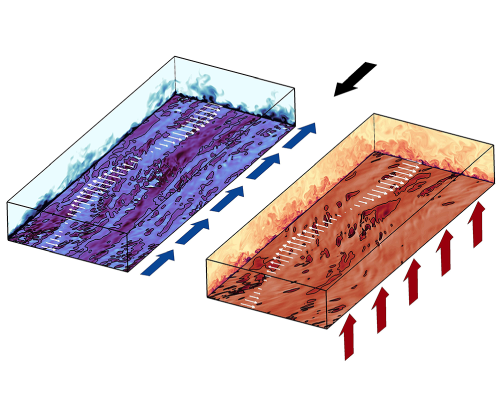
Direct numerical simulations are performed for turbulent forced convection in a half-channel flow with a wall oscillating either as a spanwise plane oscillation or to generate a streamwise travelling wave. The friction Reynolds number is fixed at $Re_{\tau _0} = 590$, but the Prandtl number $Pr$ is varied from 0.71 to 20. For $Pr\gt 1$, the heat transfer is reduced by more than the drag, 40 % compared with 30 % at $Pr=7.5$. This outcome is related to the different responses of the velocity and thermal fields to the Stokes layer. It is shown that the Stokes layer near the wall attenuates the large-scale energy of the turbulent heat flux and the turbulent shear stress, but amplifies their small-scale energy. At higher Prandtl numbers, the thinning of the conductive sublayer means that the energetic scales of the turbulent heat flux move closer to the wall, where they are exposed to a stronger Stokes layer production, increasing the contribution of the small-scale energy amplification. A predictive model is derived for the Reynolds and Prandtl number dependence of the heat-transfer reduction based on the scaling of the thermal statistics. The model agrees well with the computations for Prandtl numbers up to 20.


Dynamic equilibrium of electrochemical bubbles growing on micro-electrodes
-
- Journal:
- Journal of Fluid Mechanics / Volume 1011 / 25 May 2025
- Published online by Cambridge University Press:
- 13 May 2025, A23
-
- Article
-
- You have access
- Open access
- HTML
- Export citation

Experimental study of velocity statistics in wall-bounded turbulent emulsions
-
- Journal:
- Journal of Fluid Mechanics / Volume 1011 / 25 May 2025
- Published online by Cambridge University Press:
- 13 May 2025, A14
-
- Article
- Export citation

Resonant standing internal waves in a basin filled with two liquids separated by a pycnocline
-
- Journal:
- Journal of Fluid Mechanics / Volume 1011 / 25 May 2025
- Published online by Cambridge University Press:
- 13 May 2025, A16
-
- Article
-
- You have access
- Open access
- HTML
- Export citation

Drift of a semi-permeable vesicle through an osmotic gradient: anomalous velocity amplification due to a proximate wall
-
- Journal:
- Journal of Fluid Mechanics / Volume 1011 / 25 May 2025
- Published online by Cambridge University Press:
- 13 May 2025, A18
-
- Article
-
- You have access
- Open access
- HTML
- Export citation
-
A spherical vesicle is made up of a liquid core bounded by a semi-permeable membrane that is impermeable to solute molecules. When placed in an externally imposed gradient of solute concentration, the osmotic pressure jump across the membrane results in an inward trans-membrane solvent flux at the solute-depleted side of the vesicle, and and outward flux in its solute-enriched side. As a result, a freely suspended vesicle drifts down the concentration gradient, a phenomenon known as osmophoresis. An experimental study of lipid vesicles observed drift velocities that are more than three orders of magnitude larger than the linearised non-equilibrium prediction (Nardi et al., Phys. Rev. Lett., vol. 82, 1999, pp. 5168–5171). Inspired by this study, we analyse osmophoresis of a vesicle in close proximity to an impermeable wall, where the vesicle–wall separation $a\delta$ is small compared with the vesicle radius $a$. Due to intensification of the solute concentration gradient in the narrow gap between the membrane and the wall, the ‘osmophoretic’ force and torque on a stationary vesicle scale as an irrational power, $1/\sqrt {2}-1\ (\approx -0.29289\ldots )$, of $\delta$. Both the rectilinear velocity $\mathcal V$ and the angular velocity $\unicode {x1D6FA}$ of a freely suspended vesicle scale as the ratio of that power to $\ln \delta$. In contrast to the classical problem of sedimentation parallel to a wall, where the ratio $a\unicode {x1D6FA}/\mathcal V$ approaches $1/4$ as $\delta \to 0$, here the ratio approaches unity, as though the vesicle performs pure rigid-body rolling without slippage. Our approximations are in excellent agreement with hitherto unexplained numerical computations in the literature.


Asymptotic coefficients of the attached-eddy model derived from an adiabatic atmosphere
-
- Journal:
- Journal of Fluid Mechanics / Volume 1011 / 25 May 2025
- Published online by Cambridge University Press:
- 13 May 2025, A29
-
- Article
-
- You have access
- Open access
- HTML
- Export citation
-
The attached-eddy model (AEM) predicts that the mean streamwise velocity and streamwise velocity variance profiles follow a logarithmic shape, while the vertical velocity variance remains invariant with height in the overlap region of high Reynolds number wall-bounded turbulent flows. Moreover, the AEM coefficients are presumed to attain asymptotically constant values at very high Reynolds numbers. Here, the AEM predictions are examined using sonic anemometer measurements in the near-neutral atmospheric surface layer, with a focus on the logarithmic behaviour of the streamwise velocity variance. Utilizing an extensive 210-day dataset collected from a 62 m meteorological tower located in the Eastern Snake River Plain, Idaho, USA, the inertial sublayer is first identified by analysing the measured momentum flux and mean velocity profiles. The logarithmic behaviour of the streamwise velocity variance and the associated ‘ $-1$’ scaling of the streamwise velocity energy spectra are then investigated. The findings indicate that the Townsend–Perry coefficient ( $A_1$) is influenced by mild non-stationarity that manifests itself as a Reynolds number dependence. After excluding non-stationary runs, and requiring the bulk Reynolds number defined using the atmospheric boundary layer height to be larger than $4 \times 10^{7}$, the inferred $A_1$ converges to values ranging between 1 and 1.25, consistent with laboratory experiments. Furthermore, nine benchmark cases selected through a restrictive quality control reveal a close relation between the ‘ $-1$’ scaling in the streamwise velocity energy spectrum and the logarithmic behaviour of streamwise velocity variance. However, additional data are required to determine whether the plateau value of the pre-multiplied streamwise velocity energy spectrum is identical to $A_1$.


On inhomogeneous Poissonian pair correlations
- Part of
-
- Journal:
- Mathematical Proceedings of the Cambridge Philosophical Society / Volume 179 / Issue 1 / July 2025
- Published online by Cambridge University Press:
- 13 May 2025, pp. 17-27
- Print publication:
- July 2025
-
- Article
-
- You have access
- Open access
- HTML
- Export citation
Orbifold Euler characteristics for compactified universal Jacobians over $\overline{\mathcal{M}}_{g,\,n}$
- Part of
-
- Journal:
- Mathematical Proceedings of the Cambridge Philosophical Society / Volume 179 / Issue 1 / July 2025
- Published online by Cambridge University Press:
- 13 May 2025, pp. 1-16
- Print publication:
- July 2025
-
- Article
-
- You have access
- Open access
- HTML
- Export citation
-
We calculate the orbifold Euler characteristics of all the degree d fine universal compactified Jacobians over the moduli space of stable curves of genus g with n marked points, as defined by Pagani and Tommasi. We show that this orbifold Euler characteristic agrees with the Euler characteristic of $\overline{\mathcal{M}}_{0, 2g+n}$ up to a combinatorial factor, and in particular, is independent of the degree d and the choice of degree d fine compactified universal Jacobian.


Near-wall effect on vortex dynamics in the flow around a rectangular cylinder
-
- Journal:
- Journal of Fluid Mechanics / Volume 1011 / 25 May 2025
- Published online by Cambridge University Press:
- 13 May 2025, A21
-
- Article
- Export citation
-
This study presents a novel investigation into the vortex dynamics of flow around a near-wall rectangular cylinder based on direct numerical simulation at $Re=1000$, marking the first in-depth exploration of these phenomena. By varying aspect ratios ( $L/D = 5$, $10$,
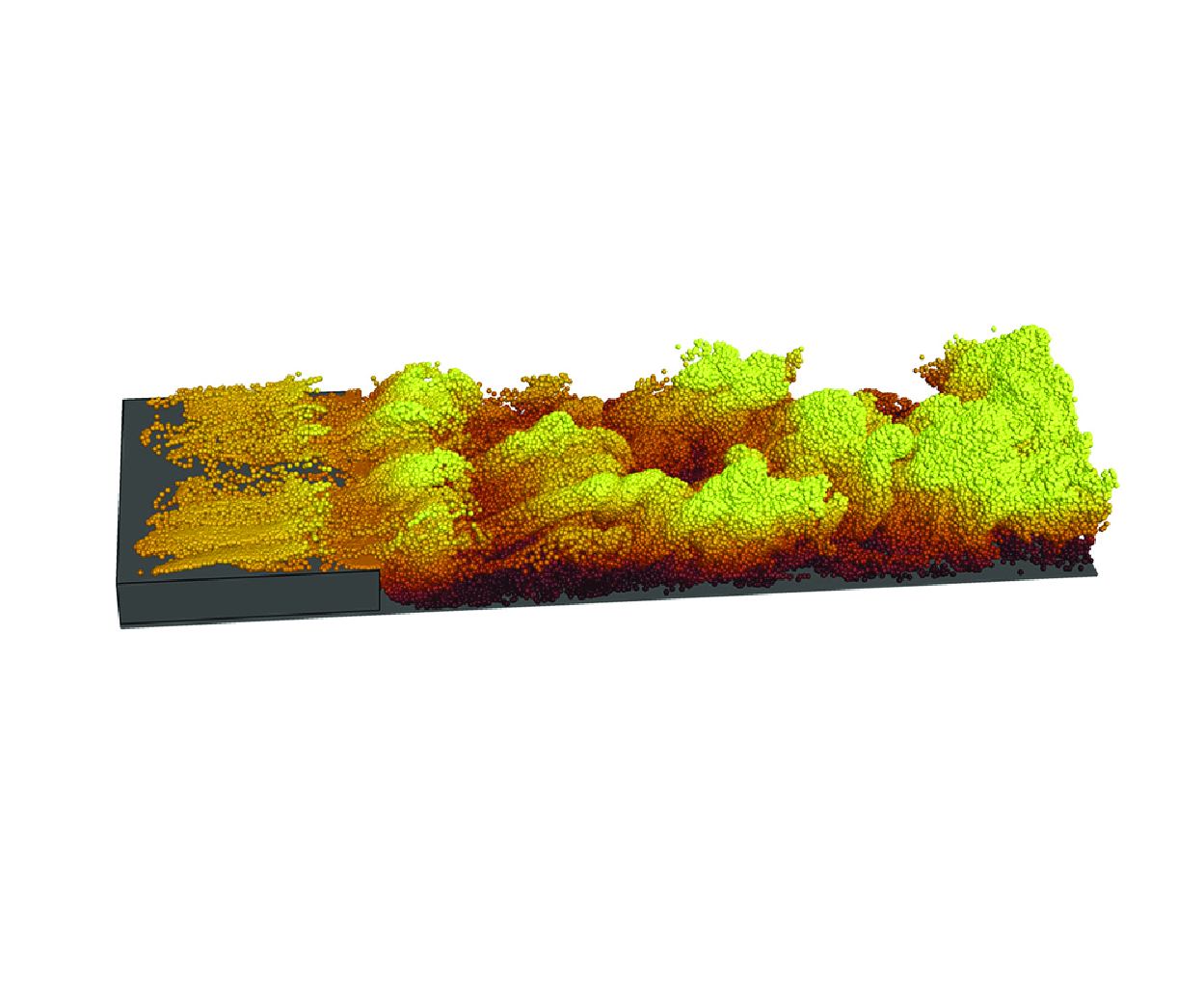
$10$,  $15$) and gap ratios ( $G/D = 0.1$, $0.3$, $0.9$), the study reveals the vortex dynamics influenced by the near-wall effect, considering the incoming laminar boundary layer flow. Both $L/D$ and $G/D$ significantly influence vortex dynamics, leading to behaviours not observed in previous bluff body flows. As $G/D$ increases, the streamwise scale of the upper leading edge (ULE) recirculation grows, delaying flow reattachment. At smaller $G/D$, lower leading edge (LLE) recirculation is suppressed, with upper Kelvin–Helmholtz vortices merging to form the ULE vortex, followed by instability, differing from conventional flow dynamics. Larger $G/D$ promotes the formation of an LLE shear layer. An intriguing finding at $L/D = 5$ and $G/D = 0.1$ is the backward flow of fluid from the downstream region to the upper side of the cylinder. At $G/D = 0.3$, double-trailing-edge vortices emerge for larger $L/D$, with two distinct flow behaviours associated with two interactions between gap flow and wall recirculation. These interactions lead to different multiple flow separations. For $G/D = 0.9$, the secondary vortex (SV) from the plate wall induces the formation of a tertiary vortex from the lower side of the cylinder. Double-SVs are observed at $L/D = 5$. Frequency locking is observed in most cases, but is suppressed at $L/D = 10$ and $G/D = 0.9$, where competing shedding modes lead to two distinct evolutions of the SV.


Mathematically established chaos and forecast of statistics with recurrent patterns in Taylor–Couette flow
-
- Journal:
- Journal of Fluid Mechanics / Volume 1011 / 25 May 2025
- Published online by Cambridge University Press:
- 13 May 2025, R2
-
- Article
-
- You have access
- Open access
- HTML
- Export citation

Transient motion of a swimming sheet in the inertial regime
-
- Journal:
- Journal of Fluid Mechanics / Volume 1011 / 25 May 2025
- Published online by Cambridge University Press:
- 13 May 2025, A2
-
- Article
- Export citation
-
Undulatory swimming is among the most common swimming forms found in nature across various length scales. In this study, we analyse the inertial effects of both the fluid and the swimmer on the transient motion of undulatory swimming using Taylor’s waving sheet model. We derive the transient velocity of the sheet for combined longitudinal and transverse waves in the Laplace domain, identifying three contributions to the velocity: the ‘slip’ velocity, fluid convection and a hydrodynamic force contribution. By numerically inverting the Laplace transform, we obtain the time history of the velocity for swimmers with varying swimming parameters and initial configurations. The acceleration performance of two types of swimmers is analysed by considering three dimensionless parameters: the acceleration rate $1/T$, sheet mass $M$, and Reynolds number $Re$, representing the effects of unsteady, convective and swimmer inertia, respectively. Under a relatively strong inertia effect, the start-up time scales as $\sim TM^2\,Re$ and $\sim TM^2$ for longitudinal and transverse waving sheets, respectively. Under weak inertia effects, the start-up time approximately reaches a constant for longitudinal waves, while it scales as $\sim T$ for transverse waves. Additionally, the transverse waving may induce a velocity overshoot, and enhances the burst swimming performance.


Large cuts in hypergraphs via energy
- Part of
-
- Journal:
- Mathematical Proceedings of the Cambridge Philosophical Society / Volume 179 / Issue 1 / July 2025
- Published online by Cambridge University Press:
- 13 May 2025, pp. 45-61
- Print publication:
- July 2025
-
- Article
- Export citation
-
A simple probabilistic argument shows that every r-uniform hypergraph with m edges contains an r-partite subhypergraph with at least $({r!}/{r^r})m$ edges. The celebrated result of Edwards states that in the case of graphs, that is $r=2$, the resulting bound $m/2$ can be improved to $m/2+\Omega(m^{1/2})$, and this is sharp. We prove that if $r\geq 3$, then there is an r-partite subhypergraph with at least $({r!}/{r^r}) m+m^{3/5-o(1)}$ edges. Moreover, if the hypergraph is linear, this can be improved to $({r!}/{r^r}) m+m^{3/4-o(1)}$, which is tight up to the o(1) term. These improve results of Conlon, Fox, Kwan and Sudakov. Our proof is based on a combination of probabilistic, combinatorial, and linear algebraic techniques, and semidefinite programming.
A key part of our argument is relating the energy $\mathcal{E}(G)$ of a graph G (i.e. the sum of absolute values of eigenvalues of the adjacency matrix) to its maximum cut. We prove that every m edge multigraph G has a cut of size at least $m/2+\Omega({\mathcal{E}(G)}/{\log m})$, which might be of independent interest.


Transition between rotation- and buoyancy-dominated regimes in rotating convection: the effect of boundary conditions
-
- Journal:
- Journal of Fluid Mechanics / Volume 1011 / 25 May 2025
- Published online by Cambridge University Press:
- 13 May 2025, A7
-
- Article
-
- You have access
- Open access
- HTML
- Export citation
-
In rotating convection, analysis of heat transfer reveals a distinct shift in behaviour as the system transitions from a steep scaling regime near the onset of convection to a shallower scaling at higher Rayleigh numbers ( $Ra$), irrespective of whether the top and bottom plates have stress-free, no-slip or no boundaries (homogeneous convection). However, while most research on this transition focuses on no-slip boundary conditions, geophysical and astrophysical flows commonly involve stress-free and homogeneous convection models as well. This study delves into the transition from the rapidly rotating regime to the non-rotating one with both stress-free and homogeneous models, leveraging direct numerical simulations (DNS) and existing literature data. Our findings unveil that for stress-free boundary conditions, the transitional Rayleigh number ( $Ra_T$) exhibits a relationship $Ra_T\sim Ek^{-12/7}$, whereas for homogeneous rotating convection, $Ra_T\sim Ek^{-2}\, Pr$, where $Ek$ denotes the Ekman number, and $Pr$ denotes the Prandtl number. Both of these relationships align with the data obtained through DNS.


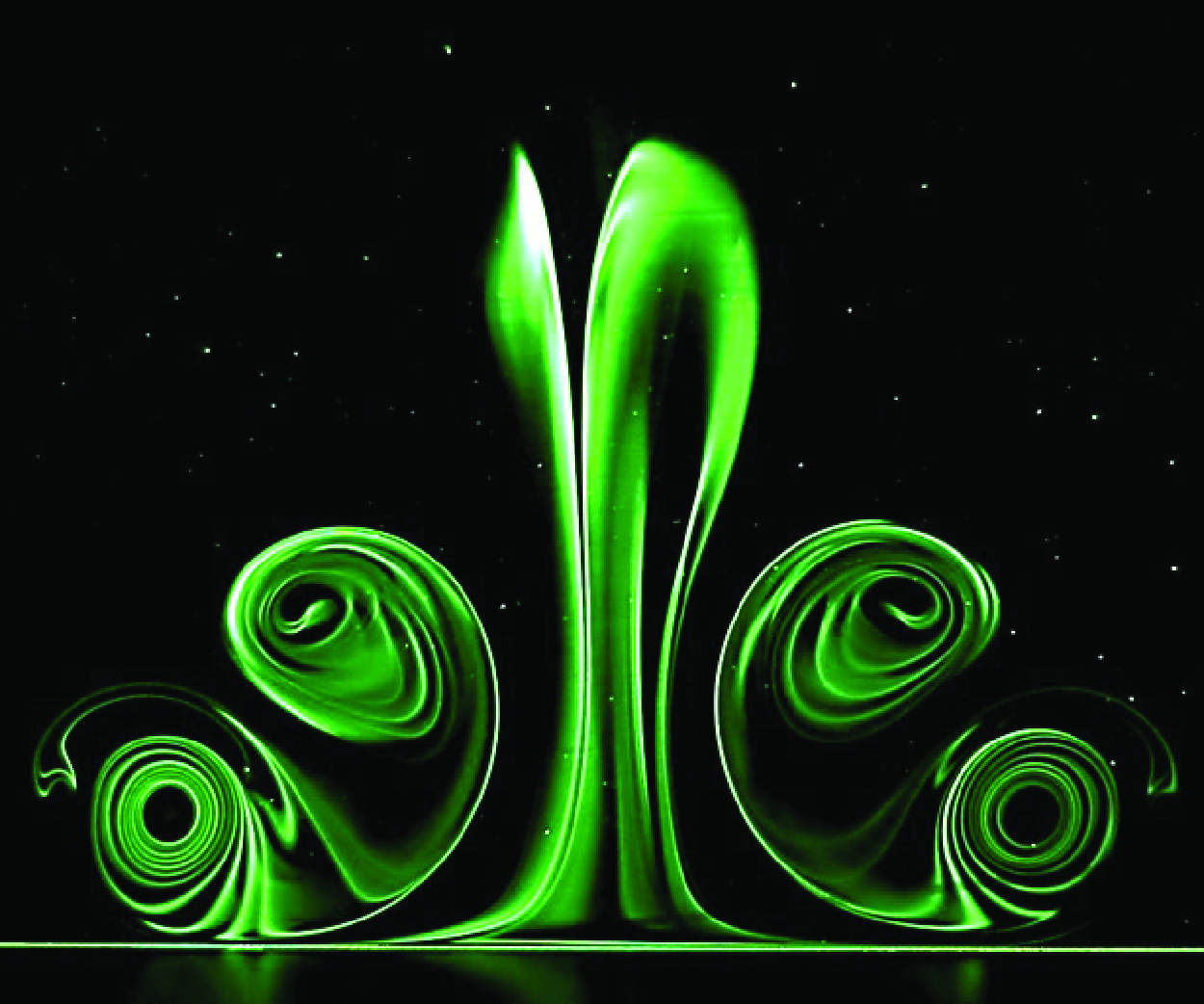
Collisions of elliptic vortex rings upon flat walls
-
- Journal:
- Journal of Fluid Mechanics / Volume 1011 / 25 May 2025
- Published online by Cambridge University Press:
- 13 May 2025, A19
-
- Article
-
- You have access
- Open access
- HTML
- Export citation
-
Head-on collisions between elliptic vortex rings (EVRs) and walls were studied experimentally using planar laser-induced fluorescence visualisations and time-resolved particle image velocimetry. Aspect ratios of $AR=2$ and 4 EVRs at a Reynolds number of $Re=4000$ were used. Collision locations were based on four key axis-switching stages of freely translating EVRs, which would shed light upon how axis-switching behaviour and aspect ratio variations affect the collision outcomes. Results show that non-uniform circumferential induced velocities in both colliding EVRs produce different behaviours along major and minor planes, where vortex-stretching/compression and hence circumferential flows play key roles in the vortex dynamics. Non-uniform formations of secondary/tertiary EVRs also lead to varied entanglements around the primary EVRs. As such, secondary vortex rings form vortex loops that may congregate along the collision axis, depending on the exact collision location. Vortex-core trajectories show the net primary/secondary vortex-core movements result from a balance between EVR diameter expansion due to collision and EVR segment motions associated with the axis-switching stage at the point of collision. Confinement effects are also observed to dominate over aspect ratio effects when the collision occurs closest to the orifice. While increasing the aspect ratio leads to different vortex-stretching/compression behaviour and more varied vortex-core trajectories due to the greater non-uniform induced velocities, they could still be understood by the preceding interpretations. Finally, three-dimensional vortex flows are reconstructed based on the experimental results to further explain the flow mechanisms.


