Refine listing
Actions for selected content:
240 results in 14Dxx
MODULI SPACES OF SLOPE-SEMISTABLE SHEAVES WITH REFLEXIVE SESHADRI GRADUATIONS
- Part of
-
- Journal:
- Nagoya Mathematical Journal , First View
- Published online by Cambridge University Press:
- 22 August 2025, pp. 1-19
-
- Article
- Export citation
Minimal Kinematics on $\mathcal{M}_{0,n}$
- Part of
-
- Article
-
- You have access
- Open access
- HTML
- Export citation
-
Minimal kinematics identifies likelihood degenerations where the critical points are given by rational formulas. These rest on the Horn uniformization of Kapranov–Huh. We characterize all choices of minimal kinematics on the moduli space $\mathcal{M}_{0,n}$. These choices are motivated by the CHY model in physics and they are represented combinatorially by 2-trees. We compute 2-tree amplitudes, and we explore extensions to non-planar on-shell diagrams, here identified with the hypertrees of Castravet–Tevelev.


Moduli spaces of rational graphically stable curves
- Part of
-
- Journal:
- Mathematical Proceedings of the Cambridge Philosophical Society , First View
- Published online by Cambridge University Press:
- 04 August 2025, pp. 1-17
-
- Article
-
- You have access
- Open access
- HTML
- Export citation
DEGENERATIONS OF ORBIFOLD CURVES AS NONCOMMUTATIVE VARIETIES
- Part of
-
- Journal:
- Nagoya Mathematical Journal , First View
- Published online by Cambridge University Press:
- 15 July 2025, pp. 1-19
-
- Article
- Export citation
Consistent dimer models on surfaces with boundary
- Part of
-
- Journal:
- Forum of Mathematics, Sigma / Volume 13 / 2025
- Published online by Cambridge University Press:
- 10 July 2025, e114
-
- Article
-
- You have access
- Open access
- HTML
- Export citation
Vanishing of Brauer groups of moduli stacks of stable curves
- Part of
-
- Journal:
- Forum of Mathematics, Sigma / Volume 13 / 2025
- Published online by Cambridge University Press:
- 10 July 2025, e115
-
- Article
-
- You have access
- Open access
- HTML
- Export citation
-
We show that the cohomological Brauer groups of the moduli stacks of stable genus g curves over the integers and an algebraic closure of the rational numbers vanish for any $g\geq 2$. For the n marked version, we show the same vanishing result in the range $(g,n)=(1,n)$ with $1\leq n \leq 6$ and all $(g,n)$ with $g\geq 4.$ We also discuss several finiteness results on cohomological Brauer groups of proper and smooth Deligne-Mumford stacks over the integers.


Moduli spaces of framed logarithmic and parabolic connections on a Riemann surface
- Part of
-
- Article
-
- You have access
- Open access
- HTML
- Export citation
Upper bounds on the genus of hyperelliptic Albanese fibrations
- Part of
-
- Journal:
- Forum of Mathematics, Sigma / Volume 13 / 2025
- Published online by Cambridge University Press:
- 02 May 2025, e84
-
- Article
-
- You have access
- Open access
- HTML
- Export citation
-
Let S be a minimal irregular surface of general type, whose Albanese map induces a hyperelliptic fibration $f:\,S \to B$ of genus g. We prove a quadratic upper bound on the genus g (i.e.,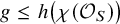 $g\leq h\big (\chi (\mathcal {O}_S)\big )$, where h is a quadratic function). We also construct examples showing that the quadratic upper bounds cannot be improved to linear ones. In the special case when $p_g(S)=q(S)=1$, we show that $g\leq 14$.


Asymptotic behaviour of large-scale solutions of Hitchin’s equations in higher rank
- Part of
-
- Article
-
- You have access
- Open access
- HTML
- Export citation
-
Let $X$ be a compact Riemann surface. Let $(E,\theta )$ be a stable Higgs bundle of degree $0$ on $X$. Let $h_{\det (E)}$ denote a flat metric of the determinant bundle $\det (E)$. For any $t\gt 0$, there exists a unique harmonic metric $h_t$ of $(E,t\theta )$ such that $\det (h_t)=h_{\det (E)}$. We prove that if the Higgs bundle is induced by a line bundle on the normalization of the spectral curve, then the sequence $h_t$ is convergent to the naturally defined decoupled harmonic metric at the speed of the exponential order. We also obtain a uniform convergence for such a family of Higgs bundles.


Kappa classes on KSBA spaces
- Part of
-
- Article
-
- You have access
- Open access
- HTML
- Export citation
-
We define kappa classes on moduli spaces of Kollár-Shepherd-Barron-Alexeev (KSBA)-stable varieties and pairs, generalizing the Miller–Morita–Mumford classes on moduli of curves, and computing them in some cases where the virtual fundamental class is known to exist, including Burniat and Campedelli surfaces. For Campedelli surfaces, an intermediate step is finding the Chow (same as cohomology) ring of the GIT quotient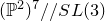 $(\mathbb {P}^2)^7//SL(3)$.
A virtual ${\rm PGL}_r$– ${\rm SL}_r$ correspondence for projective surfaces
- Part of
-
- Article
-
- You have access
- Open access
- HTML
- Export citation
-
For a smooth projective surface $X$ satisfying $H_1(X,\mathbb{Z}) = 0$ and $w \in H^2(X,\mu _r)$, we study deformation invariants of the pair $(X,w)$. Choosing a Brauer–Severi variety $Y$ (or, equivalently, Azumaya algebra $\mathcal{A}$) over $X$ with Stiefel–Whitney class $w$, the invariants are defined as virtual intersection numbers on suitable moduli spaces of stable twisted sheaves on $Y$ constructed by Yoshioka (or, equivalently, moduli spaces of $\mathcal{A}$-modules of Hoffmann–Stuhler).
We show that the invariants do not depend on the choice of $Y$. Using a result of de Jong, we observe that they are deformation invariants of the pair $(X,w)$. For surfaces with $h^{2,0}(X) \gt 0$, we show that the invariants can often be expressed as virtual intersection numbers on Gieseker–Maruyama–Simpson moduli spaces of stable sheaves on $X$. This can be seen as a ${\rm PGL}_r$– ${\rm SL}_r$ correspondence.
As an application, we express ${\rm SU}(r) / \mu _r$ Vafa–Witten invariants of $X$ in terms of ${\rm SU}(r)$ Vafa–Witten invariants of $X$. We also show how formulae from Donaldson theory can be used to obtain upper bounds for the minimal second Chern class of Azumaya algebras on $X$ with given division algebra at the generic point.


Corrigendum: Conformal blocks for Galois covers of algebraic curves
- Part of
-
- Journal:
- Compositio Mathematica / Volume 161 / Issue 4 / April 2025
- Published online by Cambridge University Press:
- 15 August 2025, pp. 945-946
- Print publication:
- April 2025
-
- Article
-
- You have access
- HTML
- Export citation
Vector fields and admissible embeddings for quiver moduli
- Part of
-
- Article
-
- You have access
- Open access
- HTML
- Export citation
Rationality and arithmetic of the moduli of abelian varieties
- Part of
-
- Article
-
- You have access
- Open access
- HTML
- Export citation
-
We study the rationality properties of the moduli space ${\mathcal{A}}_g$ of principally polarised abelian $g$-folds over $\mathbb{Q}$ and apply the results to arithmetic questions. In particular, we show that any principally polarised abelian 3-fold over ${\mathbb{F}}_p$ may be lifted to an abelian variety over $\mathbb{Q}$. This is a phenomenon of low dimension: assuming the Bombieri–Lang conjecture, we also show that this is not the case for abelian varieties of dimension at least 7. Concerning moduli spaces, we show that ${\mathcal{A}}_g$ is unirational over $\mathbb{Q}$ for $g\le 5$ and stably rational for $g=3$. This also allows us to make unconditional one of the results of Masser and Zannier about the existence of abelian varieties over $\mathbb{Q}$ that are not isogenous to Jacobians.


COMPACT MODULI OF ENRIQUES SURFACES OF DEGREE 2
- Part of
-
- Journal:
- Nagoya Mathematical Journal , First View
- Published online by Cambridge University Press:
- 26 February 2025, pp. 1-44
-
- Article
-
- You have access
- Open access
- HTML
- Export citation
-
We describe a geometric, stable pair compactification of the moduli space of Enriques surfaces with a numerical polarization of degree $2$, and identify it with a semitoroidal compactification of the period space.

EIGENPERIODS AND THE MODULI OF POINTS IN THE LINE
- Part of
-
- Journal:
- Nagoya Mathematical Journal , First View
- Published online by Cambridge University Press:
- 24 February 2025, pp. 1-24
-
- Article
- Export citation
Smoothing, scattering and a conjecture of Fukaya
- Part of
-
- Journal:
- Forum of Mathematics, Pi / Volume 13 / 2025
- Published online by Cambridge University Press:
- 13 February 2025, e7
-
- Article
-
- You have access
- Open access
- HTML
- Export citation
-
In 2002, Fukaya [19] proposed a remarkable explanation of mirror symmetry detailing the Strominger–Yau–Zaslow (SYZ) conjecture [47] by introducing two correspondences: one between the theory of pseudo-holomorphic curves on a Calabi–Yau manifold $\check {X}$ and the multivalued Morse theory on the base $\check {B}$ of an SYZ fibration $\check {p}\colon \check {X}\to \check {B}$, and the other between deformation theory of the mirror X and the same multivalued Morse theory on $\check {B}$. In this paper, we prove a reformulation of the main conjecture in Fukaya’s second correspondence, where multivalued Morse theory on the base $\check {B}$ is replaced by tropical geometry on the Legendre dual B. In the proof, we apply techniques of asymptotic analysis developed in [7, 9] to tropicalize the pre-dgBV algebra which governs smoothing of a maximally degenerate Calabi–Yau log variety
  introduced in [8]. Then a comparison between this tropicalized algebra with the dgBV algebra associated to the deformation theory of the semiflat part $X_{\mathrm {sf}} \subset X$ allows us to extract consistent scattering diagrams from appropriate Maurer–Cartan solutions.


 introduced in [8]. Then a comparison between this tropicalized algebra with the dgBV algebra associated to the deformation theory of the semiflat part
NON-LOG LIFTABLE LOG DEL PEZZO SURFACES OF RANK ONE IN CHARACTERISTIC FIVE
- Part of
-
- Journal:
- Nagoya Mathematical Journal , First View
- Published online by Cambridge University Press:
- 10 February 2025, pp. 1-24
-
- Article
- Export citation
-
Building upon the classification by Lacini, we determine the isomorphism classes of log del Pezzo surfaces of rank one over an algebraically closed field of characteristic five either which are not log liftable over the ring of Witt vectors or whose singularities are not feasible in characteristic zero. We also show that such a surface is always constructed from the Du Val del Pezzo surface of Dynkin type $2[2^4]$. Furthermore, We show that the Kawamata–Viehweg vanishing theorem for ample $\mathbb {Z}$-Weil divisors holds for log del Pezzo surfaces of rank one in characteristic five if those singularities are feasible in characteristic zero.


Geometrization of the Satake transform for mod p Hecke algebras
- Part of
-
- Journal:
- Forum of Mathematics, Sigma / Volume 13 / 2025
- Published online by Cambridge University Press:
- 05 February 2025, e26
-
- Article
-
- You have access
- Open access
- HTML
- Export citation
Deformations of morphisms of sheaves
- Part of
-
- Journal:
- Canadian Journal of Mathematics , First View
- Published online by Cambridge University Press:
- 04 February 2025, pp. 1-27
-
- Article
-
- You have access
- Open access
- HTML
- Export citation
