To save content items to your account,
please confirm that you agree to abide by our usage policies.
If this is the first time you use this feature, you will be asked to authorise Cambridge Core to connect with your account.
Find out more about saving content to .
To save content items to your Kindle, first ensure no-reply@cambridge.org
is added to your Approved Personal Document E-mail List under your Personal Document Settings
on the Manage Your Content and Devices page of your Amazon account. Then enter the ‘name’ part
of your Kindle email address below.
Find out more about saving to your Kindle.
Note you can select to save to either the @free.kindle.com or @kindle.com variations.
‘@free.kindle.com’ emails are free but can only be saved to your device when it is connected to wi-fi.
‘@kindle.com’ emails can be delivered even when you are not connected to wi-fi, but note that service fees apply.
In recent years, many countries have significantly increased military spending, mainly due to geopolitical instability in several regions and the potential risk of armed conflicts spreading worldwide. In this context, understanding the nutritional needs of soldiers in different climates (warm, cold and high altitude) is important and directly impacts the performance and health of soldiers, especially in extreme environments. The amount of liquids, calories, and macro- and micronutrients contained in military rations must be determined considering the type of exercise, duration and environment. Military rations, in addition to being nutritionally adequate, must be practical, sustainable and easy to consume at any temperature and situation. Given these considerations, this study aimed to review scientific knowledge regarding the convenience, sensory attributes and nutritional components of military rations. Furthermore, this review studied the factors influencing soldiers’ appetite, gut microbiota and nutritional needs during training or combat in extreme environments (warm, cold and high altitude). This exploration further advances our understanding of contemporary nutritional strategies for military personnel, contributing to future research and highlighting areas that must be developed.
Pectin is composed of a group of complex polysaccharides that are naturally found in various plants and are associated with a range of beneficial health effects. Health outcomes from dietary pectin can vary depending on botanical origin, dietary dose and structure of pectin. The objective of this scoping review is to build a comprehensive overview of the current evidence available on intervention studies conducted in humans and to better understand the possible knowledge gaps in terms of structure–function relationships across the different health-related effects. PubMed and Embase databases were searched using PRISMA-ScR guidelines, yielding 141 references (from the initial 3704), representing 134 intervention studies performed between 1961 and 2022 that met inclusion criteria. Studies were divided into six categories, which included gut health, glycaemic response and appetite, fat metabolism, bioavailability of micronutrients, immune response and other topics. Review of these human intervention studies identified a variety of cohort characteristics and populations (life stage, health status, country), sources/types of pectin (i.e. citrus, sugarbeet, apple, other and non-defined), intervention timeframes (from one single intake to 168 d) and doses (0.1–50 g/d) that were tested for health outcomes in people. Gut health, post-prandial glucose regulation and maintenance of blood cholesterol represented the largest categories of studied outcomes. Further research to strengthen the structure–function relationships for pectin with health properties and associated outcomes is warranted and will benefit from a more precise description of physico-chemical characteristics and molecular compositions, such as degree of esterification, weight, degree of branching, viscosity, gel formation and solubility.
Globally, each year 1.3 million neonates acquire human immunodeficiency virus during pregnancy, labour, and breastfeeding time. Replacing breastfeeding with recommended safe infant feeding practices significantly reduces the risk of transmission, nearly eliminating it. This study aimed to assess Human immunodeficiency virus exposed child feeding among 314 mothers with infants under 24 months old. Participants were selected using a systematic random sampling technique, and data were collected through a semi-structured questionnaire. Bivariable and multivariable logistic regression analyses employed to identify determinants for safe infant feeding. During interviews, the mean age of women was 32.35 years (standard deviation±4.5), and infants were 10.8(±3.951) months. The overall safe infant feeding was 67.2% (95% CI: 61.7, 72.9), with a mean knowledge score. By the study’s end, 9 infants (2.89%) were confirmed to be infected with virus based on dried blood sample test. Maternal promoting factors for safe infant practice included infant age 25–35 years (adjusted odd ratio (aOR) =2.9) completing high school education (adjusted odd ratio = 9.2), having a good knowledge score for infant feeding (adjusted odd ratio = 8.2), and urban residency (adjusted odd ratio = 2.2). On the other hand, being married made it 83% less likely for safe infant feeding practices (adjusted odd ratio = 0.17) compared to those never in a union. Two in three mothers practiced safe infant feeding for their HIV-exposed infants, with a mean knowledge score of 70.3%. Therefore, healthcare providers give accurate information and counselling services to make informed decisions about infant safe feeding.
The lifestyle of the population has undergone significant changes due to the COVID-19 pandemic, which could have influenced alterations in dietary habits and overall well-being among workers. This study aimed to evaluate healthy eating practices and their relationship with the workers’ quality of life and physical activity during the COVID-19 pandemic. This was a cross-sectional investigation involving workers in the city of Curitiba, southern Brazil. The study was conducted through the application of an online questionnaire. The data were evaluated using non-parametric tests and fitting a logistic regression model. A total of 123 workers participated in the study, most of them male (53.2%), aged between 31 and 40 years (42.2%), with a predominance of workers with postgraduate degrees (62.6%, n = 77), and the majority of workers (68.2%, n = 84) were performing their professional activities remotely for at least one day during the week, and 73.2% (n = 90). It was observed that 52.8% had excellent healthy eating practices, and the older their age and the greater the practice of physical activity (time and frequency), the better the workers’ healthy eating practices. When assessing quality of life, the lowest average score for healthy eating practices was in the domain of social relationships. A direct relationship of older age, social relationships, and the practice of physical activity with the best individuals’ healthy eating practices was detected. Considering that remote work continues to be adopted post-pandemic, evaluating the dietary practices, physical activity, and quality of life of workers is necessary to understand this new labour phenomenon.
Vitamin D and cholesterol share the same intestinal transporters. Thus, it was hypothesized that dietary cholesterol adversely affects vitamin D uptake. The current studies investigated the influence of cholesterol on the availability of oral vitamin D. First, 42 wild-type mice received a diet with 25 µg/kg labelled vitamin D3 (vitamin D3-d3), supplemented with either 0% (control), 0.2%, 0.4%, 0.6%, 0.8%, 1.0% or 2.0% cholesterol for four weeks to investigate vitamin D uptake. In a second study, 10 wild-type mice received diets containing 0% (control) or 1% cholesterol over four weeks to determine cholesterol-induced changes in bile acids. Finally, we investigated the impact of cholesterol versus bile acids on vitamin D uptake in Caco-2 cells. Surprisingly, dietary cholesterol intake was associated with 40% higher serum levels of vitamin D3-d3 and 2.3-fold higher vitamin D3-d3 concentrations in the liver compared to controls. The second study showed that cholesterol intake resulted in higher concentrations of faecal bile acids (control: 3.55 ± 1.71 mg/g dry matter; 1% dietary cholesterol: 8.95 ± 3.69 mg/g dry matter; P < 0.05) and changes in the bile acid profile with lower contents of muricholic acids (P < 0.1) and higher contents of taurodeoxycholic acid (P < 0.01) compared to controls. In-vitro analyses revealed that taurocholic acid (P < 0.001) but not cholesterol increased the cellular uptake of vitamin D by Caco-2 cells. To conclude, dietary cholesterol seems to improve the bioavailability of oral vitamin D by stimulating the release of bile acids and increasing the hydrophobicity of bile.
There is an urgent need to develop sustainable and impactful interventions to mitigate the high risk of diet-related non-communicable diseases (diet-NCDs) in South Asians living in high-income countries. The current study using a co-design methodology aimed to identify community-led intervention components (solutions) to address barriers and enablers of disease-promoting dietary and physical activity behaviours in New Zealand South Asians. Data were collected from South Asian immigrants aged 25–59 years via three focus group discussions (n = 21) and 10 telephone or face-to-face interviews between 2018 and 2019. The thematic analysis resulted in identifying 22 barrier and enabler codes and 12 solution codes which were summarised under five themes. The key solutions (intervention components) to mitigate the identified target behaviours were providing recipes for using local vegetables in South Asian cuisine, information on the nutritional quality of frozen vegetables and canned lentils, simple home gardening techniques, the saturated fat content of dairy foods, interpreting nutrition labels, optimal portion sizes of foods, and framing low-fat messages positively. Similarly, group-based activities with peer support such as walking, cultural dancing and community sports like cricket, football, and tennis were the identified solutions to increase physical activity levels. The identified solutions for health promoting dietary habits and physical activity levels could be part of any targeted multicomponent health promoting programme to reduce the risk of diet-NCDs in South Asian immigrants.
Selenium (Se) is a mineral with several biological functions, and studies have shown that its deficiency can be linked to many complications in patients with chronic kidney disease (CKD). This study aims to systematically review the effects of Se supplementation in patients with CKD undergoing haemodialysis (HD). This systematic review was carried out according to the PRISMA statement. Clinical trials were searched in PubMed, Lilacs, Embase, Scopus and Cochrane Library databases from inception to July 2021 and updated in July 2024. The protocol was registered on PROSPERO (CRD42021231444). Two independent reviewers performed the study screening and data extraction, and the risk of bias was evaluated using the Cochrane Collaboration tool. Thirteen studies were included in this review. Only nine studies showed results on Se levels; in all, reduced Se levels were observed before supplementation. A positive effect of supplementation on plasma Se level was demonstrated. Of the ten studies analysed, six demonstrated positive effects on antioxidant and inflammatory markers. Only one study analysed immunological parameters, showing a positive impact. From two studies that analysed thyroid hormones, only one showed positive results. All studies were classified as high risk of bias. The findings suggest that Se supplementation significantly increases plasma Se levels in these patients; however, there are still not enough studies to clarify the effects of Se supplementation on the antioxidant and inflammatory markers, immune system and thyroid hormones. Further studies are needed to elucidate the effects of Se supplementation and to provide a recommendation for patients with CKD undergoing HD.
To assess the relationship between dietary intake of α-carotene, β-carotene, β-cryptoxanthin, lycopene and lutein+zeaxanthin (LZ) and occurrence of metabolic dysfunction-associated fatty liver disease (MAFLD).
Design:
Cross-sectional study design. The MAFLD diagnosis was based on hepatic steatosis and metabolic dysregulation. Carotenoid intake was adjusted for using an energy-adjusted model. Logistic regression and restricted cubic spline (RCS) analyses were used to assess the relationships, with sensitivity analysis to validate the findings. Weighted quantile sum regression (WQS) was used to explore the combined effect of these carotenoids on MAFLD. Subgroup analyses were conducted to identify population-specific associations.
Setting:
National Health and Nutrition Examination Survey (NHANES) 2017–March 2020.
Participants:
This study included 5098 individuals aged 18 years and older.
Results:
After adjusting for potential confounders, a weak inverse association was observed between α-carotene and β-carotene intakes and MAFLD occurrence (all P value <0·05). The highest quartile of β-carotene intake showed a significantly lower occurrence of MAFLD compared with the lowest quartile (OR = 0·65; 95 % CI: 0·44, 0·97). RCS analysis showed that a significantly lower occurrence of MAFLD was associated with a higher intake of the four carotenoids, excluding lycopene. Furthermore, the WQS analysis revealed a negative relationship between combined carotenoid intake and MAFLD occurrence (OR = 0·95, 95 % CI: 0·90, 1·00, P = 0·037). Subgroup analyses showed dietary carotenoid intake was associated with reduced MAFLD occurrence in populations aged 50–69 years, females, physically active individuals and non-drinkers.
Conclusion:
Higher dietary intake of carotenoids is associated with lower MAFLD occurrence. However, this relationship varies among individuals of different ages, sexes and lifestyles.
The International Code of Marketing of Breast-Milk Substitutes is an important instrument to protect and promote appropriate infant and young child feeding and the safe use of commercial milk formulas. Ghana and Tanzania implemented the Code into national legislation in 2000 and 1994, respectively. We aimed to estimate the effects of the Code implementation on child mortality (CM) in both countries.
Setting:
The countries analysed were Ghana and Tanzania.
Participants:
For CM and HIV rates, data from the Institute for Health Metrics and Evaluation from up to 2019 were used. Data for income and skilled birth rates were retrieved from the World Bank, for fertility from the World Population Prospects, for vaccination from the Global Health Observatory and for employment from the International Labour Organization.
Design:
We used the synthetic control group method and performed placebo tests to assess statistical inference. The primary outcomes were CM by lower respiratory infections, mainly pneumonia, and diarrhoea and the secondary outcome was overall CM.
Results:
One-sided inference tests showed statistically significant treatment effects for child deaths by lower respiratory infections in Ghana (P = 0·0476) and Tanzania (P = 0·0476) and for diarrhoea in Tanzania (P = 0·0476). More restrictive two-sided inference tests showed a statistically significant treatment effect for child deaths by lower respiratory infections in Ghana (P = 0·0476). No statistically significant results were found for overall CM.
Conclusion:
The results suggest that the implementation of the Code in both countries had a potentially beneficial effect on CM due to infectious diseases; however, further research is needed to corroborate these findings.
Dietary surveys are critical in evaluating dietary trends prevailing across the entire population. The aim of this study is to present the results of the latest research into the intakes of energy, macronutrients, and micronutrients amongst the adult population in Lithuania from 2019 through 2020. A cross-sectional study was conducted and dietary data was collected using a 24-h dietary recall method from a total of 2555 Lithuanian adults. Medians, 25th and 75th percentiles were calculated. The diet of Lithuanian adults was found insufficient as the energy intake from fats exceeded the recommended norms, while the energy intake from carbohydrates was below the lower range. The intakes of dietary fibre and most vitamins and minerals were insufficient. Men, compared to women, had a statistically higher total energy intake and energy intake from fats, and a higher intake of dietary fibre. Younger adults, compared to older ones, had statistically lower intakes of energy from fats, including saturated fats, and lower intakes of sodium chloride. Respondents with primary education, compared to those who had attained a higher degree of education, had a statistically lower intake of total energy and dietary fibre. Study showed that intakes of majority of nutrients in the diet of the adult Lithuanian population are not in compliance with the recommended daily intakes. Continuous nationally representative studies into food consumption and nutrient intake of the adult Lithuanian population must be carried out to assess the changes in the population’s diet and the effectiveness of policies aimed at promoting healthy diets.
The solicitation of nutrition-related health advice on social media platforms is on the rise. However, there is a paucity of research on the distinctive nutrition-related concerns and needs faced by transgender and gender-diverse individuals. Understanding patterns of nutrition-related information-seeking behaviour is vital to advancing health promotion efforts within this community. This study aimed to characterise the nutrition-related questions posed by the transgender community on a prominent social media outlet, Reddit.
Design:
A qualitative, cross-sectional content analysis was conducted, focusing on the top 100 submissions (ranked by popularity) within a transgender-centric online subreddit (r/asktransgender). Data extraction was facilitated using the Application Programming Interface Pushshift. The content analysis was conducted using NVivo.
Setting:
The study was situated within the discussion forum of the social media platform, Reddit.
Results:
A total of 148 references from 90 eligible posts were identified and coded. The major themes included the effects of hormone replacement therapy (HRT) on nutritional health (n 66), weight status (n 45), dietary needs and behaviours (n 21), physical activity and weight loss on body shape (n 9), social undermining (n 4) and effects of health behaviours on HRT (n 3).
Conclusion:
This study underscores the pressing need for tailored and evidence-based nutrition guidelines and communication toolkits that specifically address the distinct needs and experiences of transgender individuals, particularly those undergoing HRT.
Osteoarthritis (OA), a disease with a multifactorial aetiology and an enigmatic root cause, affects the quality of life of many elderly patients. Even though there are certain medications utilised to reduce the symptomatic effects, a reliable treatment method to reverse the disease is yet to be discovered. Zinc is a cofactor of over 3000 proteins and is the only metal found in all six classes of enzymes. We explored zinc’s effect on the immune system and the bones as OA affects both. We also discussed zinc-dependent enzymes, highlighting their significant role in the disease’s pathogenesis. It is important to note that both excessive and deficient zinc levels can negatively affect bone health and immune function, thereby exacerbating OA. The purpose of this review is to offer a better understanding of zinc’s impact on OA pathogenesis and to provide clarity regarding its beneficial and detrimental outcomes. We searched thoroughly systematic reviews, meta-analysis, review articles, research articles and randomised controlled trials to ensure a comprehensive review. In brief, using zinc supplementation in the treatment of OA may act as a doubled-edged sword, offering potential benefits but also posing risks.
To investigate how dieting is portrayed on TikTok and the potential implications for public health considering the effect of diet culture on eating disorders amongst young people.
Design:
A cross-sectional descriptive content analysis of 250 videos from the five most popular diet-related hashtags. A codebook was developed to analyse the content of the videos and collect the engagement for each video (likes, comments and shares).
Setting:
TikTok website.
Participants:
There were no participants in this study.
Results:
More than half of the videos portrayed ‘body checking’, a potentially harmful practice for body image. Of the videos that represented body image, almost half represented body image negatively. However, most videos promoted the idea of ‘healthy eating’, and only 6·4 % displayed disordered eating behaviours. Over half of the videos provided dietary advice, and of those videos, most content creators claimed to be experts (64 %). Claiming expertise was not significantly associated with engagement; however, the use of humour was significantly associated with engagement. Additionally, males were more likely than females to disclose their goals of the diet.
Conclusions:
Overall, it appears that TikTok is commonly used to share nutrition tips and personal experiences around dieting and eating in general, often employing humour as an effective technique. The popularity of the platform and rapid dissemination of information would be a useful tool for health professionals, especially those working with eating disorders, to utilise.
Food literacy (FL) is a potential approach to address the nutrition transition in Africa, but a validated tool is lacking. We developed and validated a scale to assess FL among Ugandan and Kenyan adult populations.
Design:
A mixed-method approach was applied: (1) item development using literature, expert and target group insights, (2) independent country-specific validation (content, construct, criterion and concurrent) and (3) synchronisation of the two country-specific FL-scales. Construct validity was evaluated against the prime dietary quality score (PDQS) and healthy eating self-efficacy scale (HEWSE).
Setting:
Urban Uganda and Kenya.
Participants:
Two cross-sectional cross-country surveys, adults >18 years (n = 214) and university students (n = 163), were conducted.
Results:
The initial development yielded a forty-eight-item FL-scale draft. In total, twenty-six items were reframed to fit the country contexts. Six items differed content-wise across the two FL-scales and were dropped for a synchronised East African FL-scale. Weighted kappa tests revealed no deviations in individuals’ FL when either the East African FL-scale or the country-specific FL-scales are used; 0·86 (95 % CI: 0·83, 0·89), Uganda and 0·86 (95 % CI: 0·84, 0·88), Kenya. The FL-scale showed good reliability (0·71 (95 % CI: 0·60, 0·79), Uganda; 0·78 (95 % CI: 0·69, 0·84), Kenya) and positively correlated with PDQS (r = 0·29 P = 0·003, Uganda; r = 0·26 P < 0·001, Kenya) and HEWSE (r = 0·32 P < 0·001, Uganda; r = 0·23, P = 0·017, Kenya). The FL-scale distinguishes populations with higher from those with lower FL (β = 14·54 (95 % CI: 10·27, 18·81), Uganda; β = 18·79 (95 % CI: 13·92, 23·68), Kenya).
Conclusion:
Provided culture-sensitive translation and adaptation are done, the scale may be used as a basis across East Africa.
The aim of this study is to assess nutritional status and associated factors among infants and young children aged 6–23 months in Yeka sub-city, Ethiopia, 2021. An institution-based cross-sectional study was conducted in selected health centres found in the Yeka sub-city from May 2021 to July 2021. In total, 396 systematically selected infants and young children aged 6–23 months attended the selected health centres were included in the study. Data were collected by using a structured questionnaire and anthropometric measurements. A multinomial logistic regression model was used.
The overall magnitude of undernutrition and overnutrition among infants and young children were 24.7% and 5.5%, respectively. Dietary diversity score (DDS) ((adjusted odd ratio (AOR) = 5.65; 95% CI = 2.301, 10.87; P value = 0.003), minimum meal frequency (MMF) (AOR = 5.435; 95% CI = 2.097, 11.09; P value = 0.0052), and diarrhoea (AOR = 2.52; 95% CI = 1.007, 6.310; P value = 0.002) were statistically significantly associated factors for nutritional status among infants and young children. Malnutrition (undernutrition and overnutrition) is a public health problem among infants and young children in Yeka sub-city, Ethiopia. DDS, MMF, and diarrhoeal disease were associated with higher odds of undernutrition.
Folate, vitamin B12, vitamin B6 and riboflavin interact by functioning as cofactors within one-carbon metabolism (OCM), a network of interrelated cellular pathways essential for numerous biological processes, including the biosynthesis of DNA, amino acid interconversions and methylation reactions. The pathways of OCM are influenced by endocrine signals and genetic polymorphisms and are particularly responsive to relevant B-vitamin intakes. Physiological changes in healthy pregnancy, leading to a steady decline in B-vitamin status, add another layer of complexity to the regulation of OCM. Although significant advances have been made to improve our understanding of these pregnancy-related changes, no specific reference ranges yet exist for B-vitamin biomarkers in pregnancy to support normal fetal growth without depleting maternal stores. The lack of pregnancy-related criteria for adequacy of B-vitamin status is in turn a major limitation in identifying pregnant women most at risk of B-vitamin deficiency. Another challenge is that the evidence is very limited to provide a basis for establishing pregnancy-specific dietary recommendations for B-vitamins to support successful pregnancy outcomes. In terms of preventing adverse outcomes, periconceptional folic acid supplementation has a proven role, established more than 30 years ago, in protecting against neural tube defect-affected pregnancies and this has been the major focus of public health policy worldwide. This review evaluates the emerging evidence for the less well recognised role of B-vitamins in preventing hypertensive disorders in pregnancy and the intergenerational effects of B-vitamins on offspring neurodevelopment and cognitive performance during childhood. We also consider the underlying biological mechanisms.
Prior research has shown that there are more supermarket displays of sugar-sweetened beverages (SSB) during times when Supplemental Nutrition Assistance Program (SNAP) benefits are distributed (‘issuance periods’). This may contribute to inequitable purchasing and consumption. This study examines whether SSB marketing in weekly supermarket circulars, which retailers use to advertise products, is more prevalent during issuance periods compared to non-issuance periods.
Design:
We conducted longitudinal, difference-in-differences analyses of data extracted from weekly supermarket circulars of randomly selected SNAP-authorised retailers in six states. Analyses tested whether SSB advertisements (‘ads’) were more prevalent during SNAP issuance periods compared to non-issuance periods within states with distinct issuance periods (3, 5, 10 or 15 d), compared to one state with continuous benefit issuance (28 d; the ‘control’ state).
Setting:
Weekly online supermarket circulars collected from August to September 2019 were analysed in 2021.
Participants:
The study sample included 5152 circulars from 563 SNAP-authorised retailers in the states California, Connecticut, Nebraska, New Jersey and Texas (distinct issuance period states) as well as Florida (‘control’ state).
Results:
The estimated mean percentage of beverage ads classified as SSB ads during issuance days was 51·5 % compared to 48·4 % during non-issuance days (P < 0·001). In difference-in-differences analyses comparing to the ‘control’ state with continuous issuance, SSB ad counts were 2·9 % higher (95 % CI 1·9 %, 3·9 %) during SNAP issuance relative to non-issuance.
Conclusions:
SSB ads are slightly more prevalent in weekly supermarket circulars during SNAP issuance periods. Future research should explore the linkages between circular ads and SSB purchasing and consumption.
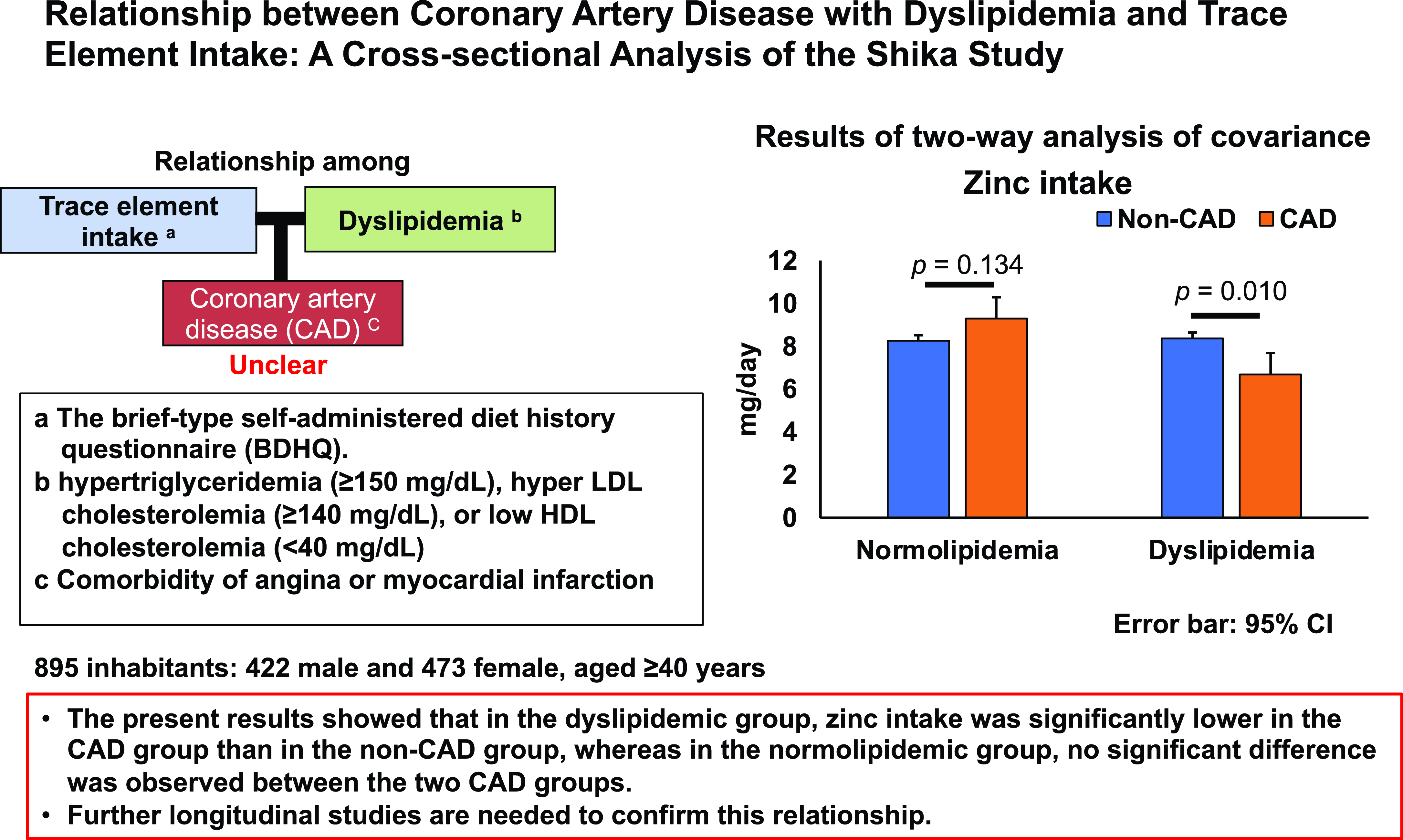
Although the relationship between dyslipidaemia (DL) and coronary artery disease (CAD) or between trace minerals intake and CAD is well known separately, the exact nature of this relationship remains unknown. We hypothesize that the relationship between trace mineral intake and CAD may differ depending on whether or not the individual has DL. The present study analysed the relationships among trace mineral intake, DL, and CAD in middle-aged and older adults living in Shika town, Ishikawa prefecture, Japan. This study included 895 residents following the exclusion of those with genetic risk carriers for familial hypercholesterolemia. Trace mineral intake was evaluated using the brief-type self-administered diet history questionnaire. Interactions were observed between DL and CAD with zinc (p = 0.004), copper (p = 0.010), and manganese intake (p < 0.001) in a two-way analysis of covariance adjusted for covariates such as sex, age, body mass index, and current smokers and drinkers. Multiple logistic regression analysis showed that zinc (odds ratio (OR): 0.752; 95% confidence interval (CI): 0.606, 0.934; p = 0.010), copper (OR: 0.175; 95% CI: 0.042, 0.726; p = 0.016), and manganese (OR: 0.494; 95% CI: 0.291, 0.839; p = 0.009) were significant independent variables for CAD in the dyslipidaemic group. The present results suggest that DL with a low trace mineral intake is associated with CAD. Further longitudinal studies are required to confirm this relationship.
Previous investigations on protein associations with diet quality and obesity still have inconclusive findings, possibly due to how protein intake was expressed. This study aimed to compare how different ways of expressing total protein intake may influence its relationships with diet quality and obesity. Usual protein intake was estimated from the 2011–12 Australian National Nutrition and Physical Activity Survey (n = 7637 adults, ≥19 years), expressed in grams (g/d), percent energy (%EI), and grams per actual kilogram body weight (g/kgBW/d). Diet quality was assessed using the 2013 Dietary Guidelines Index, and obesity measures included Body Mass Index (BMI) and waist circumference (WC). Sex-stratified multiple linear and logistic regressions were performed and adjusted for potential confounders. Total protein (g/d) was directly associated with diet quality (males, β = 0.15 (95% CI 0.12, 0.19); females, β = 0.25 (0.22, 0.29)), and this association was consistent across units. Protein intake (g/d) was directly associated with BMI (males, β = 0.07% (0.04%, 0.11%); females, β = 0.09% (0.04%, 0.15%)), and WC (males, β = 0.04 (0.01, 0.06); females, β = 0.05 (0.00, 0.09)). While in males, protein as %EI was associated with higher WC, no association was found in females. Adults with higher protein intake (g/d) had higher odds of overweight/obesity (males, OR = 1.01 (1.00, 1.01); females, OR = 1.01 (1.00, 1.01)), and central overweight/obesity (females, OR = 1.01 (1.00, 1.01)), but no significant association with females odds of overweight/obesity when protein was expressed in %EI. In conclusion, protein intake was positively associated with diet quality and obesity, yet these associations were stronger for women. The effect sizes also varied by measurement unit due to the different scales of those units.