To save content items to your account,
please confirm that you agree to abide by our usage policies.
If this is the first time you use this feature, you will be asked to authorise Cambridge Core to connect with your account.
Find out more about saving content to .
To save content items to your Kindle, first ensure no-reply@cambridge.org
is added to your Approved Personal Document E-mail List under your Personal Document Settings
on the Manage Your Content and Devices page of your Amazon account. Then enter the ‘name’ part
of your Kindle email address below.
Find out more about saving to your Kindle.
Note you can select to save to either the @free.kindle.com or @kindle.com variations.
‘@free.kindle.com’ emails are free but can only be saved to your device when it is connected to wi-fi.
‘@kindle.com’ emails can be delivered even when you are not connected to wi-fi, but note that service fees apply.
Adequate fruit and vegetable consumption is essential for healthy ageing and prevention and management of chronic disease. This study aimed to examine characteristics associated with fruit and vegetable consumption in Chinese men and women aged 50 years and over. Data from the first wave of the Chinese cohort (2008–2010) of the WHO’s Study on global AGEing and adult health (SAGE) survey was used. Fruit and vegetable consumption was assessed by self-reported typical consumption in serves/day. Characteristics examined were age, education, financial security, home ownership, marital status, social cohesion and rural location. Associations with fruit and vegetable consumption were assessed using multiple linear regression adjusted for confounders and stratified by sex. Overall, women consumed more serves of fruit per day than men (mean (standard deviation): 2·6 (2·2) and 2·2 (2·1) serves/day, respectively) whereas men consumed more serves of vegetables than women (7·2 (4·0) and 6·7 (3·7)). Lower fruit consumption was associated with lower education, lower social participation, income insecurity, renting, being un-partnered and rural residency in men and women, as well as older age in women. Lower vegetable consumption was associated with older age, lower education and urban residency in men and women and lower social participation in men and being unpartnered in women. This study has identified characteristics associated with fruit and vegetable intake in a sample of mid aged and older Chinese men and women. Further research on the interrelationships between these characteristics and fruit and vegetable intake as well as longitudinal relationships is warranted.
Plant-derived proteins are often deficient in essential amino acids and have lower rates of digestibility than animal-derived proteins. Blending different plant-derived proteins could compensate for these deficiencies and may augment postprandial aminoacidemia over single-source plant proteins. This study assessed plasma amino acids and appetite hormones, appetite sensations and ad libitum energy intake following ingestion of a pea-rice protein blend (BLEND), compared with pea-only (PEA) and whey (WHEY) protein. In a randomised, double-blind, crossover design, ten healthy adults (M n 4, F n 6; mean (sd) age 22 (sd 3) years; BMI 24 (sd 3) kg·m2) ingested 0·3 g·kg·body mass–1 of BLEND, PEA or WHEY. Arterialised venous blood samples and appetite ratings were obtained in the fasted state and over 240 min postprandially. Energy intake was measured via an ad libitum buffet-style test meal. Mean plasma essential amino acid incremental AUC was higher in WHEY, compared with PEA (P < 0·01; mean diff (95 % CI): 44 218 (15 806, 72 631) μmol·240 min·l–1) and BLEND (P < 0·01; 14 358 (16 031, 101 121) μmol·240 min·l–1), with no differences between PEA and BLEND (P = 0·67). Plasma ghrelin and glucagon-like peptide-1, appetite ratings and ad libitum energy intake responses did not differ between treatments (P > 0·05 for all). Ingestion of a pea-rice protein blend did not augment postprandial aminoacidemia above pea protein, perhaps attributable to marginal differences in essential amino acid composition. No between-treatment differences in appetite or energy intake responses were apparent, suggesting that the influence of protein ingestion on perceived appetite ratings and orexigenic hormonal responses may not be solely determined by postprandial plasma aminoacidemia.
The COVID-19 pandemic and subsequent policy response to mitigate disease spread had far-reaching impacts on health and social well-being. In response, the Supplemental Nutrition Assistance Program (SNAP) underwent several pandemic-era modifications, including a 15 % monthly benefit increase on January 1, 2021. Research documenting the health effects of these SNAP modifications among low-income households and minoritized groups who were most impacted by the economic fallout during the first years of the pandemic is lacking. We aimed to estimate the health effects of the 15 % SNAP benefit increase in January 2021, among SNAP-eligible US households.
Design:
We estimated the effects of the SNAP increase on food insufficiency, mental health, and financial well-being using a rigorous quasi-experimental difference-in-differences (DID) analysis.
Setting:
August 19, 2020, to March 29, 2021.
Participants:
Participants were drawn from the national US Census Bureau Household Pulse Survey waves 13–27 (n 44 477).
Results:
Compared with SNAP-eligible non-recipients, SNAP-eligible recipients experienced decreased food insufficiency (–1·9 percentage points (pp); 95 % CI –3·7, –0·1) and anxiety symptoms (–0·09; 95 % CI –0·17, –0·01), and less difficulty paying for other household expenses (–3·2 pp; 95 % CI –4·9, –1·5) after the SNAP benefit increase. Results were robust to alternative specifications.
Conclusions:
Expansions of federal nutrition programmes have the potential to improve health and financial well-being. This study provides timely evidence to inform comprehensive safety net nutrition policies during future economic crises and public health preparedness response plans.
Vitamin D deficiency (VDD) is common among young women and causes various health problems, including those that occur during pregnancy and childbirth. Thus, we investigated the risk factors for VDD in young Japanese women and developed a simple risk scoring system called Vitamin D Deficiency Predicting Scoring (ViDDPreS).
Design:
A cross-sectional study, using the following factors for multivariate logistic regression analysis to create the ViDDPreS score: residential area, season, cumulative ambient ultraviolet-B irradiation, BMI, vitamin D supplement use, sun exposure habits, frequency of habitual food intake and eating habits. The subjects were randomly divided into development and test sets for analysis. Serum 25-hydroxivitamin D concentration of less than 20 ng/ml was defined as VDD.
Setting:
Four regions (Hokkaido/Tohoku, Kanto, Chubu/Kinki/Shikoku and Kyushu/Okinawa) in Japan.
Participants:
Five hundred and eighty-three healthy women aged 18–40 years.
Results:
In the development set, the VDD group (68·4 %) had higher proportions of the following variables than the non-VDD group: residential area outside the Kanto region; blood samples obtained in winter; low BMI (<18·5 kg/m2); vitamin D supplement non-users; short time regularly spent outside on weekdays; intake of fish, vitamin D-abundant fish, dried fish and redfish less than once a week. VDD risk was classified as low, medium or high according to the ViDDPreS scores including these contributing factors, with a test set C-index of 0·671.
Conclusion:
We identified the risk factors for VDD in young Japanese women and developed a simple risk scoring system that enables us to assess VDD risk and aid in the development of appropriate prevention and treatment strategies for this population.
Studies using the dietary inflammatory index often perform complete case analyses (CCA) to handle missing data, which may reduce the sample size and increase the risk of bias. Furthermore, population-level socio-economic differences in the energy-adjusted dietary inflammatory index (E-DII) have not been recently studied. Therefore, we aimed to describe socio-demographic differences in E-DII scores among American adults and compare the results using two statistical approaches for handling missing data, i.e. CCA and multiple imputation (MI).
Design:
Cross-sectional analysis. E-DII scores were computed using a 24-hour dietary recall. Linear regression was used to compare the E-DII scores by age, sex, race/ethnicity, education and income using both CCA and MI.
Setting:
USA.
Participants:
This study included 34 547 non-Hispanic White, non-Hispanic Black and Hispanic adults aged ≥ 20 years from the 2005–2018 National Health and Nutrition Examination Survey.
Results:
The MI and CCA subpopulations comprised 34 547 and 23 955 participants, respectively. Overall, 57 % of the American adults reported 24-hour dietary intakes associated with inflammation. Both methods showed similar patterns wherein 24-hour dietary intakes associated with high inflammation were commonly reported among males, younger adults, non-Hispanic Black adults and those with lower education or income. Differences in point estimates between CCA and MI were mostly modest at ≤ 20 %.
Conclusions:
The two approaches for handling missing data produced comparable point estimates and 95 % CI. Differences in the E-DII scores by age, sex, race/ethnicity, education and income suggest that socio-economic disparities in health may be partially explained by the inflammatory potential of diet.
To estimate how incentives that encourage healthy eating among Supplemental Nutrition Assistance Program (SNAP) participants impact intra-monthly variation in fruit and vegetable spending.
Design:
We used transaction data from three Alabama grocery stores participating in a programme that offered dollar-matching coupons for fresh produce. For each store, we calculated daily spending on fresh produce out of SNAP benefits and daily incentive coupon redemptions. We compared total daily spending on fresh produce and daily coupon redemptions on days over which SNAP benefits are distributed in Alabama with spending and redemption on days at the end of the month with no SNAP distribution.
Setting:
SNAP and incentive transactions in three Alabama grocery stores.
Participants:
SNAP participants purchasing fruit and vegetables April 2023–July 2023.
Results:
Daily spending with SNAP on produce dropped by 38% at the end of the month. Incentive coupon redemption did not significantly drop at the end of the month. The share of total SNAP spending going to fresh fruits and vegetables increased by two percentage points and the share of fresh fruits and vegetables spending coming from redemptions increased by ten percentage points at the end of the month.
Conclusions:
SNAP households may use incentive coupons to smooth drops in produce consumption at the end of the month. These findings also highlight trade-offs inherent in different delivery mechanisms for SNAP incentives.
Maternal diet may modulate human milk microbiota, but the effects of nutritional supplements are unknown. We examined the associations of prenatal diet and supplement use with milk microbiota composition. Mothers reported prenatal diet intake and supplement use using self-administered food frequency and standardised questionnaires, respectively. The milk microbiota was profiled using 16S rRNA gene sequencing. Associations of prenatal diet quality, dietary patterns, and supplement use with milk microbiota diversity and taxonomic structure were examined using Wilcoxon signed-rank tests and multivariable models adjusting for relevant confounders. A subset of 645 mothers participating in the CHILD Cohort Study (originally known as the Canadian Healthy Infant Longitudinal Development Study) provided one milk sample between 2 and 6 months postpartum and used prenatal multivitamin supplements ≥4 times a week. After adjusting for confounders, vitamin C supplement use was positively associated with milk bacterial Shannon diversity (β = 0.18, 95% CI = 0.05, 0.31) and Veillonella and Granulicatella relative abundance (β = 0.54; 95% CI = 0.05, 1.03 and β = 0.44; 95% CI = 0.04, 0.84, respectively), and negatively associated with Finegoldia relative abundance (β = –0.31; 95% CI = –0.63, –0.01). Fish oil supplement use was positively associated with Streptococcus relative abundance (β = 0.26; 95% CI = 0.03, 0.50). Prenatal diet quality and dietary patterns were not associated with milk microbiota composition. Prenatal vitamin C and fish oil supplement use were associated with differences in the milk microbiota composition. Future studies are needed to confirm our findings and elucidate mechanisms linking maternal supplement use to milk microbiota and child health.
Postprandial hyperinsulinaemia plays a key role in the development of non-alcoholic fatty liver disease (NAFLD). Diet is a potential factor affecting serum insulin levels. This study aimed to examine the relations of dietary insulin index (DII) and dietary insulin load (DIL) to the risk of NAFLD.
Design:
This study was a cross-sectional study. DII and DIL were calculated using the dietary data obtained from the FFQ. Fatty liver index ≥ 60 and the confirmation of a gastroenterologist were required to diagnose NAFLD.
Setting:
Community-based study.
Participants:
A total of 3158 people (46·7 % male), aged 40·57 ± 8·25 years, participated in this study in Tehran, Iran from April 2016 to December 2019.
Results:
The prevalence of NAFLD was 29·9 % (21·59 % in males and 33·74 % in females). In the fully adjusted model controlled for sex, age, energy intake, BMI, smoking, physical activity and education, DII was significantly associated with the increased risk of NAFLD in males (OR: 2·74, 95 % CI = 1·75, 4·31; P-trend = ≤0·001) and females (OR: 2·26, 95 % CI = 1·39, 3·69; P-trend = 0·005). A significant relationship was also detected between DIL and NAFLD in females (OR: 2·90, 95 % CI = 1·70, 4·93; P-trend ≤0·001) but not in males (OR: 1·33, 95 % CI = 0·84, 2·10; P-trend = 0·13).
Conclusions:
Adherence to a diet with a high DII and DIL may be related to the increased risk of NAFLD. These results may be useful for healthcare providers to design appropriate preventive measures for people at risk of NAFLD.
Schools are identified as a setting for food and nutrition education (FNE) in childhood. FNE is a key strategy to optimise child growth and development and impart life-long food skills. There is limited synthesis of the literature to understand the socio-ecological determinants of teachers and schools engaging in FNE.
Design:
For this scoping review, five databases (APA PsycInfo, ERIC, Medline, CINAHL and Scopus) were searched using the terms (and synonyms for) primary school teacher, self-efficacy and food and nutrition. A quality assessment using relevant Johanna Briggs tools was carried out for the included papers. Data were extracted using a modified socio-ecological model, and narrative themes were identified.
Setting:
Primary (elementary) schools in high-income countries.
Participants:
Primary-school teachers.
Results:
Forty-one papers were included in this review from ten countries (predominantly the USA). The narrative synthesis identified five themes that interact with teacher delivery of FNE. These were (i) perceived food and nutrition responsibilities of teachers, (ii) teacher beliefs and self-efficacy, (iii) opportunities to build teacher nutrition knowledge and self-efficacy, (iv) interpersonal contributors and (v) broader environmental, structural and policy contributors.
Conclusions:
Multiple strategies are needed to build the capacity of teachers to undertake FNE within primary school settings. These strategies include a focus on learner-centred education that will build teacher agency, school leadership, ensuring the health and well-being of teachers and providing initial teacher education as well as innovative professional development for cross-curriculum integration. Strategies drawing from each level of the socio-ecological framework will increase opportunities for capacity building.
Numerous studies have examined the relationship between overweight/obesity and iron deficiency anaemia (IDA) across diverse population groups, but a definitive link has not been clearly determined. This systematic review examined the association between overweight/obesity and IDA in women of reproductive age (WRA).
Design:
The initial search was performed in the CINAHL, Embase, MEDLINE, SCOPUS and Web of Science databases. The studies included should report at least one Fe status with/without an inflammatory marker, using the BMI to define overweight/obesity. Only baseline data were extracted for longitudinal studies.
Setting:
Global.
Participant:
Pregnant or non-pregnant women aged 18–50 years.
Results:
In total, twenty-seven papers were included (twelve addressing pregnant women and fifteen addressing non-pregnant women). Overall, most of the studies reported no association between overweight/obesity and Hb concentration. However, a positive association was reported more frequently in pregnant women. The association between overweight/obesity and serum ferritin concentrations was mixed. Most of the studies on non-pregnant women reported a positive association. Only a few studies measured hepcidin and inflammatory markers, and the majority revealed an increased level among overweight/obese WRA. Among pregnant women, overweight/obesity was positively associated with anaemia and IDA but negatively associated with iron deficiency (ID). Meanwhile, overweight/obese non-pregnant women were positively associated with anaemia, ID and IDA.
Conclusions:
Overweight/obesity was associated with a decreased prevalence of anaemia and IDA but an increased prevalence of ID, while its association with several Fe markers was inconclusive. Further studies integrating the assessment of various Fe markers, inflammatory markers and hepcidin are needed.
Water is an essential nutrient for all organisms and is important for maintaining life and health. We aimed to develop a biomarker-calibrated equation for predicting water turnover (WT) and pre-formed water (PW) using the doubly labelled water (DLW) method.
Design:
Cross-sectional study.
Setting:
General older population from the Kyoto–Kameoka Study, Japan.
Participants:
The 141 participants aged ≥ 65 years were divided into a model developing (n 71) and a validation cohort group (n 70) using a random number generation. WT and PW was measured using the DLW method in May–June of 2012. In developing the cohort, equations for predicting WT and PW were developed by multivariate stepwise regression using all data from the questionnaires in the Kyoto–Kameoka study (including factors such as dietary intake and personal characteristics). WT and PW measured using the DLW method were compared with the estimates from the regression equations developed using the Wilcoxon signed-rank test and correlation analysis in validation cohort.
Results:
The median WT and PW for 141 participants were 2·81 and 2·28 l/d, respectively. In the multivariate model, WT (R2 = 0·652) and PW (R2 = 0·623) were moderately predicted using variables, such as height, weight and fluid intake from beverages based on questionnaire data. WT (r = 0·527) and PW (r = 0·477) predicted that using this model was positively correlated with the values measured by the DLW method.
Conclusions:
Our results showed factors associated with water requirement and indicated a methodological approach of calibrating the self-reported dietary intake data using biomarkers of water consumption.
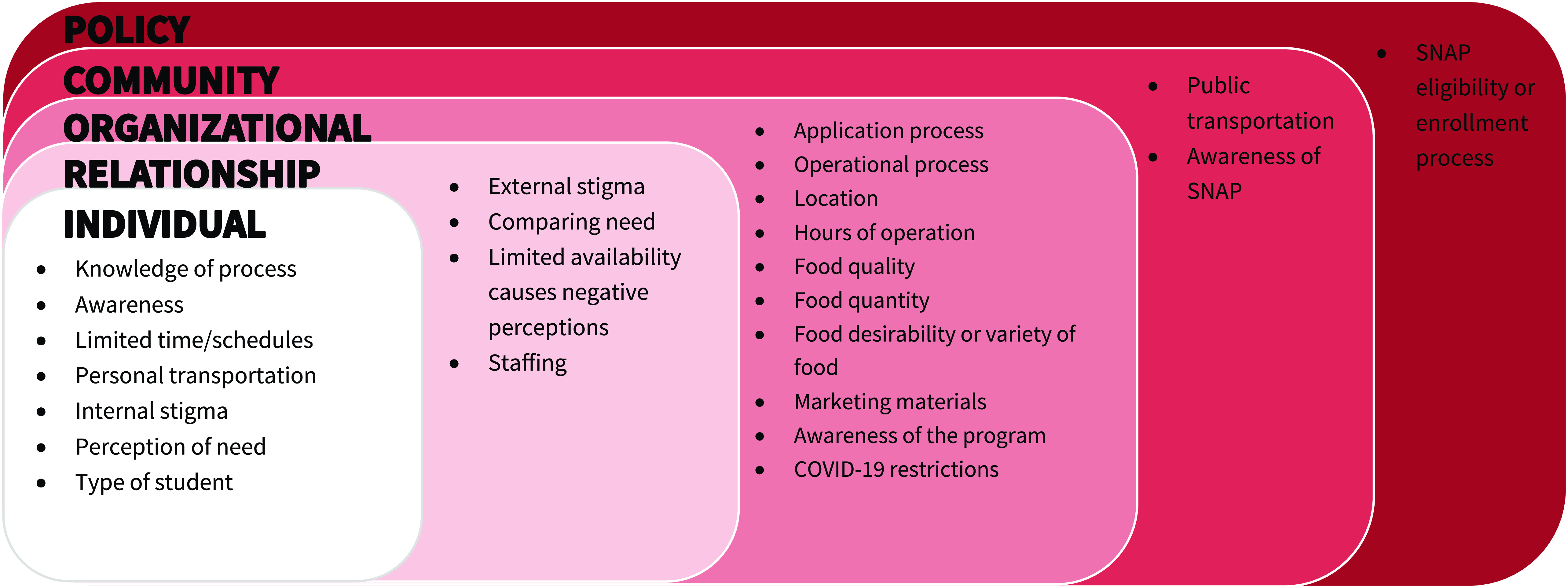
College student food insecurity (FI) is a public health concern. Programming and policies to support students have expanded but utilisation is often limited. The aim of this study was to summarise the barriers to accessing college FI programming guided by the social ecological model (SEM) framework. A scoping review of peer-reviewed literature included an electronic search conducted in MEDLINE, ERIC, and PubMed databases, with a secondary search in Google Scholar. Of the 138 articles identified, 18 articles met eligibility criteria and were included. Articles primarily encompassed organisational (17/18) level barriers, followed by individual (15/18), relationship (15/18), community (9/18), and policy (6/18) levels. Individual barriers included seven themes: Knowledge of Process, Awareness, Limited Time or Schedules, Personal Transportation, Internal Stigma, Perception of Need, and Type of Student. Four relationship barriers were identified: External Stigma, Comparing Need, Limited Availability Causes Negative Perceptions, and Staff. Ten barrier themes comprised the organisational level: Application Process, Operational Process, Location, Hours of Operation, Food Quality, Food Quantity, Food Desirability or Variety of Food, Marketing Materials, Awareness of the Program, and COVID-19 Restrictions. Two barrier themes were identified at the community level, Public Transportation and Awareness of SNAP, while one barrier theme, SNAP Eligibility and Process, encompassed the policy level. Higher education stakeholders should seek to overcome these barriers to the use of food programmes as a means to address the issue of college FI. This review offers recommendations to overcome these barriers at each SEM level.
The study sought to explore nutrition graduates’ employability and role of employability capitals in supporting nutrition science graduate outcomes.
Design:
In-depth semi-structured, audio-recorded interviews were conducted with nutrition graduates who had completed a nutrition science degree between 2015 and 2021. Interpretivism guided this study, which endeavoured to co-construct meaning with participants. Transcribed interviews were thematically analysed, whereby data were coded, themes identified and discussed by all authors. The data were further mapped against the graduate capital model (GCM) by deductively coding against the five graduate capitals (human, identity, social, psychological and cultural).
Setting:
Ireland and Australia.
Participants:
Forty-two nutrition graduates from across nine universities in Ireland and twenty-two from a single university programme in Australia.
Results:
All elements of the GCM were identified with human, social and identity capital most dominant and identified as significantly influential on employability. Presence or absence of these capitals could be clearly identified within each graduates’ experience. Formation of professional identity and connection to the profession was strongest amongst Irish graduates. However, more than half of the Australian cohort perceived barriers to professional identity formation, including lack of regulation, imposter syndrome, presence of non-qualified individuals and comparison to dietetics. Both psychological and cultural capitals were rarely spoken about.
Conclusion:
The development of human, social and identity capital is observed among nutrition science graduates. Further investigation is required to enhance the process of identity development and ascertain potential remedies for obstacles. The absence of psychological and cultural capital, therefore, poses a significant issue for the resilience and comprehension of prospective graduates.
To assess the impact of nutritional and multiple-micronutrient supplementation to lactating mothers on the micronutrient status of mother–infant dyad at 6 months of age postnatally.
Design:
This study was a trial that aimed to investigate the impact of maternal nutritional supplementation on infant growth. A secondary objective was to assess the effect on the micronutrient status of mother–infant pairs. The intervention group mothers received snacks with 600 kcal energy, 20 g protein and daily micronutrient tablets.
Setting:
Blood samples were collected from both mothers and infants at 6 months.
Participants:
The participants in this study were mother–infant pairs. The micronutrient status of these pairs was assessed through blood samples, focusing on vitamins A, D, B12, ferritin, Zn and folate.
Results:
Micronutrient analysis of serum samples from 600 mother–infant pairs showed that mothers in the intervention group had higher levels of serum ferritin (mean difference (MD) 14·7 ng/ml), retinol (MD 0·6 μmol/l), folate (MD 3·3 ng/ml) and vitamin D (1·03 ng/ml) at 6 months postpartum. Additionally, the supplementation was associated with a higher mean ± sd of serum ferritin (MD 8·9 ng/ml) and vitamin A (MD 0·2 μmol/l) levels in infants at 6 months.
Conclusions:
The study found that supplementing maternal nutrition with additional dietary and micronutrient intakes during lactation improved maternal micronutrient status and slightly increased ferritin and vitamin A levels in infants at 6 months. The findings highlight the importance of nutritional interventions for improving the micronutrient health of mother–infant pairs, with significant public health implications.
To identify (1) who experiences food insecurity of differing severity and (2) who uses food banks in England, Wales and Northern Ireland; (3) whether the same groups experience food insecurity and use food banks; and (4) to explore country- and region-level differences in food insecurity and food bank use.
Design:
This pooled cross-sectional study analysed the characteristics of adults experiencing food insecurity of differing severity using generalised ordinal logistic regression models and the characteristics of adults using food banks using logistic regression models, using data from three waves of the Food and You 2 surveys, 2021–2023.
Setting:
England, Wales and Northern Ireland.
Participants:
18 557 adults.
Results:
20·8 % of respondents experienced food insecurity in the past 12 months, and 3·6 % had used a food bank. Food insecurity was associated with income, working status, respondent age, family type, ethnicity, country, long-term health conditions, food hypersensitivity, urban-rural status and area-level deprivation. Severe food insecurity was concentrated among respondents with long-term health conditions and food hypersensitivities. Food bank use was more prevalent among food insecure respondents and unemployed and low-income respondents. Neither outcome showed clear geographical variation. Certain groups experienced an elevated likelihood of food insecurity but did not report correspondingly greater food bank use.
Conclusions:
Food insecurity is unevenly distributed, and its nutrition and health-related consequences demonstrate that food insecurity will intensify health inequalities. The divergence between the scale of food insecurity and food bank use strengthens calls for adequate policy responses.
India has one of the highest burdens of childhood undernutrition in the world. The two principal dimensions of childhood undernutrition, namely stunting and underweight can be significantly associated in a particular population, a fact that is rarely explored in the extant literature. In this study, we apply a copula geoadditive modelling framework on nationally representative data of 104,021 children obtained from the National Family Health Survey 5 to assess the spatial distribution and critical drivers of the dual burden of childhood stunting and underweight in India while accounting for this correlation. Prevalence of stunting, underweight and their co-occurrence among under 5 children were 35.37%, 28.63% and 19.45% respectively with significant positive association between the two (Pearsonian Chi square = 19346, P-value = 0). Some of the factors which were significantly associated with stunting and underweight were child gender (Adjusted Odds Ratio (AOR) = 1.13 (1.12) for stunting (underweight)), birthweight (AOR = 1.46 (1.64) for stunting (underweight)), type of delivery (AOR = 1.12 (1.19) for stunting (underweight)), prenatal checkup (AOR = 0.94 (0.96) for stunting (underweight)) and maternal short-stature (AOR = 2.19 (1.85) for stunting (underweight)). There was significant spatial heterogeneity in the dual burden of stunting and underweight with highest prevalence being observed in eastern and western states while northern and southern states having relatively lower prevalence. Overall, the results are indicative of the inadequacy of a “one-size-fits-all” strategy and underscore the necessity of an interventional framework that addresses the nutritional deficiency of the most susceptible regions and population subgroups of the country.
To characterise consumption of ultra-processed foods and drinks (UPF) across a range of socio-demographic characteristics of Canadians.
Design:
Cross-sectional study. The national-level 2015 Canadian Community Health Survey–Nutrition provided data on all foods and drinks consumed on the previous day via a 24-hour dietary recall. All food items were classified according to the type of industrial processing using the NOVA system. Multivariable linear regression models examined associations between a range of socio-demographic characteristics and the mean energy contribution (% of total daily energy intake) from total UPF and UPF subgroups.
Setting:
The ten Canadian provinces.
Participants:
Canadians aged 2 or older (n 20 103).
Results:
UPF contributed, on average, nearly half (44·9 %) of total daily energy intake of Canadians. Children aged 6–12 and adolescents aged 13–18 consumed over half of total daily energy from UPF (adjusted means of 51·9 % and 50·7 %, respectively). Recent and long-term immigrants consumed a significantly lower share of energy from UPF (adjusted means of 42·2 % and 45·1 %, respectively) compared with non-immigrants (54·4 %), as did the food secure (42·8 %) v. those in moderately (48·1 %) or severely food-insecure households (50·8 %). More modest differences were observed for intake of total UPF and UPF subgroups by sex, education, income adequacy and region of residence.
Conclusion:
Levels of UPF consumption in 2015 in Canada were pervasive in all socio-demographic groups and highest among children and adolescents, non-immigrants and those living in food-insecure households. These findings can inform public health interventions to reduce UPF consumption and promote healthier diets in various socio-demographic groups.