To save content items to your account,
please confirm that you agree to abide by our usage policies.
If this is the first time you use this feature, you will be asked to authorise Cambridge Core to connect with your account.
Find out more about saving content to .
To save content items to your Kindle, first ensure no-reply@cambridge.org
is added to your Approved Personal Document E-mail List under your Personal Document Settings
on the Manage Your Content and Devices page of your Amazon account. Then enter the ‘name’ part
of your Kindle email address below.
Find out more about saving to your Kindle.
Note you can select to save to either the @free.kindle.com or @kindle.com variations.
‘@free.kindle.com’ emails are free but can only be saved to your device when it is connected to wi-fi.
‘@kindle.com’ emails can be delivered even when you are not connected to wi-fi, but note that service fees apply.
Chapter 6 gives an overview of the properties of schwa and schwa syllables. Schwa has sometimes been analyzed as non-phonemic: It is the epenthetic vowel in German and it is the only non-moraic vowel of German. Moreover, it is featurally underspecified and does not fit the lax–tense dichotomy of the full vowels. The chapter starts with a review of the distributional properties of both schwa and syllabic sonorants in simplex and complex words. Both schwa and syllabic sonorants are often suffixal inflectional morphemes, but they also regularly appear in monomorphemic words. A part of the chapter is dedicated to sequences of sonorants that can be syllabic, and how different choices are made in different morphological environments. Again, OT analyses are provided and it is shown how syllable structure, morphological constraints and the different sonorants all play a role in the distribution of the syllabic and non-syllabic versions of the sonorants.
Chapter 10 provides an overview of some of the OT constraints introduced in the book and their rankings. It is shown here that groups of constraints are responsible for parts of the prosodic structure (e.g., the syllable). Some of the constraints introduced in the book play a role at several levels of the hierarchy, especially those regulating the syllable, the foot and the prosodic word.
This chapter first outlines a traditional phonological approach to the description and classification of segments. It introduces the “phoneme,” a notion of structuralism (i.e., the contrastive and distinctive segments of individual languages that form minimal pairs). The approach is a functional one: Phonemes are not only characterized by the sum of their features but also by their concrete allophones. Different kinds of allophonies are introduced with different sounds of German. The second part proposes a system of distinctive features for Standard German. Except for the major class features and the binary feature [±back], consonants and vowels are accounted for by different features. The role of distinctive features in cross-classifying segments as well as in building natural classes is discussed in some detail. Features are represented in a non-linear feature geometry, illustrated in the chapter for individual segments, both simple and complex, and in phonological processes such as assimilation and feature deletion. The chapter also contains a non-exhaustive proposal of how the feature system of German is accounted for in OT.
Chapter 3 introduces lower-level constituents of the prosodic hierarchy – mora and syllable. The syllable structure is discussed from different perspectives: the role played by the sonority hierarchy and the phonotactic restrictions it imposes on sequences of segments in the syllable; the individual positions such as onset, nucleus, coda as well as prefix and appendix; and the weight of individual segments expressed in moras, leading to relative weight of the syllable itself. It is shown that the number of segments allowed in each position is strictly fulfilled. As for the weight properties of syllables, lax vowels are monomoraic, tense vowels are bimoraic and schwa is non-moraic. The syllable itself can be non-moraic, bimoraic or trimoraic. The chapter ends with a detailed proposal on how ranked OT constraints can account for the sonority sequencing among the segments as well as the restrictions observed in the number of segments that can fill the different syllable constituents. The second part of the OT analysis focuses on the moraic constituency of the segments of a syllable.
It is shown how the highest levels of prosodic phrasing, φ-phrase and ι-phrase, are mapped to syntactic structure. The interface between the two is driven by the Match model, which requires an isomorphic correspondence between syntactic and prosodic constituents and assigns prosodic boundaries at both edges of syntactic constituents at once. When the syntactic structure is recursive, the prosodic structure is recursive as well. This perfect mapping can be disturbed by well-formedness conditions, a special kind of markedness constraint that bears on the prosodic constituents themselves. Constituents must have a head, be non-recursive, have a minimal weight, etc. In some cases (e.g., when syntactic constituents are too light to be matched by a φ-phrase), they even restructure the matching between syntax and prosody. Information structure is a further factor that influences prosody: Focus may require a different location for the nuclear accent, and givenness may have a deaccenting effect in the postnuclear region of the sentence. As a result, the phonological correlates of φ-phrase and ι-phrase include relative prominence of the prosodic constituents represented on metrical grids.
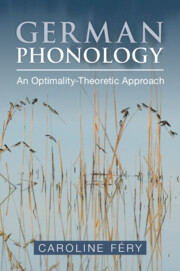
Drawing on an optimality-theoretic framework, this book provides a comprehensive overview of the phonology of German, with its idiosyncratic array of sound patterns. It starts with the consonants and vowels and the distinctive features they consist of, moving on to account for allophonic changes in detail, as well as syllables and their weight units. Phonological processes are then explored in depth, with chapter-length explorations of feet, prosodic words, prosodic phrases, and intonation phrases, showing that the prosodic hierarchy provides the domains of most phonological processes. It also includes discussions of the interfaces of morphology and syntax with phonology, as well as prosodic phrasing and intonation. The constraint-based approach allows a new holistic perspective, simultaneously encompassing all aspects of German phonology. Wide-ranging yet accessible, it is essential reading for advanced students of both linguistics and German, as well as individual scholars seeking a one-stop resource on the topic.
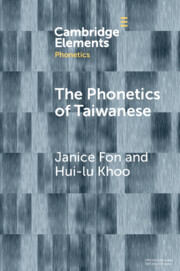
Taiwanese, formerly the lingua franca of Taiwan and currently the second largest language on the island, is genealogically related to Min from the Sino-Tibetan family. Throughout history, it has been influenced by many languages, but only Mandarin has exerted heavy influences on its phonological system. This Element provides an overview of the sound inventory in mainstream Taiwanese, and details its major dialectal differences. In addition, the Element introduces speech materials that could be used for studying the phonetics of Taiwanese, including datasets from both read and spontaneous speech. Based on the data, this Element provides an analysis of Taiwanese phonetics, covering phenomena in consonants, vowels, tones, syllables, and prosody. Some of the results are in line with previous studies, while others imply potential new directions in which the language might be analyzed and might evolve. The Element ends with suggestions for future research lines for the phonetics of the language.
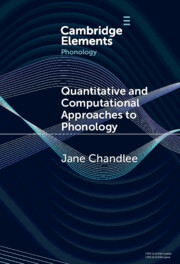
This Element surveys the various lines of work that have applied algorithmic, formal, mathematical, statistical, and/or probabilistic methods to the study of phonology and the computational problems it solves. Topics covered include: how quantitative and/or computational methods have been used in research on both rule- and constraint-based theories of the grammar, including questions about how grammars are learned from data, how to best account for gradience as observed in acceptability judgments and the relative frequencies of different structures in the lexicon, what formal language theory, model theory, and information theory can and have contributed to the study of phonology, and what new directions in connectionist modeling are being explored. The overarching goal is to highlight how the work grounded in these various methods and theoretical orientations is distinct but also interconnected, and how central quantitative and computational approaches have become to the research in and teaching of phonology.
Tima has a typologically unusual 12-vowel advanced tongue root (ATR) harmony system, contrasting six [+ATR] vowels /i e ɨ ʌ o u/ with six [−ATR] vowels /ɪ ɛ ɘ a ɔ ʊ/. This harmony system provides a test case for generalisations about ATR systems: for example, that [−ATR] is less compatible with higher vowels; that [+ATR] is less compatible with lower vowels and that central vowels are incompatible with [ATR] systems. After showing that all vowels participate fully in ATR harmony, this article presents an acoustic study of the Tima ATR contrast. We show that /ʌ/, the [+ATR] counterpart of /a/, patterns as a mid vowel, and that duration and voice quality differences characterise Tima’s crowded vowel inventory. Though F1 is the primary individual correlate of the ATR contrast, as is true cross-linguistically, a number of measures support voice quality differences as well, as predicted by the Laryngeal Articulator Model account of ATR systems.
The ambition of this article is to provide a phonological account of an intricate pattern of lenition and gemination in Campidanese Sardinian. The data show two things: that a model of phonology needs some way of showing strength and weakness as positional effects and that neither can be reliably understood in phonetic terms. In this analysis, the discovery procedure does not depend on raw phonetic facts, but rather on a rich model of abstract phonological representations. These representations are of two kinds, melodic and prosodic, and they allow for a substance-free phonological analysis of lenition and fortition in Campidanese that is not confronted by the difficulties inherent in surface-oriented approaches.
The Perceptual Assimilation Model (PAM) accounts for how native-language (L1) experience shapes speech perception. According to PAM, infants develop phonological categories by attuning to the critical phonetic features that set phonological categories apart (phonological distinctiveness) and to the phonetic variability that defines each category (phonological constancy).The effects of L1 attunement on perception can also be seen in adults. PAM generates predictions about discrimination accuracy for non-native contrasts by comparing how the non-native phones are perceived in terms of L1 phonological categories. The extent to which perception might be altered further by experience with a second language (L2) is outlined by PAM-L2. While PAM has focused on L1 attunement in monolinguals, and PAM-L2 on L2 acquisition in adulthood, their principles also apply to early bilingual language acquisition. In this chapter, we will consider the various contexts of acquisition and language use in early bilinguals to sketch out how experience with more than one native language shapes perception and how childhood L2 acquisition might modify the emerging phonological system.
We have witnessed a growing number of investigations into the acquisition process in a multilingual context, which has become recognized as an independent field, quantitatively and qualitatively different from second language acquisition. Scholars have started to differentiate between learners/speakers on the basis of the complexity of their linguistic background, with the numer of known languages being an additional variable. A growing body of studies into the acquisition of third language phonology demonstrates an inherent complexity of the field reflected, among others, in multidirectional dynamic cross-linguistic influence. As shown, multilingual learners have at their disposal a broadened phonetic repertoire, a raised level of metalinguistic awareness and enhanced perceptual sensitivity, which may facilitate the learning of subsequent phonological systems. Thus, this chapter aims to compare bilingual and trilingual phonetics and phonology by providing an overview of recent research into both subdomains, identifying their common features and, importantly, their points of departure for L3 phonology, with a view to providing new insights into the acquisition of speech.
Study abroad is typically viewed as a catalyst for pronunciation learning because it affords learners both massive amounts of L2 input and abundant opportunities for meaningful L2 use. Yet, even in such an environment, there is substantial variability in learning trajectories and outcomes. The nature of the target structure is also a powerful determinant of learning; some structures seem to develop effortlessly, whereas others do not improve much at all. Additionally, study abroad research brings to light the important issue of speaker identity, as learners often make decisions about how they want to sound and what pronunciation features they will adopt. This chapter examines developmental time frames, trajectories, and turning points in the phonetics and phonology of L2 learners in a study abroad context. We also describe how learners acquire the regional pronunciation variants of their host communities considering the phonetics of the target feature and learners’ attitudes and beliefs. We argue that study abroad should be situated within a dynamic, longitudinal, and context-dependent view of phonetic and phonological learning.