To save content items to your account,
please confirm that you agree to abide by our usage policies.
If this is the first time you use this feature, you will be asked to authorise Cambridge Core to connect with your account.
Find out more about saving content to .
To save content items to your Kindle, first ensure no-reply@cambridge.org
is added to your Approved Personal Document E-mail List under your Personal Document Settings
on the Manage Your Content and Devices page of your Amazon account. Then enter the ‘name’ part
of your Kindle email address below.
Find out more about saving to your Kindle.
Note you can select to save to either the @free.kindle.com or @kindle.com variations.
‘@free.kindle.com’ emails are free but can only be saved to your device when it is connected to wi-fi.
‘@kindle.com’ emails can be delivered even when you are not connected to wi-fi, but note that service fees apply.
Powder X-ray diffraction was used to monitor the solvent-free synthesis of two-dimensional (2D) metal–organic frameworks (MOFs) via mechanochemical methods. For four isophthalic acid-based, alkoxide-functionalized organic ligands, optimal milling times were found to vary from 12 to 48 min. This work confirms that mechanochemical synthesis routes can be utilized to afford highly-crystalline, 2D MOFs.
Crystal structure analysis of a pyrazole carboxylic acid derivative, 5-(trifluoromethyl)-1-phenyl-1H-pyrazole-4-carboxylic acid (1) has been carried out from laboratory powder X-ray diffraction data. The crystal packing in the pyrazole carboxylic acid derivative exhibits an interplay of strong O–H…O, C–H…N and C–H…F hydrogen bonds to generate a three-dimensional molecular packing via the formation of R22(8) and R22(9) rings. Molecular electrostatic potential calculations indicated that carbonyl oxygen, pyrazole nitrogen and fluorine atoms to be the strongest acceptors. The relative contribution of different interactions to the Hirshfeld surface of pyrazole carboxylic acid and a few related structures retrieved from CSD indicates that H…H, N…H and O…H interactions can account for almost 70% of the Hirsfeld surface area in these compounds.
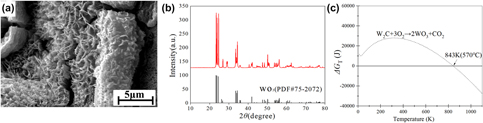
Cast tungsten carbide is widely used to reinforce iron or steel substrate surface composites to meet the demands of harsh wear environments due to its extremely high hardness and excellent wettability with molten steel. Cast tungsten carbide particle/steel matrix surface composites have demonstrated great potential development in applications under the abrasive working condition. The thermal shock test was used to investigate the fatigue behavior of the composites fabricated by vacuum evaporative pattern casting technique at different temperatures. At elevated temperatures, the fatigue behavior of the composites was influenced by the oxidation of tungsten carbide, producing WO3. Thermodynamic calculations showed that the W2C in the tungsten carbide particle was oxidized at an initial temperature of approximately 570 °C. The relationship between oxidation and thermal fatigue crack growth was investigated, and the results suggested that oxidation would become more significant with increasing thermal shock temperature. These findings provide a valuable guide for understanding and designing particle/steel substrate surface composites.
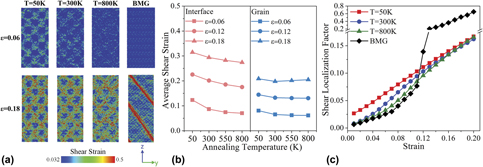
Intrinsic size effects in nanoglass plasticity have been connected to the structural length scales imposed by the interfacial network, and control over this behavior is critical to designing amorphous alloys with improved mechanical response. In this paper, atomistic simulations are employed to probe strain delocalization in nanoglasses with explicit correlation to the interfacial characteristics and length scales of the amorphous grain structure. We show that strength is independent of grain size under certain conditions, but scales with the excess free volume and degree of short-range ordering in the interfaces. Structural homogenization upon annealing of the nanoglasses increases their strength toward the value of the bulk metallic glass; however, continued partitioning of strain to the interfacial regions inhibits the formation of a primary shear band. Intrinsic size effects in nanoglass plasticity thus originate from biased plastic strain accumulation within the interfacial regions, which will ultimately govern strain delocalization and homogenous flow in nanoglasses.
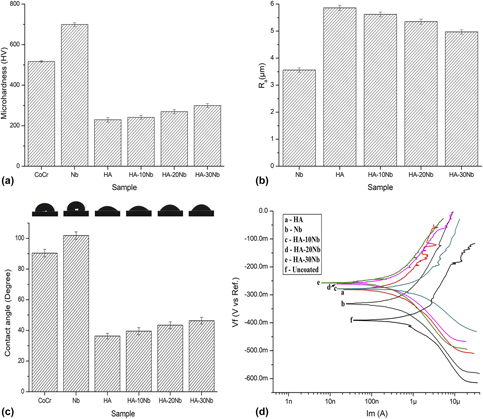
In this study, a niobium-reinforced hydroxyapatite (HA-Nb) coating was developed on cobalt–chromium (CoCr) alloy by plasma spraying with three varied levels, i.e., 10, 20, and 30% of weight percent (wt%) of Nb content. The corrosion behavior and biocompatibility of the samples were analyzed through electrochemical corrosion testing and cytotoxicity studies, respectively. The results of corrosion testing revealed that the HA coating increased the corrosion resistance of the CoCr alloy, and with the incremental increase of Nb reinforcement in HA, corrosion resistance was further enhanced. The HA-30Nb coating demonstrated the finest corrosion resistance with the highest Ecorr and lowest Icorr values, which were about one order of magnitude lower in comparison to the bare CoCr alloy. The surface hardness increased and the surface roughness decreased with the increase of Nb content in the coating. Wettability analysis revealed that HA and HA-Nb coatings had a hydrophilic nature. HA-Nb coatings demonstrated a significantly better cell proliferation than the CoCr alloy.
A total of 77 pottery shards originating from the Middle Jomon period (2500–1500 BC) were excavated from the Hinoki site in Tochigi, Japan. Fifty-five of those were Atamadai type pottery, which might contain some temper fragments from the manufacturing process. The pottery shards were analyzed by X-ray diffractometry (XRD). The mineral analyses were compared with the river sands around Mt. Tsukuba to demonstrate the temper's origin of the Atamadai type pottery. Their XRD profiles revealed the following solid solutions which could be fingerprint minerals: biotite for the temper and plagioclase, and hornblende for the clay and temper. These minerals might indicate the origin of each sample because their d-spacings depended on the solid solution composition reflecting their geological characteristics.
Protein-based materials are a powerful instrument for a new generation of biological materials, with many chemical and mechanical capabilities. Through the manipulation of DNA, researchers can design proteins at the molecular level, engineering a vast array of structural building blocks. However, our capability to rationally design and predict the properties of such materials is limited by the vastness of possible sequence space. Directed evolution has emerged as a powerful tool to improve biological systems through mutation and selection, presenting another avenue to produce novel protein materials. In this prospective review, we discuss the application of directed evolution for protein materials, reviewing current examples and developments that could facilitate the evolution of protein for material applications.
This accessible new text introduces the theoretical concepts and tools essential for graduate-level courses on the physics of materials in condensed matter physics, physical chemistry, materials science and engineering, and chemical engineering. Topics covered range from fundamentals such as crystal periodicity and symmetry, and derivation of single-particle equations, to modern additions including graphene, two-dimensional solids, carbon nanotubes, topological states, and Hall physics. Advanced topics such as phonon interactions with phonons, photons and electrons, and magnetism, are presented in an accessible way, and a set of appendices reviewing crucial fundamental physics and mathematical tools makes this text suitable for students from a range of backgrounds. Students will benefit from the emphasis on translating theory into practice, with worked examples explaining experimental observations, applications illustrating how theoretical concepts can be applied to real research problems, and 242 informative full color illustrations. End-of chapter exercises are included for homework and self-study, with solutions and lecture slides for instructors available online.
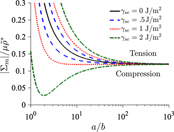
Several experiments and molecular dynamics calculations have reported anomalous mechanical behaviors of nanoporous materials that may be attributed to capillary effects. For example, nanoporous gold exhibits a tension–compression asymmetry in yield strength with the material being stronger in compression than tension. In addition, some molecular dynamics calculations have reported a spontaneous collapse of pores in nanoporous gold with nanometer-sized ligaments. Despite these perplexing observations, there are few theoretical models capable of shedding light on such capillary phenomena, particularly under general stress states. Here, we utilize a physics-based model to explore the implications of high surface energies on the mechanical response of dislocation-starved nanoporous materials subject to general stress states. For low stress triaxialities, we report an anomalous size effect and an anomalous temperature-dependence of dislocation-starved nanoporous materials with sufficiently large surface energies. Additionally, we provide an analytic criterion for spontaneous pore collapse in nanoporous materials with nanometer-sized ligaments.
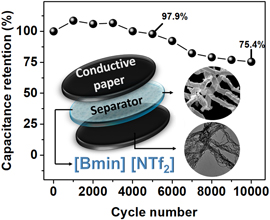
Improvement of the performance of renewable electronic devices is a crucial point for the consolidation of this emerging technology. Herein, we develop a supercapacitor based on cellulose, carbon nanotubes, and ionic liquids. A conductive paper prepared by simple acid hydrolysis of cellulose and carboxylated carbon nanotubes was used as an electrode. A cellulose sponge impregnated with 1-n-butyl-3-methylimidazolium bis(trifluoromethane sulfonyl)imide was used as a separator/electrolyte. Electrochemical tests were performed in a two-electrode cell that presented a specific capacitance of 34.37 F/g when considered the active mass and 97.9% of capacitance retention after 5000 charge/discharge cycles.
Alloy design is critical to achieving the target performance of industrial components and products. In designing new alloys, there are multiple property requirements, including mechanical, environmental, and physical properties, as well as manufacturability and processability. Computational models and tools to predict properties from alloy compositions and to optimize compositions for multiple objectives are essential in enabling efficient, robust alloy design. Data-driven property models by machine learning (ML) are particularly useful in predicting physical properties with relatively simple dependence on composition, and in predicting complex properties that are too difficult for a physics-based model to achieve with desirable accuracy. In this article, we describe examples of ML applications to model coefficient of thermal expansion, creep and fatigue resistance in designing Ni-based superalloys, and optimization methodologies. We also discuss physics-based microstructure models that have been developed for optimizing heat-treatment conditions to achieve desired microstructures.
Robots and artificial machines have been captivating the public for centuries, depicted first as threats to humanity, then as subordinates and helpers. In the last decade, the booming exposure of humans to robots has fostered an increasing interest in soft robotics. By empowering robots with new physical properties, autonomous actuation, and sensing mechanisms, soft robots are making increasing impacts on areas such as health and medicine. At the same time, the public sympathy to robots is increasing. However, there is still a great need for innovation to push robotics toward more diverse applications. To overcome the major limitation of soft robots, which lies in their softness, strategies are being explored to combine the capabilities of soft robots with the performance of hard metallic ones by using composite materials in their structures. After reviewing the major specificities of hard and soft robots, paths to improve actuation speed, stress generation, self-sensing, and actuation will be proposed. Innovations in controlling systems, modeling, and simulation that will be required to use composite materials in robotics will be discussed. Finally, based on recently developed examples, the elements needed to progress toward a new form of artificial life will be described.