To save content items to your account,
please confirm that you agree to abide by our usage policies.
If this is the first time you use this feature, you will be asked to authorise Cambridge Core to connect with your account.
Find out more about saving content to .
To save content items to your Kindle, first ensure no-reply@cambridge.org
is added to your Approved Personal Document E-mail List under your Personal Document Settings
on the Manage Your Content and Devices page of your Amazon account. Then enter the ‘name’ part
of your Kindle email address below.
Find out more about saving to your Kindle.
Note you can select to save to either the @free.kindle.com or @kindle.com variations.
‘@free.kindle.com’ emails are free but can only be saved to your device when it is connected to wi-fi.
‘@kindle.com’ emails can be delivered even when you are not connected to wi-fi, but note that service fees apply.
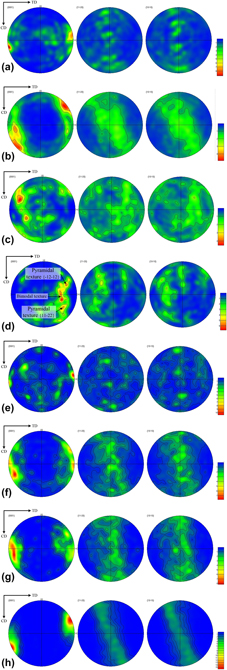
The hot compression behavior of as-extruded AZ31 magnesium alloy was investigated to study the effect of compression temperature and strain on microstructure evolution, grain orientation, and texture evolution. The thermal compression tests of AZ31 Mg alloy were carried out on the Gleeble-3800 simulation device: With constant strain, the temperatures were 250, 300, 400, and 500 °C, respectively; at constant temperature, the strains were 0.2, 0.4, 0.6, and 0.8, respectively. After observation and analysis of compressed samples, it is found that with 0.65 strain and 0.05 s−1 strain rate, grains were equiaxed, well refined, and distributed uniformly at 400 °C. At this temperature, new orientation between {0001} and $\left{\rm\char123} {12\bar{1}0} {\rm\char125} \right$ or $\left{\rm\char123} {01\bar{1}0} {\rm\char125} \right$ appeared in grains; new texture components close to $\left{\rm\char123} {\bar{1}\bar{1}22} {\rm\char125} \right$ and $\left{\rm\char123} {1\bar{2}12} {\rm\char125} \right$ pyramidal textures were formed, but whole texture strength was weakened and anisotropy of the sample was reduced. With the increase of strain, grains became smaller and volume fraction of DRX grain became higher; the original basal texture was replaced by prismatic textures; after 0.4 strain, the increase of strain did not change the texture component, but only the pole density.
Kesterite (Cu2ZnSnS4, CZTS) powders were produced by reactive high-energy milling, starting from stoichiometric mixtures of the elemental components. CZTS forms fine crystals with a cubic structure, which evolves to the stable tetragonal form after thermal treatment. Tablets were produced by cold pressing of the ball milled powder, and sintered up to 660 °C. Seebeck coefficient, electrical resistivity, and thermal diffusivity were measured on the sintered tablets, pointing out the positive effect of CZTS nanostructure and of the rather large fraction of porosity: thermal conductivity is rather low (from ~0.8 W/(m K) at 20 °C to ~0.42 W/(m K) at 500 °C), while electrical conduction is not seriously hindered (electrical resistivity from ~8500 µΩ m at 40 °C to ~2000 µΩ m at 400 °C). Preliminary results of thermoelectric behavior are promising.
The growing interest in the use of powder X-ray diffractometry for materials’ characterization has led to the introduction of relevant concepts (e.g. microstructure, strain, anisotropy, texture) to undergraduate teaching in engineering and science. In this concern, the study of polycrystalline materials underlays the use of appropriate software: free, licensed, proprietary, or commercial to assist research on structure determination, structure refinement, and microstructure characterization. Today with the easy access to personal computers, routines for powder diffractometry also becomes feasible to use for non-specialist. Therefore, it would be relevant that students with computing knowledge may decide to improve routines on such three tasks incorporating their own computational approaches. In this study, we show the development of a ready-to-use and open source program written in GNU-Octave (v4.2.1) focused on X-ray diffraction line-profile analysis. The programing language platform was chosen mainly because of two reasons: (1) there is no requirement for commercial licenses, meaning that both programing language and routines can be downloaded online, facilitating collaborative efforts between students, instructors, and developers, and (2) easy re-coding of evaluation strategies is always allowed through fast implementation of modules into the code. The code, IndexCub, features routines for background subtraction, whole profile smoothing, and Kα2 radiation removal, location of diffraction peaks positions, indexing for cubic specimens, multi peak separation of individual peaks, and evaluation of full-width at half-maximum and integral breadth values. Microstructure properties are characterized through the use of integral breadth methods (e.g. Williamson–Hall) and Fourier analysis (e.g. Warren–Averbach), and the anisotropy effects are incorporated introducing calculations of contrast factors. In terms of diffraction domain sizes, size distribution, and the lattice microstrain, the analysis of the microstructure is discussed along with examples for polycrystalline coarse-grained materials (NaCl), epitaxial film (Si), and thin-films (Au) specimens. The code facilitates the understanding of microstructure analysis by using theoretical approaches well established and in state-steady level.
A homogeneous structured CoCrNi medium-entropy alloy was synthesized by gas atomization and spark plasma sintering (SPS). The mechanical properties, corrosion resistance, and magnetic properties were reported in this study. The as-atomized CoCrNi MEA powder, with a spherical morphology in shape and a mean particle diameter of 61 μm, consisted of a single face-centered cubic (FCC) phase with homogeneous distributions of Co, Cr, and Ni elements. Also, the cross-sectional microstructure of powder particles gradually transformed from fully cellular structure into equiaxed-type structure with increasing particle size. After being sintered by SPS, the CoCrNi MEA consisted of a single FCC phase with a mean grain size of 20.8 μm. Meanwhile, the CoCrNi MEA can capable of offering an ultimate tensile strength of 799 MPa, yield strength of 352 MPa, elongation of 53.6%, and hardness of 195.3 HV. In addition, this MEA showed superior corrosion resistance to that of 304 SS (stainless steel) in both 0.5 mol/L HCl and 1 mol/L NaOH solutions. The magnetization loop indicated that this MEA has good soft magnetic properties.
Bi0.5Na0.5TiO3 (BNT)-based lead-free materials are important for piezoelectric actuator, and several researchers have studied the effect of B-site complex ion doping on strain in (Bi0.5Na0.5)TiO3–SrTiO3. In this work, a paraelectric perovskite Sr(Zn1/3Nb2/3)O3 (SZN) with B-site complex structure was introduced into 0.80(Bi0.5Na0.5)TiO3–0.20SrTiO3 (BNTST) to investigate the phase structure and electrical properties as well as the field-induced strain behavior. The results showed that SZN substitution decreases the rhombohedrality 90-γ and induces the transition from dominant ferroelectric to nonergodic relaxor by shifting its TF-R to lower temperatures. Moreover, the field-induced ferroelectric domains cannot remain stable at room temperature when SZN substitution is large than 1.0 mol%. These behaviors induced the transition between nonergodic relaxor and ergodic relaxor, which contributed to its large strain and related properties. In this work, this material gave the largest bipolar strain of 0.43% and large normalized unipolar strain of 505 pm/V at the SZN content of 2 mol% under 8 kV/mm, and showed good temperature stability up to 100 °C. The above encouraging results may be helpful for further investigation of BNTST-based ternary systems in search of a potential Pb-free piezoelectric material.
Advances in instrumentation, software applications, and database content have all contributed to improvements in pharmaceutical analyses by powder diffraction methods in the 21st century. When compared to the globally harmonized United States Pharmacopeia General Chapter <941>, “Characterization of Crystalline and Partially Crystalline Solids by X-ray Powder Diffraction”, many historic problems in pharmaceutical analysis have been addressed by combinations of improved methods and instrumentation. Major changes in the last 20 years include (i) a dramatic lowering in detection capability and detection limits, (ii) enhanced capabilities for dynamic measurements such as in situ analyses under a variety of conditions, and (iii) the ability to identify and characterize nanomaterials, non-crystalline, and amorphous materials by both coherent and incoherent scattering profiles.
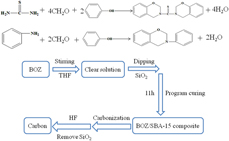
In this work, the nitrogen-doped carbon materials (NCM) and nitrogen/sulfur codoped carbon materials (NSCM) were prepared using conventional benzoxazine (BOZ) and sulfur-containing benzoxazine as precursor and SBA-15 as template. The morphology, structure, and electrochemical performance of carbon materials were characterized by scanning electron microscopy, transmission electron microscopy, the X-ray diffraction, X-ray photoelectron spectroscopy, nitrogen adsorption–desorption, cyclic voltammetry, and galvanostatic charge–discharge. The results show that the as-prepared carbon materials have ordered mesoporous structure, large specific surface area, and excellent electrochemical properties. The NSCM treated at 800 °C exhibit an extremely high specific capacitance of 550 F/g at the current density of 0.5 A/g in 0.5 mol H2SO4 electrolyte, which shows great improvement compared with NCM. The nitrogen/sulfur codoping is suggested to be a very effective method to improve the performance of carbon materials, and the NSCM should be a promising candidate as electrode materials for supercapacitors.
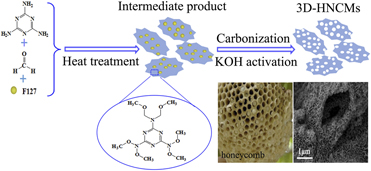
The preparation of three-dimensional honeycomb nitrogen-doped carbon materials (3D-HNCMs) which can be used as electrode materials for supercapacitors is reported. The composites with the 3D honeycomb structure exhibited better electrochemical performance, and the structure and properties were proved by various means, such as SEM, TEM, IR, N2 sorption, XRD and XPS. Used as electrode materials for supercapacitors in the KOH electrolyte, 3D-HNCMs displayed a significantly high specific capacitance (409 F/g at a current of 0.5 A/g). Moreover, the 3D-HNCM electrode exhibited superior electrochemical performance, such as excellent cycling stability (98% capacitance retention after 10,000 cycles), a maximum energy density of 15.37 W h/kg, a maximum power density of 40.3 kW/kg, and low equivalent series resistance (2.1 Ω). Particularly, the electrochemical characteristic of 3D-HNCMs could be attributed to the synergistic effect of a high surface area, unique microporous and mesoporous structure, and nitrogen atom doping. These carbon materials with unique structure are promising electrode materials for future supercapacitor application.
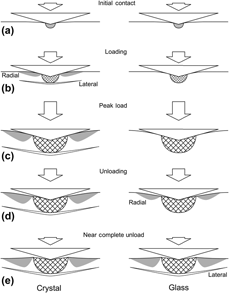
A fracture analysis is developed for crack initiation sequences occurring during sharp indentation of brittle materials. Such indentations, generated by pyramidal or conical loading, generate elastic and plastic deformation. The analysis uses a nonlinear elements-in-series model to describe indentation load–displacement responses, onto which lateral, radial, cone, and median crack initiation points are located. The crack initiation points are determined by extension and application of a contact stress-field model coupled to the indentation load, originally developed by Yoffe, in combination with crack nuclei coupled to the indentation displacement to arrive at an explicit fracture model. Parameters in the analysis are adapted directly from experimental fracture and deformation measurements, and the analysis outputs are directly comparable to experimental observations. After adaptation, crack initiation loads and sequences during indentation loading and unloading of glasses and crystals are predicted by the model from material modulus, hardness, and toughness values to within about 25% of peak contact load. This work is dedicated to George M. Pharr IV on the occasion of his 65th birthday in recognition of his contributions to indentation mechanics.
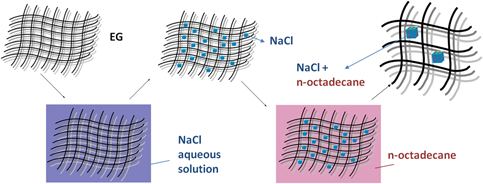
In this work, a novel shape-stabilized phase change material, composed of n-octadecane, expanded graphite (EG), and sodium chloride (NaCl), was prepared by a convenient method. In the composite, EG was used as the matrix material and NaCl served as the nucleating agent. Effects of the additional amount of NaCl on the thermal properties of the composite were investigated by DSC and TG. The melting and crystallization enthalpies of the composite are −160.23 J/g and 162.80 J/g, respectively; the supercooling degree of the composite decreased to 3.77 °C when compared to 7.58 °C of the pure n-octadecane. Furthermore, the thermal cycling performances became better, and the thermal decomposition temperature improved to 150 °C. The composite exhibited high latent heat, low supercooling degree, good thermal cycling performance, and enhanced thermal stability, making it a potential material for the thermal energy storage application in the field of thermal regulation.
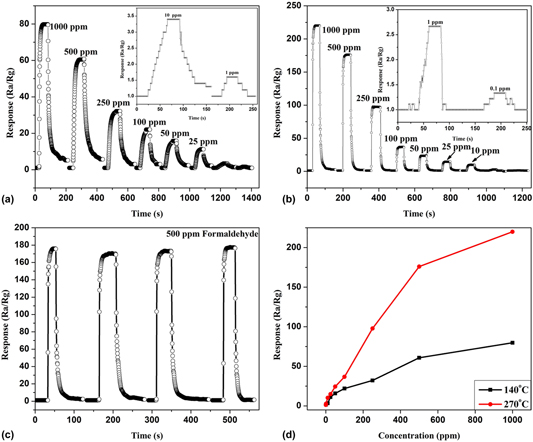
La3+-doped BaSnO3 microtubes (La3+–BaSnO3) have been synthesized by electrospinning method, and the influence of La3+ content on the sensing properties of BaSnO3 for detection of formaldehyde vapor has been investigated. The as-prepared materials have been characterized using XRD, SEM, DSC, XPS, and UV-Vis. The La3+–BaSnO3 sample doped with 4 wt% La exhibited a response as high as 220 to formaldehyde vapor (1000 ppm concentration) along with a very low detection limit of 0.1 ppm at 270 °C, whereas at 140 °C, it exhibited a response of 80 and detection limit of 1 ppm. In addition, the sensor showed excellent selectivity of 57 to formaldehyde at 140 °C when compared with other vapors. Further, the sensor also showed good repeatability and stability over a long period of time suggesting its strong potential as a commercial formaldehyde sensor.
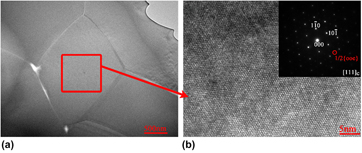
We report on the X-ray diffraction data and unit-cell parameters of Mn4C, which has a cubic perovskite-type structure with a = 3.8726 Å and unit-cell volume V = 58.1 Å3. The measured lines were indexed and are consistent with the space group $ Pm { \bar {\it 3}} m$ (No. 221).
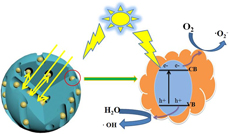
Composite materials include various components with different structures, which cooperatively increase their properties and extend their application. In this study, the graphitic carbon nitride (g-C3N4) guest material was assembled into the porous of the SiO2 aerogel, which was prepared during the gel process. By this way, the g-C3N4 could be absolutely encapsulated into the porous of the disordered porous SiO2 aerogel. The prepared g-C3N4/SiO2 composite had a loose porous structure and exhibited the much higher photocatalytic activity to the photodegradation of rhodamine B (RhB) under visible light. The disordered porous structure enhanced photocatalytic activity, and the degradation rate reached to 96.42% in 90 min under the irradiation of visible light, which could be attributed to its high surface area and effective electron–hole separation rate. The catalyst had the much higher stability and could be easily recycled utilization. The prepared composites could be applied to degrade organic pollutants in wastewater.
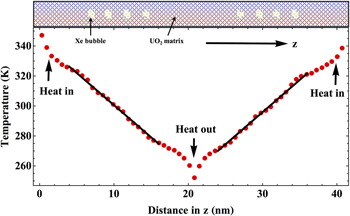
Thermal conductivity of uranium dioxide (UO2) is an important nuclear fuel performance property. Radiation- and fission-induced defects and microstructures, such as xenon (Xe) gas bubbles, can degrade the thermal conductivity of UO2 significantly. Here, molecular dynamics simulations are conducted to study the effect of Xe bubble size and pressure on the thermal conductivity of UO2. At a given porosity, thermal conductivity increases with Xe cluster size, then reaches a nearly saturated value at a cluster radius of 0.6 nm, demonstrating that dispersed Xe atoms result in a lower thermal conductivity than clustering them into bubbles. In comparison with empty voids of the same size, Xe-filled bubbles lead to a lower thermal conductivity when the number ratio of Xe atoms to uranium vacancies (Xe:VU ratio) in bubbles is high. Detailed atomic-level analysis shows that the pressure-induced distortion of atoms at bubble surface causes additional phonon scattering and thus further reduces the thermal conductivity.
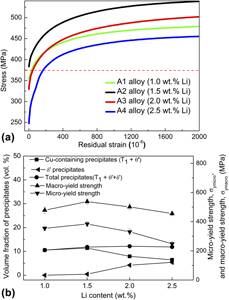
In this study, the effects of lithium(Li) content (1.0, 1.5, 2.0, and 2.5 wt%) on the microstructure, micro-yield strength (MYS) and coefficient of thermal expansion (CTE) of Al–Cu–Mg–Li–Sc–Ag alloys were investigated. The results showed that increased Li content promoted the formation of primary T1 phases and secondary T1 precipitates. While the primary T1 phases decreased the MYS of the Al–Cu–Mg–Li–Sc–Ag alloys due to large residual stress and stress concentration, secondary T1 precipitates increased the MYS due to their excellent pinning and impeding effect on mobile dislocations. In addition, the increase in Li content caused the CTETT (i.e., CTE transition temperature) first increased and then decreased, while the CTEH (CTETT to 300 °C) of alloys to first decrease and then increase. The CTEH and CTETT values were influenced by the MYS rather than by the macro-yield strength of alloys, arising from the differences in the amounts of the T1 precipitates among the four tested alloys; this was due to the superior thermal stability of the T1 precipitates.
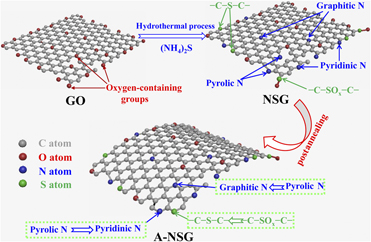
Heteroatom-doped carbon plays a vital role in the field of energy storage and conversion, and the synthesis of them has intimate relation with doping pathways. In this work, a facile two-step doping pathway, i.e., hydrothermal method followed by thermal annealing process, was employed to prepare annealed three-dimensional N,S-codoped graphene framework (3D A-NSG). The morphology, structure, composition, and related electrochemical performance were all studied. The results showed that A-NSG possessed typical 3D thin nanosheets, much increased specific surface area and structural defects, strengthened conductivity, and optimized N and S configurations (especially for dominated pyridinic N as well as graphitic N and –C–S–C–). As a result, A-NSG presented much better capacitance and oxygen reduction reaction performance than the counterparts. Apparently, our work offers a good guidance on the synthesis of advanced heteroatom-doped carbon materials by adjusting the doping strategy.